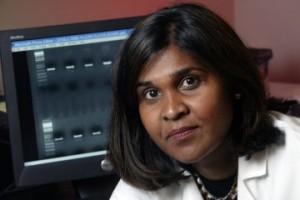
Deborah Persaud presented her findings at CROI. {credit}Johns Hopkins Medicine{/credit}
ATLANTA — Until recently, the medical community held a consensus that children born with HIV might be obliged to take antiretroviral drugs for the rest of their lives. But the announcement made last week that an infant in rural Mississippi who stopped receiving medicine at 18 months of age and has since lived for a year with no measurable viral RNA in the blood is prompting HIV experts to question the conventional wisdom.
“It’s definitely paradigm shifting,” says Deborah Persaud, a pediatric infectious disease physician at the Johns Hopkins Children’s Center in Baltimore who presented the Mississippi case here at the Conference on Retroviruses and Opportunistic Infections (CROI) on 4 March. However, a trial that involves drug cessation is fraught with ethical and medical difficulties, so the next steps going forward remain unclear.
Persaud and other HIV specialists plan to meet over three days in May at a leadership retreat of the International Maternal Pediatric Adolescent AIDS Clinical Trials (IMPAACT) group, an investigator network funded by the US National Institutes of Health (NIH), to discuss how best to test if and when antiretroviral therapy can be halted for children born with HIV who achieve undetectable levels of the virus in their blood. “We need community input on this,” Persaud says. “If we develop careful strategies, we could probably come up with a consensus approach in a couple of months.”
From Berlin to Mississippi
A prime benefit of going off antiretrovirals is the avoidance of drug-induced side effects, ranging from metabolic complications to bone demineralization to kidney failure. This is especially true for young people who could be on these medications from birth. Yet, before the Mississippi baby, no one had ever achieved a ‘functional cure’ from HIV—meaning undetectable viral replication and no disease progression in the absence of drugs—off the back of antiretroviral therapy alone. (Timothy Brown, the so-called ‘Berlin patient’, achieved this state, but only after a bone-marrow transplant with donor cells invulnerable to HIV replaced all of his native immune cells, a procedure deemed too risky for most HIV-positive individuals.)
The key to the baby’s functional cure, researchers believe, was probably the unconventionally aggressive treatment administered to the newborn in the first days of life: a trio of antiretroviral agents given twice daily starting from around 30 hours after birth. By giving these drugs before the infant had the chance to develop any memory T cells—the place where HIV goes to hide—this may have prevented the virus from establishing the latent reservoir that typically thwarts efforts at fully eliminating HIV from the body.
In contrast, most babies born to HIV-positive mothers today receive only a ‘prophylactic’ course of antiretroviral drugs to prevent infection. This typically involves fewer agents and less frequent dosing. Full treatment regimens are then given only after a positive diagnosis, which can take up to six weeks in many parts of the developing world.
Yet, in the case of the Mississippi baby, Hannah Gay, a pediatric HIV specialist at the University of Mississippi Medical Center in Jackson, put the newborn on the more aggressive regimen even before the tests came back showing that the child was infected. She did so out of the concern over the possibility of mother-to-child transmission, as the mother had never received prenatal care nor antiretroviral treatment. In fact, her HIV-positive status was only revealed to doctors while she was in labor. Following the baby’s diagnosis six days later, Gay maintained this intensive protocol with a slightly different drug cocktail going forward. Drug withdrawal was never planned. But after 18 months on the regimen, the child’s family stopped treatment for unspecified reasons. Surprisingly to Gay and her colleagues, the virus never rebounded.
“It’s always good to have your thinking jolted,” says Katherine Luzuriaga, of the University of Massachusetts Medical School in Worcester, who collaborated with Presaud and Gay in analyzing the Mississippi baby’s blood work.
Could other babies—around 1,000 of whom are newly infected globally each day with HIV—treated in a similar way now be functionally cured of their infection? A month ago, most researchers would have said no. Now, they’re not so sure.
Continue reading →

 Before there was Twitter, there was Facebook, and before that, Friendster. And who can forget MySpace? There’s a similar trend of successive usurping technologies in the fast-moving quest to develop therapeutics capable of modifying the genome. Since the late nineties, we’ve witnessed the rise of several gene-silencing approaches, from “antisense” oligonucleotides and RNA interference (RNAi) to the latest targeted genome-editing techniques, such as those based on zinc finger nucleases or CRISPR (Clustered Regularly Interspaced Short Palindromic Repeats) technology. These rapid developments raise the stakes for companies that have wagered on a particular gene-silencing approach.