
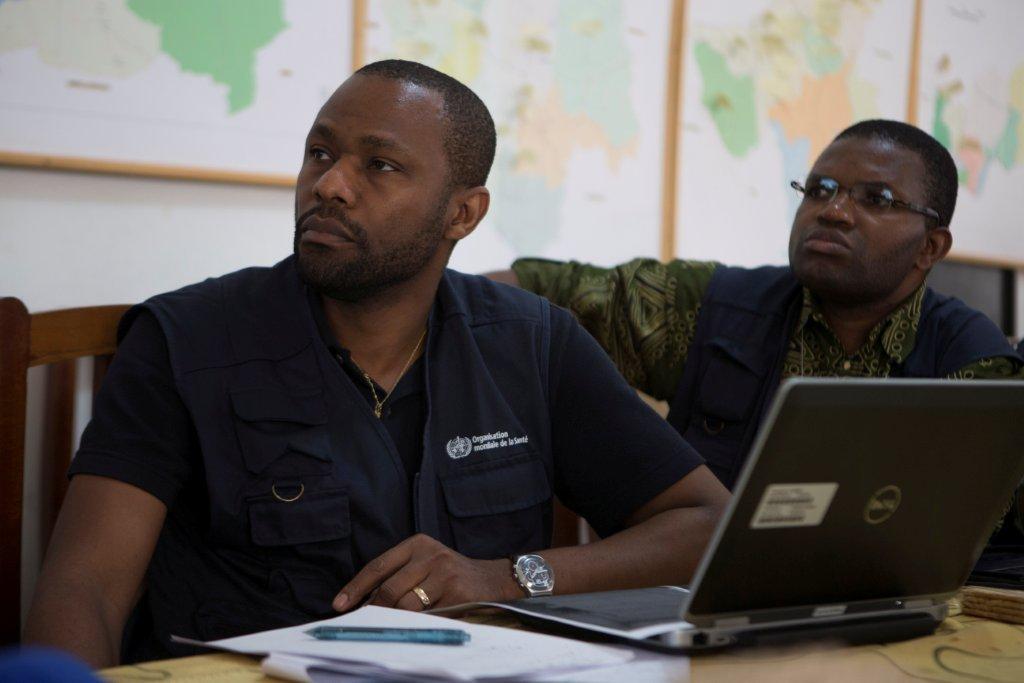
Michel Yao (left) and Etienne Minkoulou (right) at the WHO office in Bangui, Central African Republic in March 2014.
{credit}WHO/Christopher Black{/credit}
Armed conflicts and other humanitarian crises are notorious for claiming lives. But any disaster scenario can quickly go from bad to worse when health facilities are abandoned or ransacked. That’s precisely the situation brewing in the Central African Republic, where ongoing political fighting that erupted late in 2012 and intensified last December has plunged the country into chaos and devastated the health system. Many health workers have fled for safety, and looting has damaged health facilities and led to shortages of medicines and other essential supplies.
On 10 April, the United Nations Security Council voted to send peacekeeping forces to the Central African Republic. Meanwhile, the World Health Organization has been collaborating with the country’s Ministry of Health and non-governmental organizations (NGOs) to provide much-needed basic health services in the region. Michel Yao, a physician by training and the senior health security adviser for humanitarian crises at the WHO in Geneva, Switzerland, recently returned from a two-month trip to the Central African Republic. Yao spoke with Nature Medicine about the ongoing medical relief efforts in the beleaguered country.
Can you describe the current situation in the Central African Republic?
There are a huge number of people that are dying—we don’t have an exact number but we’re talking over a thousand people that have lost their lives and several thousand that have been wounded since December. Most of the health facilities have been looted, and health workers also left the health facilities, fleeing to save their own lives. So in this case, the system that is supposed to provide health services to people that are in need cannot work. As an alternative, health care is provided by the humanitarian health workers, but there are few public servants who can still work. The health facilities for the people in the capital city Bangui are more or less covered, but the main challenge remains outside of Bangui. Continue reading
 Over the past decade, neglected diseases have attracted increased attention and larger investments in research. Even often overlooked tropical diseases such as