Gap in stem cell funding could drive Australian brain drain

In late May, the Australian Research Council announced a A$21 million ($18 million), seven-year effort called the Special Research Initiative in Stem Cell Science. Many saw the decision as a move to plug a funding hole that will arise when the Australian Stem Cell Centre (ASCC) shutters its doors next June. But whether or not the new funding will serve as a sufficient replacement remains a point of debate.

The ASCC was founded in 2002 to kick start research collaborations and to help scientists commercialize discoveries relating to stem cell biology. However, the A$115 million taxpayer-funded center soon became mired by infighting and poor management. And after failing to become commercially self-sufficient within about a decade — a business aspiration that proved to be ahead of scientific reality — the ASCC is set to close in a year.

The new research initiative, which will fund one or more proposals (applications are due 30 July), is being hailed for focusing on the science over the profitability of stem cells.

“This is a mechanism that will bring together some of the key groups around the country,” says Martin Pera, who left Monash University in Melbourne in 2006 to head up a new stem cell center at the University of Southern California in Los Angeles. “It will build a network that will be a strong platform for future growth.”

Continue reading →

Beefing up the case for a rival weight loss drug

As FDA advisers meet today to discuss whether to approve Vivus’s weight loss drug Qnexa, new research shows that a competing medicine not only helps people shed pounds but does so with few side effects.

A study out today in the New England Journal of Medicine finds that after one year’s treatment with Arena Pharmaceutical’s lorcaserin, nearly half the patients on the diet drug lost at least 5% of their body weight — corresponding to an average loss of around 6 kilograms — compared to only around 20% of subjects taking placebo pills. What’s more, the drug did not increase blood pressure or cause any other heart problems among the more than 1,000 patients monitored for two years, the company-sponsored trial revealed.

“In this long-term study of lorcaserin for treating patients for obesity, there was good weight loss, outstanding safety profile and the drug was extremely well-tolerated,” lead author Steven Smith of the Translational Research Institute for Metabolism and Diabetes in Winter Park, Florida, told Bloomberg.

So, watch out Qnexa — here comes lorcaserin. Arena’s diet pill is slated to have its day in the FDA spotlight in September.

Gene test kit oversight could prove a mixed blessing for research (subscription)

By Megan Scudellari

Last month, the US Food and Drug Administration (FDA) sent letters to five commercial providers of direct-to-consumer genetic tests, stating that the companies’ devices must receive regulatory approval before they can be marketed. The move, which stops short of requiring the tests to be pulled from the market, may eventually increase consumer trust, but it could curtail current research. (Click here to continue reading)

Australia reworks research philanthropy to fill unmet need (subscription)

aussieflags.jpgBy Branwen Morgan

Australians are known to be good at cheering on their sports teams and incredibly generous in times of crisis, as reflected by the level of public giving after the 2004 Indian Ocean tsunami. Yet philanthropic funding for health and medical research is relatively low by international standards. Researchers now hope to improve this situation with the implementation of several new capacity-building initiatives. (Click here to continue reading)

Image by ro gianesi via Flickr Creative Commons

After Avandia, some seek split in drug approval and monitoring

210avandia.jpg

GlaxoSmithKline’s blockbuster diabetes drug Avandia (rosiglitazone) has been in the hot seat ever since a 2007 meta-analysis called the medicine’s safety into question. At the time, a panel of experts convened by the US Food and Drug Administration (FDA) voted 20–3 that Avandia increased cardiovascular risk, but then 22–1 that the benefits of the drug outweighed the risks.

Now, spurred on by a growing number of studies indicating that Avandia triggers more heart attacks than its competitor Actos (made by Takeda), two FDA advisory committees convened again this week to decide whether to pull Avandia from the market. In a split decision today, 22 of 33 panelists voted to either withdraw the drug completely or to heavily restrict its use.

FDA commissioner Margaret Hamburg will make the final decision about Avandia’s future. But the panel’s mixed verdict has prompted some public health researchers to wonder aloud whether the same officials who first approve medicines should also be the ones making crucial after-the-fact decisions regarding safety.

“The fundamental structural defect in FDA handling of drug safety is that the people who approve the drugs are the ones who sit in judgment of them once they’re approved,” FDA epidemiologist David Graham, who published the most recent salvo against Avandia late last month in JAMA and testified before the Avandia panel, told Nature Medicine. “These people are basically captive to their prior decisions — that’s human nature.”

Continue reading →

The Tau of combating Alzheimer’s

TAU_HIGH.JPG

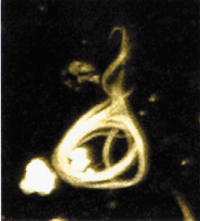
The main culprit behind Alzheimer’s disease has long thought to be the toxic protein beta-amyloid, which forms diffuse plaques in the brain. As such, most researchers have assumed that the nerve cell-engulfing tangles caused by a second protein called tau were mere consequences of the amyloid plaques. But given the failure of current amyloid-targeting drugs to reverse the course of the devastating neurodegenerative disorder, the plaque theory has been waning.

In its place, the focus is shifting over to blocking tau. In a series of new studies reported yesterday at the International Conference on Alzheimer’s Disease in Honolulu, Hawaii, researchers reported four new experimental therapies that either target tau directly or mediate levels of both tau and beta-amyloid conjointly.

In one study, a team led by Kaj Blennow of the University of Gothenburg in Sweden looked at the effects of an experimental drug called bapineuzumab, which had been designed to reduce clumps of amyloid-beta. Blennow’s team analyzed spinal fluid samples from two phase 2 clinical trials, and found that patients given bapineuzumab — which is being developed jointly by Pfizer, Elan Corp and Johnson & Johnson — had significantly lower levels of tau in their brain. These findings add to a small imaging study, published in April in Lancet Neurology, showing that drug cut amyloid levels in the brain by 25%.

Continue reading →

Researchers knock down gene to stop HIV in its tracks (subscription)

By Janelle Weaver

Last month, San Francisco officials granted a city proclamation to Gero Hütter for his 2007 discovery that a bone marrow transplant could, it seems, cure a person of HIV. The German hematologist’s findings raised hopes for a new therapeutic treatment, but the shortage of tissue-matched donors has prompted some researchers to apply the lessons learned to new techniques. (Click here to continue reading)

A thiazolidinedione by any other name would still be as sweet

ActosAvandia.jpg

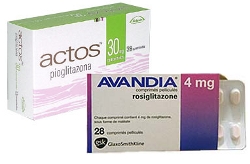
Things are not looking good for Avandia’s chances at the moment. This morning, the New York Times led with the story of a damning clinical trial that GlaxoSmithKline sought to hide. In that study, conducted in 1999, GSK found that Avandia had a higher risk of causing heart problems compared to its chief rival, Actos. Since then, independent studies have called attention to Avandia’s danger and confirmed that it’s riskier. How different are the two drugs? Let’s break it down.

Pharmacologically speaking, GSK’s Avandia (rosiglitazone) and Takeda’s Actos (pioglitazone) are quite similar. They belong to a class of drugs known as thiazolidinediones, or TZDs, and both can be used alone or in conjunction with other medications like metformin, sulfonylureas and insulin. But whereas other diabetes medications act by stimulating the body to produce more insulin, TZDs work by increasing the senstivity of cells to insulin that’s already in the body. Avandia and Actos block PPAR-gamma, a transcription factor inside cell nuclei that normally binds to fatty acids. When activated, PPAR-gamma upregulates genes that increase insulin resistance in tissues.

Continue reading →

On American presidents and AIDS

obamagesture.jpgThe International AIDS Conference is in Vienna next week, but at the moment, all eyes have turned to Washington, DC. Later today, US President Barack Obama is expected to announce his plan for combating HIV/AIDS, with the goal of reducing the rate of new HIV infections by 25% over the next five years, and to get treatment for 85% of patients within three months of being diagnosed.

American presidents have had a checkered history with the disease, especially amidst the confusion and fear that attended its rise in the 1980s. Here’s a selection of some AIDS policy decisions over the last few decades.

Continue reading →

In a busy week for the FDA, expert panel set to consider diet drug

The focus in the media this week may be on the US Food and Drug Administration’s deliberations around what to do with the diabetes blockbuster Avandia. Yet the agency’s advisory committee on endocrinologic and metabolic drugs has another drug to consider as well.

On Thursday, the panel will turn its attention at Qnexa, the weight-loss drug developed by Mountain View, California-based Vivus. The drug is yet to be approved, but in two phase 3 clinical trials subjects on the medicine — a combination of the appetite suppressant phentermine and the anticonvulsant topirimate — lost a placebo-corrected average of 9% of their body weight. A phase 2 trial also demonstrated Qnexa’s efficacy against sleep apnea.

But the drug has also been linked to anxiety, depression and concentration lapses, among other ailments, according to briefing documents released today. The report also questioned the lack of data in pregnant women and on long-term cardiovascular safety.

If Qnexa gets the advisory committee’s blessing, it could mean big business for Vivus and a head start over the company’s competitors, California-based Arena Pharmaceuticals and Orexigen Therapeutics, which both have new obesity drugs in development. Arena’s Lorcaserin and Orexigen’s Contrave will face similar scrutiny by the same panel later this year. The London-based market research agency Datamonitor estimates that the global diet-pill market could exceed $10 billion by 2018, Bloomberg reports.

For more on these new antiobesity drugs, check out our news story from earlier this year.