Religious resistance to education overhaul in Saudi Arabia

tatweer.jpgSaudi Arabian plans to reform its ailing education system are facing serious challenges from the country’s ultra-conservative clerics, who argue this is a Western sponsored to secularize the conservative kingdom, according to Financial Times.

In 2009, the newly appointed education minister, Prince Faisal bin Abdullah, launched several discussions with parents, teachers, and clerics to discuss his vision of overhauling the education system through more focus on science and mathematics and bringing sports to female students schools. Apart from the King Abdullah University of Science and Technolog (KAUST), all schools and universities in Saudi Arabia are segregated.

“Resistance to change happens when people do not understand what we are doing. We tell them their belief and traditions are not being challenged … When we teach math and science, we have to link them to Islam.” Faisal al-Muaammar, deputy education minister, tells the Financial Times.

However, a meeting between the Prince and some influential clerics on 24 March went sour, with one cleric threatening to convince families to sue the Prince and alleging that his project “corrupt female students and promote mingling of sexes.”

The main push for reform of the education system is the newly launched project Tatweer. With a US$2.4 billion investment, it will train thousands of teachers, many of them in the UK, as well as create new curricula for primary and secondary schools for boys and girls. Tatweer will also install new infrastructure in the schools to promote more use of technology and internet and create ‘smart schools’.

the project, launched in 2006, has already several pilot schools around the kingdom. But reforming education is more than just bringing new fancy gadgets for students and teachers. It remains to be seen whether the training the teachers and other teaching staff are receiving will indeed lead to the much-needed reform of the education system in Saudi Arabia.
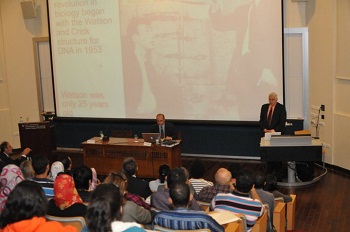
Bruce Alberts on the future of science

Bruce Albert's visit to AUC

Celebrated American biochemist Bruce Albert, editor-in-chief of Science and author of the Molecular Biology of the Cell, which is pretty much the standard cell biology textbook in most universities, visited the American University in Cairo (AUC), Egypt, where he gave a talk to students, media and members of the public about the role of science in the future.

The over-packed room listened intently as Albert spoke of how no democracy can function properly without what Indian prime minister Nehru once called “the scientific temper.”

“Science and technology can make a major difference for national development,” said Albert. He stressed that scientists must have a more prominent role as the young people go out to rebuild Egypt after 30 years of authoritarian rule.

“Scientists can’t stay in their universities anymore. They must go out all across Egypt. Often, only local scientists will have the credibility required to rescue a nation from misguided local policies and beliefs.”

Albert is an example of a scientist who has gone out to change the world. He has been very active in using science and technology to bring development on southeastern Asia. He is also one of the most prominent science diplomats, becoming one of the first three science envoys from Obama in his reach-out efforts to the Muslim world.

Alberts talked of the importance of an overhaul to science education as Egyptians rebuild their state. “Science education is not just about learning words of science – but about participating as scientists do, even from as early as when they are five years old.

He also stressed the need to “support the statuses of teachers” since they are primarily responsible to produce a new successful generation. “No democracy can work when people don’t understand. They must be educated to analyze the choices being made for them by politicians.” Modern technology can be used to educate people with the increasing popularity of social networks.

During the talk, Alberts drew several parallels between the future and opportunities of Egypt and those of India, who is quickly emerging as one of the important science centres of the world.

“As in India, science and technology can be harnessed to improve the livelihoods of people, even among the rural poor.”

While talking to the young audience after the talk, Alberts stressed the important role of young people and said he went down to Tahrir Square, the epicentre of Egypt’s 25 January Revolution, and met with some of the young people who participated in the events that led to the overthrow of Egypt’s authoritarian government. “I’m a big believer in empowering young people to address their problems. The culture of science, such as honesty, tolerance and respect for logic will be critical for Egypt’s future.”

More Egyptian artefacts stolen

ewart hall.jpg

The American University in Cairo (AUC) announced last week that one of its storehouses located beneath its old campus was raided. An initial inventory has revealed that 145 authentic pieces and 50 replicas were stolen, Zahi Hawass, Egyptian Minister for Antiquities Affairs told media outlets.

The items stolen were never on public display due to lack of space and the strict security measures needed, according to the AUC.

The artefacts lost include items from ancient Egypt as well as Coptic and Islamic origin. In a statement released, the AUC said they are “deeply disturbed by what appears to have been the theft of antiquities in its custody.”

The university said they are cooperating with the official judicial investigation, “as well as conducting an internal investigation of its own.”

When contacted, the AUC declined to give any further information or to comment on anything, but said they will make the findings of its investigations public once it is complete.

The items are legally the property of the AUC and are registered with the government as part of Egypt’s national heritage collection. The artefacts were discovered during excavations in 1946 when the law back then said that excavators could keep a share of their findings.

This comes as the latest in a series of thefts that have taken place in different places in Egypt following a security vacuum after the January 25 Revolution. Several pieces were either stolen or broken within the Egyptian Museum of Antiquities during the revolution. A few days after the president was ousted several storehouses around the area of the Giza Pyramids were raided and stolen.

Crisis in neonatal unit in Egyptian hospital

Public hospitals in Egypt are not always the cleanest or healthiest options. They are overcrowded and understaffed – often with inexperienced staff. Egypt has the highest prevalence of Hepatitis C and most experts say this is a result of neglect in the healthcare sector.

But yesterday, pictures taken from one of the teaching hospitals in Egypt started to surface on social networks and shocked viewers at the level of neglect. The pictures come from the neonatal unit in the El-Shatby Hospital in Alexandria, Egypt.

Here are the images posted online:

The images were taken by Dr. Magdy Badr El-Deen, a pediatrician at the hospital, to draw attention to the disastrous conditions the babies are put in within the neonatal unit. They are packed together in a small little bed at a stage when their immune systems are not yet fully functional.

According to Hossam Hassan, a medical student at the same hospital and the one who spread the pictures online, the neonatal unit in the hospital is caring for over 70 newborns, but there are only seven nurses in the whole unit. So that is one nurse for every 10 newborn babies, a far cry from the accepted standard of one nurse per baby (or one nurse per two babies at most). Many of the babies in the image are premature born, meaning they need extra care to make it through the first few critical days.

El-Shatby Hospital neonatal unit is no stranger to controversy. In 2006, a fire erupted in the unit due to negligence which led to the death of 12 newborn babies. The investigations later revealed that there was major neglect in the wiring and heating of the unit which was blamed for the fire.

Atherosclerosis in ancient Egypt

Egyptian mummy.jpg

Coronary and heart diseases are often thought to be modern diseases. But the first case of atherosclerosis found in a mummy of an Egyptian princess that lived 1580 and 1550 BC shows that heart diseases may have been affecting humans longer than we expected.

Adel Allam, a cardiologist at Al-Azhar Medical School in Cairo and Gregory Thomas of the University of California, Irvine, studied 52 Egyptian mummies to find how common the disease really was in this ancient civilization. Of the 44 mummies that still had heart and arteries, 45% showed hardening of the arteries.

According to these results, the disease was apparently very prevalent in ancient Egypt – at least among the noble families who ruled the country.

Known risk factors for atherosclerosis include smoking, a calorie-rich diet, lack of exercise and a genetic predisposition. The nobility of ancient Egypt probably enjoyed fattier diets than the common people in the street and might have been less mobile, but the high rate of incidence of the disease is still baffling.

“We think there must be other risk factors that we are missing,” Thomas told Science.

The team is now going to test a hypothesis that the result of this high rate of atherosclerosis may have been a result of bacterial infections widespread around the Nile basin, such as malaria. This may have called inflammations which, while they help in the healing process, can contribute to the development of atherosclerosis.

Solar energy tests spreading across the Gulf States

qatar-science-and-technology.jpg

The United Arab Emirates (UAE) is working on its ambitious Masdar Initiative, which will be the first zero-carbon city in the world and will act as a centre for renewable energy research. The King Abdullah University of Science and Technology (KAUST) in Saudi Arabia has stepped up its renewable energy research, testing new technologies in KAUST’s New Energy Oasis (NEO).

Now, Qatar has announced that the Qatar Science and Technology Park’s (QSTP) Solar Test facility should be up and running within this year. Similar to KAUST’s approach, the facility will be used to test different renewable energy technologies within the climate of Qatar to determine what is the best combination for Qatar’s energy future.

“The question is how much they cost compared to the alternatives. That is the real challenge to understand. The cost in general and in solar specifically, have gone down dramatically for the last two years, especially in photovoltaic. So we will try to see and understand the cost on the ground with the type of technology that exist and try to understand what the costs are,” said Omran Hamad Al Kuwari, GreenGulf CEO, according to The Peninsula.

Several Arab States have already set ambitious renewable energy targets. The UAE plans to have 7% of its energy generated from renewable sources by 2020. Egypt has set an whooping 20% target (although most experts agree the country is highly unlikely to meet this target).

Kuwari, however, has stressed that Qatar will continue to focus on gas as the primary source of energy for the small state. Qatar is one of the richest countries in gas reserves.

However, as in other Gulf States, the main driver of investing in renewable energy is to save their fossil fuels deposit, since exporting them is their main source of income.