Nile University students start sit-in at Zewail City campus

In an escalation of the row between Nile University and Zewail City of Science and Technology in Egypt over a disputed campus, more than 50 students from Nile University today forced their way into the Zewail City campus to protest the “loss of their campus”.
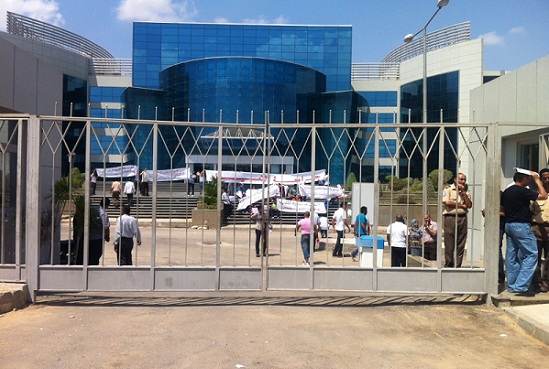
 

Nile University students start a sit-in in front of the main building until their demands are met.{credit}Mohamed Abdel-Mottaleb{/credit}

The Nile University students have been holding peaceful protests daily at the gates of the disputed campus on the outskirts of Cairo. Today, however, they managed to force their way through the gates and overcome the security at the gate. Initial reports claimed the students broke the gate and attacked security and workers. However, these were later refuted by both sides.

“I am standing by the gates now and they are fine. I don’t see any damage at all. There were no injuries whatsoever, this is all exaggerations,” says Mohamed Abdel-Mottaleb, director of the Nanotechnology Research Center at Nile University, who went to the campus after hearing what happened. “The undergraduates and some research assistants decided yesterday – and I only knew this today after the events that happened in the morning – to force their way into the campus. Now they are standing protesting peaceful on the stairs in front of the university.”

In a press statement that the students released, they said they are “protesting for their right to use their campus to prepare for the new academic year which starts next month.”

The students are continuing their protest, holding up signs and chanting against Ahmed Zewail, a chemistry Nobel laureate and the founder of Zewail City. They say they are fed up with all the talks between officials to find a solution to the deadlock which have failed so far.

The students, who are planning an open-ended sit-in until their demands are met, tried to put up some tents “but these were peacefully removed by the City’s security,” says Rawya El-Daby, the manager of the communication department at Zewail City.

“We have tried to talk to them told them this is not the right way to find a solution but they are not listening. They said we are staying here and we are not leaving – these are our buildings,” says El-Daby.

El-Daby says that, while the protesting students are peaceful, they are being very provocative with their chants, accusing Zewail and the rest of the staff of being “thieves and liars.”

The boards of directors of Zewail City and Nile University have been working on a solution but to no avail, especially after discussions on merging Nile University and Zewail City broke down last year.
Is the planetary alignment picture a hoax?

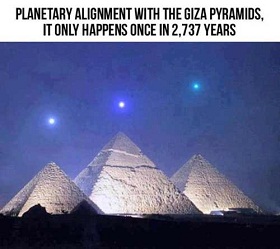
Planetary alignment over Giza Pyramids Over the past two days, the picture on the right went viral across the Internet, especially on social networks such as Facebook and Twitter. The image claims that on 3rd December, 2012, Mercury, Venus and Saturn will be aligned in the night sky, with each of the three planets showing exactly above the tip of one of the three pyramids of Giza. I kept getting several messages from friends asking if this is true or just another hoax image.

A little research online gives a straight answer. While the image itself is very cool, it is not entirely true. The image was created and published online by Charles Marcello on World Mysteries Blog. Marcello used the free software Stellarium to create the image, and claims that this event is very rare and happens every 2,737 years. The blog post hints at a possible spiritual significance to this phenomenon, and, with the year 2012 being the end of the Mayan calender, there is much interest in these events.

However,  Phil Plait over at the Bad Astronomy blog on Discover Magazine points out the many problems with this picture and why it is more or less a hoax.

There will be an event on 3rd December, 2012 and it will probably be quite special. However, according to Plait, the photoshopped image here has more than a few problems. To start with, the angle the photo is taken from is wrong. The picture is taken from the southwest facing the pyramids. However, in order to see the planet alignment, you must be northwest of the pyramids. From the angle the picture is taken from, the planets would be behind the viewer.

Meanwhile, the three planets will not align in such a straight line. The line will be a bit skewed, according to a simulation that Plait using the  SkySafari planetarium programme. They also won’t appear in a nearly horizontal line as in the image, but at a much steeper angle apparently.

{credit}Croman / Illinois Sky Watch{/credit}

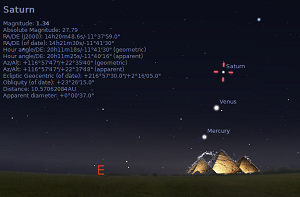
The Illinois Sky Watch has produced another image, again using Stellarium, that shows what the planets might realistically look like on the 3rd December when they align. The image can be see on the right.

Finally, an important question to ask is: will the alignment of the planets be visible to sky-gazers? On a normal day in Cairo, it is very tricky to see too many planets and/or stars due to the pollution. While the pollution is not so bad out in the desert, the pyramids are too close to some of the city’s busy centres with air and light pollution.

Being based in Cairo, I will probably head to the pyramids before dawn on 3rd December and I don’t think I want to miss this event. I’m excited to get the chance to witness this so close to home. However, I’m not getting my hopes up too much that it will look like that first amazing image. Either way, I am sure it will be something special to watch – if the smog over the city permits that is.


Is anyone planning to go look for the planetary alignment above the pyramids on 3rd December?

KAUST researchers win top places in contest to combat desertification

Two research teams from the King Abdullah University of Science and Technology (KAUST) win the first and second place in the international  “Help to Avoid Desertification” idea contest, sponsored by Bayers MaterialScience.

The two winners, KAUST PhD candidate Noura Shehab and a team led by Rodrigo Valladares Linares and Muhannad Abu-Ghdaib, both come KAUST’s Water Desalination and Reuse Center (WDRC). They have staved off competition from 87 other entrants to win first and second places for their innovative proposals, receiving €7,000 and €4,000 respectively.

“The researchers submitting the winning entries are among a talented group in the WDRC working on sustainable solutions to national, regional, and global water scarcity, of which desertification is a manifestation,” said Gary Amy, director of WDRC.

Saudi Arabia, which is mostly made up on arid deserts, produces some 24 million cubic meters of water per day from desalination, about half the world’s total. Desalination is, however, an energy intensive and expensive process. While the Kingdom is rich in oil, both winners’ proposals focused on using renewable sources of energy to produce water from desalination cheaply and more environment friendly.

Shehab, who won first place, proposed turning to the natural resources of sun, sand and wastewater to counteract the effects of desertification through a three step process.

Building on existing research, the first step will use bacteria as a source of renewable energy. Besides the actually process of removing salt from the water, an electric current produced from the bacteria will pass through the water to degrade any organic matter. This is more sustainable than using oil or gas for electricity production.

The second step involves passing the desalinated effluent through a sustainable biosand filtration system for drinking water and irrigation. The final step involves using thermal energy from Sun rays for disinfection of the water, making it ready for drinking or irrigation.

The team led by Valladares Linares and Abu-Ghdaib, which won second place at the contest, are also proposing ways to reduce the energy cost of desalination. Instead of the traditional high-energy filteration systems that use reverse osmosis or nanofiltration, the team want to make a hybrid membrane system combining the use of forward osmosis and low-pressure reverse osmosis (FO/LPRO).

By using the natural process of forward osmosis as the main force to separate water from the dissolved salts, they do not need to use the expensive hydraulic pressure-driven separation options.

The water is then passed through a low-pressure reverse osmosis pressure as a second barrier against micro-pollutants. The result is the production of high quality water at a low energy input.

Why waste money on the Mars landing?

The first image sent back from Curiosity upon landing. Part of the rover's wheels are visible as well as its shadow.{credit}NASA/JPL-Caltech{/credit}

I woke up earlier than normal today and quickly rushed to my computer to watch Curiosity, a NASA rover, attempt to land on the surface of Mars. I wasn’t alone either, people all over the world either stayed up late or woke up early to watch the event. I found myself holding my breath as the rover tried to make the very tricky landing without crashing.

When I went on Twitter to see what the community was talking about, there was much excitement as Curiosity finally made its historic landing. I was smiling as I saw the team behind the mission burst in applause after the robot successfully maneuvered the seven minutes landing. Soon after it beamed its first images back to Earth. Over the next two years it will be collecting soil samples and studying the surface of the red planet to discover if life existed there in the past and whether there is (or was) water or not.

Many people on social networks, however, were arguing that such a mission was a waste of money – begging the question of why waste US$2.5 billion to study the surface of Mars. Who cares if there was life there?

Humans have been driven throughout the millennia by our keen interest to learn more, by our curiosity about things we did not understand. This is the driving force behind all aspects of science and, arguably, the reason we have achieved so much. By nature, we tend to question everything. We have a insatiable hunger for knowledge. This curiosity is the initial driving force behind missions such as that of the aptly names Curiosity rover. Even if there is no direct, fathomable benefit we will glean from landing on Mars, our hunger for knowledge drives us on.

“If you look at Mars, it appears as Earth’s twin planet. It is very similar in size and the closest planet to us,” says Essam Heggy,  a planetary scientist in the Radar Science Group at the NASA Jet Propulsion Laboratory. “You can’t learn much about Earth unless you approach it as part of the solar system, and learn about its position among the other planets, rather than as an isolated entity.”

What we learn there may be relevant to us on Earth as well. Space exploration is, in general, about much more than what we see in space. Much of space exploration and the science involved in it is very much related to our lives here on Earth.

For example, the Curiosity mission will explore the surface of Mars for water. On Earth, we already have serious water problems. The Middle East is mostly desert. The technologies that the rover will use to hunt for water on Mars can easily be adapted to hunt for water right here on our home planet.

“The Arab region is the largest oil producer in the world, but the poorest in water resources. However, we invest more in oil exploration than anything else, and we are the poorest investors in water exploration,” says Heggy. “The NASA Jet Propulsion Laboratory has been using radar successfully for 40 years. The first radar imaging experiment was not on Earth, but on Venus. The latest experimental use of radar imaging was on the moon Titan.”

The similarities between Earth and Mars might also offer us a glimpse into the future of our planet. Radar imaging shows that Mars once had rivers of water (which are dried up now) running through it – a blue planet just like Earth. “The most interesting discovery is that, by looking through these images, we learned that water did not disappear from Mars over millions of years. It only took a few thousand years for the planet to dry up.” Is this a glimpse into what could happen on Earth, especially in a time of uncertainty due to climate change?

We may not know exactly what this drive for knowledge may bring humanity. We may not be sure now what kind of amazing technologies we will get from it. However, the Apollo programme was responsible for wonderful inventions that have become pivotal to our lives on Earth. I am not sure if Curiosity will yield the same results. However, I doubt a search for knowledge could ever be a bad thing. Even if it cost US$2.5 billion to send this relatively small rover to Mars, it is still an exciting step for humanity in our continuous exploration of our universe.

UAE turns to cloud seeding for rain

A jet disperses chemicals to act as seeds to increase rainfall in UAE.{credit}NCMS{/credit}

This year, the United Arab Emirates (UAE) saw it’s warmest July since 2002, with temperatures peaking at 50.4°C. The country is now looking to science, hoping international meteorologists can help it develop it’s cloud-seeding efforts to relieve the heat.

“We want to invite 20 or 30 of the top scientists in this field and hold a workshop, to hear how we can improve rainfall,” said Omar Alyazeedi, the director of research and development at the National Centre of Meteorology and Seismology (NCMS), according to The National.

In June, NCMS announced that it was accepting ideas to help improve cloud seeding and verify the efficiency of the technique, but had little response so far.

Counter to popular belief, cloud seeding does not produce new clouds. It attempts to alter the amount of precipitation from already existing clouds. Basically, rockets are used to disperse certain substances in the air, such as dry ice or silver iodide. These supposedly form nuclei that condense water, creating more rainfall. The main problem is that, scientifically, it’s been impossible to determine how successful cloud seeding is. There is no clear way to measure how much the seeding alters the amount of rainfall compared to unseeded clouds.

The UAE has had an active cloud seeding programme since 2001. A small jet, operated by NCMS, makes regular trips to seed clouds. During July, the centre sent out 27 of these flights and attributes some rain in the Eastern and Western regions of the country to them.

“If you are asking if we increased rainfall, then the answer is yes of course. But by how much, this is the difficult question,” Alyazeedi told The National.

The extreme hot summers in the Gulf region of the Middle East has prompted several states to find solutions in science. Qatar, which will host the World Cup 2022, has announced plans to generate man-made clouds that will float over stadiums to offer relief from the scorching sun during the competition. The artificial clouds, lead engineer Saul Abdul Ghani, who is the head of the mechanical and industrial engineering department at Qatar University, told Gulf News, will be made of a light carbon material with a giant envelope containing helium gas. There will be solar panels on top that power engines that move the cloud by remote control as needed.