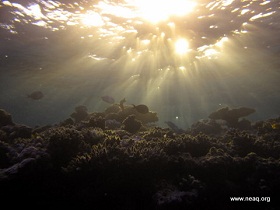
Deep inside the Red Sea

Rotjan---Red-Sea-2010-(156)-795004 Scientists know very little about the Red Sea.

When I was doing a story about a new disease infecting coral reefs around the world a couple of years ago, I took the chance to ask professors from different parts around the world about the Red Sea corals. They all told me they don’t know much about it, since the corals there were the least studied in the world.

A couple of dives in this little stripe of a sea, which carries a huge relevance to all Abrahamic religions, and you can’t help but notice how special it is. Most divers who have visited these waters once fall in love with them and come back time and again.

Earlier this year, a 10-day research trip from the King Abdullah University of Science and Technology (KAUST) sailed into these fascinating waters to fill some of the scientific vacuum. Michael Berumen, assistant professor of marine science at KAUST, and Randi Rotjan, associate scientist at the New England Aquarium, set out with 8 colleagues to document coral reefs and the abundant marine life in the Red Sea.

Rotjan blogged from the sea about the fascinating trip. The blog is a delight to read for anyone interested in diving, and especially for people who have fallen in love with the Red Sea. She documents the trip both in and on the sea, with pictures and videos of the most amazing undersea lifeforms and the research taking place on top the boat.

The trip had several scientific aims, each one more exciting then the other. My personal favourites remain, however, examining clownfish genetics and studying corallivores, organisms that feed on coral reefs.

Blogging in Rotjan’s exciting way brings a new level of interaction with audience. It invites the readers to actually share in this underwater adventure. It is indeed a great way to document a science journey, especially to ignite a love of nature and science among younger readers.

Personally, I now wish to go diving in the Red Sea more than ever before!

You can read all the blog posts regarding the trip here.

Science diplomacy that works

Muslim woman scientist.jpg

Building on US President Barack Obama’s promise to promote science as a tool for diplomacy, made last year during his speech in Cairo University, two US congressmen introduced a bill to fund research and education in Muslim-majority countries.

Egyptian-born Nobel laureate Ahmed Zewail welcomed the news, reported in Nature Medicine. He did stress that not all countries in the region will be able to make use of the funding, since they lack the infrastructure to conduct research.

While it is great that such initiatives are finding their way into US politics, I’m curious how they will be perceived in the Muslim world. The US need to work within a framework of distrust towards the West, that was sadly harboured over several years in this region. This inevitably complicates things, as reach-out attempts are seen as coming with strings attached.

The other problem is the wide disparity among the countries that compromise the Muslim world. While the approach can work with some of the better off countries, such as those in the Middle East, other nations do not have the infrastructure needed to make use of this funding opportunity. These countries need help in developing a science community and putting together an infrastructure that can help them make use of the US extended hand.

In order for these efforts to really be effective, the US will need to look at each country individually, rather than looking at the Muslim world as a whole. They also need to work with local partners, who have an intricate knowledge of the region, to determine what is best for each country.

Sustained efforts will hopefully reverse the distrust built over the years. It will take time, but in this age of science, there is probably no better way to reach out then through science diplomacy.

You can read the full article “Science seen as olive branch to the Muslim world” in Nature Medicine through Nature Middle East’s Our Picks section.

Genetics for the young

Karyotype.png

The New York-based Cold Spring Harbour Laboratory (CSHL) is exploring the possibility of opening a new branch of its Dolan DNA Learning Centre in Abu Dhabi, the capital of the Unites Arab Emirates. The centre will offer training in genetics and life sciences for teachers and students in the country.

The project, which is a result of multiple collaborations with the Higher Colleges of Technology, proposes setting up a system for science education and genetics. It will teach advanced techniques genetics and science which will be implemented into the education system in schools and universities.

“There are a number of things we are interested in doing and we’ve been talking to the HCT about the idea of boosting science education through a programme CSHL runs called the DNA Learning Centre,” Bruce Stillman, president of CSHL, told Gulf News.

He hopes the project may expand, with other countries in the region opening similar centres to boost science education.

The important role that genetics may play in the near future in the personalised medicine era means it is important for the general population, and not just the scientific and medical communities.

The new centre will come up with interesting ways to make learning about genetics fun in schools, in a bid to get schoolchildren excited about science.

The ups and downs of Arab science journalism

Science Festival Media 1.jpg

Science journalism in most places around the world may be shrinking, but it is actually increasing in the Arab world. While CNN closed down its science, technology and environmental news department last year, more dailies in the Arab world have started dedicated science and technology pages. So all this looks nice and rosy on the top, but is that growth really healthy or is it hiding something rotten?

As part of the Cairo Science Festival taking place in Cairo, Egypt, science journalists from newspapers, television, and online came together to discuss the successes and failures of their beloved profession. The large panel had representations ranging from the World Federation of Science Journalists (WFSJ) to the Arabic-language National Geographic Abu Dhabi TV channel to our very own Nature Middle East.

A quick assessment from the panelists showed there is a general agreement that all was not well with science journalism in the region.

Nadia El-Awady, the president of the WFSJ blamed a lack of basic journalistic skills and ethics on the part of the journalists, which resulted in the production of material that was inferior to the needs of the audience. On the other hand, Khaled Montaser, a journalist from the Egyptian daily Al-Masry Al-Youm, blamed the audience for “developing a science-phobia”, creating a culture that was not receptive to science in the first place. Magdy Saed, the president of the Arab Association for Science Journalists (ASJA) agreed that the main problem was in a lack of demand on behalf of the audience.

I personally don’t think there is a problem with the audience. I believe that the audience are hungry for science information, but they are not happy with what they are getting. Part of the problem lies in the journalists failing to make their coverage exciting and captivating.

The other problem lies in the incredibly tough atmosphere that science journalists must work in. Usually it is very hard, if not impossible, to reach sources for comments. There are layers and layers of constraints on people not to talk to the media about something as simple as a new research paper. Public relations officers in universities and research centres complicate things further by not offering timely help to the journalists. The journalists are in turn under pressure to turn in stories to their papers regularly within very tight deadlines. The end result is a poor report that does not satisfy the readers.

Science Festival Media 2.jpgSo is all hope lost? I really don’t think so. There is a large market for science news in the Arab region, especially with a young, budding science community in the making. Slowly but surely, a general “science may be the key” mentality is seeping through to people.

It is now time for a proper review of the whole science information delivery chain, starting from the labs with the hard science and scientists, to the science journalists and communicators, and on to the varying audiences – from pre-teen children to adults seniors.

A review of that chain will highlight where the problems are and then they all need to be addressed properly. There is no one single solution or magic pill. If will take time to transform a community from science irrelevant to science caring.

Severing all ties with science and technology when one finishes school will not work. As Alaa Ibrahim, the moderator of the session, puts it, “science journalism can pave the way for lifelong informal learning.”

Science journalists and communicators will need to rise up to that challenge, but they can do very little without support from the rest of the science community, who need to believe through and through that their science will never leave the labs without the help of those journalists.

Refrigerated by sunshine!

MEDISCO.jpg

Trials underway in Tunisia and Morocco might pave the way to the use of the energy of the sun to refrigerate dairy and other foodstuff, providing a cheap option for places that lack reliable access to electricity.

Solar energy is already being used to power air conditioning in buildings in many places around the world. Scientists from the Fraunhofer Institute for Solar Energy Systems (ISE) in Freiburg, Germany, want to build on this existing technology to use the sun’s energy to provide cooling in the food and agro sector.

The researchers set up MEDISCO (MEDiterranean food and agro Industry applications of Solar COoling technologies) to test the viability of the technology in the Mediterranean region, which is famous for receiving good sunshine on most days of the year.

“Our method is ideal for countries which have many days of sunshine and in remote areas where there are no conventional means of refrigeration owing to a lack of water and non-existent or unreliable energy sources,” explained Tomas Núñez in a press release.

They have set up experimental solar cooling systems at a dairy in Marrakech, Morocco, and a winery in Tunis, Tunisia. The objective is to assess which systems would actually serve the needs of the food industries in the region.

The team is also working with partners in Egypt, Tunisia and Morocco to analyze what the needs of the market are. They sent out surveys to several companies in the three countries to identify which industries would benefit the most from the solar cooling systems.

The device works in a similar way to solar water heating systems. Several concentrating collectors reflect direct sunlight onto an absorber. The solar radiation then heats a water-glycol mixture up to nearly 95⁰ Celsius. The hot water is used to drive the absorption refrigeration machine. “We do not use electricity to provide the refrigeration, we use heat,” explained Núñez.

The system is able to reduce the temperature down to below 0⁰ Celsius, which is why the water-glycol mixture is used. A pure water coolant would freeze in the tubes. The solution is them pumped through a heat exchanger or a system of pipes to cool down the milk or wine.

The project is funded by the European Commission Sixth Framework Programme (FP6) and run by the Polytechnic University of Milan. The smaller panels are supplied and installed in cooperation with universities, energy agencies and companies from Egypt, France, Germany, Italy, Morocco, Spain and Tunisia.

The Mediterranean Renewable Energy Centre (MEDREC), based in Tunisia, will be responsible for the transfer of the experiences of the MEDISCO project at a regional level.

Nature Middle East Inaugural Workshop

Nick Campbell.jpg

The launch of Nature Middle East was officially celebrated today on 5 May, 2010, as part of the Saudi E-Health Conference in Riyadh, Saudi Arabia.

Over 110 post graduate students and researchers, mostly from clinical and medical backgrounds, turned up for the event, which was spread out over two workshops.

For the first part of the workshop, I took the attendees through a tour of the new portal, explaining each of the different sections and how they can serve the science community. This introduction also touched on the past scientific achievements of the region and the potential that has been building up in the Arab world over the past few years for a science renaissance.

Our aim is to make the website the central home for the scientific and medical community in the region. They can come for the latest science news and information about new grants, conferences and science policies. It is also poised to be an interactive zone where the researchers can get together to share their thoughts and ideas about all issues of the region and maybe link up and collaborate on further work.

This was followed by a presentation by Nick Campbell, managing editor of Nature, who talked about how researchers can get published in high-impact journals, with a specific focus on Nature.

The talk explained the relevance of getting published in Nature, and how selective the process is. After all, only less than 10% of original research papers submitted every week end up getting published in the multidisciplinary journal. In fact, more than half of the papers submitted are refused by the editors without reaching the peer-review process.

NME Launch workshop.JPGCampbell went on to explain how researchers can benchmark their research and measure its quality against other papers, and how they can increase that quality in order to get a better chance at getting published.

This is particularly interesting because, as advanced, high quality research centres increase in the region, the researchers need to be trained on how to showcase the science conducted in the region by publishing in high impact journals, thus raising the rating of their institutes along.

The Nature Middle East sponsor, the King Abdallah International Medical Research Centre (KAIMRC), hosted the event and talked about their vision for sponsoring the new science portal. Mohammed Zamakhshary, who is the head of the Population Health unit at KAIMRC, talked about the 10-year plan they have to transform KAIMRC by 2017 into a world-class research centre.

A short tour of the Arab world is planned in the future, where the workshops will be repeated in different countries to reach more researchers in different parts of the region.

Online resource for health in Arabic

During the opening of the Saudi eHealth Conference 2010, Prince Muqrin bin Abdulaziz Al Saud, who is the head of the general intelligence in Saudi Arabia, announced plans to launch a comprehensive e-health encyclopaedia .

The project, which is sponsored by King Saud University in Riyadh and the Saudi Association for Health Information (SAHI), “will provide comprehensive health information to millions of Arabs in the world,” said Prince Muqrin to journalists.

The project aims to raise the standard of health information and material present online. A study conducted in King Saud University in November 2009 found that generally, health websites in Arabic were regarded as untrustworthy, even by Arabs from the Middle East, who preferred visiting Western websites for up-to-date health-related information.

The research also found that in a sample of 122 Arabic health website, only five were compliant with all eight of the international HONcode 8 principles.

The encyclopaedia will be fully in Arabic, in order to fill in this gap in reliable health information in Arabic. The new project plans to only have highly verified information and will be updated regularly with new information and results from new research. It will be edited by specialized medical personnel only.

No information was provided, however, on when the project should be online.