Men blamed for holding back women scientists

Women scientistsThe hardship and obstacles that women scientists in the Arab world face may actually be blamed on the attitude of their male counterparts in workplaces, as well as the ongoing lack of support from the government, suggests SciDev.Net.

This came up during the Women in Science and Technology in the Arab Countries, held last week in Kuwait. The conference itself, according to the organizers, had very little support or funding from countries in the region. in a blogpost at SciDev.Net, Nehal Lasheen, a science journalist based in Cairo who was attending the conference, points out that major science players in the region – such as Qatar and Saudi Arabia, had almost no representatives at the conference.

Over a fifth of attendees did not even come from Arab states, but came from other countries such as India, Pakistan and South Africa. Additionally, there was very little presence of men at the conference. There was only one male scientist presenting a paper at the conference, and hardly any men in the audience throughout the three day meeting.

This begs the question: what is the actual purpose of this conference? The stated goal is to shed light on research carried out by female scientists, and discuss the obstacles facing them.

This is a worthy cause – but the way it was set up here is like preaching to the converted. Women attendees are very much aware of the challenges women scientists face – in fact, they live them day in, day out. It’s policymakers that need to be made aware of these problems. Decision-makers, heads of universities and research centres need to be pushed to make changes in the workplace that make it a better working environment for women, who often have to juggle a challenging career as a scientist and a demanding position in the family.

More men should also be attending to listen, discuss, debate and ultimately understand how hard it can be for women to pursue careers in science, in the hope that this will eventually bring about a cultural change that makes Arab communities more accepting of female scientists.

According to SciDev.Net, the conference organizers did try hard to garner support from the private sector but there was little interest. It can be challenging to start this kind of paradigm shifting change. However, until that becomes a reality with a little chipping over and over, these events will fail to have the effect they are supposed to have – which is especially troubling post-Arab Spring since many women are worried about regulations formed that can set up what little victories they had already won in the past.

NME’s weekly science dose (April 19-25)

We’ve gone nuclear this week and decided it was time someone tried to make sense out of the never ending obscurity and procrastination plaguing nuclear energy plans in the Arab world. Egypt has been huffing and puffing about it since the 1950s, and now Saudi Arabia seems to be on track to spend US$80 billion to build 16 reactors by 2030.

Meanwhile, Qatar has officially commenced construction, while Jordan (like Egypt) remains in the limbo of indeterminacy. But we’re giving away too much already. Here’s the full story.

And if that’s not enough to quench your thirst for all things radioactive (did you know that many toothpaste brands were laced with radioactive substances in the past?), we also have two very contrasting Q&A’s on whether Egypt should harness nuclear power or not. On one side of the ring is Yusri Abu Shadi, a former head of Alexandria University’s nuclear engineering department, and he’s quite adamant about Egypt going nuclear. At the other is Hani El-Nokrashy, co-found of Desertec Foundation, and he’s all about going solar instead.

Beyond the hood

Seeing as diabetes has killed some 357,000 people in the Middle East alone last year, you may want to consider giving up soft drinks. A new study suggests that drinking just 336ml of a sugar-sweetened soft drink (roughly, a can) a day can increase the risk of developing type 2 diabetes by 22%. And if you are drinking two cans, you are also 22% more likely to develop the disease than the person drinking just one.

The finding is based on data collected across eight European cohorts and covering some 350,000 participants. However, the researchers also found that the risk fell to 18% when total energy intake and body-mass index (BMI) were accounted for — both factors that are thought to mediate the association between sugar-sweetened soft drink consumption and diabetes incidence.

Also, in case you are a soft drinks fan as well as a cigarette smoker, here’s some more troubling news: even a few cigarettes a day can significantly increase the risk of developing rheumatoid arthritis (RA) — at least for women. This latest entry in RA research found that just 1 to 7 cigarettes more than doubled the risk of developing the disease.

While stopping smoking reduces the chances, the risk was still significantly higher for women who had given up for 15 years than for those who had never started smoking to begin with.

Nile University wins case against Zewail City

Zewail City newThe long legal dispute between Nile University and Zewail City of Science and Technology over a campus on the outskirts of Cairo is coming to an end, after the Supreme Administrative Court in Egypt ruled in favour of giving the campus back to Nile University (NU).

This morning, the court refused two appeals from Chemistry Nobel laureate Ahmed Zewail and the Egyptian government to give the disputed land and buildings, which originally belong to the government, to Zewail City. The court also ruled on accepting a request from Nile University to change it from a private university to a civil university, or a fully independent not-for-profit university, one of NU’s long standing requests.

Ever since the popular uprising that ousted Mubarak two years ago, the future of Nile University has been in doubt when their new campus – which the researchers at the university had moved into less than a month earlier – was reallocated by the government to Zewail City. Since then, both parties have been engaged in a dragged out legal battle over the campus, each claiming they have a right to it.

The new ruling, which comes from one of the highest courts, leaves no place for any new appeals. Nile University is supposed to move into the campus, which leaves an uncertain future for Zewail City.

“I am ‘cautiously’ optimistic,” says Moustafa Ghanem, the vice president for research of NU. “Clearly a verdict with no implementation is useless – just another piece of paper. We have been there before. But I do hope that the government will implement the decision quickly.”

Sherif Fouad, the Zewail City media spokesperson, said the City respects the decision of the court and will follow all needed procedures. “Nile University can deal with the Egyptian government about the ruling and the effect it will have and we will oblige. We are not in dispute with any party, the case was always between Nile University and the government, not Zewail City.”

Applying the ruling would be a tricky business, however. Since taking over the campus, Zewail City has spent over 300 million Egyptian pounds (~US$44 million) on preparing the laboratories, offices and facilities, according to Fouad.

Ghanem contends this is an issue that can be discussed between NU, Zewail City and the Egyptian government once the NU students and staff move in. “A rational solution can be found once Nile University gains access to the campus and all three parties can sit down and discuss. It has been irrationality and absurdity that had marred this whole situation over the past two years and I don’t think we should be repeating this.”

Several months before the final ruling today, Sherif Sedky, the founding provost of Zewail University, has confirmed that no matter what happens, the project will continue, since its core was the team of researchers and academics they have built, not the buildings. Following the ruling, Fouad quickly sent out a press release stressing the project was still alive. “We are absolutely sure that the Egyptian government will follow up on its promises to support the project.”

“I hope we will be in next week, before the end of April,” says Ghanem. “But let’s see the legal loopholes, various interpretations and media and political games. More than two years of the students’ life have already been unfairly wasted. This is shame, it should not go on for much longer. “

Nature Arabic Edition celebrates six months

L-R: Steven Inchcoombe, Suweliem, Magdy Saed

L-R: Steven Inchcoombe, Mohammed Al-Suwaiyel, Magdy Saed.

Nature Arabic Edition, the monthly Arabic translation of the leading science magazine Nature launched in October 2012, celebrated its sixth issue during the week long Saudi International Conference on Science Culture in Riyadh last week.

The official inauguration of the magazine, which is a monthly publication giving readers in the Arab world a chance to read about cutting-edge science in their native language, was followed by a talk by Philip Campbell, Nature‘s editor-in-chief, about how scientists can get published in high impact journals.

Saudi Arabia has been working to increase its science profile internationally, and offering science in Arabic and making it available to Arabs everywhere is one of the main endeavours of the King Abdulaziz City for Science and Technology (KACST), the sponsor of Nature Arabic Edition.

During the inauguration event, Mohammed Ibrahim Al-Suwaiyel, KACST president stressed the important role that science will play in the development of the Kingdom of Saudi Arabia. “Arabic speakers now have free access to the latest developments in science and technology, and in their native language, in hopes that the coming generations will have a deeper connection with and appreciation for science, technology and innovation.”

“Humanity has always been building up knowledge and science and experiences through exchange. While science today moves in all directions, the majority is produced in the West,” said Magdy Saed, the editor-in-chief of Nature Arabic Edition. “Translation is one of the most important tools in the exchange of knowledge and this is where Nature Arabic Edition comes in, helping bring science from the West to the Arab world. Making cutting-edge research available to scientists in the region will also promote a science culture throughout.”

The magazine currently reaches 10,000 people in its print format, while it is freely available for anyone to access online. The last month has seen over 14,000 visitors to the portal.

NME’s weekly science dose (April 12-18)

Over the past five years, the Egyptian government has spent US$500 million treating Hepatitis C (HCV). Despite this, Egypt remains the country with the highest incidence of the disease, and health officials are growing impatient with the current strategy.

So is it time for Egypt to take on a more preventative approach to this epidemic? Check out our latest feature on the debate between HCV prevention and treatment — is it possible that just 10% of the money spent on treatment could be used to prevent new transmissions of the disease altogether?

Also, hopeful news comes from a study just published in Nature on blocking a protein that is stopping adult hearts from regenerating after injury. Mammals have hearts that can generate new heart muscle cells only up to seven days after birth — however, blocking a protein called Meis1 may allow hearts to carry on this capacity safely into adulthood — at least in mice.

Beyond the hood

12.8 billion light-years from Earth — yes, billion — there is (or at least there was) a galaxy churning out nearly 3000 stars per (Earth) year — that’s 2000 times more than our own galaxy.

The massive galaxy was discovered using a global collection of telescopes , and is so distant that the astronomers viewing it are looking at the universe when it was just 6% of its current age. You can read more about this prolific galaxy, called HFLS3, here.

Also interesting this week: apparently there is a brain region that is fully dedicated to recognizing numerals. Just one-fifth of an inch across on the outer cortex of the brain (in an area called the inferior temporal gyrus), neurons  in that region were found to be activated when people view ordinary numerals — that is, 1, 15, and 23, and not one, fifteen and twenty three.

When presented with the numerals spelled out as numbers, activity in that brain area dropped off substantially. Interestingly, while the brain never evolved to have an innate ability to recognize numerals, it seems it can learn to dedicate the 1 to 2 million neurons in this region just to numeral recognition thanks to early elementary education. More details here.

A science culture for democracy

bruce alberts Cairo Science Festival 2013

{credit}© Mohammed Yahia{/credit}

Science is the only way to pave the road to a real democracy following the revolutions of the Arab Spring, said Bruce Alberts, outgoing editor-in-chief of Science, during the opening of the annual Cairo Science Festival.

Speaking to various students and science enthusiasts from across the Egyptian capital, Alberts stressed that the key to the future is creating a “science culture” to change the way people think and approach life. He defines this as a shift in the way of thinking that is influenced by science and science education, and suggests that India may be the best place for Egypt to look for a role model.

“President Nehru always talked about having a scientific temper. That is a way of thinking influenced by science where people are tolerant and make decisions based on facts, pretty much like scientists,” he explains.

“The society of scientists is simple… it must inspire the single scientist to be independent, and the body of science to be tolerant ” says Alberts. “In Egypt today, there’s something important to learn from science. People have to be more tolerant and learn to live together or your democracy will fail. People have to move away from dogma and focus on evidence-based decisions.

“If you are going to have a successful democracy then your young people should learn to think like scientists. They don’t  need to be scientists, just learn how to think like one.”

This shift to a science culture will require a serious overhaul of science education that moves away from the current model of memorization of scientific facts to to focus on the actual practice of science. “This means that science education should have students solving problems in class, have them experience thinking like scientists.” This overhaul should extend from the very first levels of school and all the way into college.

Another lesson that Egypt and other developing countries can learn from India, says Alberts, is how to work to make the Internet available in as many places as possible, even the poorest villages furthest away from the main cities. India has been using optic fibres to increase Internet access in its villages. “You need to support institutions in Egypt that would connect science and technology to ways to improve the livelihoods of the poor. That was the core of your revolution,” he adds.

Finally, Alberts stressed how important it is to build up local institutions that can actually help Egypt retain all the talented people who often leave the country for greener pastures. “America is full of talented people who came here because they couldn’t be successful at home. You must set up institutions based on merit-based rewards and funding.”

NME’s weekly science dose (April 5-11)

Refugees who have fled from Syria’s ongoing conflict are faced with a different crisis when they arrive in Lebanon: limited access to healthcare and a heightened risk of becoming ill in the overcrowded camps.

With some 40,000 Syrian refugees coming into Lebanon each month, a recently published survey found that only 32.6% of refugee children have been vaccinated against some of the most common diseases such as tetanus, polio and measles. The risk of communicable diseases spreading among the refugees is alarming. You can find the full story here.

A study of a consanguineous Egyptian family in which five siblings are affected by a rare epileptic condition has identified mutations in a particular gene called CNTN2 as the cause. Called cortical myoclonic tremor, the researchers compared the genomes of the siblings with 500 healthy controls and found these mutations present only in the affected siblings. More details here.

Finally, a research team from Cairo University and the University of California have come up with a flexible supercapacitator that promises to help realise the next generation of flexible electronic devices such as electronic paper, displays and health-monitoring kits. Their secret? Graphene. Read more here.

Beyond the hood

Researchers from the University of Granada have found another reason for our readers to get off their backsides and do some exercise: sporty folks seem to have significantly better cognitive capacities than those with more sedentary lifestyles.

These better brain muscles however appear to only highlight sporty people’s capacity to sustain their attention and react rapidly to external stimuli while engaged in monotonous tasks. The article was published in the latest edition of the journal PLOS ONE.

Sporty or not, however, it seems the adults of today are less “metabolically” healthy than their counterparts from previous generations. A large cohort study from the Netherlands compared a range of metabolic risk factors across generations. They found that more recently born generation are doing worse, despite having a greater life expectancy.

Their results show that while obesity and hypertension increase with age across all generations, more recently born generations have a higher prevalence of metabolic risk factors compared to those born ten years earlier. You can find more details here.

Developing world sessions axed from WCSJ2013

wcsj2013The programme of the World Conference of Science Journalists (WCSJ2013) has seen a sudden reshuffle last month, with six sessions that focused on the developing world countries removed. This may end up giving the conference, held in Helsinki, Finland, a rather “Western” taste instead of a more global one.

According to SciDev.Net, the producers are now invited to take part instead in a two-hour ‘around the world’ session. The conference organizers say this decision was made due to the lack of funding to bring the session speakers and producers to Helsinki.

Two of the sessions focused on issues facing science and science journalism in Latin America, an area often vastly underrepresented in previous WCSJ, and two focused on African and non-English speaking media. The final two cut sessions were on neglected diseases and tuberculosis, which often plague developing countries.

This is truly unfortunate because from previous experiences, there is much that both journalists from the developing and the developed world can learn from each other through interactions at these professional meetings.

Science journalism is still in its infancy in the developing world, but it is growing steadily and gaining respect and momentum. The challenges that science journalists there face are very real and we (since I’m included in this part of the world) can often use all the help we can get from our counterparts from the West. On the other hand, science journalists from Africa and other developing regions bring a side of the profession to the table that many scientists in Europe or the US may be unaware of.

I was on the organizing team for the last WCSJ, held in June 2011 in Doha, Qatar, and – while things may not have gone perfect due to an abrupt movement from Cairo to Doha following the events of the Arab Spring – the fact that nearly half of attendees were journalists from the developing world brought a much needed angle to the meeting and greatly enhanced it in my opinion. A session I produced on reporting science to non-English speaking audiences, for example, shed light on a challenge that most journalists in the developed world are unaware of and generated some incredible tips and techniques that established science journalists reporting in their native languages came up with over their careers.

According to the WCSJ2013 organizers, they are working to secure more funding in order to bring as many science journalists from the developing world as possible. They have already announced scholarships available that will support travel and accommodation and conference registration for developing world science journalists.

Commenting on SciDev.Net, Jean-Marc Fleury, the executive director of the World Federation of Science Journalists (WFSJ) which is co-hosting the conference, stressed that the federation is working hard with the conference organizers and other organizations to secure that a large number of science journalists from developing countries join the conference. Vesa Niinikangas, president of the WFSJ, also commented saying that the “developing world is not being purged from the WCSJ2013” and pointing out the various sessions that have speakers from the developing world and with a focus that can be important to these regions of the world.

NME’s weekly science dose (March 29-April 4)

Lebanon’s diversity of religious and ethnic backgrounds has not made things too stable there for some time. But beyond the Sunni, Shia, Maronite and about half a dozen other factions along with the tensions that have accompanied them, it seems Lebanese folks are really just one big family sharing a Phoenician heritage  — or at least 30% of Lebanese men are, regardless of any current religious differences.

It’s a finding that Pierre Zalloua, an eminent geneticist from Lebanon, uncovered through his study of the Y-Chromosome to trace the historic movement of human populations. You can read more about Zalloua and his work here.

Also, here’s some tentatively good news: a research team led by the UAE’s Rabah Iratani has found that using leaf extract from a certain herb called marjoram, which is native to Cyrpus and southern Turkey, can inhibit the growth of cultured invasive breast cancer cells. Given in higher concentration, the extract was shown to stop cancer cells from forming colonies — one of the features that make them deadly and invasive. Check out this page for more details.

Finally, as we all know, electric batteries currently face a serious problem: they suck. That is, they don’t last very long between charges. They can become unsafe when they form deposits in their liquid electrolyte, which can also become hot and pressurized, potentially leading them to explode This would not make for a fun ride if this battery is running your electric vehicle.

To circumvent these two problems, Moroccan material scientist Abdelmaula Aboulaich along with other engineers have come up with a lithium battery that uses a solid electrolyte. This prototype stops deposits from forming as well as inhibits the built up of potentially explosive pressure. The battery might be running future electric vehicles.

Beyond the hood

3-D printing has been forecasted as the “next big thing” for a couple of years now, promising to potentially revolutionize how we make and fix things. Oxford University scientists are now further suggesting that it may even change how we heal ourselves.

The researchers made a custom-built 3-D printer that creates materials akin to living tissue that may one day replace damaged tissues. The material is made of thousands of connected water droplets that are encapsulated within lipid films. The fact that the material lacks a genome and does not replicate means it can bypass some of the more common problem associated with other techniques used to replace tissues and organs.

Also, you know how there’s this mysterious thing called dark matter that’s theoretically supposed to compose a quarter of the universe, except no one’s really ever detected it or knows anything about it? Well, the US$2 billion particle detector mounted onto the International Space Station might just have gotten a whiff of it. At least that’s what NASA and CERN jointly announced yesterday. Here’s a good place to get more details.

Simplifying science in Arabic

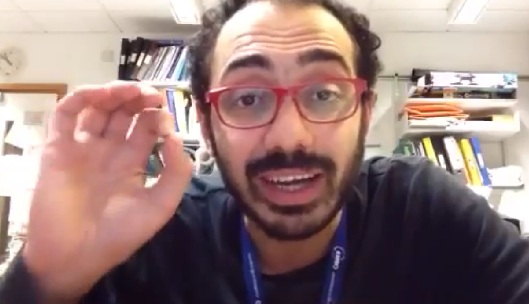
Mouhannad MalekMouhannad Malek, a young Syrian researcher studying in Cambridge University in the United Kingdom, is obsessed with spreading science among the public in the Arab world. He wants to start with complex issues of science from interesting research papers and distill them down to a format where someone with no prior science knowledge whatsoever would be able to understand.

He started the “Syrian Researchers” page last year on Facebook which was quite successful, which has over 13,000 likes now, where he explains science papers in a simple, easy to understand way. “When I write an article to publish it on this page, I try to read it to my parents, who don’t know anything about science. So if they understand it, I publish it. Simple, but it works,” says Malek.

More recently, Malek has launched a YouTube channel where he explains new science papers to a layperson audience in Arabic – probably a first of its kind. The topics are diverse – ranging from the effect of drinking diet soda to sleep deprivation and stem cell research. Malek contends he opted to use videos because Arabs mostly prefer to watch television rather than read. This way, he is able to offer them science knowledge in an exciting format with the click of a mouse.

While Malek has been posting a new movie every two weeks or so, he is increasing the frequency to twice a week on Mondays and Thursdays. While it is currently a one man show, several other scientists have contacted him showing interest in joining the project and generating similar videos. “I asked them to shoot something and to speak with a simple language, this is my red line. I am waiting for their trials.

While there are over 40 volunteers now helping across the website and Facebook page, Malek still handles the YouTube channel alone. “My problem is technical; I don’t have any professional software to help me so I am learning as I go. And on top of being a scientist from 9:00 to 6:00, when I get back home I start to become an actor, animator, editor and director.”

He does not want to stop at YouTube, however. Malek would one day like to expand his project into a full-fledged science channel on television. He hopes he can generate interest in science and compete with other mainstream channels by offering science in a simple, fun and engaging manner, making it a contender for the time people spend in from of the television. “I am not talking just biology; I am talking about everything – biology, geology, physics, economy, art, architecture, music, etc.”

The channel he envisions would be profitable to the investors, while part of its revenues would go to a charity that supports scholarships for students in the Arab world to study overseas “in order to create a new Middle Eastern scientists generation,” he explains.

“I hope that one day, this YouTube channel would reach every single connected house in the Middle East. I hope really that we increase the knowledge of our people. I hope that people would ask questions, not just reacting passively. I hope by doing what I do, I can make science and culture entertaining,” says Malek.


It’s a worthy endeavour, and one much needed in the region today. Meanwhile, you can watch the latest video that Malek had posted on his channel below:

https://youtu.be/zFjwAqsjMJA