Uncovered spyware may have been at work for years

Some of sKyWIper's encryption-related code

Cross posted from Nature’s News Blog on behalf of Ivan Semeniuk.

A massive computer virus dubbed Flame or sKyWIper may have been targeting computers in the Middle East, and Iran in particular, for the past five years, according to a report by a research team involved in analysing the sophisticated computer code.

The report, released on 28 May by the Laboratory of Cryptography and System Security in Budapest, Hungary, which was part of a team analysing the malware, bases its estimate on file names that were first spotted in Europe in 2007.

Analysts say that the virus is designed to steal information by turning infected computers into spying machines, capturing screen shots, turning on microphones and otherwise probing them for other information that can be transferred to servers under the malware’s control.

“It covers all major possibilities to gather intelligence, including keyboard, screen, microphone, storage devices, network, wifi, Bluetooth, USB and system processes,” the Hungarian researchers wrote.

Although Flame is being compared to Stuxnet, the infamous malware that is credited with damaging Iran’s nuclear centrifuges in 2010, it does not appear to target industrial security processes. Rather, it is a highly complex version of spyware. Kaspersky Lab, the antivirus company that first revealed the existence of the Flame malware, describes it as “a huge package of modules comprising almost 20 megabytes in size when fully deployed”.

“This is on a completely different level,” Roel Schouwenberg, a Kaspersky researcher, told the Associated Press on Tuesday. “It can be used to spy on everything that a user is doing.”

Indeed, what makes Flame similar to Stuxnet is its size and complexity, which has led researchers and computer-security firms to suggest that it is the work of a government-backed team, rather than a criminal network or hacking group. “[T]his code was not likely to have been written by a single individual but by an organized, well-funded group of people working to a clear set of directives,” Symantec, another leading computer security firm, wrote on its blog.

Another similarity with the Stuxnet virus is that Flame appears to be most prevalent in the Middle East, and in Iran in particular. The malware may also have been involved in an April cyberattack against the Iranian Oil Ministry, according to Symantec.

Iran’s Computer Emergency Response Team, the Maher Center, which provided an alert of the malware on Monday, claimed that it had already developed ways to detect Flame and to remove it. Although a report by Iran’s Fars New Agency links the attack to Israel, there is no specific evidence pointing to who developed or deployed Flame.

Although Flame is being described as spyware at present, researchers acknowledge that there may be elements of the malware attack that are not yet fully known or understood.

But one thing that researchers seem to agree on is the significance of the new attack. “Overall,” the Kaspersky Lab notes on its blog, “we can say Flame is one of the most complex threats ever discovered.”

Tunisia reaches out to India

Tunisia is looking at emerging countries to boost its scientific research rather than focusing on the developed world as it reforms its scientific strategy following the 2011 uprising that overthrew long-time president Zine El Abidine Ben Ali.

Last week, Tunisia signed an agreement with India to create a US$8 million programme to fund collaborative research between the two countries, reports SciDev.Net. As part of the programme, there will be joint workshops and training, as well as exchange of scientists from laboratories in the two countries.

According to Mohammed Nejib Azhari, director of research programming and cooperation at the Tunisian Ministry of Higher Education and Scientific Research, researchers from both countries are submitting joint research proposals for consideration. The programme, which will run for three years, will focus on biotechnology and medical sciences. The selected projects should start receiving funding in September of this year.

Tunisia is not the only Arab state reaching out to India. A report published in Nature Biotechnology in 2010 suggests that South-South science collaborations will increase in the near future, making drugs and vaccines much more affordable and accessible for millions of poor people around the world.

According to the report, the strongest research and development ties that Egypt has are with India.


You can read the full story on SciDev.Net.

Masdar Institute reaches out to Emiratis

Panoramic view of the wind tower at Masdar Institute

{credit}Masdar Institute{/credit}

When Masdar City, a zero-carbon green city on the outskirts of Abu Dhabi, United Arab Emirates (UAE), was announced, there was much fanfare. Heralded by some as the future of cities (and contested by many) – it is also home to the Masdar Institute of Science and Technology, an independent, research-driven graduate-level university focused on advanced energy and sustainable technologies.

However, after the initial fanfare, Masdar Institute quickly all but disappeared from the news. This week, however, the institute started reaching out to UAE nationals.

Thirteen UAE nationals from across the country’s universities were selected to join Masdar Institute’s six-week summer internship programme. The interns were selected based on high academic performance in science, engineering and computer science. They will be expected to work as full-time assistants.

Over 40 undergraduate students submitted applications for the internship, before the final 13 were selected .

Ektashif

Earlier today, Masdar Institute launched another outreach project called Ektashif, a 12-day residential programme – also for UAE nationals only – to learn about research in renewable energy, sustainability and the environment.

The programme is aimed at undergraduate students from the different universities in the country majoring in science or engineering and starts on 8 July. The students will be involved in some basic laboratory work as well as attend evening lectures in energy, environment and sustainable development. They will also participate in design challenges, field trips and recreational activities.

The lab topics will include studies in nanotechnology, desalination technologies, biofuels, renewable energy and artificial intelligence.


GLORIAD science network finally comes online

After several long delays due to the events following the uprising in Egypt that toppled the previous ruling regime, a high-speed fibre-optic network linking scientists and educators from around the world has finally linked Egypt into it’s network.

The Global Ring Network for Advanced Applications Development (GLORIAD) was first formed after the Cold War to link scientists in the United States to their counterparts in Russia. It later extended to cover several countries in the northern hemisphere, reaching out to China, India, Korea and  Singapore. In 2010, Greg Cole, the principal investigator of GLORIAD, announced the network will reach Egypt through its new Taj extension.

“This internet is vastly more powerful than the one we use at our homes and offices and dedicated to support research, education and medical science,” said Cole in a press statement. “Connecting Egypt allows Egyptian scientists and students vastly increased speed of data transfer with thousands of universities and science facilities across the U.S., Europe, Asia and the rest of the world. And it allows the world access to Egyptian scientists’ knowledge.”

Researchers in Egypt will be able to use the high bandwidth connection, with speeds at more than a billion bits per second, to collaborate with their counterparts around the world in research such as high-energy physics, astronomy and climate.

Through the new link, GLORIAD hosted the first ever school-to-school exchange over the new network, involving the STEM (Science, Technology, Engineering and Math) Academy High School and a technology magnet elementary school in Knoxville and GLORIAD’s partners in Cairo.

GLORIAD is set to continue expanding, with a new connection reaching the Gulf States in the Middle East and linking into a science infrastructure in Africa.

The 4th Africa Water Week comes to Cairo

This is a guest post by Ola Al-Ghazawy, a freelancer working with Nature Middle East.

Some 24 ministers from across Africa gathered yesterday in Cairo, Egypt, for the 4th Africa Water Week (AWW4). Representatives from all countries were present, including the newest African state South Sudan, to discuss the challenge of securing water for the continent’s increasing population.

Topics discussed from the first day ranged from water and sanitation for development and the role of the private sector in investment to issues of governance and financing.

Kicking off the event, Egyptian prime minister Kamal Al-Ganzoury opened with a speech about the importance of water for the development of all African states. He stressed the importance of collaboration between Africa states on water and sanitation, as the whole continent is facing a myriad of challenges and most of them are in danger of water scarcity.

“I hope that the development road will extend from Cairo to Johannesburg and from Addis Ababa to Accra as soon as possible,” he said.

During the event of today, the African Minister’s Council on Water (AMCOW) celebrated its 10th anniversary. South Africa handed Egypt the presidency of the council for the coming 2 years.

Bai-Mass Taal, executive secretary of the African Minister’s Council on Water (AMCOW), said that the top priority for AMCOW now is to engage policymakers with the water issues facing their countries. “AMCOW has transformed from being just an idea to a development mechanism.

“When we started AMCOW all of the members said enough talking, we have to start acting,” said Taal. He pointed that water issues could touch on many other aspects of life. “Millions of African children do not go to school as they go to fetch water which may be kilometers away from home.”

Panel discussions will continue throughout the week until Friday with government representatives, practitioners, members of the private sector and financiers coming together to address the continent’s urgent problem.

Strangely, the programme seemed to be rather light on the need for scientific research with weak representation of scientists in the meeting.

Curricula of Zewail University

© Zewail University

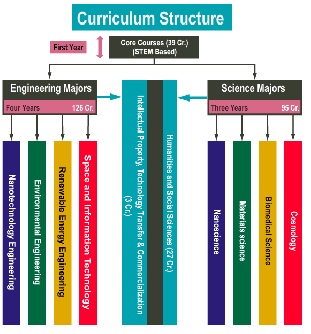
As promised earlier in an interview with Nature, Nobel laureate Ahmed Zewail has revealed the curricula for undergraduate students for Zewail University, which expects its grand opening in September as part of the Zewail City of Science and Technology.

According to the announcement, all students attending the university will study 39 credit hours of physics, chemistry, biology, mathematics, technology and engineering during their first year. Following that, they will be able to pursue one of two tracks: engineering or science.

There are four engineering majors available: nanotechnology engineering, environmental engineering, renewable energy engineering, and biomedical engineering. For students pursuing science, they can choose between medical sciences, nanosciences, and cosmology. Any of the engineering tracks will total five academic years, while the science tracks are four years only.

All the majors were chosen to fulfill the needs of the research centres that are being set up at the Zewail City of Science and Technology.

Students pursuing either of the two tracks will be required to take 27 credit hours of humanities and social sciences. These include subjects such as Arabic, Arab World history, communication skills, literature, management, philosophical thinking, and social sciences. There are several courses within the curriculum as well that encourage critical thinking and teach students about intellectual property, business management and how to handle the transfer of an idea from the lab to industry.

The university hopes to receive students for its first academic year starting September 2012.