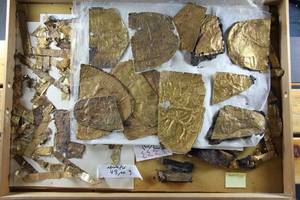
Gold motifs from Tutankhamun’s tomb hint at Levantine influence

Photographer: Christian Eckmann

Photographer: Christian Eckmann{credit}RGZM, DAI Cairo and University of Tübingen{/credit}

Tutankhamun’s tomb is the gift that keeps on giving, it seems, as archaeologists continue to uncover new “treasures” after examining, for the first time, embossed gold applications on artifacts recovered from the famed tomb.

The objects, along with the tomb itself, were previously unearthed by English archaeologist Howard Carter in 1922 and, for decades, had been stowed away in the Egyptian Museum. Now, archaeologists from Tübingen University have painstakingly restored and analyzed the motifs adorning the tomb a century after the historical discovery. And according to their observations, the art on the motifs – images of battling animals and goats – is foreign to Egypt and betrays strong Middle Eastern, specifically levantine, aesthetic influence.

“Presumably these motifs, which were once developed in Mesopotamia, made their way to the Mediterranean region and Egypt via Syria,” says Peter Pfälzner, leader of the team of archaeologists and conservators. According to the lead archaeologist, the images from the Pharaoh’s tomb resemble those previously found on a tomb in the Syrian Royal city of Qatna, discovered during a dig in 2002.

“This again shows the great role that ancient Syria played in the dissemination of culture during the Bronze Age.”

The next step, says Pfälzner, lies in solving the riddle of how the foreign motifs came to be adopted in Egypt to begin with.
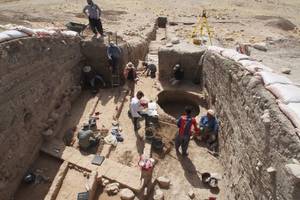
Cuneiform clay tablets discovered in Kurdistan

The tablets are valuable and could reveal insights into Bronze age Iraq.

The tablets are valuable and could reveal insights into Bronze age Iraq.{credit}Peter Pfälzner, University of Tübingen{/credit}

University of Tübingen archaeologists unearthed 93 clay tablets adorned with cuneiform pictograms, an early Sumerian writing system, in the Kurdish region of northern Iraq. The archive dates back to 1250 BCE.

The tablets were dug out of Bassetki, an ancient Bronze-age site which was only discovered in 2013, and whose location lay along busy trade routes from Mesopotamia to Anatolia and Syria.

“Bassetki was of key significance on important trade routes,” Peter Pfälzner, lead archaeologist, says of the discovery. “Our finds provide evidence that this early urban center in northern Mesopotamia was settled almost continuously from approximately 3000 to 600 BCE.”

A big chunk of tablets had been deposited in a ceramic pot, probably used for storage, in a room inside a destroyed Assyrian building.

“The vessels may have been hidden this way shortly after the surrounding building was destroyed. Perhaps the information inside it was meant to be protected and preserved for posterity,” says Pfälzner.

A fragment of the clay tablet contains mentions of a temple to the ancient goddess Gula. However, the scientists believe it might be too early to rule whether they’re looking at legal, or religious text.

The researchers will begin translating the text in Germany, which they say will be challenging, time-consuming and intense since many of the tablets are either unbaked or badly worn.