Gold motifs from Tutankhamun’s tomb hint at Levantine influence

Photographer: Christian Eckmann

Photographer: Christian Eckmann{credit}RGZM, DAI Cairo and University of Tübingen{/credit}

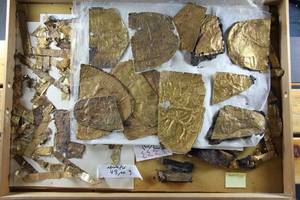
Tutankhamun’s tomb is the gift that keeps on giving, it seems, as archaeologists continue to uncover new “treasures” after examining, for the first time, embossed gold applications on artifacts recovered from the famed tomb.

The objects, along with the tomb itself, were previously unearthed by English archaeologist Howard Carter in 1922 and, for decades, had been stowed away in the Egyptian Museum. Now, archaeologists from Tübingen University have painstakingly restored and analyzed the motifs adorning the tomb a century after the historical discovery. And according to their observations, the art on the motifs – images of battling animals and goats – is foreign to Egypt and betrays strong Middle Eastern, specifically levantine, aesthetic influence.

“Presumably these motifs, which were once developed in Mesopotamia, made their way to the Mediterranean region and Egypt via Syria,” says Peter Pfälzner, leader of the team of archaeologists and conservators. According to the lead archaeologist, the images from the Pharaoh’s tomb resemble those previously found on a tomb in the Syrian Royal city of Qatna, discovered during a dig in 2002.

“This again shows the great role that ancient Syria played in the dissemination of culture during the Bronze Age.”

The next step, says Pfälzner, lies in solving the riddle of how the foreign motifs came to be adopted in Egypt to begin with.

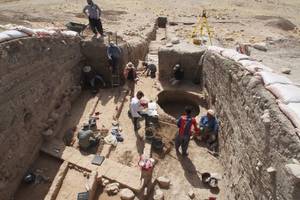
Cuneiform clay tablets discovered in Kurdistan

The tablets are valuable and could reveal insights into Bronze age Iraq.

The tablets are valuable and could reveal insights into Bronze age Iraq.{credit}Peter Pfälzner, University of Tübingen{/credit}

University of Tübingen archaeologists unearthed 93 clay tablets adorned with cuneiform pictograms, an early Sumerian writing system, in the Kurdish region of northern Iraq. The archive dates back to 1250 BCE.

The tablets were dug out of Bassetki, an ancient Bronze-age site which was only discovered in 2013, and whose location lay along busy trade routes from Mesopotamia to Anatolia and Syria.

“Bassetki was of key significance on important trade routes,” Peter Pfälzner, lead archaeologist, says of the discovery. “Our finds provide evidence that this early urban center in northern Mesopotamia was settled almost continuously from approximately 3000 to 600 BCE.”

A big chunk of tablets had been deposited in a ceramic pot, probably used for storage, in a room inside a destroyed Assyrian building.

“The vessels may have been hidden this way shortly after the surrounding building was destroyed. Perhaps the information inside it was meant to be protected and preserved for posterity,” says Pfälzner.

A fragment of the clay tablet contains mentions of a temple to the ancient goddess Gula. However, the scientists believe it might be too early to rule whether they’re looking at legal, or religious text.

The researchers will begin translating the text in Germany, which they say will be challenging, time-consuming and intense since many of the tablets are either unbaked or badly worn.

2016: Editor’s choice

Extracts from selected news and feature articles published this year.

Astrophysics

An international team of scientists, including from New York University Abu Dhabi (NYUAD), managed to directly observe structural components of one slowly rotating star, thanks to asteroseismology. This new technique, 10,000 times more precise than its predecessor, reveals a star’s flatter, rounder contours and different rotational speeds. It allows scientists to ‘see’ the nature of the stellar interior with very high precision.

Marine science

In an unprecedented study on non-model organisms in captivity, scientists from Saudi Arabia, Australia and Norway were able to create large sequence datasets on how reef fish and their offspring react to the phenomenon of decreasing pH levels, called ocean acidification, brought on by climate change. Acidification happens due the uptake of atmospheric carbon dioxide. “The amount of sequencing data we generated is unparalleled for a non-model organism,” says Timothy Ravasi, the senior author of the paper. Scientists discovered that the offspring of some reef fish can tolerate acidification by adjusting their circadian rhythm to night time function throughout the day.

Ecology and evolution

An international consortium of researchers analysed the coding portions of genes, or “exomes”, belonging to 1,794 nationals of Greater Middle Eastern (GME) countries, a region spanning from Morocco in the west to Pakistan in the east. “As expected for a region so rich in history and at the crossroads of many civilizations, the Middle East ‘variome’ [the set of genetic variations in a given population] suggests mixing with other populations, although the percentage varies greatly depending on which subpopulation you look at,” says geneticist Fowzan Alkuraya from Saudi Arabia’s King Faisal Specialist Hospital and Research Center. Northwest African genes were found in people across northern Africa, most likely representing the Berber genetic background. Arabian Peninsular genes were observed in nearly all GME peoples studied, possibly the result of the Arab conquests of the seventh century. Similarly, Persian expansion in the fifth century into the Turkish peninsula, the Syrian Desert region and parts of northeast Africa probably accounts for the Persian and Pakistan genetic signal present in the peoples of those regions. The peoples of the Syrian Desert and Turkish peninsular regions show the highest levels of mixing with European populations.

Geology

Shallow, dense magma reservoirs may be responsible for the most hazardous type of volcano on Earth, according to a new study. Ivan Koulakov and colleagues, including scientists from Saudi Arabia, present a fresh seismic model, based on studying magma paths beneath the Toba volcano in Indonesia, which last erupted some 74,000 years ago. The model explains why the magma system under Toba causes large, devastating eruptions, and how such large volumes of magma are generated.

Archaeology

“We always say it can’t get any worse, and then it does — and that’s the hardest part,” says Allison Cuneo, project manager for the American Schools of Oriental Research’s Cultural Heritage Initiative (CHI), which documents the loss of Syrian heritage. CHI reported 851 incidents of damage to cultural heritage between September 2015 and August 2016, mostly concentrated in areas of northern Syria controlled by forces opposed to President Bashar al-Assad. With such extensive damage, there “is so much data on destruction to report, it’s like holding the ocean back with a broom,” says Michael Danti, the academic director of CHI.

Environment

A world atlas of artificial night sky brightness, published earlier this year in Science Advances, captured the extent to which we are smothered in light. It reveals Kuwait, Qatar, United Arab Emirates and Saudi Arabia as the most light-polluted places to live on the planet, topped only by Singapore. More than half of people living in Israel and Libya live through extremely bright nights, and the widest connected twilight zone in the world is along the Nile Delta in Egypt. No more can people in Kuwait and Qatar see the glowing band of the Milky Way from their homes. For more than 97 per cent of people in the United Arab Emirates, Israel, and Egypt, this is also true. “The night sky is the beginning of our civilization. It leads to all religions, philosophy, science, literature and the arts. The cultural significance of a sky full of stars is huge. The new generations have lost this source of inspiration,” says Fabio Falchi, of the Italian Light Pollution Science and Technology Institute’s Fabio Falchi, who led the study.

Astronomy

The Qatar Exoplanet Survey (QES) has discovered three new “exoplanets” outside our solar system. The planets, named Qatar-3b, Qatar-4b and Qatar-5b, are hot Jupiters: they are similar in size to Jupiter (11 times the size of Earth) and orbit very closely to their respective suns. They are located some 1400 to 1800 light years away from Earth and can be seen in the same part of the sky as the Andromeda Constellation, best observed in autumn in the northern hemisphere.

Empowering ancient Egyptian queens

Queen 1

{credit}The National Museum of Antiquities{/credit}

If you find yourself near Leiden, home to Leiden University, the oldest university in the Netherlands, make sure to visit the Queens of the Nile exhibition at the National Museum of Antiquities, which promises to finally afford the wives of the pharoahs the attention they deserve. The exhibit of royal portraits, godly statues, lavish jewellery and accessories is curated by Leiden University students and PhD candidates, in addition to egyptologist Olaf Kaper.

“Too little attention has been paid to the wives of the pharoahs, both in science and in the museum world. I wanted to tell their history and show different aspects of life at court,” says Kaper.

According to Leiden University, the exhibition covers a period of 500 years and pays tribute to five queens of the era known as the “new empire”. Those queens were famed for their political prowess and divinity.

Among the showcase are two particularly valuable pieces, “the decorated granite cover of the sarcophagus of Queen Nefertari and a five-metre papyrus,” explains Kaper. “This enormous document is a legal text that describes the conspiracy against and the murder of Pharoah Ramses III by a group of ladies from the harem and a number of officials. It proves that women at that time were by no means happy to accept a subordinate role.”

This is the first major exhibit of its kind on the Egyptian queens in the Netherlands. It continues until 17 April 2017.

Solar barques: Ritual vessels into the afterworld or real, functioning boats?

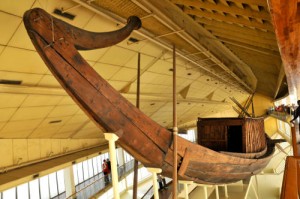
Khufu solar boat museum, King Cheops ship in the museum at the base of the Great Pyramid, Giza, Cairo, Egypt.

Khufu solar boat museum, King Cheops ship in the museum at the base of the Great Pyramid, Giza, Cairo, Egypt.{credit}Jack Sullivan / Alamy Stock Photo{/credit}

The exact functions of the Khufu “solar vessels” unearthed south of the Pyramids of Giza, have come into question again after a new revelation by archaeologists showed that ancient Egyptians used metal in their boats.

The most famous of the vessels, and the largest, is the Khufu vessel, preserved in the Giza solar boat museum. The typically human-propelled vessels were discovered in several boat pits around the pyramids.

Now, a fresh dig near the Great Pyramid of Giza unearthed circular and U-shaped metal hooks in a piece of wood–eight metres in length, 40 centimetres­ wide–that belonged to the frame of a boat discovered during the same year as Khufu’s vessel.

In all the boats discovered from this era, “we have not found the use of metals in their frames like in this boat,” Mohamed Mostafa Abdel-Megeed, an antiquities ministry official and expert in boat-making in ancient Egypt, tells AFP.

In ancient Egypt, funerary boats were used to ferry the dead, most commonly in funeral processions of kings. The wooden boats were believed to be “magically charged” after having been used. And it’s the reason why ancient Egypt would dispose of them after use, since they were “dangerous to the living,” explains Pearce Paul Creasman, associate professor of Dendrochronology and Egyptian Archaeology and director of the Egyptian Expedition at the University of Arizona.

In the Old and Middle Kingdoms, funerary boats were buried near royal chambers at the pyramid complexes. Now, as far as many archaeologists believe, “solar boats were a concept, not necessarily a construction,” says the scientist, “to be used by the god Ra in his travels across the sky, perpetuating neheh, the cyclical nature of the world.” In iconography, solar barques feature a specific set of accouterments associated with them, setting them apart from other types of boats.

Creasman chats to Nature Middle East about the possible nature of the boats, in light of of the new discovery, the first of its kind.

NME: How significant is this discovery?

PPC: The discovery of metal used in association with the ships of ancient Egypt is significant as it fills a logical hole in our understanding. The Egyptians had metal and were capable seafarers, why wouldn’t they use the metals to improve the durability or function of their boats? Until the recent discoveries, including the Khufu II vessel as well as ship remains from the Red Sea harbor of Wadi Gawasis (dating to the Middle Kingdom), we lacked archaeological evidence to demonstrate such a link. While the finds from the Khufu II work have not yet been scientifically published, from the press photos it appears that the metal was used precisely where we might expect: at stress points, such as oarlocks. The totality of the importance of these finds will have to wait for the scientific publications and analyses, but this is a great start.

NME: Was not this seen before in ancient Egyptian boats?

PPC: In only one instance prior to the Khufu II finds has metal been found in association with the structure and function of ancient Egyptian boats, that is, the disarticulated boat parts from Wadi Gawasis. The Khufu II finds are, by far, the oldest and appear to be used in the locomotive aspects of the boat. While we have seen metal in association with sails and their ropes, we have not previously seen it in the human-propelled aspects of boats.

NME: Why is this an important piece of information for archaeologists?

PPC: In the more than 3,000 years of intensive maritime history for the pharaonic Egyptians, there must have been tens-of-thousands of boats created to traverse the waters. Yet, today we have comparatively little archaeological remains to understand the the ships that facilitated this maritime life: whole or part of only some 30 boats. So, any new clue in unraveling the mysteries of the world’s first great maritime society is extremely valuable.

Check Nature Middle East’s sister magazine For Science for the full coverage in Arabic.

Genomes of stone-age woman carry farming tales

Zagros Mountains harbor a site with evidence for an ancient economy.

Zagros Mountains harbor a site with evidence for an ancient economy. {credit}JTB MEDIA CREATION, Inc. / Alamy Stock Photo{/credit}

The sequencing of the first genome of an early stone-age woman from Ganj Dareh, in the Iranian Zagros Mountains, can give us a glimpse into the world’s first farming efforts and the evolution of an activity that has profoundly affected human societies.

The international team of scientists, including a researcher from King Abdullah University for Science and Technology (KAUST), Saudi Arabia, has been studying an archaeological site in Zagros – a site with early evidence for an economy of a population of pastoralists, primarily based on goat herding, some 10,000 years ago.

This population has evidently occupied the area for two to three centuries.

Their findings suggest that Western Iran was inhabited by a population genetically similar to hunter-gatherers from the Caucasus, but distinct from the new stone-age Anatolian people who later brought food production into Europe.

The inhabitants of Ganj Dareh made little direct genetic contribution to modern European populations, suggesting those of the Central Zagros were somewhat isolated from other populations of the Fertile Crescent.

Archaeobotanical evidence remains limited, according to the study published in Scientific Reports yesterday, but the evidence present gives us an idea into what crops were common: for instance two-row barley with no evidence for wheat or rye.

This probably means that the overall economy was at a much earlier stage in the development of cereal agriculture than that found in the Levant, Anatolia and Northern Mesopotamian basin.

Ancient bird may be signature of a breeding system for raptors

It's not gluttony, it's force-feeding that killed the bird

It’s not gluttony, it’s force-feeding that killed the bird{credit}Iziko Museums, Carina Beyer{/credit}

A bird of prey’s last meal may offer us some insight into how Ancient Egyptians handled their feathered offerings to the gods – also, hinting at the possibility that Egyptians may have bred them in large numbers.

The mummified kestrel in question, a raptor, was kept in captivity and is believed to have been forcefully fed as a votive, according to new research published in the Journal of Archaeological Science. The bird was previously kept in the Iziko Museums of South Africa in Cape Town’s Social History collection.

Macroscopic study and 3D digital imaging have allowed the research to lift the veil on the “unusual” circumstances surrounding this particular bird’s death: SACHM 2575 was not deliberately killed, as far as appearances go, but it clearly died due to overeating.

SACHM 2575’s last supper

When it died, the scans reveal, the kestrel was full of at least one or two digested mice and a partially digested sparrow, in addition to a mouse whose tail got stuck in the kestrel’s gullet – the meal that finally killed it.

It’s unusual for this type of raptor to devour its food in this manner; generally, it tears its food to pieces, and if the bird catches too much food for a single meal, it stores the rest for later consumption. It regurgitates whatever it fails to digest – like teeth for instance.

The kestrel’s gizzard, however, contained a mass of bones and numerous, unattached teeth of mice – the whole affair strongly suggesting it was force-fed. The kestrel was probably a male, and for it to be chosen for mummification – essentially compromised – could mean that the females were saved for breeding purposes.

It’s not a first that mummified birds of prey were found in Ancient Egypt, in fact numerous numbers of votive mummies have been discovered in catacombs throughout Egypt.

Researchers often wondered about the sheer numbers of captured raptor birds that ended up being mummified and how the Ancient Egyptians did it. “Did they catch or trap them and kill them, raid nests or find them dead?” says Salima Ikram, Professor of Egyptology at The American University in Cairo and lead author of the study. “We now think it was because of active breeding.”

She adds: “The idea of birds of prey being bred to the extent of being kept and force-fed is new.”

Faces of Gods

Study suggests falconry may have been practiced

Study suggests falconry may have been practiced {credit}Stellenbosch University{/credit}

At this point, the research is still largely speculative, Ikram explains to Nature Middle East. “We’re going to see if we can CT other raptors, to see if this has cropped up in other places as well.”

Killing an animal, like this, was not seen as a form of cruelty at the time. Animals were avatars of the gods, seen as closer to the deities than humans and speaking their language. “You’re giving a sacrifice for gods. When the animal dies, it becomes one with God. It’s united with God for eternity.”

In addition to clarifying how Egyptians might have been able to mummify so many raptors, the research has implications about wild animal husbandry and the possibility of falconry being practiced in ancient Egypt, says Ikram.

“We know raptors were religiously important but it’s interesting to think about the role they may have had in falconry. It’s also interesting that Egyptians were exerting so much thought and control over nature and that their aptitude with wild animals is considerable.”


ICARDA saves gene bank

The gene bank in Tel Hadya, Syria

The gene bank in Tel Hadya, Syria{credit}ICARDA{/credit}

Shortly after the uprising in Syria deteriorated into civil war, the International Center for Agricultural Research in the Dry Areas (ICARDA) started facing major problems that threatened the survival of the research centre. Looters repeatedly attacked the main facility in Aleppo and stole computers and equipment before staff had to be evacuated to other ICARDA facilities in neighbouring countries.

Last week, ICARDA received the Gregor Mendel Innovation Prize for managing to save all the samples that were stored in its gene bank, one of the most important agricultural gene banks in the world.

““Over the years, ICARDA had managed to safety-duplicate most of its gene bank collections outside Syria. When the conflict there escalated, we sped up the duplication and now have secured 100% of the germplasm collection outside Syria,” said Mahmoud Solh, the director of ICARDA, in a statement released.

The gene bank at ICARDA’s Syrian research centre were particularly important because they carried samples of wild relatives of many of the crops that are widely cultivated today, such as bread wheat, barley, lentil and faba beans. These wild crops carry important genes that have allowed them to adapt to different habitats and challenges, such as droughts, pests and diseases. Domesticated plants may have lost these genes throughout the years, so the gene banks acts as reservoirs that breeders can use to breed new strains to combat new challenges as they arise.

The Fertile Crescent, where agriculture is thought to have originated, is rich with these unique wild crops. Scientists are worried these may be lost in the conflicts across the region. ICARDA had previously rescued and safety-duplicated germplasm collections from Afghanistan and Iraq when the wars there erupted. Now, along with the samples collected in Syria, these are being duplicated elsewhere, with 80% of ICARDA’s collection already duplicated in Svalbard Seed Vault in Norway.

“The efforts of Mahmoud Solh and his teams are valuable not only for plant breeders who are highly dependent on diversity to improve agricultural varieties but also for following generations who benefit from drought tolerant and disease and pest resistant crops” justifies Peter Harry Carstensen, president of the Gregor Mendel Foundation.

Libya’s fossil discovery illuminates an interval of evolutionary history

A team of scientists, led by Christopher Beard, professor of Ecology and Evolutionary Biology at the University of Kansas, shed light on an otherwise poorly documented interval of evolutionary history through fossils discovered in the Libyan desert.

Beard’s work focuses on the origin and evolution of primates and anthropoids — the precursors to humans. His paper unveils a discovery of mammal fossils uncovered in the Zallah Oasis in the Sirt Basin of central Libya. The fossils date back to between 30 and 31 million years ago.

The paper is available online but has yet to be published in the April edition of the Journal of African Earth Sciences, and documents the findings of a 2013 expedition.

According to the University of Kansas’ official press release of said research, the study demonstrates how climate and environmental change can alter a local ecosystem.

The team’s worked in a rock unit called the Zallah Oasis in Libya’s Sirt Basin — an area that has “sporadically” produced fossil vertebrates since the 1960s. According to the paper, the team discovered a highly diverse and unique group of fossil mammals dating to the Oligocene, a time marked by a broad diversity of animals and development of species critical to human evolution.

Beard has also discovered several new species of fauna, including a new species of the primate Apidium, which the team considers to be the most exciting of the fossils uncovered so far.

Additionally, Beard says that the fossil species his team discovered in Libya were surprisingly different from previous fossils tied to the same geologic epoch discovered in Egypt.

“The fact that we are finding different species in Libya suggests that ancient environments in northern Africa were becoming very patchy at this time, probably because of global cooling and drying which began a short time earlier,” he’s quoted in the university’s press release as saying. “That environmental patchiness seems to have promoted what we call ‘allopatric speciation.’ That is, when populations of the same species become isolated because of habitat fragmentation or some other barrier to free gene flow, given enough time, different species will emerge. We are still exploring how this new evolutionary dynamic may have impacted the evolution of primates and other mammals in Africa at this time.”

The Zallah Incision local fauna from Libya appears to be close in age to Fayum quarries in the Jebel Qatrani Formation of Egypt and the Taqah locality in the Ashawq Formation of Oman.

“These are the first anthropoid primate fossils known from the Oligocene of Libya and the only anthropoid fossils of this age known from Africa outside of Egypt,” says the researcher. “Earlier hypotheses suggested that anthropoids as a group may have evolved in response to the global cooling and drying that occurred at the Eocene-Oligocene boundary. Our new research indicates this was certainly not the case, because anthropoids had already been around for several million years in Africa prior to that boundary.

“But the climate change still had a deep impact on anthropoid evolution, because habitat fragmentation and an increased level of allopatric speciation took place as a result. Anthropoids, being forest dwellers, would have been particularly impacted by forest fragmentation during the Oligocene,” he adds.

On Beard’s research team is Libyan professor Mustafa J. Salem, of the Geology department at Tripoli University – an expert on the Sahara Desert, and the one who gave Beard et al the greenlight to return to the country in 2013 “despite State Department warnings against travel to Libya,” says Beard.

The lead author of the research, however, says that another return to the field in Libya to continue the work is practically problematic, and currently impossible until the country is stable and the security of researchers can be assured.

Mainz University Egyptologist to create massive digital inventory of hieroglyphic characters

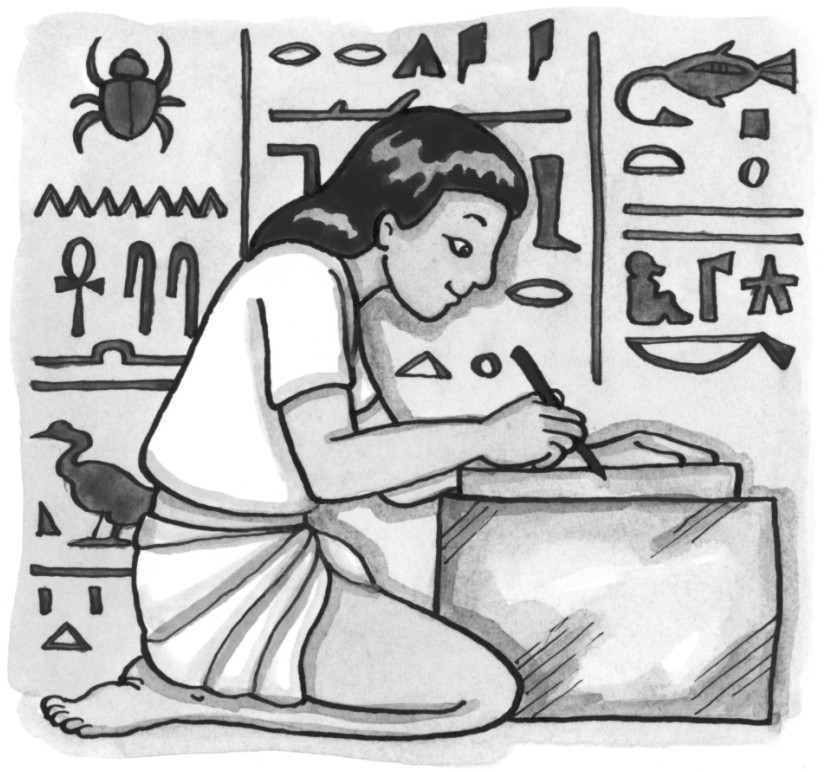
An Egyptian boy writing. Scribe, hieroglyphs, symbols denoting meaning. Carving in stone or painting. System of sign language. Ancient Egypt.

{credit}Macmillan South Africa{/credit}

Mainz University was given the go-ahead to start a long-term project to study ancient Egyptian cursive scripts – and make all the data accessible and searchable in digital format.

Cursive scripts were used in day-to-day interactions in ancient Egypt – written using rush stems and black or red ink on materials such as papyrus, linen, leather, wood, ceramics, plaster, and even stone, explains the press release by Mainz University. The style of writing was a modification of the detailed hieroglyphs – often seen carved on temple walls and ancient artifacts – and by studying it, the evolution and adaptation of handwriting to suit daily needs can perhaps be traced.

There are two types of scripts: hieratic and cursive. “Hieratic script was used for every stage of the ancient Egyptian language during 3,000 years and was only displaced in some contexts by demotic cursive script in the middle of the first millennium BC,” says the release.

The researchers will continue previous decades-long analysis of both scripts and their relation to hieroglyphs and to demotic script, but for the first time, they’re attempting to “compile a systematic and digital inventory of hieratic and cursive hieroglyphic characters from selected and significant sources, whereby different eras, regions, textual genres, and writing mediums for the documentation period from around 2700 BC to 300 AD will be taken into account.”

The analysis will also focus on the scripts’ emergence and development, the context of their use in additions to aspects such as the economy, the layout of manuscripts and the identification of individual scribes’ hands.

The project is expected to create a “digital paleography database,” a repertoire of characters, that will be available online, could be searched and inspected by international experts. Extensive metadata on all relevant sources will be provided, the project promises. Partial or special paleographies will be downloadable.

The project, titled “Ancient Egyptian Cursive Scripts: Digital Paleography and Systematic Analysis of Hieratic and Cursive Hieroglyphs,” is partly funded by the German government. It will be supervised by Egyptology Professor Ursula Verhoeven-van Elsbergen of the Department of Ancient Studies of Johannes Gutenberg University Mainz, and will be spread over 23 years, receiving an annual grant of a little over $325,500.

Although the project is centered on the study of ancient Egypt, the actual work will take place in the Egyptology section at Mainz University and in the Computer Philology section at the Technical University of Darmstadt.