Saudi Arabia opens a cutting-edge laser facility; unique in the region

The Attosecond Science Laboratory at King Saud University (KSU) in Riyadh – opening only this week – is the first of its kind in the region, hosting an “attosecond laser,” an important tool in atomic physics and molecular sciences, reports Nature magazine.

The kingdom’s largest and oldest universities has collaborated with the Max Planck Institute of Quantum Optics (MPQ) in Garching, Germany, which hosts its own attosecond laser, and the Ludwig Maximilian University of Munich. “It is very exciting that the frontier of attosecond science is now having its outpost in the Gulf state,” Olga Smirnova, an atomic physicist at the Max Born Institute in Berlin, tells Nature.

Attosecond lasers generate ultrashort pulses of light, lasting just a few billionths of a billionth of a second, that can image otherwise invisible electrons as they move similarly fast within atoms. They were first reported in 2001 by a team led by the MPQ’s Ferenc Krausz, who heads the Attosecond Science Lab, and they have since expanded from the realm of atomic physics to the that of molecular science, including condensed-matter systems and molecular biology.

Read more on the new state-of-the-art facility and the collaborative efforts with Western scientists to make it happen here.

Researchers can now tell who will be depressed, or not, in response to stressors

Two people, with similar circumstances, can experience the same stressor – death, trauma or even bankruptcy – and one could go on to develop depression while the other would weather the crisis and come out unharmed. What makes the difference between one and the other? Why do some function normally following a crisis, or are more resilient, while others become emotionally crippled by it?

Scientists from Duke University, Durham, believe they have a clue in the form of an almond-shaped group of nuclei in the temporal lobe of the brain called the amygdala whose reactivity during such circumstances can indicate future vulnerability to depression or anxiety – essentially acting as a predicative marker of risk.

It’s not the first study that attempts to link individual differences in brain activity to the ability to handle trauma and stress; activity of this area is crucial for detecting and responding to danger.

Previous studies, however, looked at participants who endured highly traumatic events, like war and active combat, but this study focuses on the general population, who encounter less punishing forms of stress, like divorce, or loss of a loved one.

A longitudinal study of 340 healthy young adults published this February in Neuron, and flagged in Duke Today, the university’s e-publication, explores how experiencing stressors increases the likelihood of developing treatment-resistant, chronic psychological problems, including depression and anxiety, for some, but not others.

The scientists measured the intensity of this activation using functional magnetic resonance imaging.

The research, done in the lab of senior author Ahmad Hariri, professor of psychology and neuroscience, concludes that amygdala reactivity interacts with stress to predict internalizing symptoms, occurring as much as 1 to 4 years after scanning. The study also traces individual differences in how the brain reacts. “These results highlight a readily assayed biomarker, threat-related amygdala reactivity, which predicts psychological vulnerability to commonly experienced stressors and represents a discrete target for intervention and prevention,” reads the paper.

Depression, globally, is responsible for more “years lost” to disability than any other conditions, revealed Nature magazine in a special portfolio on depression. Some 350 million suffer from it, according to the WHO, and it remains widely undiagnosed and untreated in many places because of stigma, or underreported or misdiagnosed in others. In November 2014, Nature tracked prevalence of depression across countries, and many Arab countries came on top of those highly affected by the mental condition. In fact, of the first 20 countries with highest prevalence of depression worldwide, 12 of those were Arab.

“Often, individuals only access treatment when depression and anxiety has become so chronic and difficult to live with that it forces them to go to a clinic,” explains the study’s first author Johnna Swartz, a Duke postdoctoral researcher, in Duke Today. “With a brain marker, we could potentially guide people to seek treatment earlier on, before the disorders become so life altering and disruptive that the person can’t go on.”

Hariri and his team say they will continue to follow up with, and monitor, their study participants – with the ultimate goal of understanding why some are more susceptible to mental health problems, as per a long-term project launched by Duke Neurogenetics Study.

“We [also] want to know just how far in the future knowing something about an individual’s brain helps us understand their risk,” says Hariri.

KAUST academics: Institution pushing the envelope through education, not protests

The King Abdullah University of Science and Technology (KAUST) is between a rock and a hard place – asked to condemn the flogging of a Saudi blogger, perhaps try to influence the sentence, in a country that doesn’t forgive opposition, and shuns dissenters.

Last month, a group of 18 Nobel laureates, “friends of KAUST” sent an open letter addressed to KAUST’s president Jean-Lou Chameau to urge the scientists of the world-class institution to speak up against the public flogging of Saudi blogger Raif Badawi. Badawi was sentenced to 10 years in prison and 1,000 lashes for starting a blog that criticized the Kingdom’s religious clerics and its politics. A Youtube video taken on a mobile phone showing the blogger receive the first 50 lashes shocked the international community, including said Nobel prizewinners who suggested that KAUST must decry the sentence or risk losing a measure of its credibility and world standing.

“The Badawi case once again highlights the responsibility of researchers and scientific institutions who collaborate with authoritarian and repressive regimes such as Saudi Arabia to denounce human-rights abuses,” reads a Nature editorial, in the magazine’s 5 February 2015 edition.

But KAUST leaders, it seems, are not faltering under peer pressure, and according to a new story published last week also in Nature, the scientists will continue their efforts to “quietly” attempt to impact Saudi Arabia – and perhaps the entire Arab and Muslim world – through scientific enlightenment, not confrontation.

“KAUST is built on values that I espouse as a scientist, and the impact of KAUST will be felt over time, in major part through the influence of its graduates,” Mark Tester, an Australian who is associate director of KAUST’s Center for Desert Agriculture, told Nature magazine.

“We are making a real contribution to the country through education, and through research advances,” he adds.

KAUST argues that its very presence challenges the status quo – and indeed, as the story notes, in “stark exception to strict Saudi society, [KAUST’s] campus in Thuwal, 90 kilo­metres north of Jeddah, imposes no discrimination on the basis of sex, religion or ethnicity. Unlike in the rest of the country, women and men mingle, and women can also drive.”

These freedoms were reportedly a condition of many of the Western scientists who backed KAUST’s development.

A researcher familiar with KAUST, who spoke to Nature on condition of anonymity because of the sensitivity of the issues, says that if KAUST researchers protest, “it would have little effect on the regime and would risk providing ammunition for the institution’s critics in Saudi Arabia,” who according to the researcher, already have KAUST under scrutiny.

“KAUST’s existence is evidence of the kingdom’s desire to develop,” Tester says. “It will take time, and I ask that people give us time.”

The Nature editorial from last week, insisting on the urgency of speaking out to defend freedoms while acknowledging the complexity of Saudi Arabia’s culture and society, says however that there’s no conflict between defending individual freedoms and having a broader reach.

“Campaigns for persecuted individuals whose plights otherwise risk going unnoticed can also, as in Badawi’s case, send the powerful message that the world is watching.

“Scientists at KAUST are perhaps not best placed to speak out, being at risk of potential retribution. But Saudi Arabia benefits hugely, not least in terms of its international image, from prominent collaborations with Western research organizations and universities, which have a duty to use that leverage to speak out on abuses, and to call for greater democratic reforms — both publicly and in their private dealings with their Saudi partners.”

“Revolutionary” type 2 diabetes therapy to be released soon

SGLT2 diabetes

{credit}Boehringer Ingelheim{/credit}

A new class of diabetes therapy, soon to be available on the markets, including in the UAE and Saudi Arabia, is the first to target the kidney, say experts, and is hailed as “revolutionary” by Boehringer Ingelheim, the pharmaceutical producing it.

The modus operandi of the treatment, targeting type 2 diabetes (T2D), was revealed to the press during Dubai’s Arab Health conference last week – and it works by targeting glucose directly, independent of impaired ß-cell function and insulin pathways.

T2D is the most common of the two types of the disease accounting for 90% of diabetes cases and affecting approximately 382 million worldwide – 36.8 million of which are based in the Middle East and North Africa, a number that is expected to double by 2035. This type is marked by high blood glucose levels over a long period, reduced ability of the pancreas to produce insulin, and insulin’s inability to lower blood glucose.

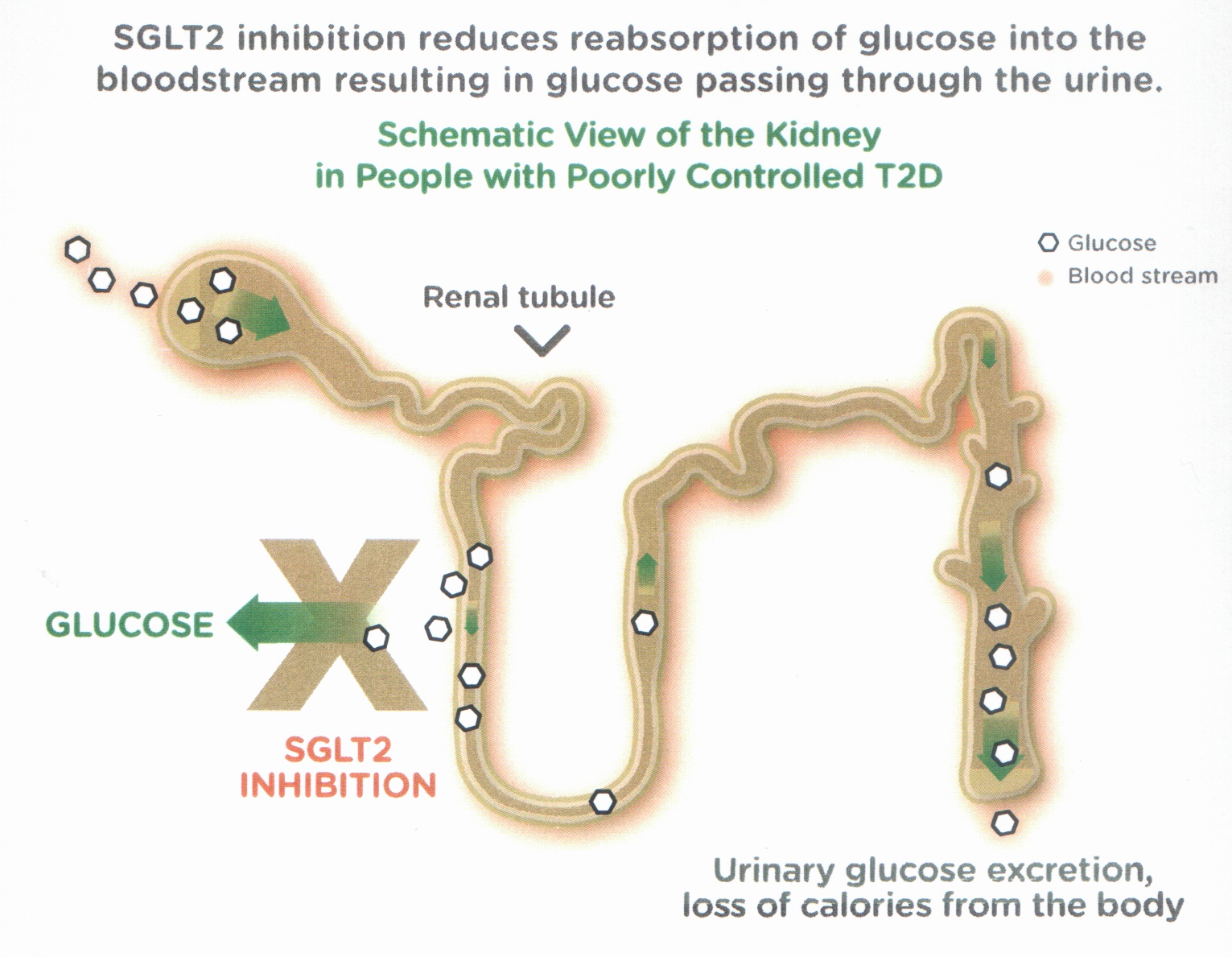
Diabetics, with poorly controlled T2D, have very high renal threshold for glucose reabsorption in their kidneys. The novel treatment inhibits sodium glucose co-transporters (SGLTs) – proteins responsible to the kidneys’ role in reabsorbing glucose into the bloodstream. Specifically, it blocks SGLT2, which reabsorbs 90 % of glucose filtered by the kidney.

Al Sifri describes SGLT2 inhibition as a breakthrough therapy, with few side effects.

Al Sifri describes SGLT2 inhibition as a breakthrough therapy, with few side effects.

Through reducing reabsorption of glucose into the bloodstream, the SGLT2 inhibitor allows excess glucose to pass through the urine, leading to urinary glucose excretion. It’s one of the few treatments available that also guarantees loss of weight, besides regulating blood glucose. It also has a positive effect on blood pressure.

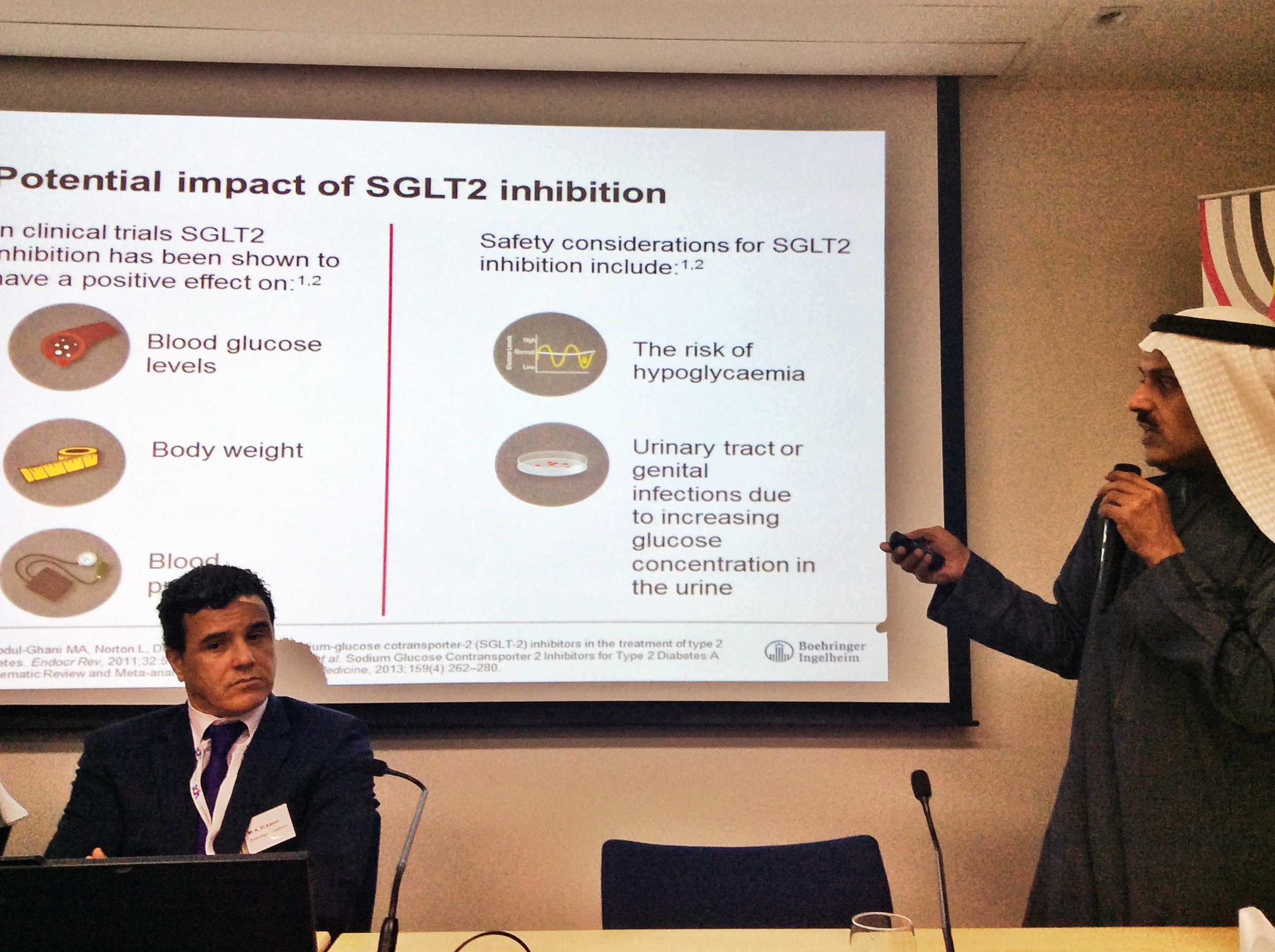
So far, when prescribing this medication, the primary side effects that doctors should look out for are hypoglycaemia (low blood sugar levels) and urinary tract and genital infections, explains Saud Al Sifri, chairman of the endocrinology, and diabetes department at Al Hada Armed Forces Hospitals, Saudi Arabia. Al Sifri, a proponent of the drug, however explains that so early in its introduction, it’s unclear what long-term effects the medication could have on the kidney or otherwise. “We’re not aware of long-term complications,” he says.

Al Sifri explains that considering diabetes is “very complicated; a disease with different faces, and with many subsets,” new classes of treatment provide a range of viable options, since patients require different sets of treatment and drug combinations, especially if the disease progresses. “There are no templates when it comes to diabetes,” he adds.

“It’s FDA-approved. [And ] the risks are very low with this one, as far as we know,” he adds. “It has a different mode of mechanism; other medications work through the pancreas, namely beta and alpha cells. This is the first therapy that cures diabetes through the kidney.”