Life = matter + information. Or does it?

This is a guest post by Sarah Hiddleston 
{credit}Eileen Haring Woods{/credit}

“We are points of order in a disordered universe. This is an expression of how we feel about being ruled by physics in all our emotions and reactions. It’s how we interpret, describe and live our lives within this system.”

Artist or scientist? These are the words of curator Caroline Wiseman, whose brainchild “Alive in the Universe” found a home at the world’s longest standing contemporary art fair in Venice yesterday. It is a month-long exhibition that seeks to interpret what life is, and rather than reduce it to an equation, surround the viewer with an experience of what that means.

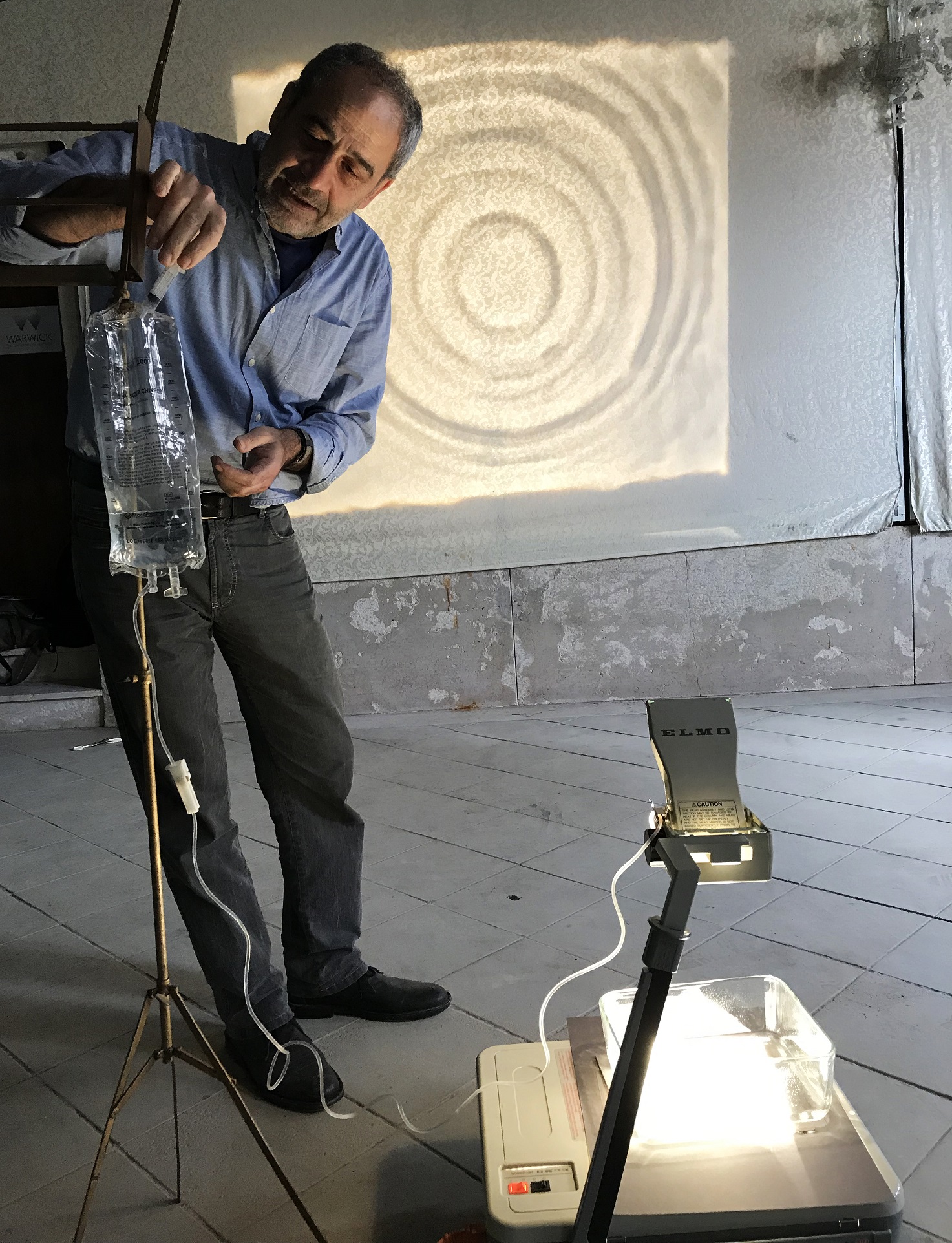
Opening the show is Syrian-born Issam Kourbaj. His three-piece installation is made up of a video of burnt matches, 98 boats made of recycled material and an IV drip. It juxtaposes the energies of fire and water, the flow of death and life, the struggle of a people between the two and the flow of time with the flow of migrants.

“Are we aware of the threads of our lives? I am putting the viewer in a place where many senses are being revisited. Each material sends new signals of information.”

Collaborating alongside him is Ruth Padel, a British poet whose book The Mara Crossing (2012) elucidates detailed comparisons in the way life organizes itself. Whether in cell biology, ornithology or human history, it is with the passage of migration that life begins, she says.

“There are two main reasons cells migrate in our bodies: One to create a new life, and two to defend the body –if we get a new cut the corpuscles and others rush to the site of trauma,” she explains. There’s an interesting parallel to be drawn with people migrating – a vigorous society is constantly replenished by the outside. Human civilization began with migration out of Africa. The first cell arrived on the planet, whether from the sea or outer space, and it colonized other places. The first great land migrants were trees. DNA from the oldest oak trees in Britain shows they came from the Spanish peninsula.”

Living things migrate because life becomes impossible or there’s a desire to make a better life. Birds in or near the Arctic get too cold and fly south. When the south becomes too crowded and they need to breed they return to the Arctic where there are lots of insects –  a protein-rich diet for their offspring. It’s a bit heartbreaking but if you overlay the maps of bird migration routes and human migration routes across the Mediterranean, it’s the same. They take the passages where water is smallest – the straits of Gibraltar, or through Sicily, Malta.

Venice, Ruth says, represents the wasp waist of information flow between north and south in history. Both she and Kourbaj will find new resonance for their work in the interconnectivity of the space around them. “My interest will be in the relationship of my work to the water, and to the tourist boats and the gondola boats,” says Kourbaj, “in scale and in meaning, and in contradictions, they will have a new charge.”

For Wiseman, this too is interesting: “What I am trying to do through creativity is put order into things. The more I thought about what this order could be, the more I found that it is the life force, it is evolution.”

Life seems coupled to flow, movement, change, transformation: information in whatever form – the passage of energy, the replication of DNA within biological cells, to animal migrations and the organization of human societies.


You can watch a video about Kourbaj’s work here: https://www.youtube.com/watch?v=vpUOx-wTUz4
Gold motifs from Tutankhamun’s tomb hint at Levantine influence

Photographer: Christian Eckmann

Photographer: Christian Eckmann{credit}RGZM, DAI Cairo and University of Tübingen{/credit}

Tutankhamun’s tomb is the gift that keeps on giving, it seems, as archaeologists continue to uncover new “treasures” after examining, for the first time, embossed gold applications on artifacts recovered from the famed tomb.

The objects, along with the tomb itself, were previously unearthed by English archaeologist Howard Carter in 1922 and, for decades, had been stowed away in the Egyptian Museum. Now, archaeologists from Tübingen University have painstakingly restored and analyzed the motifs adorning the tomb a century after the historical discovery. And according to their observations, the art on the motifs – images of battling animals and goats – is foreign to Egypt and betrays strong Middle Eastern, specifically levantine, aesthetic influence.

“Presumably these motifs, which were once developed in Mesopotamia, made their way to the Mediterranean region and Egypt via Syria,” says Peter Pfälzner, leader of the team of archaeologists and conservators. According to the lead archaeologist, the images from the Pharaoh’s tomb resemble those previously found on a tomb in the Syrian Royal city of Qatna, discovered during a dig in 2002.

“This again shows the great role that ancient Syria played in the dissemination of culture during the Bronze Age.”

The next step, says Pfälzner, lies in solving the riddle of how the foreign motifs came to be adopted in Egypt to begin with.

Year in review: Under pressure

Conflict and wars have continued to bend the region out of shape in 2016, with health infrastructure in Syria and Yemen continuing to crumble and fall, and the exodus of people out of dangerous zones affecting neighboring populations. The following are some of the most critical situations borne out of the flow of people as a result of infighting in 2016.

Water

Besides the human cost of the war in Syria, the ecological and environmental impact has, no doubt, been huge. For example, earlier this month, researchers based in the US and Canada have shown how mass migrations are changing the country’s hydrological landscape.

The flight of Syrian refugees since 2013 has dramatically changed water-use patterns and led to an increased water flow into Jordan through the Yarmouk River. In the absence of direct measurement data from Syria, the scientists had turned to remote sensing techniques, combining spatial and statistical analyses of satellite imagery with water balance calculations to estimate the changes in irrigation patterns and reservoir usage in southwest Syria. While the end of a regional drought is partly responsible for the increased flow of the Yarmouk, the analysis showed that decreased water use in the Syrian part of the river basin accounts for roughly half of the 340% increase in transboundary flow.

In a way, the war in Syria carried some good for Jordan – at least in terms of water supply.

Health

War and migration had once led to outbreaks of infectious diseases, such as visceral leishmaniasis, across the region, originating from Sudan and South Sudan. And new research is warning that this could happen again. Visceral leishmaniasis is endemic in Sudan and South Sudan, where the climate allows sandflies to thrive, and poor health systems compound the problem.

Researchers from the US and Saudi Arabia have presented new evidence suggesting that conflict, and the chronic malnutrition and displacement that follow, interrupt the cycle of immunity and allow a disease like visceral leishmaniasis to flourish. Gloomily, the scientists say they expect another outbreak.

Not far off, in Aleppo, the scene of much violence and suffering, an outbreak of another form of leishmaniasis has taken place. The Aleppo boil, which is caused by a parasite in the bloodstream and transmitted through the bites of sandflies, has been reported to have infected hundreds of thousands across the Middle East, especially across refugee camps. The disease causes disfiguring lesions on the body and the numbers are bad, according to scientists.

Until recently, the disease was contained to areas around Aleppo and Damascus, but this changed with the continuous disruption of insecticide control, poor water and sanitation services in conflict zones.

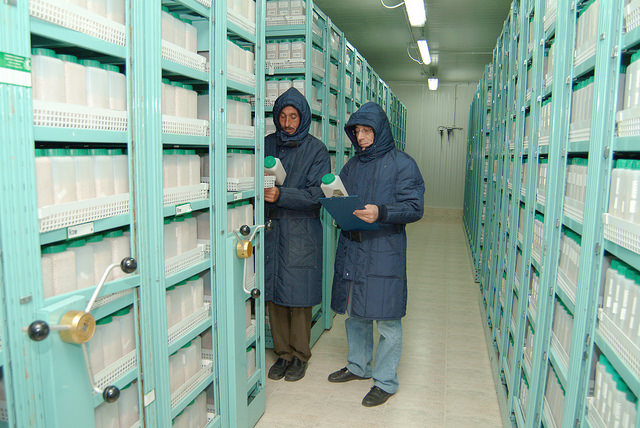
ICARDA saves gene bank

The gene bank in Tel Hadya, Syria

The gene bank in Tel Hadya, Syria{credit}ICARDA{/credit}

Shortly after the uprising in Syria deteriorated into civil war, the International Center for Agricultural Research in the Dry Areas (ICARDA) started facing major problems that threatened the survival of the research centre. Looters repeatedly attacked the main facility in Aleppo and stole computers and equipment before staff had to be evacuated to other ICARDA facilities in neighbouring countries.

Last week, ICARDA received the Gregor Mendel Innovation Prize for managing to save all the samples that were stored in its gene bank, one of the most important agricultural gene banks in the world.

““Over the years, ICARDA had managed to safety-duplicate most of its gene bank collections outside Syria. When the conflict there escalated, we sped up the duplication and now have secured 100% of the germplasm collection outside Syria,” said Mahmoud Solh, the director of ICARDA, in a statement released.

The gene bank at ICARDA’s Syrian research centre were particularly important because they carried samples of wild relatives of many of the crops that are widely cultivated today, such as bread wheat, barley, lentil and faba beans. These wild crops carry important genes that have allowed them to adapt to different habitats and challenges, such as droughts, pests and diseases. Domesticated plants may have lost these genes throughout the years, so the gene banks acts as reservoirs that breeders can use to breed new strains to combat new challenges as they arise.

The Fertile Crescent, where agriculture is thought to have originated, is rich with these unique wild crops. Scientists are worried these may be lost in the conflicts across the region. ICARDA had previously rescued and safety-duplicated germplasm collections from Afghanistan and Iraq when the wars there erupted. Now, along with the samples collected in Syria, these are being duplicated elsewhere, with 80% of ICARDA’s collection already duplicated in Svalbard Seed Vault in Norway.

“The efforts of Mahmoud Solh and his teams are valuable not only for plant breeders who are highly dependent on diversity to improve agricultural varieties but also for following generations who benefit from drought tolerant and disease and pest resistant crops” justifies Peter Harry Carstensen, president of the Gregor Mendel Foundation.