This is a guest post by Sarah Hiddleston
{credit}Eileen Haring Woods{/credit}
“We are points of order in a disordered universe. This is an expression of how we feel about being ruled by physics in all our emotions and reactions. It’s how we interpret, describe and live our lives within this system.”
Artist or scientist? These are the words of curator Caroline Wiseman, whose brainchild “Alive in the Universe” found a home at the world’s longest standing contemporary art fair in Venice yesterday. It is a month-long exhibition that seeks to interpret what life is, and rather than reduce it to an equation, surround the viewer with an experience of what that means.
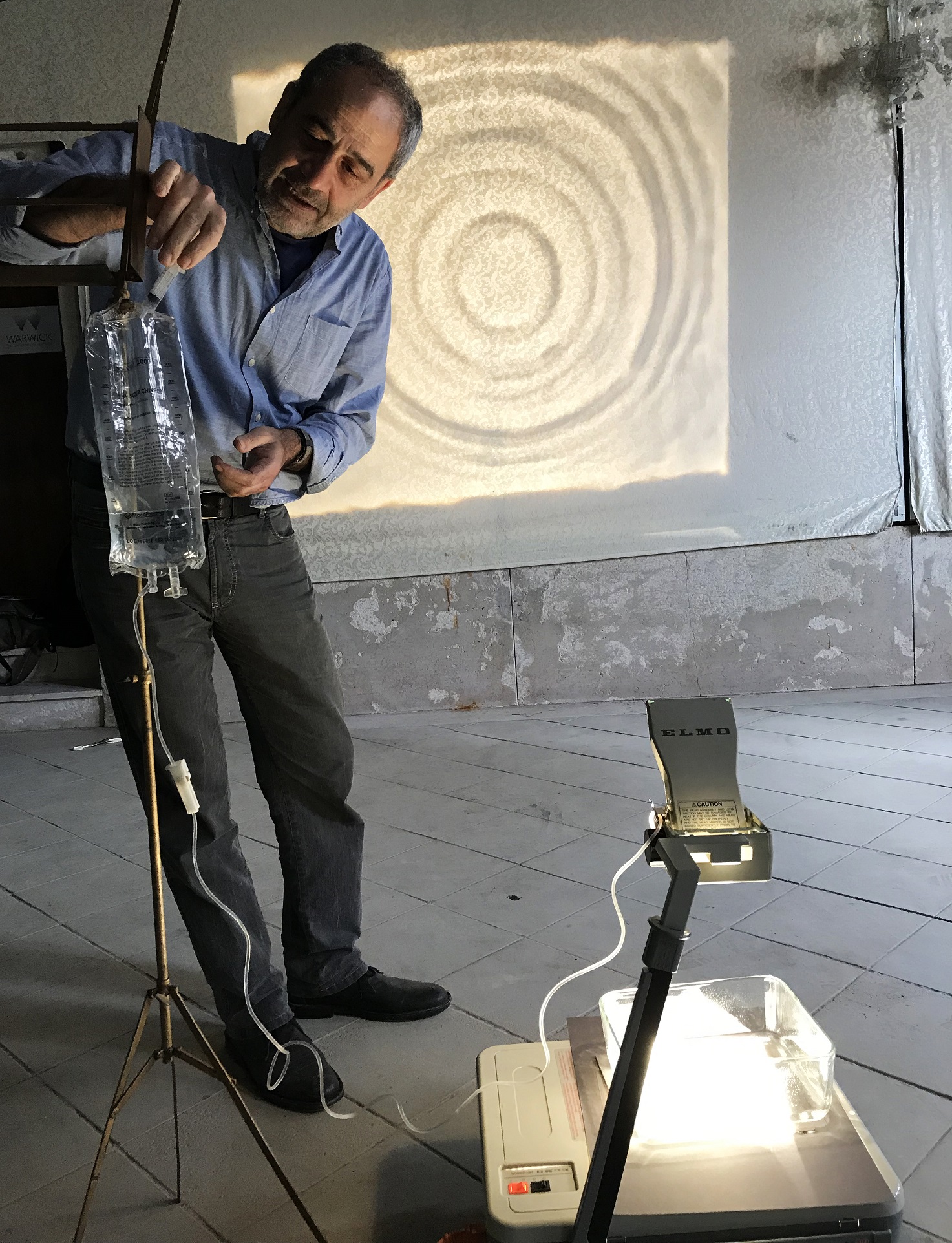
Opening the show is Syrian-born Issam Kourbaj. His three-piece installation is made up of a video of burnt matches, 98 boats made of recycled material and an IV drip. It juxtaposes the energies of fire and water, the flow of death and life, the struggle of a people between the two and the flow of time with the flow of migrants.
“Are we aware of the threads of our lives? I am putting the viewer in a place where many senses are being revisited. Each material sends new signals of information.”
Collaborating alongside him is Ruth Padel, a British poet whose book The Mara Crossing (2012) elucidates detailed comparisons in the way life organizes itself. Whether in cell biology, ornithology or human history, it is with the passage of migration that life begins, she says.
“There are two main reasons cells migrate in our bodies: One to create a new life, and two to defend the body –if we get a new cut the corpuscles and others rush to the site of trauma,” she explains. There’s an interesting parallel to be drawn with people migrating – a vigorous society is constantly replenished by the outside. Human civilization began with migration out of Africa. The first cell arrived on the planet, whether from the sea or outer space, and it colonized other places. The first great land migrants were trees. DNA from the oldest oak trees in Britain shows they came from the Spanish peninsula.”
Living things migrate because life becomes impossible or there’s a desire to make a better life. Birds in or near the Arctic get too cold and fly south. When the south becomes too crowded and they need to breed they return to the Arctic where there are lots of insects – a protein-rich diet for their offspring. It’s a bit heartbreaking but if you overlay the maps of bird migration routes and human migration routes across the Mediterranean, it’s the same. They take the passages where water is smallest – the straits of Gibraltar, or through Sicily, Malta.
Venice, Ruth says, represents the wasp waist of information flow between north and south in history. Both she and Kourbaj will find new resonance for their work in the interconnectivity of the space around them. “My interest will be in the relationship of my work to the water, and to the tourist boats and the gondola boats,” says Kourbaj, “in scale and in meaning, and in contradictions, they will have a new charge.”
For Wiseman, this too is interesting: “What I am trying to do through creativity is put order into things. The more I thought about what this order could be, the more I found that it is the life force, it is evolution.”
Life seems coupled to flow, movement, change, transformation: information in whatever form – the passage of energy, the replication of DNA within biological cells, to animal migrations and the organization of human societies.
You can watch a video about Kourbaj’s work here: https://www.youtube.com/watch?v=vpUOx-wTUz4