
The Middle East: most water stressed region in the world by 2040?


The Middle East could be the least water-secure worldwide

The Middle East region could possibly be the least water-secure worldwide

This region will suffer from acute water scarcity, as projected by dreary future scenarios for 2020, 2030 and 2040 – at least according to an August 2015 report by environmental think tank World Resources Institute (WRI).

The WRI report covers the globe, but the emphasis on the Middle East comes from the fact that it harbors 14 of the 33 likely most water stressed countries in 2040. The statistics include nine countries that are considered “extremely highly stressed”: Bahrain, Kuwait, Palestine, Qatar, United Arab Emirates, Israel, Saudi Arabia, Oman and Lebanon.

The region already lacks security, water-wise, above all else. The report cites examples such as heavy migration of farmers and herders in Syria, from the countryside to urban areas, as a result of dwindling water supplies. In Saudi Arabia, and in fear of water depletion, the kingdom will depend on grain imports, instead of growing them by 2016.

Only this month, Nature Middle East reported that more than 20 million Yemenis – 80 per cent of the country’s population – have limited access to clean water due to raging conflict. The water shortages have created cases of blood diarrhoea among children under five and an increase in other diseases such as malaria. As well, they have created a crisis among farmers. Experts have warned that in many areas it is too late and the groundwater is running out or has disappeared. Eventually, this will lead to a shrinking rural economy.

“Whatever the drivers, extremely high water stress creates an environment in which companies, farms and residents, are highly dependent on limited amounts of water and vulnerable to the slightest change in supplies,” says WRI. “Such situations severely threaten national water security and economic growth.”

The report drew projections under business-as-usual, optimistic, and pessimistic scenarios. The water stress scores for each scenario and year were weighted by overall water withdrawals, but the report also provides scores for individual sectors, like agricultural, domestic, and industrial ones.

Of the Arab countries that scored the highest on water stress, a 5.0 out of 5.0 risk score, are: Bahrain, Kuwait, Qatar, United Arab Emirates and Palestine, followed by Saudi Arabia with a score of 4.99. For a breakdown of these projections, read the full report here.
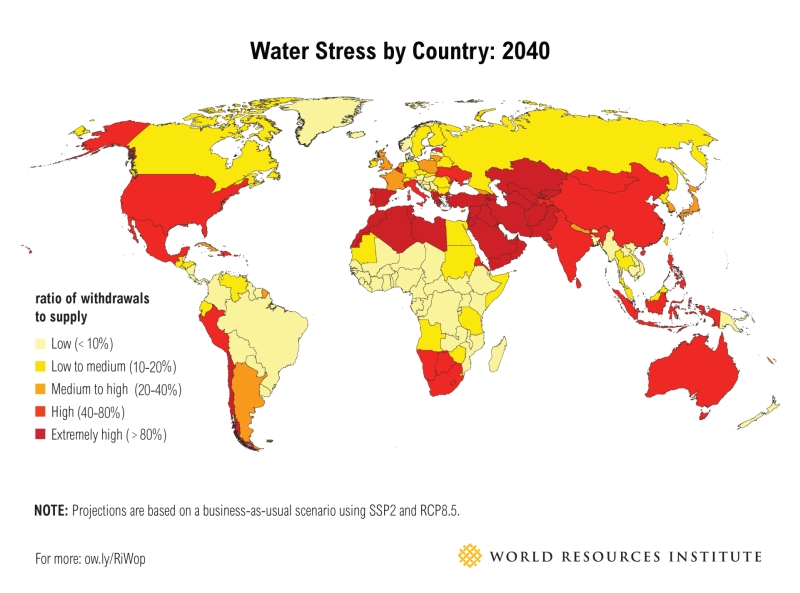
water_stress_world_map_webready

Click on the picture to enlarge it
{credit}Infograph courtesy of World Resources Institute{/credit}

Whale sharks aggregating in Arabian gulf

whale sharks ARC14

{credit}Mohammed Yahia{/credit}

A few months ago, researchers from the King Abdullah University of Science and Technology discovered a gathering site for whale sharks off the Saudi Arabian red sea coast. But that was not the first such site discovered in the relatively warmer waters of the Middle East.

For years, workers in offshore oil rigs in Al Shaheen, the largest offshore oil field in Qatar, have noticed whale sharks aggregating around the platforms. When one of the workers took a picture of dozens of whale sharks swimming around the platform, it ended in the formation of the Qatar Whale Shark Project by the ministry of environment to study the patterns and habits of these vulnerable species.

“In the beginning we had no clue when and where to find the sharks so we had the offshore workers report sightings to us,” said Steffen Sanvig Bach from the Maersk Oil Research and Technology Centre, which has joined the Qatari ministry of environment’s research effort.

Later, they started attaching tracking devices to the whales to try to monitor their habits and movements. “Sometimes we saw over a hundred of them in a group. They start to appear in April, peak in the summer months and disappear in October, said Bach. “We don’t really know where they go after October, they simply disappear and we can’t know where they go except if they are close to the surface. They just return every year in April.”

Whale sharks (Rhincodon Typus) are the biggest fish in the world, with reports of individuals over 20 tonnes in weight. The whale sharks that aggregate at the Al Shaheen location are mostly juvenile, however. The average age of the fish found there is around six.  Whale sharks can live up to 60-100 years, and are only mature and sexually active by the age of 30.

Aggregate sites are often important spots to understand the fish and plan for conservation efforts. “We have identified over 300 whale sharks in the Arabian Gulf and will continue to monitor, but it would take us five years to know the final count and determine if they are decreasing or not.”

But why are these young whale sharks gathering in this location? The researchers have several theories why the fish love this place. The site is rich in tuna mackerel, whose eggs is a favourite food for the whale sharks. The site contains a large amount of these fish, who make their home in the artificial reef created by the offshore rigs.

This is coupled by the warmer waters of the Arabian Gulf, which Bach thinks creates a favourable habitat for the whale sharks. “The area is probably a good feeding spot for the mbecause the water is warm, there’s plenty of prey to feed on and no predators. This is particularly important because these are relatively young fish,” he added.

During Qatar’s Annual Research Conference (ARC14), Bach discussed his the new technologies his team are using to learn more about the fish that aggregate at Al Shaheen every summer, before disappearing again. One such technology they are now using is eDNA, where they take a sample of water and study it to identify all the species that interacted with that sample recently.

Groundwater depletion is accelerating

ENERGY ISSUES

{credit}GETTY{/credit}

Global groundwater depletion is growing year by year, reaching 113,000 million cubic metres per year in the past decade – twice as high as the rate between 1960 and 2000.

Using a global water model system, hydrologist Petra Döll from the Goethe University Frankfurt and her colleagues calculated the most reliable estimate to date of the rate of groundwater depletion especially in dry regions of the world.

The bulk of that water is being used for crop irrigation. Only 10% is used for industry and drinking, with the rest going to farming. In dry areas in particular, the amount of water drained from underground reservoirs for use often exceeds the rate it is being replenished, which could eventually cause them to dry up.

In the Middle East, Saudi Arabia and Iran are the two countries with the highest rates of groundwater depletion.

In the Arabian Peninsula and Libya, Egypt, Israel, Mali, Mozambique and Mongolia, at least 30% of the underground water also came from non-renewable sources. This unsustainable use can further increase water scarcity in the future.

However, Döll points out that her estimates, while showing an increase in underground water depletion, are not as bad as was previously expected. She suggests this is because farmers in dry regions are using less water for irrigation than normal irrigation amounts.

“By comparing the modelled and measured values of groundwater depletion, we were able for the first time to show on a global scale that farmers irrigate more sparingly in regions where groundwater reservoirs are being depleted. They only use about 70% of the optimal irrigation amounts,” explained Döll.

But the researchers point out that model still contains several uncertainties. For example, the groundwater depletion in Saudi Arabia is equal to the independent estimate if optimal irrigation is assumed, while in the Nubian Sandstone Aquifer System the depletion fits best with the reduced irrigation scenario suggested.

Egypt’s scientists want to redirect sunlight to narrow streets

A group of Egyptian scientists at Ain Shams University have come up with the idea for translucent panels that are specifically fitted to be able to divert natural sunlight into densely-crowded alleyways, and can get easily positioned over roof tops, on a lower budget.

The scientists argue that a variety of health problems in overcrowded spaces—as seen all across the Arab world, including Egypt—are a result of the lack of sun exposure.

The proposed panel improves illumination by 200% and 400% in autumn and winter as per research simulations – the corrugated “sine-wave-shaped” structure is to be ideally installed on building roofs, only one meter beyond the roof edge, facing the sun and directing its light downwards into the alleys by diverging it.

“We expect the device to provide illumination to perform everyday tasks, and improve the quality of light and health conditions in dark areas,” Amr Safwat, a professor of electronics and communications engineering at Ain Shams University in Cairo, Egypt, told Science Daily.

Safwat is one of the authors of the study proposing the panel, published in Optics Express this month.

Previous structures used redirecting panels or guiding tubes that are optimized for certain solar altitude ranges, and which were suited for Middle Europe specifically; they also only direct the light upwards into the depth of a room and not into the depth of narrow streets, the researchers wrote. But the suggested panel, an improved model, can be tilted and operates over a wider range of solar altitude. “The fan-out angle exceeds 80% for certain solar altitudes and the transmitted power percentage varies from 40% to 90% as the solar altitude varies from 10°C degrees to 80°C,” the study reads.

The idea was to still use a sustainable source of energy to replace a conventional one—saving energy and reducing carbon emissions—while maintaining cost-effectiveness. The researchers say they have done this; the panels are made from polymethyl methacrylate (PMMA), a type of thermoplastic material similar to synthetic glass available at low costs, and common press forming equipments are used in the panel’s manufacture.

Safwat and his team told the press they would eventually build a full-scale model 10 times bigger for validation and testing purposes, and they plan to market and commercialize their panels.

The Ain Shams university researchers were funded by the Science and Technology Development Fund (STDF).

Talking “rubbish” with Egypt’s environment minister

laila iskandarSitting down with Minister of Environment Laila Iskandar at Alexandria’s ongoing Biovision conference, she talked to Nature Middle East about going back to the basics in terms of solid waste sorting and recycling–a thing that was overdue, according to her.

“We have tried everything else, and all has failed,” she says. Before becoming minister, Iskandar was consultant to the ministry on waste management issues in Egypt, and changing the current disposal system was what she’d been lobbying for ever since the government contracted Spanish, Italian and French waste management companies for rubbish disposal.

With Egypt’s tight budget, and rampant poverty, one would think that investing in an already-integrated community that does what big waste companies are doing, with lesser costs, instead of outsourcing the operation, is a no-brainer. However, in the minister’s words, the country chose to pool money into a “modern” management system that was practically set for failure, instead of re-organizing the work of informal garbage collectors–casually known as the “zabaleen”–who are already doing this without an extra fee from the government.

But she’s out to change that. Coordinating with municipalities, she’s bringing the “zabaleen,” whose number ranges from 80,000 to 150,000, under the jurisdiction of the ministry–giving them salaries, uniforms and all. The modern companies only moved the garbage from garbage collecting points to disposal facilities, she says, but “the ‘zabaleen’ have an invested interest in the materials because they want to recycle it.”

The informal garbage collectors usually haul the piles of refuse on donkey-pulled carts across Cairo to the seedbed of their operations, where they live and work, in Manshiyet Nasser, a squalid densely-populated settlement tucked away in Moqattam–at once experiencing the worst that the city has to offer (in terms of infrastructure) and creating a model for what an active strata of the urban poor can still contribute to the community despite living hand-to-mouth.

Like clockwork, the garbage is sorted by hand, and 80% of the organic waste gathered is reused or recycled, keeping the community’s carbon footprint to a minimum, before “sustainability” came into fashion.

“The [foreign] companies didn’t do a good job and they weren’t regular. They weren’t experts in managing so they fell apart,” she explains, labeling the contracts with multinationals, “a big disaster.” Giza has “disentangled itself” from these contracts, but Cairo is still caught up in their throes, she says.

Of course, it’s difficult–and extremely costly–to sever delicately-crafted multimillion-dollar contracts with international companies; they’re currently in arbitration. For now, Iskandar says that they’re re-introducing the work of the “zabaleen” on a limited scale, to areas not heavily covered by the companies. And let’s face it, for the “zabaleen” or rogue garbage collectors, it was business as usual, only now they’re happy to have garnered recognition by the government for a job they inherited from their fathers, and their forefathers, and had been doing for decades. Especially that until last year, it was illegal to employ garbage collectors.

Iskandar herself seems both sympathetic to their cause and impressed by the efficiency of their recycling operation. In her speech to the delegates of the conference, she described the collectors as the “honest poor,” pointing out to the audience that they’d been facing one blow after another; first the introduction of foreign companies that threatened to throw them out of business and forced them to be clandestine about it, and second, the 2009 culling of their swine population amidst the “pig influenza panic” that Egypt had experienced with the emergence of some H1N1 virus infections.

The utilization of this vast workforce, while working to better their living conditions, is a win for the ministry. But the over-powered institution still faces difficulties in other areas, especially that its environmental protection guidelines are more “advisory” than compulsory, with very few enforceable laws and a low-stake penalty code for violators. “How bad is the situation?” we asked, referring generally to conservation efforts, industrial pollution issues to name a few of the problems facing the ministry. “Pretty bad,” Iskandar shot back. “But I’m hopeful that things can get better,” she added as an afterthought.

2013 Year In Review: News highlights

Looking back, 2013 carried as much good news as it did bad news for the Middle East, especially so in the fields of science, technology and health.

Perhaps the biggest story so far—political turbulence aside—is Syria’s polio problem.

The outbreak of polio virus in Syria put the entire region at risk of infection of the once-thwarted virus, especially that refugee traffic in and out of the war-torn country continued unabated regardless of health risks. There are still question marks over how the vaccination campaigns were handled in war time, whether some areas were deliberately overlooked during vital health campaigns, and currently, how international organizations working in the region are planning to face up to the challenges of mobility and access, walking a thin line between attending to a public health emergency of international concern and maneuvering delicate politics.

The region had already plunged into 2013 heavyhearted with fears of the spread of another pandemic in the wake of the outbreak of the coronavirus, known as MERS-COV in September 2012. However, despite reported infections, some fatal, mostly in Saudi Arabia, in addition to Jordan, Qatar, UAE, and Tunisia among others, the outbreak did not warrant an international emergency status. In fact, research in 2013, has brought some significant revelations about the virus to light — including how complicated its transmission chain is, and how Omani camels may have been the elusive intermediate host that carried this virus to humans.

On the water front, both literal and figurative, 2013 saw the birth of a new partnership between Israel, Jordan and the Palestinian Authority. The countries will start feeding water from the Red Sea to the Dead Sea, in the belief that this grand project — which involves installing a 180-kilometre connection between the two sees — will save the latter from shrinking. And the World Bank is backing their game, releasing a new study that considers connecting the two seas via a channel as one of the feasible scenarios that could breathe life into the Dead Sea.

But the region’s water predicament, as revealed in 2013, is much more serious than the shrinking of the heavily saline lake. The Middle East, it turns out, has lost a drastic amount of fresh water—a Dead Sea’s worth of that.

A team of scientists released satellite images of water stores in the north-central Middle East, taken between 2003 and 2009, showing that, during this period, there was approximately 143.6 km3 less fresh water in the region between Tigris and Euphrates, which includes Turkey, Syria, Iraq and Iran.

Now on the geeky front, things have been looking up, with scientists at Saudi Arabia’s King Abdulaziz’s City of Science and Technology and Texas A&M University in the US, publishing a new “mind-bogging” study that shows that communication can occur over vast distances without a physical medium—well, at least in principle.

The scientists challenged the long-held belief that for information to travel in empty space, physical particles have to be transferred — they use a complex assortment of beam splitters, mirrors and detectors to illustrate their point.

Now, on the health front, the region’s women have some work to do. Like exercise, and counting calories. A new study reveals that a dramatic increase in obesity among Arab women is threatening to become a health crisis with almost half of adult females overweight in some countries – double the rate of men.

But as some women are getting fatter, on this side at least, some are actually getting smarter. Like Iqbal El-Assad, who graduated medical school in May at the age of 20—possibly becoming the youngest Arab doctor ever.

Perhaps hers is the most inspiring story yet, out of the Middle East in 2013.

El Assad, a Weill Cornel Medical College graduate, a Palestinian by birth and Lebanese by nationality, considers herself luckier than many men and women from her generation; at least she didn’t grow up on a run-down refugee camp as many of her Palestinian brethren who were forced to leave their homes did.  That said, she says she was always close to the suffering of her people; her parents took her on multiple visits to the camps, and she saw first-hand how dire and desperate the situation can get.

The young achiever says she learnt algebra as a toddler, and she spends her free time solving mathematical problems. She made the decision to be a medical doctor at 12.

Now if this is not a beam of light in all this darkness, this editor doesn’t know what is.

Arab scientists learn desert agriculture techniques in China

wheat MARSWhile the Middle East may have been the cradle of agriculture, it isn’t the most friendly area in the world when it comes to growing plants. Well over two thirds of the area is harsh desert, making growing enough crops to feed a rapidly increasing population one of the trickiest challenges Arab countries face.

Sixteen researchers from Yemen, Sudan, Libya, Palestine and Morocco have spent a month in China as part of a training programme in the Chinese autonomous region of Ningxia Hui. The programme teaches Arab scientists techniques used in Ningxia to fight desertification, which has successfully reduced its deserts from 1.65 million hectares in the 1970’s to 1.18 million hectares in 2010, according to China News.

The scientists are then expected to adapt these techniques to support agriculture back home. These range from using chemicals or vegetation to stabilize sand dunes to developing drought-resistant crops that can become lucrative businesses.

The Anti-Desertification Technology Training Program for Arab Countries has been held annually since 2006 and has trained over 100 scientists from the Arab world till now. However, it is not clear how effective it has been in transforming agriculture in the region. In fact, agricultural techniques used in most Arab states in the Middle East have remained unchanged for hundreds of years.

The International Center for Agricultural Research in the Dry Areas (ICARDA), which was headquartered in Aleppo, Syria until it had to move to neighbouring Jordan due to the civil war there, has been working for decades in the region to research and educate farmers on new ways to increase their yield and counter droughts. They have produced various strains of drought-resistant and disease-resistant wheat that have been pivotal in the harsh deserts of the Middle East.


Management row threatens to blow Sahara solar dream

Cross-posted from the Nature News blog on behalf of Quirin Schiermeier.

Plans to supply Europe with electricity generated in North Africa suffered another blow this week when the DESERTEC Foundation, set up in 2009 to promote the idea, pulled out of the industrial consortium which is trying to advance the €400-billion (US$514-billion) project.

The split, agreed upon during an extraordinary DESERTEC board meeting on 27 June, is the climax of growing tensions between the founders of the project and the Dii consortium — including Deutsche Bank and German energy utilities Eon and RWE — over management and strategy issues. Solar power capacities are expanding throughout North Africa and the Middle East — but Dii has recently scaled back ambitions, hinting to political and technical problems with transmitting massive amounts of electricity from North Africa to Europe.

The DESERTEC foundation — sole owner of the project’s brand name — has been increasingly unhappy with how internal discussions over the future of the project leaked to the press.

“It was always clear to us that our idea of producing electricity from the deserts (…) was never an easy task and will always face extreme challenges,” Thiemo Gropp, director of the DESERTEC Foundation, said in a statement.

“However, after many months filled with a lot of discussions we had to conclude that the DESERTEC Foundation needs to preserve its independence. [Our exit] is the result of many irresolvable disputes between the two entities in the area of future strategies, obligations and their communication.”

Gropp said the dispute has “negatively affected” DESERTEC’s reputation but he did not rule out future cooperation between the two organizations.

Analysts have repeatedly criticized the project as too big and expensive. Pulling the plug on its loss-making solar business, German engineering giant Siemens, based in Munich, quit Dii last year. Technology supplier Bosch, based in Stuttgart, also pulled out last year.

The potential for solar energy in the UAE

Steve Griffiths

Steve Griffiths

Taking into account the rising cost of fossil fuels, the United Arab Emirates could economically generate more than 20GW of electricity from solar energy by 2030, said Steve Griffiths, executive director of Institute Initiatives at Masdar Institute of Science and Technology, Abu Dhabi.

Griffiths predicts that the Middle East will be investing over US$250 billion by 2017 to produce over 120GW of clean energy. This will include energy from natural gas, nuclear energy and renewable sources. This, however, will depend on having clear, transparent policies that stimulate deployment.

He contends that solar energy could be an important, currently under-utilized source of energy in the region, which is among the sunniest in the world. “However, there is a strong need to translate technical potentials to economic benefits to guide solar energy policy development that will stimulate solar energy technology deployment,” he added. “A sustainable energy strategy considering both demand and supply side considerations will be required for the MENA region.”

The best way forward for solar energy, Griffiths suggested, would be a mixture of both photovoltaics (PV) and concentrated solar power (CSP) technologies. Currently, PV is the cheaper option in most places around the world, while CSP has the advantage of being coupled with thermal storage. “PV can be utilized particularly well in the Gulf to meet the peak mid-day demand from cooling loads. CSP can be utilized for supplying late day or early evening demand, which is particularly relevant in countries where peak demand does not always correspond with good solar resource conditions in the mid-day.”

Griffiths made his comments on a panel discussion during the 5th Middle East & North Africa Solar Conference & Expo (MENASOL 2013), held 14-15 May in Dubai, UAE.

Reflections on the Doha Climate Gateway

{credit}Jan Golinski/UNFCCC{/credit}

The UN climate talks at Doha reportedly saved 248 trees thanks to being held at a largely (though often irritatingly) paperless conference. But did it bring us any closer to saving humanity from a sizzling planet?

Not particularly, is the short answer.

Then again, this was not an especially ambitious conference, and to the extent that its stated goals were modest, the Qatari government and the UN should face no major challenge in heralding those two long weeks of negotiations as a “success.”

After all, an eight year second commitment period of the Kyoto Protocol – which was about to go all but extinct at the end of this year – was agreed to. A pathway was even set out for developed countries to compensate poorer nations affected by loss and damage due to climate change.

Moreover, countries that are taking on further commitments under the Kyoto Protocol countries agreed to review their emissions reduction targets at the latest by 2014, putting a clear moral obligation on them to make more ambitious pledges.

A more specific timetable for adopting a universal climate agreement by 2015 was also agreed to.

On the other hand, perhaps the conference’s main issue of contention – climate finance – had an outcome that is vague at best.

According to the Copenhagen Accord agreed to in 2009, developed countries are to start raising US$100 billion per year starting 2020 to help poorer nations curb their own emissions and to adapt to the effects of climate change.

Developed countries are supposed to reach the US$100 billion target by gradually increasing on the US$30 billion supposedly raised each year from 2010-2012. But this conference has failed to show just how this US$30 billion figure will increase (if at all) over the coming eight years so that it might reach its 2020 target.

This lack of specific figures leading up to 2020 makes it virtually impossible for developing countries to try to formulate a clear budget for a climate action plan.

The Climate Action Network, a global network of over 700 NGOs, expressed its take on the conclusions regarding finance as: “An extraordinarily weak outcome on climate finance which fails to put any money on the table or to ensure a pathway to the US$100 billion a year by 2020 target.”

Plenty of disappointment was also directed at Qatar and its neighbours, who are among the highest carbon emitters per capita, yet who failed to make any pledge to reduce their emissions.

Qatar, despite growing pressure and expectations – and after deporting two activists for unfurling a banner at the conference that read “Qatar, why host and not lead?” – only revealed plans to establish a climate change research institute.