
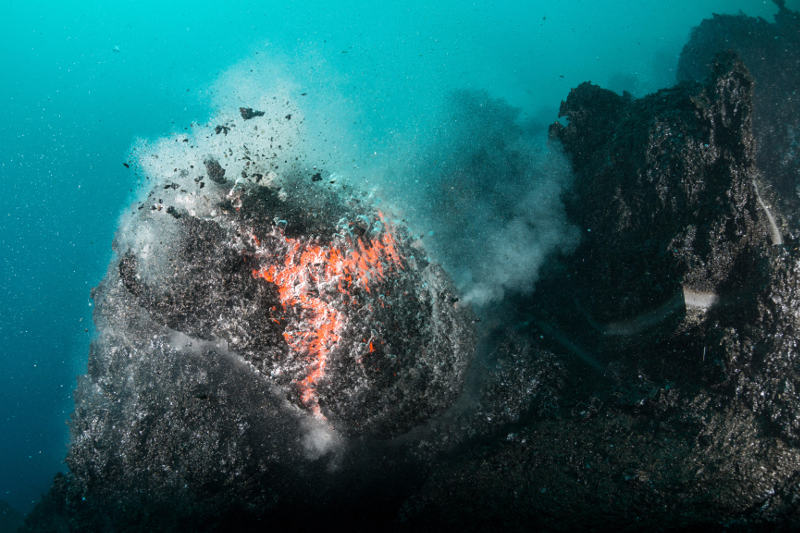
The research was inspired by the dynamic resulting from deep ocean volcanic eruptions.{credit}Nature Picture Library / Alamy Stock Photo{/credit}
In order to stack nanoclusters of oxygen-rich zinc peroxide in a way that allows it to be used for cancer therapy, researchers simulate a natural phenomenon, which usually results from underwater volcanic eruptions, inside the lab.
Nature Middle East sits down with Mady Elbahri, one of the authors of this new research. Elbahri, an Egyptian scientist, is a professor of nanochemistry and nanoengineering at the school of chemical engineering, Aalto University, in Finland.
NME: You’ve come up with a new nanotherapy tool for cancer by simulating a process called the “Leidenfrost dynamic”. Can you explain it to me? Where did you draw inspiration for it?
Mady Elbahri: Well, we’re all familiar with the Leidenfrost phenomenon and [we may] have observed it while cooking in the kitchen, when a water drop touches a very hot pan’s surface. Instead of the expected rapid evaporation, the drop starts to move and dance on the hot surface. I observed this phenomenon in my kitchen a few years ago and contemplated its origin and the idea of employing it for nanosynthesis. Based on the knowledge I collected about this process, I introduced the new concept of “Leidenfrost nanochemistry”, which means synthesis of nanoparticles using the Leidenfrost effect.
NME: Can you walk me through your methods of creating nanoclusters of zinc peroxide using this new method?
ElBahri: In our latest study, we extend applicability of the phenomenon by mimicking the activity of the volcanos deep in the ocean. In this version of the Leidenfrost process, synthesis of nanoparticles starts at the bottom of a hot bath in an overheated zone at the vapor-liquid interface. Subsequently, the particles erupt towards the colder region of liquid-air interface for further growth. By such type of physical separation we are able to tailor the size of the particles.
NME: You mention in your paper that tailoring the size of the nanoparticles produced can selectively kill cancer cells. Can you elaborate more on this?
Elbahri: Tailoring the size can directly affect the oxygen release. Size plays an important role in this therapeutic process; to ensure a uniform effect, such particles should be equal in size. Also, the drug should not harm healthy cells and fibroblasts and so you need to adjust the size in a way that it can selectively destroy the cancer cells without affecting the others.
NME: How do you plan on building on this research in the future?
Elbahri: Further research can help us acquire the best therapeutic response with respect to size and dose of the nanoparticles. I also aim to transfer this knowledge to Egypt. … It will be my honor to support my motherland in getting its deserved scientific position in the world.
Interested in knowing how Elbahri and his colleauges drew their inspiration for this study? Listen to the new episode of Nature Middle East Podcast for the story behind the research.