First ‘Falling Walls Lab’ held in Cairo

Guest post by Louise Sarant

The Middle East’s first ever ‘Falling Walls Lab,’ a fast-paced competition, attracted a reasonable crowd this week in the German Science Center Cairo (DWZ Cairo). One after the other, 13 candidates climbed on stage to present, in three minutes, their innovative idea, groundbreaking research or fresh business model in front of a jury from academia and research.

Established in 2009, two decades after the fall of the Berlin Wall, the Falling Walls is an annual conference that highlights breakthroughs in science and society.

At the beginning, the conference used to mostly host idea-makers and inventors from Germany, but starting 2013, it has been showcasing a growing number of young creative minds from across the globe.

Falling Walls 2

Members of the jury at Falling Walls Lab, Cairo.

Of the 22 international labs currently underway for the 2014 edition of the conference, the first Middle East one was held in Cairo, while the other regional lab will take place at King Abdullah University of Science and Technology (KAUST) some time in the coming months.

“The DWZ in Cairo received 70 applications, which is the most any lab has received to this point,” says Nåveed Syed from Falling Walls, who came especially for the Cairo Lab from Germany. “It shows a lot of interest for this type of format as well as an eagerness to show what they are working on.” Experts at the Cairo-based science center screened these applications and selected 13 bright minds under 35 from a various disciplines to present their innovations.

A young energetic engineer at the National Research Center, Ahmed Zakaria Hafez, sprung on stage, holding in his hand a cup filled with cold water topped by a miniature fan in motion. Filling the screen with a picture of his disabled friends sitting in wheelchairs, he told a story. “The energy contained in an electrical wheelchair only enables it to function 30 to 40 minutes. My project aspires to draw energy from three power sources:  heat created by the human energy, pressure and solar energy.”

Hafez ranked third in the competition, which results were announced after a 15 minute deliberation from the jury.

The top winner however was Hani el Khodary, a 28-year-old founder of the energy start-up ‘Biogas People’  and a composting expert. In his short exposé, entitled “Breaking the Walls of the Gas Crisis in Egypt,” he showcased his idea to partly solve two typically Egyptian problems: the insufficient energy supply and the rising amount of organic waste.

By attaching large biogas units to a chicken farm, he wants to create a closed, sustainable system in which chicken manure and organic waste would be fed to the biogas units, which would in turn provide heat for the chicks and compost for the land.

Falling Walls Cairo shortlisted candidates.

Falling Walls Lab Cairo shortlisted candidates.

“One chicken farm consumes diesel and 40 subsidized gas cylinders a day for the sole purpose of providing sufficient heat for the growing chicks,” says el Khodary, who is currently experimenting this system on a smaller scale on a chicken farm by the Ismailia road. “We are realizing that chicken manure has high ammonia levels that need to be neutralized by specific bacteria before this system can function.”

If he wins the Berlin competition, he says he will try and pursue a course on biogas in a German university.

Mohamed Salheen, Program Director of Ain Shams University’s Integrated Urbanism and Sustainable Design and a member of the jury seemed overall content with the performance of this first batch of applicants. He believes that the contenders were good at managing their time and presenting their projects, but that some of the ideas should have been more elaborated. He adds, however, “there is stamina, a momentum in Egypt right now: people want a change and a chance.”
New agricultural trends to feed the world

This is a guest blogpost by Youssef Mansour, a young researcher currently interning at Nature Middle East.

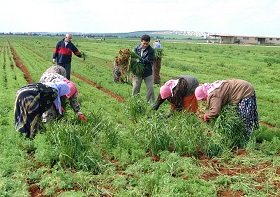
Scientists are struggling to come up with new technologies to feed ever increasing populations around the world.

Scientists are struggling to come up with new technologies to feed ever increasing populations around the world.{credit}ICARDA{/credit}

The agriculture sector needs to double food production by 2050 to meet growing global populations – a tremendous feat considering the challenges posed by climate change, water shortage and how the increase in farming land is not catching up with demand. That’s why scientists are up to their ears looking for ways to sustainably increase production of crops capable of withstanding different environmental stresses.

At the BioVision Alexandria 2014 meeting last week, a group of leading agriculture scientists showcased new trends in agriculture that attempt to address the rising food needs of the next 100 years.

Classic approaches aimed at producing stress-resistant crops such as breeding programmes and genetic engineering “have not yielded the results that people had hoped over the years” says Rusty Rodriguez, CEO of Adaptive Symbiotic Technologies, a biotechnology company focused on agriculture research. These approaches are reductionist and focus on plants only, ignoring the fact that all plant and animal life partner with microorganisms for mutual benefit, he says.

Rodriguez introduced a new trend named symbiogenics, a technology that harnesses the impact that fungi that inhabit plants internally have on their ability to tolerate stresses.

In an experiment back in 2002, he found that symbiotic plants with a particular fungus close to a hot spring at Yellowstone National Park could tolerate temperatures up to 65°C. Neither the fungus nor the plant could withstand such high temperatures alone, but they developed a heat resistance when they partner up.

The Middle East is one of the most water insecure regions in the world, with water availability per person averaging 1,200m3 per person per year – less than a fifth of the global availability per person. Additionally, it is expected to heat up faster than most other regions, with an expected 6°C increase by the end of the century over the Levant region. The region faces numerous challenges for food security, such as the lack of investment in agricultural research and development, inadequate policies and the lack of social and economic stability in the region, points out Mahmoud Solh, director-general of ICARDA.

“We have seen people working on very important things but separate from one another. It seems to me that the problems are so severe [in the Middle East], that this is the perfect location to look at the convergence of these technologies,” says Rodriguez. “We [can] use engineering to get the plant to talk to us. Then we use microorganisms, maybe some genetic engineering, maybe some synthetic biology to modulate what’s going on inside the plant, so when it tells us something is wrong, we know how to fix it.”

Other approaches

A major goal of modern agriculture is to be able to bring across the symbiotic nitrogen fixing bacteria associated with legumes to cereals such as maize, wheat and rice.

This would optimize the use of nitrogen for increasing crop production while decreasing the exposure of the environment and humans to synthetic fertilizers.

Experiments conducted by Edward Cocking, director of the Centre for Crop Nitrogen Fixation at Nottingham University, have shown that introducing a low number of a non-nodulating nitrogen fixing bacteria called Gluconacetobacter diazotrophicus has been found to significantly inhabit the root meristem and exhibited “progressive systemic plant colonization”.

The bacteria, which localizes in vesicles in the cytoplasm of plant roots and shoots, were found to express nitrogenase genes that produce enzymes responsible for formation of ammonia from hydrogen and nitrogen gas. Presently, work is geared towards determining how far these non-nodular bacteria can fix nitrogen in cereals. Field studies run under various environmental conditions would then show how much synthetic nitrogen fertilizers could be lifted.

Separately, a different approach that was pieced together in the 1980s in Madagascar by Henri de Laulanié increases rice productivity by modifying farming techniques to decrease agrochemical inputs and increase yield from the same genetic variants, explains Norman Uphoff, professor of Government and International Agriculture at Cornell University

The System of rice intensification (SRI) is emerging as a new paradigm for sustainable intensification of various crops, and many farmers in developing countries are already spearheading a movement to apply the same practices to other crops.

In the Middle East, “there is no silver bullet that will be able to solve the problems of dry areas,” Solh says. He believes an integration of strategies that optimizes the use of natural resources and utilizes genetically-modified crops, as well as the implementation of policies that promote sustainable agriculture, is the way forward.

Eyewire: Solving mysteries of the brain through gaming

Image courtesy of Eyewire.org

Image courtesy of Eyewire.org

While some may be familiar with the concept–made famous by Foldit, a pioneer online video puzzle where you “fold” protein as part of a University of Washington research project–the crowd at Bibliotheca Alexandria were blown away by a similar game model: Eyewire, neurology’s first ever computation game, open to laypeople.

“It’s fantastic because it builds a sense of community and makes science accessible,” project co-founder Amy Robinson, Creative Director of the Department of Brain & Cognitive Sciences, Massachusetts Institute of Technology (MIT), told the audience at this year’s Biovision conference during one of its seminars at Alexandria’s foremost knowledge hub.

Eyewire is a “cell mapping” game launched by MIT’s Seung Lab, where players reconstruct and map interconnected neurons in the retina–setting a precedent for neurologists everywhere, not just in using crowd-sourcing for research purposes, but in thinking outside of the proverbial box to get more work done in less time (and in this case, while entertaining the public).

The lab is working to generate translations of the application in other languages, including Arabic–which would make Eyewire the first game of this genre to be translated into Arabic.

EyeWire tweetAccording to recent estimates, there are 1.6 billion internet users worldwide who play games, across several portals, 38 per cent of which are in the Arab World. It would be interesting to see how such a large segment would respond to the prospect of Arabic-speaking citizen science gaming, if at all.

The prototype for the game application is based on–and is visually similar to–the real-life version of the lab software that MIT researchers use. The original software allows the scientists to “semi-automatically analyze neuro-image data, to see which cell is connected to which cell and this is important, because it allows us to understand how these circuits function,” Robinson explains in a chat with Nature Middle East.

“Even with the best software that currently exists it takes us 50 hours to map one neuron,” she says.

Currently, there are 120,000 players on Eyewire, which was officially launched in December 2012. It’s a relatively small but very active community, that spends a total of 1,200 hours per day tracing neurocircuits, starting with retinal neurons.

The game uses data from Max Plank Institute for Medical Research, but soon enough Seung Lab will be feeding in their own data as well.

“Essentially, gamers are helping labs make discoveries in science,” says Robinson. You don’t have to be a scientist, or to have studied science, to help MIT map a tangle of neurons, identify new cells or (literally) connect the dots in areas that the gaming app’s AI had missed. And unlike other viral video games, like CandyCrush, or Diamond Dash, one can solidly argue that this, along with others like Zooniverse or Foldit, serves a higher purpose.

“It’s a good example of citizen science,” Robinson says.

courtesy of Eyewire.org

courtesy of Eyewire.org

During the conference, one participant was concerned that as a field, science can be highly-exclusive, conservative and separated from popular audience, so naturally old hands might have a difficult time taking such citizen science ventures seriously. In response, MIT’s young and passionate creative director acknowledged that they were initially received with a degree of skepticism.

“But a lot of effort has gone into improving the effectiveness. improving accuracy and efficiency [of the application, and in turn the results],” explains Robinson. “And this is key to making citizen science work.”

This writer signed up for the game to get a glimpse of how it works–and all one needs to get started is a Facebook profile or an email address, and it’s on. Once you begin, you’re assigned a slice of the retina and you’re asked to start exploring a mystery cell, reconstructed in 3D on your screen–in what might be the most beautiful game imagery I have yet seen. Then again, neural structures are a work of art, and Eyewire gives non-scientists like myself a chance to appreciate their intricacies.

You’re requested to treat the cell’s 3D model as a coloring book; and along with the AI, you color the neurons, eventually forming a labyrinth that lab researchers, and now top players, inspect for accuracy. If you’re new, you have to build game credit before you can effectively “trailblaze a cube” or a section of the retina.

Pakinam Amer's own account of Eyewire.Org--she just signed up.

Pakinam Amer’s own account on Eyewire.Org–she just signed up.

The game is highly interactive; you can chat with other players, pitch ideas for improving the application, or even pose any question related to this specific branch of science. According to Robinson, they polled players, and many said that the game had inspired them to go out and read more on how the brain works.

Like Angry Birds or World of Warcraft, or any other viral or cult gaming portal, you keep scores, collect accolades as you level up, compete against other gamers, participate in gaming marathons (EyeWire held a gaming Olympics once, says Robinson, and sometimes they tailor “challenges” based on gamers’ requests), go on “cell hunts,” rise up the ranks to become a “grim reaper” (with the power to sever faulty cell branches or “mergers”) and even name neuron branches after yourself. And, hold the phone, these names go into the papers that the lab produces.

MIT’s Seung lab does have big plans for the evolution of the gameplay too. Besides improving the technology, the lab will introduce an alternative “action” version in a Science Fiction and Fantasy setting– with alternate universes, alien technology, warring factions, weapons and the whole shebang. It’s part of an effort to build a bigger, stronger (and fun) community for this gaming app. “Community is key if you want to inspire people to work together to build something,” says Robinson.

In my books, it’s another win for the nerds.


Sir Magdi talks about the glory and threats of science

There is a glorious side to science, to the ability to explain things and make people’s lives better. But there are also pitfalls that many researchers may fall in.

Sir Magdi Yagoub, professor of cardiothoracic surgery at the National Heart and Lung Institute, Imperial College London, UK, and chairman of Magdi Yagoub Heart Foundation in Egypt, held a lecture to students and science faculty at the Zewail City of Science and Technology to talk about “The Glory and Threat of Science and Medicine.”

Sir Magdi addresses issues of destructive competition, over recognition and commercialism – and talks about the brighter side of science as a beacon of light for all humans everywhere.

You can watch Sir Magdi’s talk (in English, only the first few minutes are in Arabic) below. Let us know what you think are the pitfalls that researchers may fall in in  the comments section below.

Desert farming pilot yields positive results

Sahara Forest Project

{credit}Sahara Forest Project{/credit}

After two and a half years of research and testing, the Sahara Forest Project pilot in Qatar has started to yield results, and initial findings are showing good results for arid land agriculture.

The pilot project, built on one hectare of land, produced 75 kg/m2 in three crops annually, which is competitive with those obtained in commercial farms in Europe. The project, however, uses seawater instead of freshwater. The greenhouse, where the plants are grown, uses seawater and blowing winds to create a cooling effect which allows the plants to grow even under the scorching summer heats of Qatar, explains a news story in Science. Pipes with cold seawater passing in them causes some air moisture to condense, which is the source of freshwater plants use.

The cold moisture coming out of the greenhouse also allowed plants to grow outside the greenhouse, and the operators were able to use “evaporative hedges” which brought temperature down by a further 10°C, which allowed desert plants to grow quicker than normal and throughout the whole year. The final component of the pilot is a concentrated solar power plant which provides energy to run the project and any surplus is used in desalination of saltwater for extra freshwater. The salt end product was collected in large pools, and researchers are trying to grow salt-tolerant algae that can be used as animal fodder or grown for bioenergy production in the pools formed.

“The remarkable results demonstrated on the ground reveal the potential for enabling restorative growth and value creation in arid land,” Joakim Hauge, CEO of the Sahara Forest Project, told reporters. According to Hauge, scaling the project to 60 hectares can cover all of Qatar’s current  imports of  cucumbers, tomatoes, peppers, and egglants. The question is, however, is this commercially feasible? The reports don’t explain how much producing these food crops would cost.

The Sahara Forest Project will launch a new, 20 hectares pilot near Aqaba in Jordan to test the commercial feasibility of the project.

Science from the lab to entrepreneurship

DSC_5896

{credit}AUC{/credit}

Chemist Hassan Azzazy, associate dean of graduate studies & research at the American University in Cairo (AUC), has been working for years on a technology to use nanoparticles of gold to diagnose Hepatitis C, a disease that affects 14.7% of Egyptians. The end result is a cheaper testing technique that takes a fraction of the time the current two-step Hepatitis C test takes.

Today, the AUC announced that after two years of negotiations they have managed to set up a spin-off company whose first business will be producing Hepatitis C diagnostic kits based on Azzazy’s research.

The company, called D-Kimia, is the first spin-off company from a university in Egypt, with the aim to transforming research from laboratories into a profitable business.

“We want to use modern technologies to control modern contagious diseases and cancers,” says Azzazy who’s also the co-founder of D-Kimia. “We start by looking at a problem and we search for a solution to it. Our aim is to find the simplest solution rather than using a certain technology. We are currently working on diagnostic kits for tuberculosis and certain cancers as well.”

The technology targets the oligonucleotides in the virus RNA, at a region that is common across all genotypes of HCV. The researchers are also working on another tool that can determine the specific genotype of virus when an infection is found to determine the best approach for treatment.

Ideally, says Azzazy, the tool can be developed into a cartridge that can be used by doctors directly rather than patients needing to go to for testing elsewhere. “We would like to be able to develop the tool for “near patient testing”, where a doctor can diagnose the patient on the spot. this will help us increase the number of people who know their status by making it easier and more affordable.”

While Hepatitis C is the most widespread disease in Egypt, millions of people carry the virus and do not know their status. Many people get infected through blood transfusions in the healthcare that result from blood donations from unknowing carriers and poor screening in hospitals.

“Diagnosis is part of the plan to control Hepatitis C. It continues to spread in Egypt because people don’t know of they are positive and thus continue to infect others. If they knew, they can be the starting point of controlling the spread of the virus,” says Karim Hussein, CEO of Di-Kimia and co-founder with Azzazy.

Azzazy is hopeful he can share his experience with others so that other universities in Egypt can do the same and produce marketable products from their research. “In my team alone there are many students that I am sure can in the future be entrepreneurs who produce other new companies,” he says.

El-Baz wants to solve Egypt’s problems from space

Following the recent and ongoing political upheaval in Egypt, Farouk El-Baz, the Egyptian-born director of Boston University’s Center for Remote Sensing, is suggesting his major development corridor construction project as a solution to Egypt’s biggest problems again, hoping the new government may be more attentive.

The project envisions building a “new Nile basin” parallel to the original river to the west, but one of asphalt instead. He wants to have an eight-line superhighway from Sudan to the Mediterranean, connected to all the major cities along the Nile basin. This should ease the population encroaching along the fertile Nile basin and offer millions of new land for agriculture and industry, El-Baz tells The Boston Globe.

El-Baz has been trying to sell his idea to successive Egyptian governments since Hosni Mubarak was president. While Mubarak’s governments was unresponsive, the first government formed after his ouster was excited about it and started selling the project as “Egypt’s salvation.” This government was dissolved under heavy protesting however, and the project was shelved again during the rule of Mohamed Morsi, the recently ousted president. Now, El-Baz is hoping the new government might bring the project, which would cost a whooping US$23.7 billion, back on the table.

There has been vast criticism of El-Baz’s project in Egypt, with some claiming it was overly optimistic, some arguing it was unaffordable and others suggesting the new population centres created would be prone to serious water shortages. El-Baz, who has been working for 30 years on this vision, refutes these claims and offers solutions to the problems. The funding, he says, should come from the private sector which would reap economic rewards immediately and the water can come from Nasser’s Lake, the large water reservoir at the High Dam.

You can read the full article at The Boston Globe.

State of science in non-Arab Spring states

Egyptian revolution 01

{credit}Mohammed Yahia{/credit}

The Arab Spring brought much hope for a science renaissance that would drive development across a region that has been rather stagnant for too long. However, for countries that overthrew their regimes, this has not yet fully materialized due to ongoing instability and turmoil.

Yet the ripples from these countries have spread far and wide to neighbouring countries that did not topple their leaders or monarchs. In a long feature published this week, SciDev.Net explores the effect of the Arab Spring on four of these countries: Algeria, Jordan, Morocco, and Sudan.

In Morocco, waves of protests spread across the country in February 2011 after the Egyptians protests toppled Mubarak in Egypt. They continued on four some four months, with angry young people protesting the increasing unemployment among younger people. This led the monarch to accelerate reform that focused on science research and linked it to industry to spur development. The money put up a US$65 million fund aimed to boost research projects up to 2014. However, Aziz Bensalah, the director of public engagement in Morocco’s National Centre for Scientific and Technical Research, told SciDev.Net that the rel problem was not about money, but about coordination between the different institutes in the country and the need to invest in good researchers to start with.

In Algeria, small protests that erupted after the success of the Tunisians and Egyptians in removing their presidents spurred the government to act quickly, which is wary of the country’s recent history of conflict between government forces and Islamists. In the 1990’s, this led to a mass exodus of researchers from the country, which has so far been unsuccessful in attracting them back.

Officials quickly moved to address the demands of the people. This led to an increase in science spending in the country’s budget, according to SciDev.Net, which rose from about US$250 million in 2012 to US$340 million in 2013 – bringing the country close to its target of spending 1% of GDP on science research. The lack of good scientists remains, however, the main hurdle – along with bureaucracy and lack of academic freedom. This may be what prompted Algeria to try to foster relations with American universities, since its researchers in the diaspora have not been very keen to return home.

In Jordan, the government’s answer to regular protests following the Egyptian revolution was to invest more in research that would help the country solve its energy problem, which was affected due to the natural gas supply from Egypt being disrupted regularly during unrest there. By investing US$39 million over a five-year-period, the country is hoping to decrease its dependence on other countries for its energy supply. Researchers, however, say that little has changed on the ground when it comes to science and research. The government’s budget has not changed, remaining firmly at 0.34%. Issa E. Batarseh, president of the Princess Sumaya University for Technology told SciDev.Net that the challenges to science research are huge and the government has not shown a real commitment to solving them.

In Sudan, an austerity plan introduced by the government in 2011 further reduced the already low science research budget. Only 0.04$ of GDP is used for science spending, and a decision to form a separate science and technology university two years ago was scrapped in 2012, merging the it with the communication ministry. Mirghani Ibnoaf, professor of sciences at Khartoum University, told SciDev.Net the problem is two-pronged. While the government is hardly investing in science and the private sector’s contribution is almost non-existent, the researchers themselves are “idle” and not involved in research that will actually help solve Sudan’s core problems.

Based on these four countries, and the others that had overthrown their regimes, it would seem that the Arab Spring has, so far, failed to bear fruit for science research. In fact, the countries that seem to be faring best and actually have a rapidly growing science sector are the oil-rich Gulf states who were mostly unaffected by the Arab Spring. Saudi Arabia, Qatar and the United Arab Emirates have been performing very well, increasing their science budgets and recruiting world talents to conduct research in their home institutes.

You can read SciDev.Net’s full article here.

Boosting agriculture in Africa

Africa farmer PHOTODISC

{credit}PHOTODISC{/credit}

Africa is probably the world’s most fertile land for agriculture (except for the arid northern parts of course). However, African farmers face a myriad of problems that limit their yields, economic growth potential and development.

IDRC partnered with The Globe and Mail on Monday to hold a Twitter live discussion with Calestous Juma, director of the Science, Technology and Globalization Project at Harvard’s Kennedy School, and Kevin Tiessen, a soil scientist with the Canadian International Food Security Research Fund, to discuss Africa’s agricultural future.

Several African science journalists, including myself, took part in the excellent discussion – which was also open to receiving questions from the public. The discussion was quite lively, with dozens of questions coming in and Juma covering several interesting topics on the potential of science to help in the development of Africa’s agricultural sector.

I’ll try to highlight below some of the points I found most interesting:

Genetically modified organisms: As expected, GMOs were quite a hot topic with many questions coming in to weight the pros and cons of adopting them for Africa. Juma made it obvious he is an advocate of GMOs, but stressed they were not the magic bullet that will solve all agricultural problems in Africa. Rather, he contends that GMOs should not be put off the table.

“I believe that Africa should leave all technological options open including genetically modified crops and organic farming. A larger toolbox is needed to respond to increased challenges such as climate change,” he said. “I would suggested first we focus on identifying the problem that needs solved and then picking the technology that is best suited to the task. I do not think we should take a dogmatic approach.”

Environmental sustainability: There’s always fear that increasing agriculture in Africa will come at the expense of local crops and forests. “The biggest threat to the conservation of species in Africa is destruction of ecosystems,” acknowledged Juma. However, he adds that the main problem is that African governments have little or no policies in place for conservation. Presidents and leaders will be the ones determining the future of agriculture in the continent and how it will affect biodiversity.

Additionally, technology will play a main role  here. “Future agriculture will need to be knowledge intensive to be sustainable,” said Juma. “Innovation is the answer to sustainability, not technological stagnation.” An example he gave several times during the discussion was to train African farmers to use geospatial science to plan their farming cycles, to accelerate the drawing up of land borders and for informed decision-making.

Agricultural development: Juma discussed what African governments should be doing to promote agriculture and make it more economically viable. Highest on his agenda was for African presidents to take charge of agricultural policy making and coordination. “This is because agricultural transformation will require the participation of many other arms of government including finance, transportation, irrigation, telecoms, commerce. If an African president is not coordinating agriculture, chances are he or she is not steering the economy as whole.”

Juma also called for more proper science-based decision-making. He suggested African scientists should be spearheading these efforts since African presidents would be more likely to listen to them. Finally, he called for governments to make significant investments in the infrastructure of rural areas, by providing energy, transportation and telecommunication facilities. In most places across the continent, rural communities have very poor access to modern technology or facilities which limits their effectiveness in the national and international economies. “Some countries are already mobilizing their armies to help bridge the infrastructure gap. This is being done with direct supervision by presidents.”


You can read the full discussion on The Globe and Mail’s archive page of the event.

Calling out to postgrads!

NME blog contestThis blogpost is about something a little different. Instead of talking about the latest developments in science in the Arab world, this is about you, our readers – especially our younger ones.

We know that there are many inspiring young scientists working on some excellent research across the Arab world and we would like to highlight and showcase your work. For this, we are running a little competition and we hope you would take part in it.

We want you to send us a brief outline of the research you are involved in and tell us why it is exciting – it’s that simple. Throughout June, we will collect all the projects sent and will select what we find are the most exciting five. Those five winners will be invited to write bloposts about their research in more details and share it here on the House of Wisdom where other visitors can read it, comment on it and share it.

The competition is open to postgraduates and research assistants from any university in any Arab state (regardless of nationality). So please share this with your friends and encourage them to join too – the more the merrier!

If you have any questions, you can post them in the comments section below and we will get back to you.

To submit your idea, just drop an email to NMEcontest[at]nature[dot]com

Good luck to everyone!