Ancient migrants left Africa with a ‘mutational load’

The populations that broke off from early out-of-Africa migrants may have progressively accumulated harmful genetic mutations, suggests a new study published this month in the Proceedings of the National Academy of Sciences.

Modern humans, originating in Africa, started migrating out of the homeland towards Asia and the Americas around 50,000 years ago. Theoretical models predict that the expansion out of Africa might have happened through small bands that started expanding into multiple continents.

Population genetics theory says that each population breaking off from these small bands carried a mutational load.

Scientists in this study say that not only did the migrations leave a mark on the genetic diversity of different populations, but they also gave way to classes of harmful alleles that have different patterns across said populations. The farther away from Africa (in other words, the greater the distance covered away from the homeland), the more harmful the mutations or genetic variants are.

To test their hypothesis, the team of scientists sequenced the full genomes and high-coverage exomes from seven geographically divergent human populations from Namibia, Congo, Algeria, Pakistan, Cambodia, Siberia, and Mexico.

The next-generation sequencing technology they used confirmed that the mutations under scrutiny evolved with the migrations, and revealed that the degree of the harm is directly proportional to the distance traveled away from Africa.

“To be able to see this, you need a huge amount of data in many populations from different continents. Only 5 years ago, this would not have been possible,” says study co-author Laurent Excoffier, in comments to Science Daily.
You’re as happy as your genes allow you to

Or so claims a new study in the Journal of Happiness Studies, by two researchers from the Varna University of Management in Bulgaria, and the Hong Kong Polytechnic University. The researchers believe they have established a link between genetic make-up and how happy certain populations are.

The happier nations are more likely to have within their DNA an allele, the A allele, involved in regulating sensory pleasure and in helping reduce pain.

For instance, the study finds that Arab nations like Iraq and Jordan, which had the lowest prevalence of this allele, were least likely to classify themselves as “very happy”.

The researchers used data from three waves of World Values Survey, in addition to population genetic data from an allele frequency database compiled by a geneticist from Yale, in addition to climate information, history of pathogenic prevalence, plus World Bank economic data on the nations under scrutiny.

The findings heavily factor in genetic data, but recognized from the onset that genetics may not be the only determinant to happiness. Politics, economics, laws governing nations, and disease patterns can affect how happy certain nations are, perhaps prevalence of the A allele in the genes notwithstanding. Testing this however, they conclude that, besides genes, climatic difference is one other thing that can very significantly affect happiness levels, more strongly than any of the other factors.

These measures however are not absolute, the researchers admit.

“We have not shown that a nation’s genetic and climatic heritage doom a particular country to a specific happiness score, but that it can still rise and fall because of situational factors,” says Hong Kong Polytechnic University professor and co-author Michael Bond.

Safekeeping Syria’s plant genetic heritage

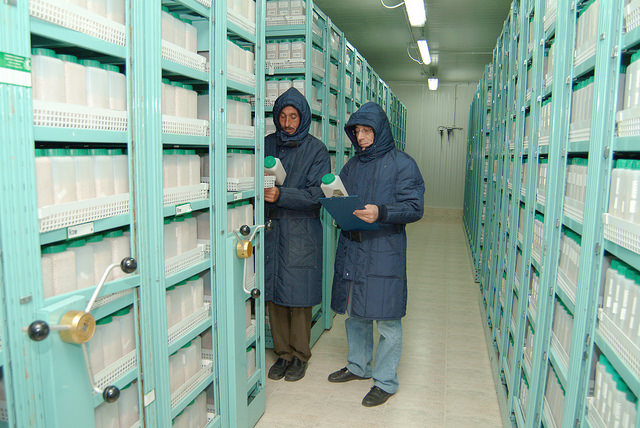
The gene bank in Tel Hadya, Syria

The gene bank in Tel Hadya, Syria{credit}ICARDA{/credit}

The war in Syria has left nothing untouched, including researchers unaffiliated to any of the fighting parties. In September 2012, the International Center for Agricultural Research in the Dry Areas (ICARDA) based in Aleppo, Syria, had to move all its international staff out of Syria as the fighting intensified. After looting and attacks on the premises, the research institute had to move a lot of sensitive equipment to hide them in rented houses, before they eventually had to evacuate and move all the operation to neighbouring Lebanon in the same year.

Before leaving the country, and to safe keep over 110,000 genetic samples for crops that were stored in ICARDA’s gene bank in Aleppo, the researchers started to send copies of all the gene accessions stored to the Svalbard gene bank in Norway, a secure ‘Doomsday’ gene bank near the North Pole designed to protect genetic material in case of a nuclear attack or devastating natural disaster. In March 2015, the organization received the Gregor Mendel Innovation Prize for managing this monumental task.

So far, genetic material has only ever gone into the vault. Last week marked the first time genetic material came out, when ICARDA requested copies of some of the samples they it had sent there for safekeeping, to fulfill requests from farmers and agricultural organizations that it works with.

“Until recently we were using and dispatching bulk seeds of these genetic materials to meet requests from Aleppo in spite of the tough security situation.” said Mahmoud Solh, ICARDA’s director general. “ICARDA requested some of its stored material in Svalbard in order to reconstitute the active collection in both Morocco and Lebanon in large bulks to meet requests for germplasm from the collections we have to meet the challenges facing dry areas globally.”

Since its formation, ICARDA has been working with developing countries, especially those in desert and arid areas, to help national programmes and individual farmers increase their yield by providing them with drought and pest resistant variants of staple crops like wheat, barley, lentil, chickpea, faba bean and peas.

Once we multiply these varieties, ICARDA will return part of it to Svalbard as another duplicated set,” adds Solh.

More bad news were reported for ICARDA yesterday, when news started to spread that Russian airstrikes near Aleppo may have destroyed the gene bank that the organization left behind in the war-torn country. However, the few ICARDA staff still in Syria confirmed that the bank was safe and unaffected.