Reactions: Michael Young

MichaelCYoung-01Michael Young is in the Department of Chemistry & Biochemistry at the University of Toledo and works in the areas of supramolecular and organometallic chemistry.

1. What made you want to be a chemist?

I love the idea of creating new things, and when I discovered synthetic chemistry I couldn’t help but turn my love of doodling ideas into drawing (and later developing) new molecules.

2. If you weren’t a chemist and could do any other job, what would it be and why?

I’d probably be a composer or a chef. Basically something where I can create new things that improve the lives of others.

3. What are you working on now, and where do you hope it will lead?

My group is currently working on new strategies to use supramolecular principles for improving regioselectivity and activity in organometallic chemistry. The hope is that this will provide exciting opportunities for synthetic chemists to access new synthetic space, and maybe even develop some functional therapeutics.

4. Which historical figure would you most like to have dinner with — and why?

Alexander Borodin. His ability to be both a successful chemist and musician has always been inspirational to me.

5. When was the last time you did an experiment in the lab — and what was it?

Earlier today I set up an iron-catalyzed reduction of an aromatic amine. Prior to that I had run a Rosenmund von Braun reaction, as well as an amine C–H functionalization reaction that we’re currently developing.

6. If exiled on a desert island, what one book and one music album would you take with you?

I would take Brave New World by Aldous Huxley to read, and Get Acoustic by The Megas to listen to.

7. Which chemist would you like to see interviewed on Reactions — and why?

Stephen Buchwald everyone I know who has met him describes him as one of the most amicable chemists they’ve ever met, and his chemistry is intellectually stimulating. Also, I’d like to see what new comments he has about his cats, although that might require an eighth question.

The 5th Molecular Sensors and Molecular Logic Gates Meeting

Editor’s note: this is a guest post on behalf of Prof. Tony James.

————————–

We are very excited about the upcoming 5th Molecular Sensors and Molecular Logic Gates (MSMLG) meeting in Bath from July 24th to 28th 2016. The MSMLG Award Lecture will be delivered by inspirational scientist and good friend Eric V. Anslyn. With great ‘Sense and Sensibility’ Eric was the unanimous choice of the Molecular Sensor and Logic Community for the 2016 MSMLG award.

We are delighted that the meeting includes a special conceptual lecture by Sir J. Fraser Stoddart (Sponsored by Chem from Cell Press) a founder of logic in chemistry and inspiration to many of the researchers at the meeting. We will then be treated to an Irish adventure by AP de Silva (Nature Chemistry Lecture) who will shed light and amuse us with his many important research stories based on his Sri Lankan origins a touch of serendipity and driven by friendship.

The meeting will be a true ’round table’ of exciting and delightful research by an unparalleled line-up of scientists from the molecular sensing and logic community. Held at the University of Bath during its 50th Anniversary in the delightful World Heritage City off Bath. For those wishing to attend the meeting registration will remain open till the 18th July 2016. For more information contact Tony James and Dan Pantos (www.msmlg2016.uk, msmlg2016@bath.ac.uk)

Blindingly simple

Double-blind peer review is now an option for manuscripts submitted to Nature Chemistrythis post from a couple of weeks ago mentioned that it was coming and provided some links for further reading.

Authors who wish to choose this option should check the box ‘Yes I do want to participate in double-blind peer review’ during the submission procedure, and ensure their manuscript is prepared in a way that does not give away their identity. Below are some instructions on how to go about ensuring that your manuscript is ready for double-blind peer review. A PDF of these instructions can also be found here.

1. Do not include names or affiliations anywhere in the manuscript file or in any of the supplementary information files. This information should be included in the cover letter and it is important that you state very clearly in which order the authors should appear on the paper in the event of publication.

2. Ensure that there is no author information in the metadata of any of the submitted files. This information is usually added automatically from the identity information on your computer. In many commonly used programmes, such as Microsoft Word, author information is displayed (and can be edited) in the ‘File’ tab under ‘Properties’.

3. When referring to your own previously published work within the paper, use neutral terminology: that is, replace phrases like ‘we have previously reported that…’ with ‘it has previously been reported that…’ or similar.

4. Do not include unpublished work in the reference list. It is a requirement of submission, however, that you alert us to any related manuscripts from your group that are under consideration or in press at other journals, or are being written up for submission to other journals. Copies of these manuscripts should be clearly marked and included as separate files with your submission.

5. The Acknowledgments section and the Author information section (including the author contributions statement, to whom requests for correspondence and materials should be addressed, and any competing financial interests statement) should be included in the cover letter and not in the manuscript file. This information should be added back into the manuscript only after the peer-review process is complete and the paper is accepted for publication.

A PDF version of a one-page guide-to-authors summary for initial submissions to Nature Chemistry can also be found here.

A chemical-free paper

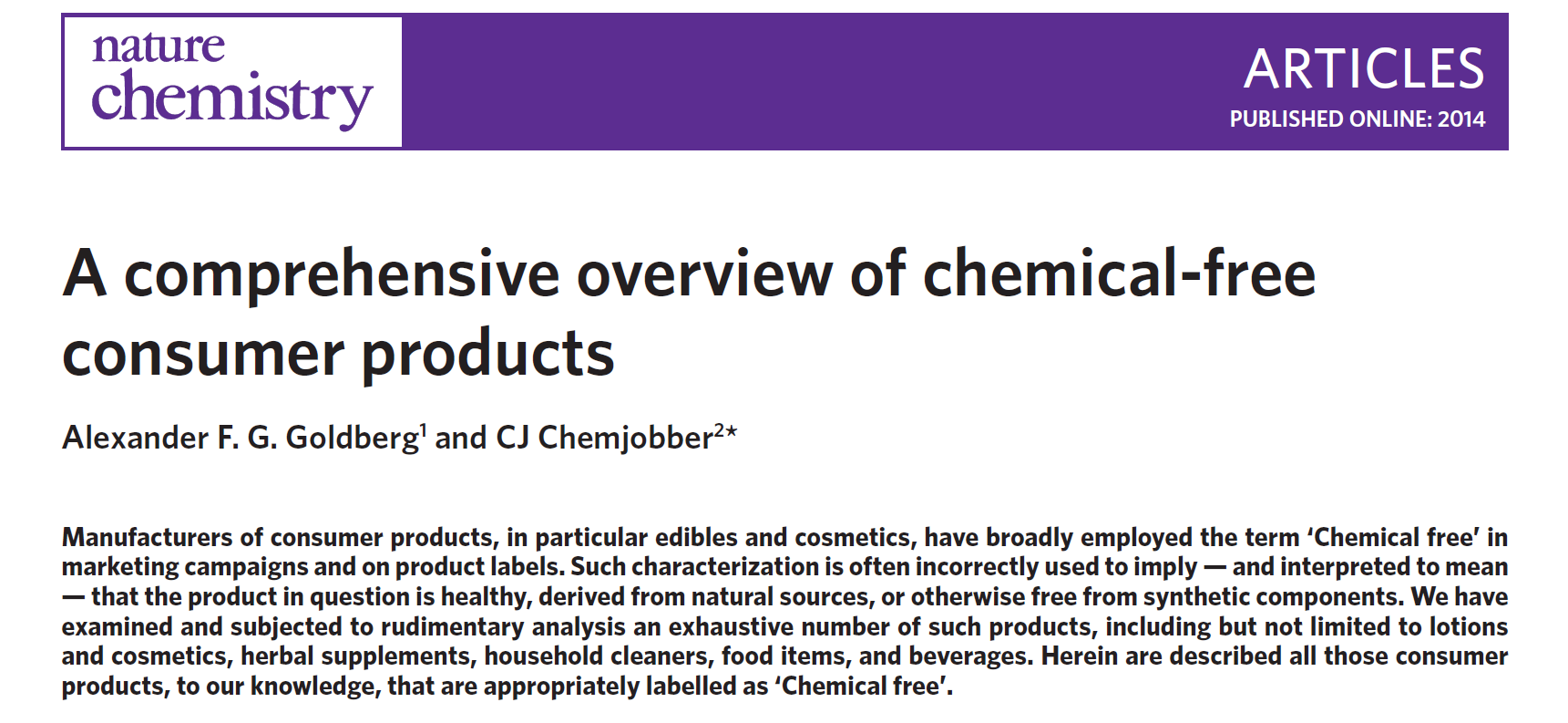
Back in April of this year, a manuscript popped up in our submission system from two chemists we know well from Twitter/the chemistry blogosphere — Chemjobber and Alex Goldberg. The paper, entitled A comprehensive overview of chemical-free consumer products is perhaps best summarised by quoting (with permission from the authors) from the cover letter that came with it:

“We have completed an exhaustive study of common products that are marketed as ‘chemical-free’ and have prepared a detailed analysis of those products that are appropriately labeled as such. In brief, there aren’t many. In briefer, see the body text of our manuscript. We believe that the popular use of the term ‘chemical-free’ is of great interest (and of even greater malaise) among chemists of all backgrounds, that our findings are generally applicable and our analysis robust enough. In addition, though this topic is frequently discussed in many circles in the chemistry community, no peer-reviewed study to our knowledge has been reported on this topic at this length. For these reasons, we consider Nature Chemistry to be the appropriate journal for publication of our manuscript. We hope that this article serves as a practical resource for chemical education and science advocacy and that the examples described therein provide useful guidance for appropriate marketing and labeling practices.”

Chemjobber and Alex go on to suggest who would (and would not) be appropriate reviewers:

“As potential referees from a cross-section of the field of chemistry, we propose Dr Carmen Drahl (Chemical & Engineering News), Dr Derek Lowe (Vertex Pharmaceuticals), Prof. Paul Bracher (St. Louis University), and the Chemical-Free Bear (On Twitter somewhere), all of whom are experts in the field of chemical-free chemistry. We request that you exclude as possible referees the editors of the Chemical Free Kids Facebook page, and all of the 3000+ individuals who have ‘Liked’ it.”

Because we still have print copies of the journal, we figured that we couldn’t publish this paper in the journal itself as that would have meant using chemicals… and that just didn’t seem right for a chemical-free paper — so alas, it didn’t make the cut. That said, however, we don’t get submissions like this every day… ones that first make us laugh and then make us think, so we thought long and hard about what we could do. With many thanks to our production team for assembling the PDF file, we’ve decided to post the manuscript here on our blog, in what is essentially Nature Chemistry format (just click on the image below to download the full pdf). If you feel like reviewing the manuscript, please leave your chemical-free comments on this blog post.

chem-free paper

Speaking Frankly: Sanger’s legacy

Editor’s note: Frank Leibfarth is a postdoc who is trying to make his way through the academic maze. Find him contributing to the Sceptical Chymist or continue the conversation on Twitter @Frank_Leibfarth.

– – – – – – – – – – – – – – – – – – –

Frederick Sanger, the British biochemist and two-time Nobel laureate, died this week at the age of 95. He holds the distinction of being the only individual to win two Nobel Prizes in Chemistry and one of only four people to win two Nobel prizes in any field; an honour he shares with John Bardeen, Marie Curie, and Linus Pauling.

Sanger took a fundamentally chemical approach to solve complex problems in molecular biology and genetics. Early on he became interested in the structure and sequence of biopolymers, which led him to study and eventually fully sequence the protein insulin. This feat of ingenuity, chemistry, and spectroscopy led to his first Nobel Prize awarded in 1958. Soon after, he moved from the University of Cambridge to the British Medical Research Council Laboratory of Molecular Biology, where he studied with a slew of young, ambitious, and talented scientists including the likes of Max Perutz and Francis Crick.

Here, Sanger began his work on developing a method to sequence deoxyribonucleic acid, or DNA, the alphabet of heredity. His success in this field, culminating in the development of the ‘Sanger method’ for sequencing DNA, was one of the most important scientific feats of the last century. Originally employed for sequencing the complete genome of a virus and then human mitochondria, the Sanger method would eventually be the primary technology used to complete the sequencing of the entire human genome. Sanger shared his second Nobel Prize in 1980 for his work on sequencing DNA, only three years before his retirement from scientific research in 1983.

Sanger’s legacy will not be one of excess. Despite his groundbreaking contributions, he only published around 100 research articles. The quality of his work is undeniable; each of his publications has been cited an average of almost 1000 times. A commentary penned by Sanger in 2001 provides a rare glimpse into his research philosophies. He worked at the bench throughout his career, preferring to do experiments himself than plan them for others. Furthermore, he mentions the importance of interacting with scientists outside his discipline, “who were interested not only in what they were doing but also in other people’s work and keen to exchange ideas.”

Although Sanger won awards for his landmark discoveries, an underappreciated facet of his contributions was the technology he created to make these discoveries possible. He was primarily interested in developing simple, scalable, and reproducible chemical techniques to sequence these biopolymers. As a result, Sanger’s legacy extends far beyond the sequencing of the amino acids in insulin or the genetic code of mitochondria. His user-friendly methods have been adopted by scientists around the globe and are indirectly responsible for much of our advances in modern medicine.

Sanger’s scientific career ended more than three decades ago, but in many ways he is a model for the next generation of chemists. The day-to-day work in his lab consisted of fundamental chemical investigations of the structure of biopolymers; breaking them down, reconstructing them, and developing analytical methods to see how and where bonds broke and reformed. From a broader perspective, however, Sanger can be rightfully credited with being a founding member of the fields of molecular biology and genetics, a seemingly far cry from ‘traditional’ chemical disciplines. So while some would argue that chemistry is a mature discipline, I contend that well-trained chemists are only scratching the surface of their potential.

There are surely many grand challenges within the discipline, but chemists are broadly trained to be able to make molecules, understand their bonding properties, and connect their structure to function. If elucidating the primary structure of proteins and DNA revolutionized biochemistry in the 20th century, could understanding the structure, interactions, and dynamics of the cell membrane or extracellular matrix do the same in the 21st century? Problems of structure and bonding will always require the skills of a chemist to solve and Sanger recognized that in the 1940s. He has shown us the roadmap, now we only have to follow it.

Reactions: Philippe Zinck

Philippe Zinck is at the Catalysis and Solid State Chemistry Unit, University Lille 1 (France) and works on polymerization catalysis, with a focus on functional and bio-based polymers. He goes on Twitter by @PhilippeZinck.

1. What made you want to be a chemist?

I studied materials science, because at that time the materials science department of my college was more oriented toward research. I did the first year of my masters as an exchange student in Berlin, and the macromolecular chemistry teacher was really excellent, so I fell in love with that specialty. When I went back to France I chose the polymer chemistry department for the second year of my masters and my lab training period, and I stayed for my PhD.

2. If you weren’t a chemist and could do any other job, what would it be – and why?

Well I think I could have been a researcher in many other fields like physics or biology for example. What really makes me happy in my job is the research adventure. A bit like the ancient explorers, the researcher is discovering new territories, and that’s what makes me happy and excited when I go to work every morning (or almost).

3. What are you working on now, and where do you hope it will lead?

We are just starting a biorefinery project for making bio-based polymers, with several industrial and academic partners. It’s a 10 year project, and you rarely have projects that last so long in our profession. Honestly, I don’t know where it will lead, but it gives me the opportunity to work on issues in society. I hope it will be a success story.

4. Which historical figure would you most like to have dinner with – and why?

Pierre-Gilles de Gennes. I find the way he conducted research fascinating. A lot of his discoveries were achieved through analogies between different research fields. Besides, he was also an excellent teacher, and did a lot to raise high school student’s interest for research. He also took an interest in societal issues. I had the chance to give a seminar in his lab several years ago and to meet him briefly, but not to have dinner with him!

5. When was the last time you did an experiment in the lab – and what was it?

I had to open my lab-book to check. It was in July 2010, I was trying to polymerize some carbohydrate derivatives in a new way, but it did not succeed. These kinds of reactions almost never work, and that would have demoralized the students, so I used to do them myself.

6. If exiled on a desert island, what one book and one music album would you take with you?

I’m hesitating between a world encyclopedia of wines and a longboard user manual, but the latter will definitely be more useful on a desert island! For the music, I’ll take one of Pink Floyd’s albums, probably Atom Heart Mother, a fantastic brass instruments album.

7. Which chemist would you like to see interviewed on Reactions – and why?

Well, I think that green chemistry is more than ever an essential issue for our society, for many reasons that I will not explain here. Scientists from this area should be interviewed on Reactions, like Barry Trost for example, among many others.


Reactions: Ehud Keinan

Ehud Keinan, President of the Israel Chemical Society, is in the Schulich Faculty of Chemistry at the Technion – Israel Institute of Technology, and works on supramolecular chemistry, biomolecular computing and biocatalysis.

1. What made you want to be a chemist?

My chemistry teacher in high school, Mr. Zeev Karp, opened for me a window to the magic world of fascinating colors, smells, tastes, sounds, action and concepts that excited all my senses, triggered my curiosity, and fueled my imagination. At age 17, discovering the great opportunity of merging business with pleasure, I was determined to go for chemistry. I realized that if I became a research chemist I am awarded with a license to extend my childhood for the rest of my life, a license to keep playing wild games, with all the associated joy of discovery and creativity, and even be compensated for that. Obviously, that was an offer I couldn’t refuse, and I grabbed it. The funny thing is that even now, 50 years later, and being slightly less naïve, I still think the same way about chemistry.

2. If you weren’t a chemist and could do any other job, what would it be – and why?

I would probably be doing anything that involves imagination and creativity but nothing that involves routine procedures. I would be happy being a visual artist, photographer for National Geographic, architect, carpenter, gardener, a member of an exploring expedition, etc. In retrospect, as a research chemist I have been all of these.

3. What are you working on now, and where do you hope it will lead?

I am working now on several things, probably too many. Yet, a new type of synthetic cavitands intrigues me much these days. We named these macrocyclic host molecules “multifarenes” due to their multifarious structures, comprising several different building blocks. One can envision many potential applications of these hollow molecules, including chemical sensing, highly selective catalysis and nano-fabrication. But frankly, my main motivation to make these molecules is their beautiful molecular architecture and the synthetic challenges involved.

4. Which historical figure would you most like to have dinner with – and why?

Undoubtedly, my choice would be Thomas Jefferson. I guess that I share the view of President John F. Kennedy, who said in 1962 at a White House dinner attended by every living American Nobel Laureate: “There has never been a greater concentration of intellectual power here at the White House since Thomas Jefferson dined alone.” I adore his eternal statement inscribed around the rotunda interior in Jefferson Memorial: “I have sworn upon the altar of God eternal hostility against every form of tyranny over the mind of man.” Definitely, he is the guy I would love to spend some time with.

5. When was the last time you did an experiment in the lab – and what was it?

This is a painful issue, the frustrating side of my career. I have never wanted a career that requires sitting in a closed office for long hours, and, ironically, this is what I do most of my day. My most enjoyable experiments were always related to organic and organometallic synthesis, building a complex experimental setup with well-crafted glassware and sophisticated mechanical and electronic gadgets. Unfortunately, it has been already 10 years or more since I had an opportunity of playing alone with these toys. One of the games that I enjoy most is crystallizing a new organic compound, which has always involved more art than science. It is highly rewarding and aesthetically pleasing to watch the growing crystals of something that has never existed before. It is exciting to reveal the crystallographic structure, which is always unexpected, pretty much like scratching a lottery card or opening the white envelope in the Oscar ceremony.

6. If exiled on a desert island, what one book and one music album would you take with you?

I would probably take Beethoven symphonies or string quartets. The music is so rich with details and emotions, so it is never boring to listen to it time and again and discover hidden elements every time, pretty much like looking again and again at a masterpiece of Rembrandt or van Gogh. This is important because I’ll probably have much free time on that island. For the same reasons I would choose March’s Advanced Organic Chemistry because I love organic chemistry, I love thinking of reaction mechanisms and the limitless architecture of organic molecules. I am sure that every time I’ll get back to March I’ll find new points and come up with new ideas. Frankly, I look forward to going exile on a desert island because this will give me a great opportunity to focus on writing my own book, which has been waiting for too long.

7. Which chemist would you like to see interviewed on Reactions – and why?

Either Albert Eschenmoser or Jack Dunitz would be a great choice. Both are not only giant scientists but also extremely original and creative individuals with very broad knowledge and broad perspective on almost any topic, a quality that many specialized scientists lack these days. I see both as role models for the young generation of scientists and I’ll be intrigued to read their answers to the above questions.

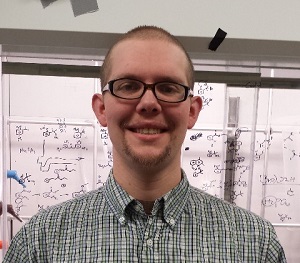
Reactions: Mike Tarselli

Mike Tarselli is a Principal Scientist at Biomedisyn, where he develops drugs to combat neural diseases.

1. What made you want to be a chemist?

Like many other scientists, two great teachers pointed me in that direction. The first, Mr. Vito, joyfully bounced around the room as he drew fantastically intricate chemical structures for my high school biology class. The second, Dr. Adams, inspired everyone with his enthusiasm for teaching sophomore organic chemistry.

2. If you weren’t a chemist and could do any other job, what would it be – and why?

No question – I’d be a professional musician. It’s been my passion since I was four years old. I still have a pipe dream to one day perform at Carnegie Hall.

3. What are you working on now, and where do you hope it will lead?

At Biomedisyn, we’re developing natural product-inspired molecules to help treat neurodegenerative disorders. As the population ages, we’ll need better treatments for Alzheimer’s, Parkinson’s and a variety of other challenging diseases.

4. Which historical figure would you most like to have dinner with – and why?

Tough choice. Probably Leonardo da Vinci, whose “non-traditional” career in science, art, and engineering fascinates me.

5. When was the last time you did an experiment in the lab – and what was it?

I work for a small company; I’m in lab every day! We mostly run reactions med chemists might find familiar: alkylations, cyclizations, deprotections, oxidations, and (of course) daily Pd cross-couplings.

6. If exiled on a desert island, what one book and one music album would you take with you?

For the book, let’s take Richard Feynman’s Surely You’re Joking, Mr. Feynman. I strive towards his style, which matches a light, playful tone with serious scientific undercurrent. I’ll cheat a little and bring two albums: Miles Davis’ Kind of Blue and They Might Be Giants Severe Tire Damage.

7. Which chemist would you like to see interviewed on Reactions – and why?

Let’s hear from Alois Furstner, an organometallic chemist from the Max Planck. I find his work with gold catalysis and metathesis refreshing and exciting.


How to write an editorial (in tweets)

Today we published an Editorial describing how Nature Chemistry (@NatureChemistry) has used Twitter over the past 4 years. The topic of the Editorial was something I had been mulling over for a while, but the format is something that wasn’t planned until I sat down to write it. An Editorial about Twitter? Well, why not write it in a series of tweets (some team members even joked about doing it this way before I sat down to write the thing)? As it turns out, I couldn’t resist the challenge…

And what were the challenges exactly? Well, each tweet (including any mentions or links) obviously had to be 140 characters or fewer. That was a rule that couldn’t be broken. Other considerations were a little more subtle: I wanted each tweet to more-or-less stand alone and make sense in its own right. Typically an Editorial has a main theme that builds and builds as you read it, and the writer can usually depend on the reader remembering what they read in the previous sentence or paragraph to put the current point in context. That wasn’t the case here, yet I did want the Editorial to flow — well, as much as 42 individual statements can…

Another concern was repetition; I didn’t want each tweet to start with ‘We use Twitter to…’ — something that would have been so easy to do (but would have been so boring to read). And while the Editorial does use the words ‘Twitter’ and ‘tweet’ quite a bit, that was pretty much unavoidable. The final challenge, and it might seem ridiculous considering the topic, was for the Editorial to fill one printed page in the journal. Yep, a printed page. Filled. With tweets. Before writing this particular Editorial, I looked at previous examples in the journal and came up with a rough estimate of the number of tweets that it would take to fill a page. 40-45 looked like the magic number, and it would be better to write more and cut later, rather than shoehorn new ones in at a later stage. Once it became clear that the final figure might be 42, there was an opportunity (well, compulsion) to finish with a reference to Douglas Adams.

It’s worth mentioning the time scale on which Editorials are written for the journal. Today — the day the Editorial was published — is March 20th. Content for our April issue had to be finalized for ‘press day’ — the day the final PDFs get made up and sent off to the printers; that was March 6th. The date by which the Editorial had to be given to the production team for copy-editing and layout was March 1st. Working back from that, I wanted to make sure that my team had plenty of time to tell me just what a bad idea this was and that I should just write a normal editorial and so, with that in mind, the first draft was written on the weekend of 16/17th February (yep, a weekend, for those paying attention). So, that’s more than one month between putting pen to paper (fingers to keyboard) and the date of publication. That explains some of the date ranges given in the Editorial and why some of the numbers that are quoted will have changed if you look them up now.

photo-1The version that was handed over to our production team consisted of a title, standfirst, Wordle, and 42 tweets in the main body of the article. It turned out to be 22 lines too long. Ouch. Look at the picture of the proof to see what needed to be done to cut it down to size. 4-line tweets were cut to 3 and a couple of tweets were removed completely. Click through to the larger version of the image to see exactly what changes were made. And it was on the second page so you can’t see it, but #overlyhonestmethods had to be cut from the hashtag tweet (it didn’t play nice with line breaks).

The ’42’ ending still works; one tweet for the title, one for the standfirst and 40 for the main text (you could argue that the original version was actually 44 tweets and the published one is genuinely 42 tweets in total). We still had problems with orphans and widows in the pdf version, so we shifted some of the tweets around. If you compare the proof to the published version (and you care that much) you can figure out what was moved where. Yes, it’s somewhat bizarre that an Editorial about how we use a web 2.0 tool is dictated — to some extent — by old-fashioned typesetting issues, but there you go.

Once the Editorial was finalized and it was too late to make changes, other examples of how we use Twitter obviously sprang to mind. It’s not just the one book review that came about because of interactions on Twitter. Declan Fleming (@declanfleming) reviewed Itch for us (review here; subscription required) after I contacted him about it through Twitter and after getting to know Jamie Gallagher (@JamieBGall) on Twitter, we asked him to review the 2012 Royal Institution Christmas Lectures for us — (review here; subscription required).

The intention from the beginning was to tweet the whole thing, as we did today — and that’s the first (and probably the last) time we’ll do something like this. We hope you enjoyed it, or at least found it interesting!

Stuart (Chief Editor, Nature Chemistry)