Blogroll: Welcome to the club

Editor’s note: As we continue to invite bloggers out there in the wild to compose our monthly Blogroll column, Doctor Galactic penned the June 2013 column.

———-

Twitter’s new #chemclub aims to help you find exciting chemistry to read.

A weekly laboratory journal club is a great way to encourage researchers to read the literature and share their enthusiasm for great pieces of chemistry. Writing at Behind NMR Lines, Andrew Bissette found that he often caught wind of interesting papers via the watchful eyes of the chemistry crowd on Twitter. So he came up with an idea: why not form an online journal club that draws attention to ‘cool papers’ and spark some discussion? Thus began #chemclub.

Chemists of the Twitterverse have thrown themselves in with wild abandon. Andrew posts weekly round-ups of the best material, and the contributions so far range from the most cutting-edge total syntheses to the dusty old classics of yesteryear. Anyone can join in with #chemclub, so if you’re reading a truly fascinating (or even slightly weird) paper, why not let the rest of us know about it?

Meanwhile, JessTheChemist who writes at The Organic Solution has been wondering just how academically interconnected the online chemistry community really is. Jess started out building her own chemistry ‘family tree’, but the project has since blossomed and is still growing. We’re encouraged to add our own branches to the tree and who knows where your branch might lead. Perhaps even to the not-long-departed Maggie Thatcher? And on that note, Kat Day of The Chronicle Flask tells us to ‘never mind the politics’, Thatcher will always be one of those very famous female chemists who ‘ignored the limits’. Besides, once part of the club, always part of the club, right?

Written by Doctor Galactic, who blogs at https://doctorgalacticandthelabcoatcowboy.wordpress.com/

———-

[As mentioned in this post, we’re posting the monthly blogroll column here on the Sceptical Chymist. This is the June 2013 article]
Reactions: Mike Tarselli

Mike Tarselli is a Principal Scientist at Biomedisyn, where he develops drugs to combat neural diseases.

1. What made you want to be a chemist?

Like many other scientists, two great teachers pointed me in that direction. The first, Mr. Vito, joyfully bounced around the room as he drew fantastically intricate chemical structures for my high school biology class. The second, Dr. Adams, inspired everyone with his enthusiasm for teaching sophomore organic chemistry.

2. If you weren’t a chemist and could do any other job, what would it be – and why?

No question – I’d be a professional musician. It’s been my passion since I was four years old. I still have a pipe dream to one day perform at Carnegie Hall.

3. What are you working on now, and where do you hope it will lead?

At Biomedisyn, we’re developing natural product-inspired molecules to help treat neurodegenerative disorders. As the population ages, we’ll need better treatments for Alzheimer’s, Parkinson’s and a variety of other challenging diseases.

4. Which historical figure would you most like to have dinner with – and why?

Tough choice. Probably Leonardo da Vinci, whose “non-traditional” career in science, art, and engineering fascinates me.

5. When was the last time you did an experiment in the lab – and what was it?

I work for a small company; I’m in lab every day! We mostly run reactions med chemists might find familiar: alkylations, cyclizations, deprotections, oxidations, and (of course) daily Pd cross-couplings.

6. If exiled on a desert island, what one book and one music album would you take with you?

For the book, let’s take Richard Feynman’s Surely You’re Joking, Mr. Feynman. I strive towards his style, which matches a light, playful tone with serious scientific undercurrent. I’ll cheat a little and bring two albums: Miles Davis’ Kind of Blue and They Might Be Giants Severe Tire Damage.

7. Which chemist would you like to see interviewed on Reactions – and why?

Let’s hear from Alois Furstner, an organometallic chemist from the Max Planck. I find his work with gold catalysis and metathesis refreshing and exciting.


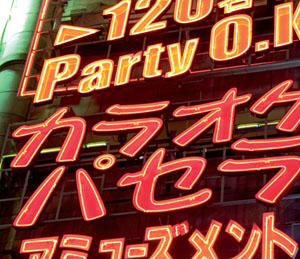
Neon behind the signs

A few different versions of the periodic table do exist — as Michelle Francl wrote about here a while ago in a certain chemistry journal  — but we’re all attached to the one that adorned our science class rooms at school: Mendeleev’s version. We generally think that each position is firmly set, but in this issue’s ‘in your element’ article (subscription required) Felice Grandinetti ponders on whether neon should really be at the top of the noble gases group — this would involve helium moving next to hydrogen, at the top of group 2.

Print

{credit}© PHOTO JAPAN / ALAMY{/credit}

An argument in favour of this change is the fact that neon is less reactive than helium. ‘Less reactive’ is perhaps a bit of a stretch when it comes to the noble gases, let me rephrase this to “neon is more inert than helium”. We know that, moving down the periodic table (that is, when moving from helium to neon, then argon, krypton and finally xenon) an increase in polarizability accompanied with a decrease in ionization potential makes elements more prone to form bonds. This trend is in good agreement with what we know of noble gas reactivity, both from experimental and theoretical studies — I’ll let you go to the article to read about the compounds that have been prepared or predicted — except from the fact that neon is more inert than helium. Should helium move to group 2, the situation would be resolved.

Grandinetti also relates how the discovery of neon represents a good illustration of the synergy between fundamental and applied research, and how element 10 went on to participate in the development of mass spectrometry. What nicely connects today’s widespread uses of neon to its history is its bright red-orange emission. The spectroscopic line that led to the identification of this new element (quite literally, as its name comes from ‘neos’, the Greek word for ‘new’) is the basis for signs that brighten cities at night, barcode scanners, laser eye surgery and blood cell analysis.