The top blog posts of 2014

Editor’s note: Jess Breen who blogs at The Organic Solution and Andrew Bissette round up the best blog moments of the year. If your favourite chemistry-related blog post doesn’t appear on the list, leave a comment letting us know what it is.

——————-

Last year we rounded up our ten favourite posts of 2013. This year we’ve ditched the round number, and instead compiled a Bumper Blogroll of topics that chemists have been talking about in 2014.

Science is increasingly interdisciplinary, as reflected in the now-traditional annual argument over whether the winners of the Nobel Prize for Chemistry are actually chemists or not. In this interdisciplinary spirit, we’ve not limited ourselves to chemists, instead drawing on some of the best writing by scientists of all stripes.

Women in science

In September, Science published a story about the top 50 scientists on Twitter. Among many others, Paige Brown Jarreau highlighted the shortage of women on the list, and offered an alternative list filled with fascinating female scientists. The relative absence of chemists on the original list also prompted reflection about how to better capture the imagination of the general public (see here and here).

Food for thought

The anonymity available to bloggers and commenters can be a blessing or a curse, allowing vulnerable people to speak the truth safely or offering malicious individuals a shield to hide behind. In January, Michael Eisen offered a thoughtful dissection of the differences between anonymity and pseudonymity and the ethical questions raised by social media and peer review. Questions of anonymity are not limited to social media, and Mark Lorch shared a story highlighting the importance and limitations of anonymity in peer review.

Organic synthesis

The Baran lab blog, Open Flask, is approaching its second anniversary and continues to share fascinating behind-the-scenes looks at their recent publications. The ever-brilliant BRSMblog has educated us throughout 2014; the highlight for us was a recap of three classic total syntheses. Meanwhile, Brandon Findlay of Chemtips spent the year offering invaluable practical advice to young researchers, such as a guide to bypassing the ‘black tar phase’ of synthesis.

PhD life

During the low-points of a PhD, a blog can offer an outlet for anxiety or a source of reassurance. Tom Phillips shared his struggle with the second-year blues, hopefully providing some comfort to others in the same situation. Via Chemjobber, Chad Jones shared lessons he learned in graduate school about coping with the demands of research. On a happier note, chemists from the University of Groningen shared their PhD experiences through the medium of dance.

Careers

Securing an academic position is hard, and from the outside it can seem almost impossible. Aidan Horner, a neuroscientist, shared his ‘negative CV’ of career and publishing rejections with the world to offer some reassurance to early-career researchers. As Aidan tells us, “you need to keep banging on the door until someone lets you in”. For those who do decide to leave academia, the fear of being seen as a failure can be off-putting. Women in particular may feel a duty to continue in academia to avoid becoming part of the ‘leaky pipeline’. Sci Curious shared at length her positive experience of leaving academia and thoughts on academic culture. Not all graduate students can or should continue in academia, and those who choose a different path should not be seen as failures.

Literature woes

The scientific literature can be a source of fascination or frustration. Dr Freddy shared five things that synthetic chemists hate to see in papers in a post that, remarkably, has a comment section worth reading. Meanwhile, Mike at Amboceptor asked what is the volume of a drop? It turns out that this classic unit is more widespread than one might think. Finally, Sylvain Deville recounted the making of a paper, from the inception of an idea, to the trials and tribulations of gaining the all-important results, to publication in Nature Materials.

Chemophobia

The popular notion that ‘chemicals are bad’, often called chemophobia, is a perennial topic for chemistry bloggers. Renée Webster shared her attempt to engage with a beauty company and asked how she could have done better. Alternatively, Chad Jones suggested that chemists can be too defensive when it comes to chemophobia. We hope these reflective writers will help promote a more nuanced approach to communication from chemistry bloggers.

#Realtimechem

No blog round-up would be complete without reference to #RealTimeChem week. Now in its second year, this is a highlight for the online chemistry community, showcasing some of the best writing and creativity chemists have to offer. Bring on #RealTimeChem week 2015!

Best new blog

Finally, our favourite new blog of the year is Compound Interest, written by Andy Brunning. Andy creates beautiful infographics about all sorts of everyday chemistry, from autumn leaves to xylitol. There is even a chemistry Advent calendar. To top it off, the infographics are available for purchase as full-sized posters for your office, lab, or classroom. Keep it up, Andy!
One ring to bind them all

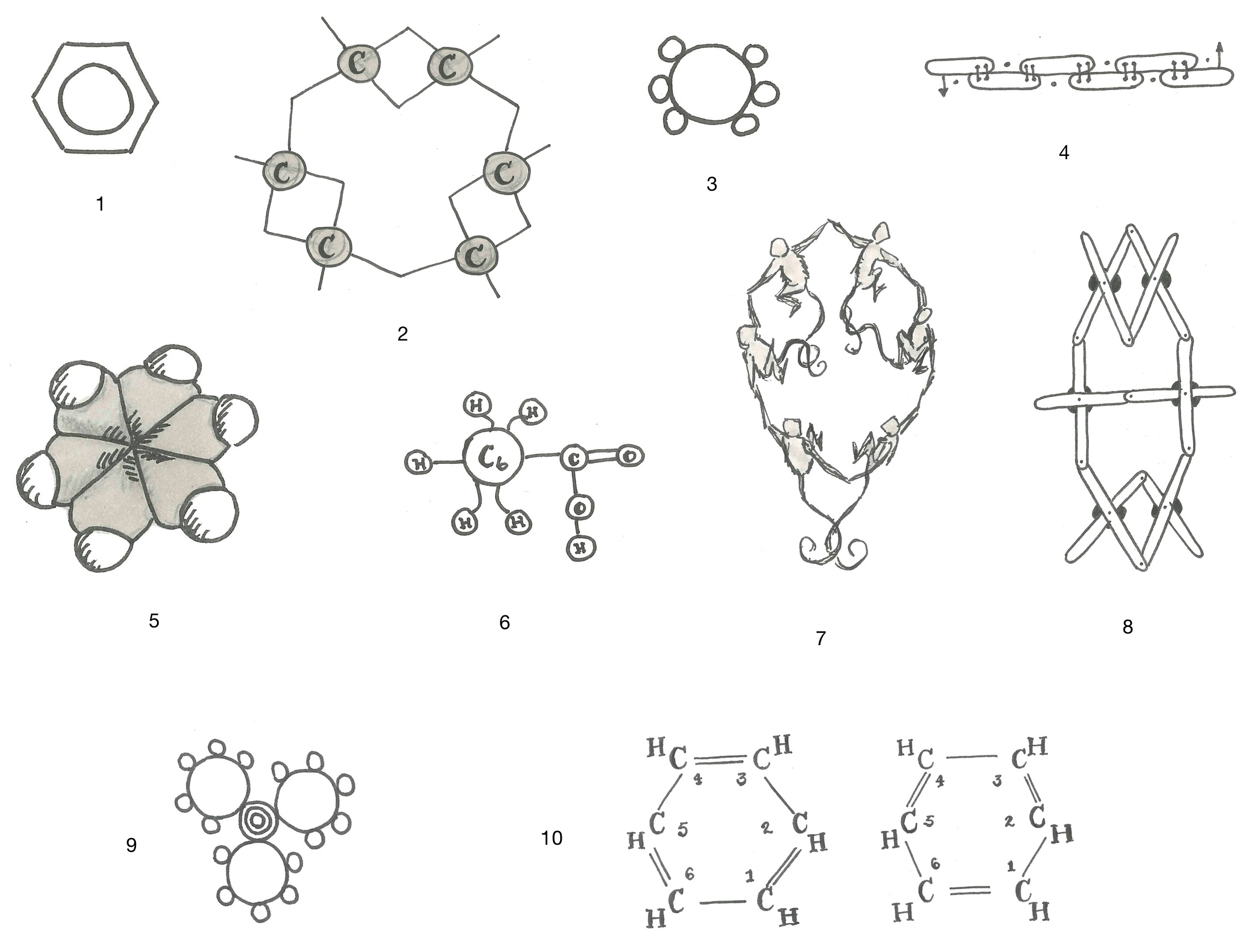
Editor’s note: the January 2015 issue of Nature Chemistry features a Thesis article ($) from Michelle Francl that looks at chemists’ fascination with benzene. It is illustrated with a range of different representations of benzene and benzene-containing compounds drawn by Michelle’s own fair hand. Here is a short accompanying blog post by Michelle, including a quiz!

I’m teaching the first year course in chemistry this fall, and in addition to making certain my students have a firm grasp on Hess’ law, VSEPR theory, and gases, I’ve been insisting they learn to draw. To think like chemists, I tell them, and to keep from drowning in later organic chemistry lectures, they need to be able to quickly draw chemical structures that other chemists can ‘read’ and to see in their own heads the reality these particular embeddings represent. So we learn the chemical alphabet, wedges and dashes, chairs and boats — and the iconic hexagon.

It took chemists more than 100 years after Michael Faraday isolated and characterized benzene to settle on the hexagon with a circle in the center as a convenient way to represent the hexavalent kernel of organic chemistry. I found more than a dozen different representations of benzene in the chemical literature, Kekulé alone used three types, and like the Buddhist wisdom tale of the elephant and the blind men, each attempt brought out a different facet of the structure and bonding. Can you match each of the structures (1-10) with its description (A-J)?

Benzene for blog post

A. Alexander Crum-Brown’s 1866 representation of benzoic acid.
B. From a Liebigs Ann. Chem. paper published by August Kekulé in 1872.
C. Appeared in 1886 in Berichte der Dürstigen Chemischen Gesellschaft (Reports of the Thirsty Chemical Society) a spoof edition of Berichte der Deutschen Chemischen Gesellschaft.
D. From Kekulé’s first paper suggesting that benzene was a circle (published in 1865).
E. From an 1861 pamphlet published by Johann Loschmidt.
F. James Dewar’s contraption for representing molecular structure, illustrating an isomer of benzene, the inspiration for ‘Dewar benzene’. Despite legends to the contrary, Dewar does not suggest the structure in his 1867 paper as an alternate bonding scheme for benzene, the paper is about building the brass pieces to use to make molecular models.
G. From a paper published by Robert Robinson and James Armit in 1925. Armit etched it into the window of his family’s bakery in St. Andrews, Scotland.
H. In August Kekulé’s 1867 Lehrbuch der organischen Chemie (Textbook of Organic Chemistry).
I. A representation of benzene following the style used in a paper published by Cox, Cruickshank and Smith in 1958.
J. Triphenylamine in Loschmidt’s notation (from the same 1861 pamphlet as E).

Editor’s note: post your answers as a comment here, or on Twitter (mentioning @NatureChemistry), in the form 1A, 2B, 3C, 4D, etc… no prizes, apart from kudos and some retweets.

Editor’s note Jan 9th, 2015 – the correct answers are: 1G, 2H, 3E, 4D, 5I, 6A, 7C, 8F, 9J, 10B. The first person to get them all right was Stephen Davey (his second guess in the comments). Steve does, admittedly, work at Nature Chemistry, but before you all groan and roll your eyes, he had no way of finding the answers (that was all between Michelle and myself). You’ll see that Cristiano Zonta also got all the answers right and it is worth noting that his and Steve’s blog comments were both moderated (by me) at the same time, so even though Steve’s comment was first, Cristiano could not have seen these answers before posting his own identical ones (because both blog comments were published at the same time). With 8/10, @fxcoudert and @samofthedamned also get honourable mentions – and thanks to everyone else who played along on Twitter. Apologies if I’ve missed any other high-scoring guesses.

Blogroll: Friends and foes

Editor’s note: As we continue to invite bloggers out there in the wild to compose our monthly Blogroll column, Justin Brower penned the January 2015 column.

———-

Battling pseudoscience and chemophobia with knowledge and education.

When there are concerns about chemicals and the foods we eat, chemophobia usually runs rampant. More information about what we eat is a good thing. Pushing an agenda using pseudoscience, dubious sources and a fear of chemicals is not. Fortunately, analytical chemist Yvette Guinevere, writing as Science Babe, has taken it upon herself to address a popular series of unscientific food claims by “using science to rip them to shreds”.

A more sensible way of looking at the chemicals in the foods that we eat would be to learn from those who actually understand and practice the science behind them. We call these people scientists, and a group of them from UCLA have banded together to write the blog Science & Food. Topics range from how proteins denature to achieve the perfect soft-boiled egg, to the chemicals and mechanisms responsible for the flavours of fresh, cooked and dried ginger.

Science isn’t all rainbows and unicorns, however, and any complete education should include the deleterious effects that may arise from ingesting certain chemicals. ForensicToxGuy — unsurprisingly a forensic toxicologist — blogs at The Dose Makes the Poison and tackles the chemistry and toxicology surrounding the newest waves of designer drugs. Of particular interest to him are synthetic cannabinoids, which thanks to their ‘alphabet-soup’ nomenclature, confound doctors, scientists and legislatures alike. If you’ve ever wondered what ADB-CHMINACA is, here’s your chance to find out.

Both friends and foes, chemicals simply exist. Everywhere. But discerning between the good and the bad requires education by those skilled in the field, and these blogs are not a bad place to start.

Written by Justin Brower, who blogs at https://naturespoisons.com/.

———-

[As mentioned in this post, we’re posting the monthly blogroll column here on the Sceptical Chymist. This is the January 2015 article]