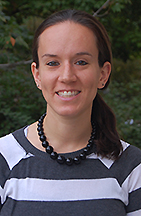
Reactions: Mike Rose

Rose, Mike 2012

Mike Rose is in the Department of Chemistry at The University of Texas at Austin, and works on synthetic modeling of metalloenzymes (specifically mono-iron hydrogenase), and electron transfer in solar fuels devices for hydrogen generation.

1. What made you want to be a chemist?

I’ve always loved building things — my room growing up was a smorgasboard of Legos, Construx and electronics components. Actually I started college as a Civil Engineering major because I wanted to design and build bridges, buildings and freeways (I grew up in LA). I then realized that engineers spent most of their time doing math, which was a lot less alluring. Once I learned about building molecules around these fascinating elements called transition metals (oxidation states, unpaired spins, and spin-orbit coupling — oh my!), I was hooked.

2. If you weren’t a chemist and could do any other job, what would it be — and why?

I would probably split my time between being a welder, and a high school English & Chemistry teacher so that I could coach high school soccer. I love guiding and helping students (or players) maximize their potential — watching them achieve more than they think they can.

3. What are you working on now, and where do you hope it will lead?

Right now we’re working on these mononuclear iron complexes that activate H2 and perform hydride transfer, just like the enzyme mono-iron hydrogenase. I hope it will lead to the recognition that first row transition metals can actually do all the stuff precious metals can do — they just need a bit more design, attention and cajoling to do it.

4. Which historical figure would you most like to have dinner with — and why?

Probably William Wallace (Braveheart), so that I can stop watching all these “Story of Scotland” documentaries that my wife complains about. I’d like to know what motivated him to take on and surmount all odds in pursuit of independence — or kingship, I suppose.

5. When was the last time you did an experiment in the lab – and what was it?

That’s an easy one. Last summer after I submitted my NSF proposal I had two weeks without travel and deadlines, so I prepared what I believed to be (NEt4)2[(MoS4)2Co] to use as a single source precursor for cobalt-doped MoS2 electrodeposition. I couldn’t get it to crystallize, though, so I just threw it in the back of the freezer. A few months ago during lab clean-up, I discovered huge crystals! Of course, they melted on the way to the diffractometer. Labwork teaches us to try and try again relentlessly. I’m going to set up another reaction this summer, and hope for crystals by spring!

6. If exiled on a desert island, what one book and one music album would you take with you?

That’s a fun question. Bookwise, I would probably take Thomas Pynchon’s Against the Day, because I’ve been trying to finish it for the last five years. I could probably read it ten times and still discover new words and sub-plots.

Regarding an album, that’s a tough one — I think I’d have to go with Ritual de lo Habitual by Jane’s Addiction — one of most complete albums of all time. It has to be the ‘clean’ white album cover with the First Amendment from the US Constitution (freedom of speech) — as a reminder that censorship is always lurking right around the corner. Freedom of expression is what keeps free societies vibrant and, ultimately, functional. The back cover text seems, uh, timely as well.

7. Which chemist would you like to see interviewed on Reactions – and why?

Harry Gray, because I want to know his answers to Questions #5 and #6.

Reactions: Gabriella Graziano

Gabriella Graziano is an Associate Editor for Nature Reviews Chemistry.GabriellaGraziano

1. What made you want to be a chemist?

My interest for science started pretty early. When I was 11 and I had the chance to meet a very passionate science teacher who transferred to me a curiosity for natural events.  Although an interest in science has been constant in my studies, I’ve never been sure which particular subject I wanted to focus on more – physics, chemistry, biology or medical sciences – until I attended a talk on how to change certain properties of the surface of a material by changing its chemistry. After that talk it was clear to me that I wanted to study chemistry.

2. If you weren’t a chemist and could do any other job, what would it be – and why?

I’d most likely be a musician. I’ve studied music since I was a kid and I’ve always played in one way or another, plus my  passion for music has always been in competition with my passion for science, so why not!

3. What are you working on now, and where do you hope it will lead?

I just started as associate editor for Nature Reviews Chemistry and I am currently working with the rest of the team toward the launch of the journal. Of course there is a lot to do and a lot to learn, but the excitement is high and I look forward to witnessing the launch of the first issue.

4. Which historical figure would you most like to have dinner with – and why?

I would like to have dinner with Rita Levi-­Montalcini. She was a great scientist in a time when it was very difficult to be a good (female) scientist. So I guess it would be very interesting chatting with her.

5. When was the last time you did an experiment in the lab – and what was it?

“La…” what? I’m joking. I’m a computational chemist, so for me a lab is an office with a machine where I can run simulations, and the last time I was in a lab was almost one month ago. I was simulating the melting of materials at extreme conditions. Last time I was in an actual lab was probably two years ago when I was performing some neutron scattering measurements.

6. If exiled on a desert island, what one book and one music album would you take with you?

I’d most likely bring with me something that will leave me with a positive message so I will take “City of Joy” by Dominique Lapierre. As my one only album I’d take with me “The Velvet Underground & Nico” by Velvet Underground.

7. Which chemist would you like to see interviewed on Reactions – and why?

I would suggest Dr. Chiara Gattinoni. She is a computational scientist and a chemist “by adoption.” I believe her answers to these questions will be interesting to read.

Reactions: Jeff Chan

Jeff ChanJeff Chan is an Assistant Professor in the Department of Chemistry at the University of Illinois at Urbana-Champaign. He studies photoacoustic imaging in cancer imaging and targeted drug delivery.

1. What made you want to be a chemist?

It wasn’t until I began undergraduate research during college that I wanted to become a chemist. You know you are destined to become a chemist when you prefer to spend long hours in the lab instead of going out with friends or even sleeping.

2. If you weren’t a chemist and could do any other job, what would it be – and why?

I would probably be in marketing or working in commerce as an investment banker. I think I would enjoy being able to sell an idea or a product to people. However, my only criteria is it has to be something I believe in.

3. What are you working on now, and where do you hope it will lead?

My lab is currently developing analyte-selective probes for photoacoustic imaging. This technology utilizes tissue-penetrating light to optically excite molecules, either those naturally found in the body or chemicals delivered exogenously. A portion of the absorbed energy is released as heat through non-radiative relaxation pathways. The local temperature rapidly increases, resulting in a corresponding pressure change that propagates through the tissue as ultrasonic waves which can be detected and converted into high-resolution images. We hope our work will augment the ability of investigators to non-invasively study complex biological processes in vivo.

4. Which historical figure would you most like to have dinner with – and why?

I have recently been watching Marco Polo on Netflix, so that would definitely have to be Kublai Khan. He was able to lead an entire empire with wisdom rather than with brutality. I would love to get some advice from him over dinner to help me more effectively run my lab.

5. When was the last time you did an experiment in the lab – and what was it?

I’m actually in the lab quite often. The last experiment I did was last evening when I helped an undergrad student in my lab with a recrystallization in order to purify a compound he had synthesized.

6. If exiled on a desert island, what one book and one music album would you take with you?

If I was on a desert island I would prefer to have a pen and lots of paper so I could write my own book instead. As for a music album? Ironically, I like to play “nature sounds” when I write because I find that it doesn’t distract my thoughts.

7. Which chemist would you like to see interviewed on Reactions – and why?

I would love to see an interview from my colleague Prof. Scott Denmark. He’s such an amazing chemist who knows a lot about everything!

Reactions: Ellen Matson

matsonEllen Matson is an Assistant Professor in the Department of Chemistry at the University of Rochester. She studies cooperative reactivity between non-traditional ligand platforms and first-row transition metals and goes on Twitter by @MatsonLab.

1. What made you want to be a chemist?  

As a result of a short-minded freshman physics teacher, I ended up taking both biology and chemistry during my sophomore year of high school. The connection between the two fields of science completely blew my mind! In college, I found that the more upper level chemistry classes I took, the more I loved the subject. When I finally got to graduate school and into a lab, I knew that research had to be a part of my future. The ability to ask and answer questions through synthesis is a feeling of gratification I can’t even describe!

2. If you weren’t a chemist and could do any other job, what would it be – and why?  

I’d be a politician or lobbyist. Our world needs some help!

3. What are you working on now, and where do you hope it will lead?  

In my young research group, we are working on the synthesis and characterization of transition metal functionalized polyoxovanadate-alkoxide clusters. So far, we’ve been able to generate these compounds and study their electrochemical properties by cyclic voltammetry. We aim to develop a new class of three-dimensional, robust, redox-active reservoirs for first-row transition metals in an effort to facilitate multi-electron bond activation processes with earth abundant elements.

4. Which historical figure would you most like to have dinner with – and why?

I think I would like to meet with a group of the United States’ founding fathers, Thomas Jefferson and Ben Franklin especially. In addition to chatting about normal science-related things (it’s so amazing to consider how far we have come as a community!), I would like to understand their thought processes when they wrote our constitution. I feel like a meal with these gentlemen would help to clear up some of the ambiguity!

5. When was the last time you did an experiment in the lab – and what was it?

As a newly minted second-year assistant professor, my life still predominantly revolves around my own experiments. I’ve got a great team of graduate students and a phenomenal postdoc who have provided me with opportunity to remove myself from the bench when necessary, but assisting them with experiments is still a major part of my academic life. Last week, I helped an undergraduate put together a reaction exploring oxidative pathways for the generation of manganese-substituted POV-alkoxide complexes. Yesterday, I started to make some interesting mixed-metal precursors for cluster formation. Today, I’m going to distill a thioether one of my graduate students has synthesized.

6. If exiled on a desert island, what one book and one music album would you take with you?  

Exiled on a desert island is probably the appropriate place for my reading and music interests! I’m majorly interested in any music that I can sing along to, much to the chagrin of my students. From a book standpoint, I’d probably bring along Bard and Faulkner’s “Electrochemical Methods: Fundamentals and Applications”, as the solitude and quiet might actually give me an opportunity to sit down and learn something new!

7. Which chemist would you like to see interviewed on Reactions – and why?  

My colleague, Bill Jones. The man knows everything and he has an epic perspective on the world!