Reactions – Chemjobber

Chemjobber works in industry and blogs about the chemistry job market.

1. What made you want to be a chemist?

I wanted to be a medical doctor and enjoyed biology, but I found organic chemistry to be such a fascinating world that I could never quite leave it. The first reaction I did as an undergraduate researcher was gorgeous and I think I’ve been trying to reproduce that high ever since.

2. If you weren’t a chemist and could do any other job, what would it be – and why?

Other than being a medical doctor? I think medicine is fascinating and I envy the ability to affect people’s lives for the better immediately. I think I’d enjoy being a warehouse manager for FedEx. There’s something deeply interesting about the logistics of efficiently getting things where they need to be in a timely fashion. I’d also enjoy being a restaurant owner, but (in the immortal words of Anthony Bourdain) it would just be the fantasy of ’swanning about the dining room signing dinner checks like Rick in Casablanca."

3. What are you working on now, and where do you hope it will lead?

I work in industry, and my employer probably isn’t very interested in me divulging what I work on. Suffice it to say that I’m a process chemist; I hope to synthesize compounds in sufficient yield and purity on budget and on deadline. I sincerely hope to affect my company’s bottom line in a positive manner by creating or improving processes. (It sounds so corporate, but it’s really true!) It’s a fun challenge and I love the different disciplines that I get to work with as a process chemist.

4. Which historical figure would you most like to have dinner with – and why?

I would choose J. Robert Oppenheimer. I was deeply struck with him when I read Richard Rhodes’ book “The Making of the Atomic Bomb.” Oppenheimer’s ability to manage both the science and the scientists/engineers of the Manhattan Project was quite remarkable, and I’ve love to try to get some of the inside story of all the egos that must have clashed in Los Alamos.

5. When was the last time you did an experiment in the lab – and what was it?

Today — I set an azeotropic distillation. I’m proud to work in the lab daily; there’s nothing quite like it.

6. If exiled on a desert island, what one book and one music album would you take with you?

Vogel’s Textbook of Practical Organic Chemistry — I’ve still never quite made it through the whole thing.

Frank Sinatra’s “Only The Lonely” — if you’re going to be lonely, why not?

7. Which chemist would you like to see interviewed on Reactions – and why?

I could name a couple, so I will. I’d like to hear from Neal Anderson, who’s a fairly prominent author in pharmaceutical process chemistry. I really like his book and I’d like to hear more from him and his thoughts on where the industry is going. I’d also choose Duane Burnett of Merck, who helped develop the cardiovascular drug ezetimibe (Zetia). It’s a beautiful molecule and a great story of drug discovery.
Speakly Frankly: Commentary comments

Frank Leibfarth is a graduate student trying to make his way through the academic maze. Find him contributing to the Sceptical Chymist or continue the conversation on Twitter @Frank_Leibfarth.


The International Year of Chemistry is upon us and, as these Commentaries in Nature Chemistry illustrate, our year of celebration is doubling as a year for re-evaluation. The past two decades have brought rapid changes that have and will continue to profoundly affect how we conduct science.

Unrelenting globalization,’ as Keith J. Watson puts it, has made the world flat, giving us access to almost infinite amounts of information. Business — and thus social, political, resource, and economic instability — is magnified on an international scale, yet we are having trouble effectively training the next generation of chemists to deal with the necessary multifaceted, cognitive challenges to keep pace. These more recent issues just pile on top of the long-standing problems of our discipline including gender inequality, a finite supply of resources, and our inability to communicate with the public. Such fundamental subjects are all addressed in the Commentaries, but I assert that a common thread for beginning to solve many of these problems starts with scientists taking matters into their own hands.

The internet, globalization, and social media have made the world ‘pluralistic, participatory, and social,’ as Matthew R. Hartings and Declan Fahy astutely observe, but has chemistry kept up? This seems to be a central theme in many of these Commentaries. Industry is trying to — Connelly, Vuong, and Murcko tell us how, and Watson gives sound advice for chemists looking to keep up. Our educational system has not, but David K. Smith provides a path to rethink our pedagogy. Scientific communication is getting there, looking to modernize so it can inspire and educate a complex and diverse audience. Chemistry in the developing world is in a precarious position, with C. N. R. Rao wondering ‘whether there will ever be reasonable contributions to chemical research from poor underdeveloped countries…’

So where does this all leave us? I must agree with Smith, in that the defining feature of this new age is our incredible access to information. We have quickly shifted from an age where a select few had access to some information to one in which everyone has access to almost all information, but we have not figured out how to use this for the greater good of chemistry. If social media can catalyse revolution in the Middle East and riots in the UK, why are we not using it to share ideas among scientists about the best way to harness the sun’s energy or make a more effective chemotherapy agent?

Science is missing out on one of the fundamental attributes of the information era — its immediacy. We write grants to make better water purification membranes, but we are working in the developed world, where we find out if a grant is funded in 6-8 months and may publish a paper years later. Why are we not in a constant conversation with scientists from the developing world, asking them exactly what they need, sifting through the massive amount of available information collaboratively, and using our combined cognitive skills to find the needle we are looking for in the haystack? Furthermore, when we do discover something, shouldn’t we make sure to communicate it back through those same inclusive outlets, explaining it in an accessible manner for anyone who may be interested? This is not difficult in 2011.

I am not suggesting we do away with the peer-review process or journal publishing. These serve our community well. In the name of embracing our ‘pluralistic, participatory, and social’ future, however, non-traditional media outlets will only enhance our vision of collaborative, inclusive, and highly progressive science. Alternate communication methods, such as web-based content, blogs, podcasts, and YouTube, let people know not only what you are thinking, but how you are thinking about it and why it is important. As Hartings alluded to, journalists and members of the media are no longer the gatekeepers to our interfacing with members of our own discipline and the public. Just as Kevin Smith skipped the Hollywood studio system to release his award winning film or Marc Maron gave up on comedy clubs in favour of podcasts, so too can scientists make our case to the public without waiting for traditional news outlets to do it for us.

As a young scientist, I think I speak for my generation when I say that I am intimidated by the diversity and magnitude of the challenges contained in these Commentaries, but I am constantly hopeful when I see people from other disciplines and walks of life succeeding outside of the traditional avenues. We can do it too, but we do not and should not wait for the traditional gatekeepers to do it for us. Globalization and the information age have put the power in our hands, now we just need to figure out how to use it.

Mercury eyewash, anyone?

I imagine most or all of our readers have heard of Thomas Midgley, the chemist responsible for some ingenious solutions to refridgeration and engine knocking – unfortunately, they were CFCs and tetraethyl lead. Go and read the wikipedia for more on this fairly controversial character.

But I only just learnt that, back in ~1911 when he was working for Dayton Metal Products, he was the victim of a pretty nasty accident. The safety diaphragm on a hydrogen cylinder blew out and he was left with shards of metal in his eye. Although a doctor was able to remove the larger pieces, several much smaller fragments remained. As you might expect, this compromised his vision (and I imagine was rather painful) in one eye, which began to sympathetically affect the other one.

So what did Midgley do to remove these flecks of bismuth, tin and lead alloy? Why, by using fresh mercury as an eyewash of course! After just two weeks of application his eyes were fine again and the metal was removed.

My mind is fairly boggling at the idea of all of this…! All that I can say is: Kids! Wear those goggles/specs! Otherwise it might be your turn on the mercury fountain next…

Postscript: This brilliant story is a great example of how you can stumble across very interesting by the most unexpected pathways…Mat Todd had just suggested something interesting for us to cover in next month’s blogroll and for some reason I looked back through his Twitter feed. He’d retweeted something from ‘TastyMolecules’ (aka Martin Lersch from Khymos), which was a fairly brilliant dialogue between a chemist and his 3 year old daughter. ‘Who is this chemist?’ I thought to myself. I eventually discovered W. Stephen McNeil of the University of British Columbia Okanagan and this story is on his journal club page. You’ll note from the Ind. Eng. Chem. article that it doesn’t mention Midgley by name, so we only have McNeil’s word, which I’m prepared to take for the sake of a blogpost!

Neil

Neil Withers (Associate Editor, Nature Chemistry)

Marie mosaic

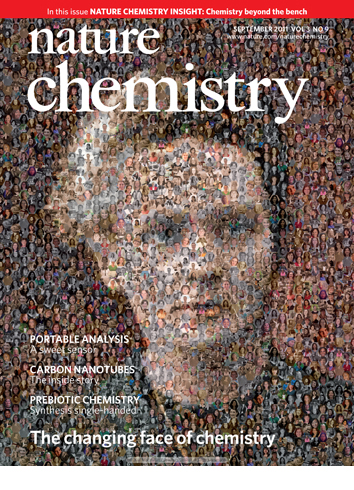
nchemcover.jpg If you haven’t noticed yet, our September issue is a little bit different to all the other issues we’ve published so far. It contains what we call an ‘Insight’, which in this case is a collection of Commentary articles that look at broader issues in chemistry beyond the science itself. We’re doing this to mark the International Year of Chemistry – which happens to coincide with the 100th anniversary of Marie Curie being awarded the second of her Nobel Prizes (the chemistry one).

One of the Commentary articles was written by Michelle Francl – who is moonlighting from her usual job of writing Thesis articles for us. We asked Michelle to write about Marie Curie and how the representation of women in science has changed in the last 100 years. Even before the first draft of Michelle’s article landed in my inbox, she’d come up with a great idea for how to illustrate her article: a picture of Curie as a mosaic made up of photos of female scientists.

This was a fantastic idea, but getting permissions to use a large number of images filled me with dread. Nevertheless, Michelle sent along a mock up of the sort of picture she was suggesting by using images from Google — and it proved just what a great idea it was. Obviously we can’t just scrape the internet for images and then publish them; that would get us into a lot of trouble. We needed to get photos from scientists who wanted to be part of the mosaic and who would be willing to sign a form saying that we could use their photo.

Michelle was so enthusiastic about the mosaic from day one, that we decided we’d give it a go (and the mock up did look quite stunning). Putting down her pen and picking up her camera, Michelle turned photographer instead of writer and started snapping pictures (and made sure those forms were filled in). As the project gained momentum, members of the editorial team e-mailed some of their contacts to see if others wanted to take part. And we also decided that as well as using the image to illustrate Michelle’s article, it should feature on the cover of the journal.

Not only did we get lots of photos from people we contacted, but we got even more photos from others who had had the original e-mail forwarded on to them. I’m not exactly sure of the final count of different people we received photos from, mostly because some people sent more than one photo and some photos contained more than one person. What I can tell you is that we ended up with 270 photos. And then it was time to create the mosaic…

Michelle suggested we used MacOSaiX — and once I discovered you can have hexagonal tiles, I was sold. (There are plenty of other mosaic apps out there, including ones that are not just for Macs). So that we’d have more than just 270 photos and a better colour range, I created black and white versions of each photo and also sepia versions. For a bit of extra variation, I also cropped each original image more tightly to generate another set of photos. All told, that meant 1080 photos.

The mosaic template I chose was 45 × 50 tiles, so 2250 tiles in total. There is a higher-resolution version of the cover available here, and if you look closely, you will definitely see that some photos were used much more than others (I had no control over this…). And I also had no control over where photos were placed, so apologies go to anyone who might have ended up behind the Nature Chemistry logo or the red banner at the top of the cover.

Anyway, thanks to everyone who took part and agreed to be on the cover. I think it’s our best cover yet and will take some beating! If you contributed to the mosaic, we encourage you to leave your name and a comment below!

Stuart

Stuart Cantrill (Chief Editor, Nature Chemistry)

Reactions – Andrei Yudin

Andrei K. Yudin is in the Department of Chemistry at the University of Toronto and works on chemical synthesis of functionally significant molecules.

1. What made you want to be a chemist?

Way before I got interested in chemistry I had started drawing and painting. This is where my passion was then and continues to be now (besides science). When I got exposed to organic chemistry I realized that my drawing skills were really helping me in class. I was completely “sold” when I found out that it was possible to represent chemical properties by using neatly drawn abstractions such as chemical structures.

2. If you weren’t a chemist and could do any other job, what would it be – and why?

There is no doubt in my mind that it would be fine arts. I do this regularly even now by attending weekly life drawing sessions at the Toronto School of Arts and the Arts Gallery of Ontario. This is what I will do 100% when (and if) I retire.

3. What are you working on now, and where do you hope it will lead?

We are working on the so-called amphoteric molecules. They contain counterintuitive combinations of mutually exclusive functional groups (for instance – an amine and an aldehyde). It is a simple concept but the resulting reagents help us design effective syntheses with high bond forming efficiency. In terms of applications, our current focus is on what we like to call cycloinformatics. It deals with the emergence of functionally significant folded structures out of large macrocyclic molecules. We want to be in a position to offer synthetic processes that will help define rules that govern both protein target selectivity and cell permeability of protein fold mimetics.

4. Which historical figure would you most like to have dinner with – and why?

This will have to be Paul Cezanne. He had a rare gift to discern similar tonal values among different colors. In his work, Cezanne was able to create an infallible perception of depth using tone alone, by making a mosaic of tiny brush strokes of color. There was a rhythm in his brushstrokes, you can see it and feel it. His colors vibrate after all these years and nothing is ever static in his work. Towards the end of his life he foreshadowed cubism through his use of tonal values (take a look at his late Mt. St. Victoire paintings). This is whom Picasso (whom I like but am not too passionate about) learned cubism from.

5. When was the last time you did an experiment in the lab – and what was it?

I love synthetic electrochemistry. The last time I ran a reaction (sadly) was about 9 years ago. We plugged two platinum electrodes into an acetonitrile solution (with some supporting electrolyte) and made an oxidized heterocycle. I will probably go back to that soon since students really shy away from electrosynthesis and I want to keep convincing them (haha – every 9 years!) that there is not much to it, really.

6. If exiled on a desert island, what one book and one music album would you take with you?

As far as music I would take Prokofiev’s violin concertos (with Oistrakh) and Shostakovich’s 24 preludes and Fugues (by Nikolaeva). In terms of a book – it would be Sholokhov’s “Tihii Don” (in Russian, it will be “Quiet Flows the Don” in English).

7. Which chemist would you like to see interviewed on Reactions – and why?

I would suggest Bruce Maryanoff. He is someone who has a ton of great science stories to tell about how medicinal chemistry is done. He is also a great connoisseur of wine and I am hoping he will share a few anecdotes as well! I would also suggest my good friend Christophe Coperet, who is working in the area of heterogeneous catalysis and has done some wonderful work there (by coincidence, also a real expert in wine!).

Element of the month – Under sulfur’s spell

In this month’s ‘in your element’ article (subscription required), Thomas Rauchfuss from Illinois points out curious trends in sulfur’s chemistry.

As it turns out, sulfur is a little difficult to describe in a concise manner: although in its elemental form it mostly adopts a crown-shaped 8-membered ring structure, it also exists in 7-membered rings (those are the bright yellow ones) and even traces of smaller rings; and it happily converts to a one-dimensional elastomer when heated. Its anions also like to form chains, which can be extended or reduced, and easily catenated, through redox chemistry.

Similarly, its reactivity can be puzzling, and in particular its catalytic activity. Even though sulfur is well-known to poison industrial catalysts, it actually acts as a catalyst in biological systems — among many other roles. Metal sulfide clusters can quickly transfer electrons, a very desirable property for catalytic functions, and are widespread in biology. Take methanogens, for example, those microbes that produce methane under anaerobic conditions, thus contributing to global warming. Although the precise mechanism continues to intrigue chemists, at least one step involves breaking a methyl–sulfur bond. A reverse reaction, catalyzed by nickel, is now also attracting attention. Another example is the microorganisms that also use metalloenzymes with iron–sulfide sites to convert CO2 to CO or N2 to NH3. Check out the article to find out other sulfur roles.

Even its spelling is a little controversial, with both ‘sulfur’ and ‘sulphur’ widespread in the literature — have a look at our editorial (free but you have to be (freely) registered on nature.com) to find out why we’ve adopted ‘sulfur’ (and nope, this time it’s not simply the Oxford English vs American English spelling, the arguments are more etymologic).

Anne

Anne Pichon (Associate Editor, Nature Chemistry)

Reactions – Guru Row

Guru Row is in Solid State and Structural Chemistry Unit at Indian Institute of Science, Bangalore, India and works on aspects related to chemical crystallography and materials design which include topics like charge density analysis in molecular crystals, in situ cryo-crystallography, polymorphism and co-crystals in pharmaceuticals.

1. What made you want to be a chemist?

Well it is an interesting story. I started as a physicist, did my masters in solid state physics and appeared for interview in the physics department at the Indian Institute of Science. I was elected to work with Professor K. Venkatesan (who worked with Professor Dorothy Hodgkins as a post-doctoral fellow and was involved in the structure determination of Vitamin B12), who has just moved from University of Madras and had joined the department of organic chemistry as a crystallographer. So, I ended up getting my PhD degree in organic chemistry and then on became a chemist!

2. If you weren’t a chemist and could do any other job, what would it be – and why?

I would have been a student of physics and maybe I would have ended up as a macromolecular crystallographer rather than a chemical crystallographer.

3. What are you working on now, and where do you hope it will lead?

Currently, I am working on the evaluation and importance of intermolecular interactions in molecular crystals by charge density analysis. Professor Gautam Desiraju and myself with our students have developed a new methodology (SBFA) which allows for the transfer of charge densities of fragments called synthons from one molecule to the other. We believe that this work will have a major impact in understanding mechanistics of binding of drugs in macromolecules.

4. Which historical figure would you most like to have dinner with – and why?

Of course with Professor Albert Einstein, both of us are vegeterians.

5. When was the last time you did an experiment in the lab – and what was it?

This was a couple of weeks ago when one of my students had a difficulty in mounting a hygroscopic crystal in a Lindemann capillary. I will be regularly helping my students when they have difficulties in solving or refining crystal structures.

6. If exiled on a desert island, what one book and one music album would you take with you?

I always like to have and read and reread Alice in Wonderland, every time I read it, I come up with new thoughts. I am not a music fan, however I like to listen to old Hindi movie songs.

7. Which chemist would you like to see interviewed on Reactions – and why?

No one in particular, I believe every chemist would have interesting stories to tell as they work in the laboratory with chemicals and interesting students.

ICBIC15: Feeling jaded?

Greetings from Vancouver, where I am attending ICBIC15 – the international conference on bio-inorganic chemistry. As the name suggests, this is the 15th instalment of this series of conferences…or is it? There have been quite a few mentions of a mysterious ‘ICBIC zero’, which happened 35 years ago, also here at the University of British Columbia in Vancouver. Chris Orvig, the chair, showed us the programme from that meeting during his welcome address – as organizer, he was interested to see that there were no times for any of the talks, just ‘morning’ or ‘afternoon’! The only speaker at that conference who is also speaking this year is (no prizes for guessing) Harry Gray, who is quite a godfather of this field.

He’s not the only godfather though, and many long-standing members of this quite friendly community are giving jade anniversary lectures, to celebrate the 35 years passed since ‘ICBIC 0’. These jade lectures aren’t the plenaries, however: these are being given by speakers who have never given plenaries at an ICBIC before. All this adds up to a pretty good mix, because there have been some excellent plenaries from speakers at the younger end of the spectrum.

There is a bit of drawback to these lectures (and not just that the conference programme has been printed black and white, so the jade lectures don’t stand out like they do in the PDF): the difficulty of trying to fit a lot of work into just 20 or 30 minutes! After complimenting Ed Solomon on doing well to keep to his 20 minute slot, Harry Gray said he was going to go one better and fit 35 years of work on electron transfer in proteins into 3 slides! He just about managed…

One of the jade lectures that I enjoyed the most was from Karl Wieghardt, and he almost managed to get through his whole talk without moving past the title slide! He was talking in the radical enzymes and non-innocent ligands sessions and certainly convinced me that bipyridine and terpyridine aren’t anywhere near as innocent as people think. Terpyridine in particular can take on four electrons and thus have five different oxidation states and a variety of spin states. Although that’s not what it says in Cotton & Wilkinson, it’s what the X-ray data and DFT calculations suggest.

As this is quite a distinct and friendly community, I’m going to leave the last word to Harry Gray. In his talk he mentioned that the two most important reactions in the world are photosynthesis and respiration. As he said, they’re both firmly in the bio-inorganic field…so tell that to the organic chemists!

Neil

Neil Withers (Associate Editor, Nature Chemistry)

Reactions – John Spevacek

John Spevacek is at Aspen Research, and works on thiol-ene polymerization, mostly with UV initiation.

1. What made you want to be a chemist?

In grade school, I wanted to grow up and become a mad scientist, blowing up the lab everyday just for the devious fun of it. While I did become a chemist, I have scaled back on the rest of that dream somewhat (no explosions yet, just a few very small fires).

2. If you weren’t a chemist and could do any other job, what would it be – and why?

A professional bicycle racer. Not as a Tour de France rider, but a one-day-race rider, competing in Paris-Roubaix or Fleche Wallone. Anytime I ride my bike, I feel young.

3. What are you working on now, and where do you hope it will lead?

We are looking to incorporate more non-petroleum based chemicals and materials into our products. Petrochemicals will be around far longer than most of the doomsday predictions we hear, but they will become increasingly expensive. This will make it easier to economically justify alternatives, and if the economics aren’t there, large-scale production just won’t occur. I’m also excited that these new sources of materials (microbes, algae…) will give me access to monomers that are otherwise too difficult and expensive to produce from petroleum resources.

4. Which historical figure would you most like to have dinner with – and why?

Benjamin Franklin would be wonderful as he was involved in so many areas of science, government and diplomacy. Plus I could rib him about getting the direction for flow of electrons wrong, while Emil Fischer, a chemist, got the stereochemistry of sugars correct.

5. When was the last time you did an experiment in the lab – and what was it?

As my company doesn’t employ many technicians, I am constantly in the lab. Don’t considered that a complaint. Being in the lab is the other activity that makes me feel young. I am always trying different combinations of monomers and photoinitiators in order to change the properties of the final polymer. The latest effort is to use a bio-based material as a chemical feedstock, not just as a filler or a reinforcing agent. The challenge is that the material is not pure and has multiple reaction sites. Finding the appropriate reaction conditions is far more challenging than when you get your chemicals in labelled bottles.

6. If exiled on a desert island, what one book and one music album would you take with you?

Choosing the book would be difficult. There are so few that I would like to reread, and I wouldn’t want to take a chance on an unread book. The collected plays of Shakespeare would be a safe bet, and “The Tempest” would be the most appropriate, wouldn’t it?

As for the album, that’s a much easier choice: Rachmaninoff’s 2nd Piano Concerto, recorded by Jean-Ives Thibaudet, classical music that I didn’t know about until my wife introduced me to it.

7. Which chemist would you like to see interviewed on Reactions – and why?

Professor Robert Bryant of the University of Virginia. He taught my freshman chemistry class at the University of Minnesota in 1980-81, a class for which my high school had left me woefully underprepared. With his help, I survived quite well and have had an enjoyable career, so I’m curious as to what his answers would be.