Blogroll: Toxicity and death

Editor’s note: Now that Neil has left the Nature Chemistry fold to move over to Chemistry World, we have invited bloggers out there in the wild to compose our monthly Blogroll column. Second up is Paul Bracher.

———-

Bloggers breathe life into wounded chemicals and contemplate the death of organic synthesis.

For about a week, the chemical blogosphere became a toxic environment, but the only thing that bloggers sought to poison was public misperception. In a carnival spearheaded by Matt Hartings of American University, over 20 bloggers authored posts about their favourite toxic chemicals. Hartings hosted the carnival on his site, ScienceGeist, in an effort to emphasize that many chemicals demonized in the media as ‘toxic’ have safe uses of immense practical value. “Chemicals aren’t inherently good or bad,” he writes, “in most cases, the danger is in the dosage.”

Dr Rubidium, an analytical chemist who blogs at the Journal of Are You Fucking Kidding, contrasted several cases of homicide by the paralytic agent succinylcholine with its medical use in life-saving tracheal intubations. Although that post was shockingly free of swear words, an ode to tetracyanoethylene (TCNE) on Carbon-Based Curiosities was as vulgar as it was informative. Long-time blogger Excimer noted that “even the chemical industry is starting to shy away from chemicals” before proudly hailing applications of TCNE in the synthesis of the first organic ferromagnet and as a “highly efficient unicorn killer.”

And speaking of death…debate over whether to sustain research in organic synthesis flared up again when Chemjobber sifted through a 120-page report on graduate education and found a rather provocative question inspired by Harvard chemist George Whitesides: “Should U.S. graduate students be doing organic synthesis if most organic synthesis is being done in China?”. Derek Lowe at In the Pipeline prefaces his analysis with the statement, “If it hasn’t crossed your mind, you haven’t thought hard enough about the issues yet.”.

Written by Paul Bracher, who blogs at https://blog.chembark.com

———-

[As mentioned in this post, we’re posting the monthly blogroll column here on the Sceptical Chymist. This is August’s article]

Reactions: Tom Mallouk

Tom Mallouk is in the Department of Chemistry at the Pennsylvania State University, and works on nanomaterials of relevance to problems in energy conversion, catalysis, and electronics.

1. What made you want to be a chemist?

As an undergraduate I was majoring in chemistry for not very good reasons when I starting doing research with Prof. Aaron Wold at Brown University. He inspired me and my fellow students (many of whom are now professional chemists and leaders in their fields) with his encyclopedic knowledge of solid-state chemistry and his love of discovering new compounds and structures. It was my first glimpse of chemistry as a living science, and of the fun and the power of making new materials.

2. If you weren’t a chemist and could do any other job, what would it be – and why?

I’d have to go with professional baseball player, preferably with the Boston Red Sox or the Oakland A’s. But if excluded from that career or from the entertainment industry by my lack of talent, I would choose to work in education or public policy. I like teaching, and I think teaching science well at all levels is very important. The world is facing some big problems and choices in the areas of energy and climate change. This is really the greatest challenge of the next decade or two. Probably the most effective thing we can do about it as scientists is to communicate what we know.

3. What are you working on now, and where do you hope it will lead?

We have a number of projects related to solar energy, including solar water splitting and improving the ultilization of light by solar cells. We are part of a collaborative project on nano- and microscale motors that we hope will one day lead to robotic microsurgeons and other diverse applications. We are also working on the chemistry of layered materials, which are interesting for catalysis, electronics, and electrochemical energy storage.

4. Which historical figure would you most like to have dinner with – and why?

Without singling any one out, I’d like to have dinner with the people who founded religions to see if any of them had an idea of the kind of trouble they were starting.

5. When was the last time you did an experiment in the lab – and what was it?

My wife, who is not a chemist but brilliant in many ways, convinced me to take our recent sabbatical in Paris, and one of the wonderful things about that was being able to work in the lab until about 2 pm before the first distracting email arrived from the U.S. The last successful experiment I did there was in 2010, in collaboration with Mauricio Hoyos. We accidentally discovered the ultrasonic propulsion of microscopic metal ‘rockets’ in fluids and it has since turned into a very interesting project. I did some unsuccessful experiments with two other collaborators, Leila Boubekeur and Christian Amatore, trying to grow self-assembled monolayers on tungsten microwires. We still haven’t completely given up on that idea.

6. If exiled on a desert island, what one book and one music album would you take with you?

I would like to have a practical book on how to build a sailboat from driftwood and palm fronds. For the music, is a double album OK? (e.g., George Harrison’s ‘All Things Must Pass’) If not, I’d choose ‘American Beauty’ (Grateful Dead) or ‘Down Home’ (Seals and Crofts). After 40 years I’m still not tired of listening to them.

7. Which chemist would you like to see interviewed on Reactions – and why?

Three academic chemists whose careers are inspiring, and whose comments are always interesting, are John Goodenough, Allen Bard, and George Whitesides.

August 2012 issue

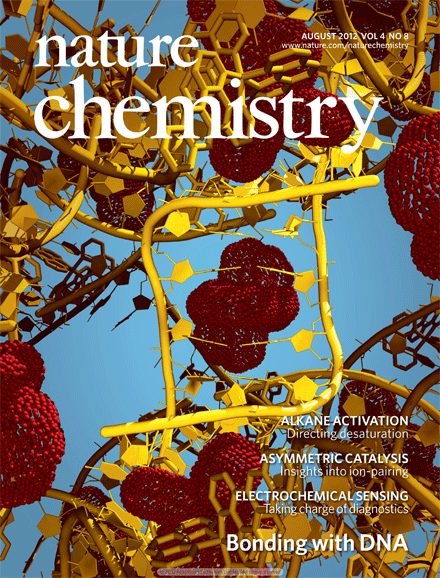
Our August issue went live today and so I thought I’d give you all a quick tour and point out some notable content and a few ‘firsts’. The issue includes a focus on small molecules that bind to DNA, specifically metal complexes. All of the content that makes up the focus (the editorial, an interview with Claudia Turro, an Article from Jackie Barton and co-workers, an Article from Christine Cardin and co-workers, and a News & Views article from Stephen Neidle that looks at those two research papers) is free until August 23rd. And if that’s not enough, Christine Cardin has posted a short video to YouTube about her Article.

Elsewhere in the issue (and all of this is subscriber only – sorry!) there is a guest Thesis article from Jean-François Lutz, who suggests that chemists should slow down a little in the pace of their research. Here’s a short excerpt to whet your appetite:

The quantity of new information published every week in chemistry and closely related disciplines has become so great that today a rapid glance at table-of-content graphics has often replaced in-depth reading of articles themselves. A recurrent question in this context is whether all of this literature is necessary? It seems obvious that many newly published articles are routine studies that are often a repetition, with small variations, of existing concepts.

In addition, there is also a Review article from Dean Toste and co-workers about the use of chiral anions in asymmetric catalysis, lots of great research Articles on a wide range of topics (total synthesis, organic electronics, synthetic methodology, electrochemical sensing, reaction dynamics, and more), and another competition-winning In Your Element essay — this one from Michael Tarselli on nitrogen (this should be free to nature.com registrants).

And now, those ‘firsts’. We’ve reviewed books and TV shows before in the Books & Arts section, but in this issue we review an app for the first time. Jon T. Njardarson reviews SANROS (Strategic Applications of Named Reactions in Organic Synthesis) by László Kürti & Barbara Czakó. And finally, we have another first in the Blogroll column, written by Paul Bracher. The column includes mentions of Dr Rubidium, Excimer, ScienceGeist, Chemjobber and Derek Lowe. But that’s not the new bit… Paul’s written a blogpost explaining what is somewhat unique about his column (strong language included in that link).

We hope you enjoy the issue!

Stuart

Stuart Cantrill (Chief Editor, Nature Chemistry)


IMAGE: CHRISTINE CARDIN AND JAMES HALL

COVER DESIGN: ALEX WING

Transatlantic Tales: The PhD question

Posted on behalf of Nessa

————————-

I’m now getting used to the US, having been around for a month — stopped being hyper-aware of the accents and looking the wrong way when crossing the road and such. Urbana-Champaign is a pretty place with strong historical foundations and lots going for it scientifically. Already I’m starting to think about how gutted (but a bit relieved) I’ll be when I have to leave in September!

The one matter that keeps coming up when talking to my co-workers here is about the PhD system. The postdoc:PhD student ratio in most groups is a lot lower here because of how the funding works — although maybe that makes sense, as chemistry PhDs take an average of five years to obtain in the US, and often longer. Everyone here advises me to apply for my PhD in America, whereas scientists at home in England are saying stay in Europe…

The US system is a lot more structured than the British ‘turn up and do some research, then a bit later put Dr in front of your name’. You have to take classes in all kinds of things, even including inorganic and/or physical chemistry if you’re specializing in organic like me. Then there are other classes on hilarious topics like how to write reports or give presentations, which to me sound like general studies at A level, i.e., about as practical as a chocolate rotovap. Teaching classes and labs is expected, which is nice as it means your supervisor can’t say no if you want to do it, but also means that no one can get the upper hand for later life by making sure they get in the extra experience. You also seem to see a lot more of your supervisor in general here (decide for yourself whether that’s a good thing or not!), and as people keep pointing out to me, the three best universities in the world are US institutions (although I reply that they could only get there by copying Oxbridge).

So if American PhDs really are better respected and better for your career — why does anyone do their PhD in Britain? Well apart from obvious additional factors like Brits wanting to stay close to home, the truth is that most of my lecturers in Oxford scoff at the idea of a 7-year PhD. I admit I’m not sure I like the sound of years and years, flitting about from project to project. The overwhelming mood in Britain is ‘why bother? When you can get the same qualification in half the time’.

At the end of the day if you’re in this dilemma, the best path is to try and get into somewhere where you can do the best science for you. And that includes factors such as funding, the culture of the place you live in, and how close you are to friends and family. PhDs: they’re not just black and white.

Nessa (you can find me on G+ here)

Reactions: Margit Müller

Margit Müller is in the Department of Drug Design and Pharmacology at the University of Copenhagen, Denmark, and works on calcium and cAMP dynamics in brain energy metabolism — she is also one of the winners of our In Your Element essay competition (we’re hoping to feature all of the winners on Reactions over the coming months).

1. What made you want to be a chemist?

When I was fourteen years old I attended a university biochemistry lecture given by my father. I don’t recall the topic of this lecture, but I remember vividly how he explained the interconnections of single molecules in enormous and dynamic biochemical networks and how, during the course of his explanations, these networks slowly started to make sense. Also, I remember him instructing the students not to learn these things by heart, but to understand them. This was the first time I experienced a scientific view of the world and the moment I first wanted to become a scientist.

2. If you weren’t a chemist and could do any other job, what would it be – and why?

As a child I always wanted to be a writer and ever since then this idea has been living in a tiny corner of my brain, so…

3. What are you working on now, and where do you hope it will lead?

I am studying calcium and cAMP dynamics in connection to brain glycogen and am hoping to find out why our brains seemingly “waste energy” on storing glycogen.

4. Which historical figure would you most like to have dinner with – and why?

I would choose Ludwig van Beethoven. I grew up deeply admiring him and I don’t want to imagine what the world would sound like without his music.

5. When was the last time you did an experiment in the lab – and what was it?

Last week I used fluorescent calcium indicators to monitor signal transduction in neurons.

6. If exiled on a desert island, what one book and one music album would you take with you?

I would pick Rainer Maria Rilke’s poems, because I would miss poetry more than stories.

My one music album would be Ludwig van Beethoven, The 9 Symphonies, played by the Berlin Philharmonic Orchestra with Herbert von Karajan conducting.

7. Which chemist would you like to see interviewed on Reactions – and why?

Someone working in eastern Europe, because we don’t hear enough from there.

Peculiar protactinium

In this month’s ‘in your element’ article (subscription required), Richard Wilson from the Argonne National Lab presents some peculiar aspects of protactinium’s history and properties.

One of protactinium’s particularities is that it was independently identified (and named) twice, just a few years apart. In 1913, Kasimir Fajans and Oswald Helmuth Göhring discovered a short-lived element 91 (234mPa) — whose half-life was only one minute — which they accordingly named brevium. A few years later, in 1918, when Lise Meitner and Otto Hahn were examining a silica residue extracted from pitchblende, they successfully identified the element that decays into actinium. It turned out to be a different isotope of brevium (231Pa) — but one that had a much longer half-life. This gave their suggested name, protoactinium (which later evolved in the simpler protactinium), the edge over Fajans’ brevium.

© SHUTTERSTOCKPHOTO.COM
TISCHENKO IRINA

Protactinium isn’t really so well-suited to extensive, thorough, detailed characterization — it is rare, difficult to isolate, highly radioactive and toxic. It further confused chemists by its seemingly contradictory properties. Was it a transition metal, as its pentavalent oxidation state seemed to suggest? An actinide, owing to its tetravalent oxidation state available on reduction? The situation became clearer once the place of actinides in the periodic table was established — yet protactinium still differentiates itself from most actinides, find out how in the article.

Despite a period of activity related to thorium-based nuclear power, protactinium hasn’t elicited much interest in terms of practical applications. Its electronic structure however, especially owing to its 5f electron, makes it a very valuable element in computational studies to understand the reactivity of 5f elements. As Richard Wilson observes, “[protactinium’s] future contributions to chemistry may well come from where Meitner and Hahn first found it, in silico”.

Anne
Anne Pichon (Associate Editor, Nature Chemistry)


Reactions: Christine Cardin

Christine Cardin is in the Department of Chemistry in the University of Reading, and works on the crystal structures of both small and large molecules. Her particular interest is nucleic acid crystallography, and she loves working at the Diamond synchrotron, near to Reading.

1. What made you want to be a chemist?

My father gave me lots of encouragement. He came from a family of Manchester engineers and had himself studied maths, as my son later did.  I was his eldest daughter, and he had no sons. I think he could see that I had the practical aptitude (which he lacked) and thought that a woman would have more chance in chemistry than in engineering. I had a very enthusiastic (female) chemistry teacher from the age of 16 who suggested I apply to Oxford – chemistry was a fashionable subject back then, and Oxford was the best place, so I was astonished when I was offered an scholarship, and felt my path had been chosen for me. Chemistry was fun, and seemed a great escape from all sorts of mundane matters into a world of ideas.

2. If you weren’t a chemist and could do any other job, what would it be – and why?

There are some professions that seem to generate people who live long productive lives, or perhaps it’s that they attract them in the first place. I’m thinking of creative people such as orchestral conductors and pianists, who often continue well into their eighties and nineties. But gifted scientists like Max Perutz were also like that. My careers advice has always been to find out what you love to do and get paid for it, and now it might include using some  interest or skill which will last for the whole of your life. On that basis, perhaps I should have been a travel writer. I could go round the world by train and ship, and write about that.

3. What are you working on now, and where do you hope it will lead?

As a crystallographer, I find that seeing is usually believing. I like working with people who have a mental picture of how their molecule or interaction will look, and want to see if it’s right. Sometimes they don’t like the answer, but that’s another story. So, right now, we want to link our recent work on crystal structures showing how ruthenium ‘light-switch’ complexes bind to nucleic acids to their photochemistry. Can we use crystallography to capture some photochemistry in action? That could be exciting. We’d love to take a nucleic acid crystal containing a photoactive species of some sort, shine a light on it, and see the result in the crystal. The Diamond synchrotron is well set up for this sort of thing, and we would get some insight into DNA damage mechanisms.

4. Which historical figure would you most like to have dinner with – and why?

Hmm, that’s a hard one. It would also be interesting to think of where you could have eaten, and what dining locations fostered the development of science. I used to work in Trinity College Dublin, whose Dining Hall must have hosted some eminent scientists  for erudite discussions. There I was once shown a letter from Charles Darwin, perhaps he also visited that Dining Hall, and would have had some interesting stories to tell. A person I would like to have met, perhaps over a meal in Turin, was the great Italian and chemist Primo Levi. He most famously wrote about his Auschwitz experiences in ‘If this is a man’, but his 1975 book ‘ The Periodic Table’ is a wonderful autobiographical, but short, book, in which each chapter is named after a chemical element. It’s a masterpiece of conciseness, so there must be so much more he didn’t say.

5. When was the last time you did an experiment in the lab – and what was it?

Last night I was looking at some crystallisation experiments in the microscope, that’s my therapy. It’s like a gardener checking on how the vegetables are coming along.

6. If exiled on a desert island, what one book and one music album would you take with you?

I’m not very good at hypothetical situations. But my daughter has recorded some of her music, and the sound of her singing to her guitar would keep my spirits up more than anything. We have hundreds of classical CDs at home, but I couldn’t choose between them. Any Mozart opera would be good, though.  I should probably take the last novel I started reading and still haven’t finished, a year or so later, Haruki Murakami’s ‘Norwegian Wood’. Murakami was reacommended by my daughter and I did read ‘Kafka on the Shore’ which has a strange hypnotic quality.

7. Which chemist would you like to see interviewed on Reactions – and why?

My former PhD supervisor Mike Lappert. He’s how I met my husband, David. He’s still travelling the world as a chemist, and it’s keeping him young.  He’s also the person that suggested I try crystallography, guessing that I might perfer that to organometallic synthesis. I never really looked back.

Reactions: Bas de Bruin

Bas de Bruin is in the Department of Homogeneous and Supramolecular Chemistry at the van ‘t Hoff Institute for Molecular Sciences (HIMS) at the University of Amsterdam (UvA), and works on catalysis research. He specifically focusses on fundamental development of homogeneous catalysis with metals in unconventional oxidation states and with unconventional ligands, aiming at the development of new catalytic reactions.

1. What made you want to be a chemist?

As a boy at the age of 10, I got inspired by visits to the laboratories of the KEMA institute in Arnhem (Netherlands), where my father took me sometimes. Since then I already wanted to become a chemist. This has not changed since.

2. If you weren’t a chemist and could do any other job, what would it be – and why?

I would probably be working in physics or biology, areas which have always appealed to me besides chemistry. I could well imagine exploring the fascinating world of deep-sea marine biology, for example.

3. What are you working on now, and where do you hope it will lead?

I am currently working on a quite broad range of topics, all involving coordination chemistry, organometallic chemistry and catalysis. My primary interest is to understand reactivity, in a broad sense and in particular around transition metals. I am involved in explorative design and synthesis of new materials based on highly functionalised polymers, metallo-radical chemistry, carbene and nitrene transfer reactions, modelling transition metal catalysis (combination of synthetic modelling and computational catalysis), and EPR spectroscopy (combined with computational methods), as well as the development of applied homogeneous catalysts in unconventional oxidation states and/or with unconventional ligands. Current and long-term future activities aim at development of new (supra)molecular catalysts and (polymeric) materials, focusing on increasing demands to uncover new catalysts for new desirable and atom & energy efficient transformations providing several opportunities for new research lines.

4. Which historical figure would you most like to have dinner with – and why?

I am fascinated by the history of Fritz Haber. This German scientist saved many people from starvation (Haber-Bosch process) and developed several important concepts in chemistry (e.g. Born-Haber cycles). However, he was also named the “father of chemical warfare” as a result of his work in developing nerve gasses during World War I. He lived in a dangerous, dynamic and fascinating time. It seems intriguing to me to talk to this controversial man about the role he played in history.

5. When was the last time you did an experiment in the lab – and what was it?

I still do occasional experiments in the lab myself, but this mostly involves preparing samples for EPR spectroscopic measurements. My last real synthetic efforts were around 2004. Unfortunately, I do not have enough time left to do that anymore myself. Luckily my PhD students and postdocs keep me updated with their fascinating chemistry almost every day.

6. If exiled on a desert island, what one book and one music album would you take with you?

Difficult question. I guess every book and album becomes boring if you are alone on a desert island for a very long time. A survival handbook is probably the smartest choice, but I guess the question involves a novel. In that case I would choose “The world according to Garp” (John Irving). The music album would probably be Communique (Dire Straits).

7. Which chemist would you like to see interviewed on Reactions – and why?

Jonas Peters (Caltech). He seems to be an interesting guy, and his chemistry is fascinating.

Transatlantic Tales: An introduction

Posted on behalf of Nessa

————————-

So, hi everyone! I’ve been asked to write about my experiences coming from Britain to a chemistry lab in the US. I’m an undergrad, just finished Finals at Oxford Uni with another research year left, and this summer I have a placement in an organic chemistry research lab at the University of Illinois at Urbana-Champaign. You might have seen me around a little bit on the RSC blog Confessions of an Undergrad.

I have to admit, moving to Illinois for 3 months was a little bit daunting. I’d never been to the US before, or abroad at all hardly, so it was particularly strange becoming an international student. As soon as I left the airport, I started to notice how everything was just a little bit different. Driving on the right, pizzas the size of bike wheels… nobody warned me about how every single doorknob and lab gas tap turns the wrong way, either!

Anyway you’ll be hearing from me over the next 3 months as to what the differences between research labs on both sides of the Atlantic are. I spent two months last summer in one of the organic labs in Oxford. Let’s see how they compare!

Nessa (you can find me on G+ here)