
Note: Posted on behalf of Pekka Pyykkö, who wrote about gadolinium in our August issue‘s In Your Element article. This post comes in complement to the IYE essay – and is best read after the article. Coincidentally, there is a bit of a connection between Pekka Pyykkö and the discoverer of the rare earths: Pekka’s former position, as Professor of Chemistry, was split off as ‘the parallel chair of chemistry’ in 1908 from Gadolin’s chair of chemistry, which had been established in 1761 at the Royal Academy of Turku (Kungliga Åbo Akademi) in Finland and had been moved to Helsinki in 1828.
– Anne.
Etymology of the name ‘gadolinium’
This new ‘earth’ was first referred to by Marignac with the provisional name of ‘Y α’ (ref. S1). In 1886, it is Boisbaudran who suggested the name of ‘gadolinium, symbol Gd’, noting that Marignac has accepted the choiceS2. Circumstantial evidence from the parallel case of samarium, from the mineral samarskite, from the person Samarskii, suggests that Boisbaudran in that case thought of both the mineral and the man: “je propose le nom de samarium (symbole = Sm) dérivé de la racine qui a déjà servi à former le mot samarskite” (I suggest the name samarium (symbol Sm), from the root that has already served to form the word samarskite)S3. The exact reference for the mineral name ‘gadolinite’ is not available, but we know that Klaproth already used it in 1801 (ref. S4).
The name Gadolin itself has its own history, which dates back two generations before the chemist Johan Gadolin. His grandfather, who came from a farm named Maunula not far from Turku, Finland, needed a surname when he entered the learned path. Re-tracing the name of his farm to the Latin ‘magnus’ 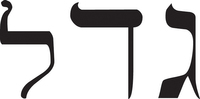 (meaning great), he first adopted Magnulin as his last name. Giving it further consideration, he envisaged both the Greek Megalin and the Finnish Isolin, then finally settled on the Hebrew Gadolin, from ‘gadol’ (pictured), also meaning ‘great’. All university students at the time had to learn Greek, Hebrew and Latin.
First preparation and observation of the element
According to Jørgensen’s accountS5, Marignac separated the rare earths by repeated recrystallization of the potassium double sulphates, K3Ln(SO4)3, and also reported the atomic weights, counted per one oxygen of mass 16. The atomic weight (‘équivalent’) of at least 120.5 for Gd2O3 in his first paper corresponds to a MGd of 156.75 — very close to the modern value of 157.25 (ref. S6). Another characteristic also reported by Marignac was that the oxide was ‘incolore’, meaning with no obvious absorption spectrum.
An interesting twist was the putative observation of phosphorescence, for gadolinium compounds, excited by electric discharges in vacuum — an experiment reported by both CrookesS7 and BoisbaudranS8. A bright green band at 541 and 549 nm was seen. Finally, though, Boisbaudran found that it was not connected to gadolinia and mentions a terbine impurity as a possible source for those bandsS8. This is in good agreement with recent studies of systems with Tb3+ ions, which do have an emission at 544 nm (ref. S9).
Pure metallic Gd was first produced by high-temperature electrolysis by Trombe in 1935 (ref. S10).
Literature
Finally, note that the original papers in French are freely available from the Gallica library gallica.bnf.fr.
References
S1. Marignac, [J-C. G. de] Ann. Chimie Phys.(Paris) 20, 535-557 (1880); Arch. Sci. Phys. Mat. (Genève) 3, 413-438 (1880).
S2. Lecoq de Boisbaudran, P.-E., C. R. Acad. Sci. 102, 902 (1886).
S3. Lecoq de Boisbaudran, P.-E. C. R. Acad. Sci. 89, 212–214 (1879).
S4. Klaproth, [M.H.] Crells Ann. 307–308 (1801).
S5. Jørgensen, C. K., Chimia 34, 381–383 (1980).
S6. Gadolin, J. Kungl. Svenska Vetenskapsak. Handl. 15, 137–155 (1794); Crells Ann. 313–329 (1796).
S7. Crookes, W., (a) Proc. Roy. Soc. 243, 77-80 (1886); (b) Nature 33, 525–526 (1886); (c) Nature, 160–162 (1886) [June 17].
S8. Lecoq de Boisbaudran, P.-E., C. R. Acad. Sci. 103, 113–117 (1886)
S9. Wang, R-F., Zhou, D-C., Qiu, J-B., Yang, Y., Wang, C., J. Alloys Comp. 629, 310–314 (2015).
S10. Trombe, F., C. R. Acad. Sci. 200, 459–461 (1935).