A day of isotopes

This wasn't just a dinner party, this was a defining-moment-in-chemistry dinner party.

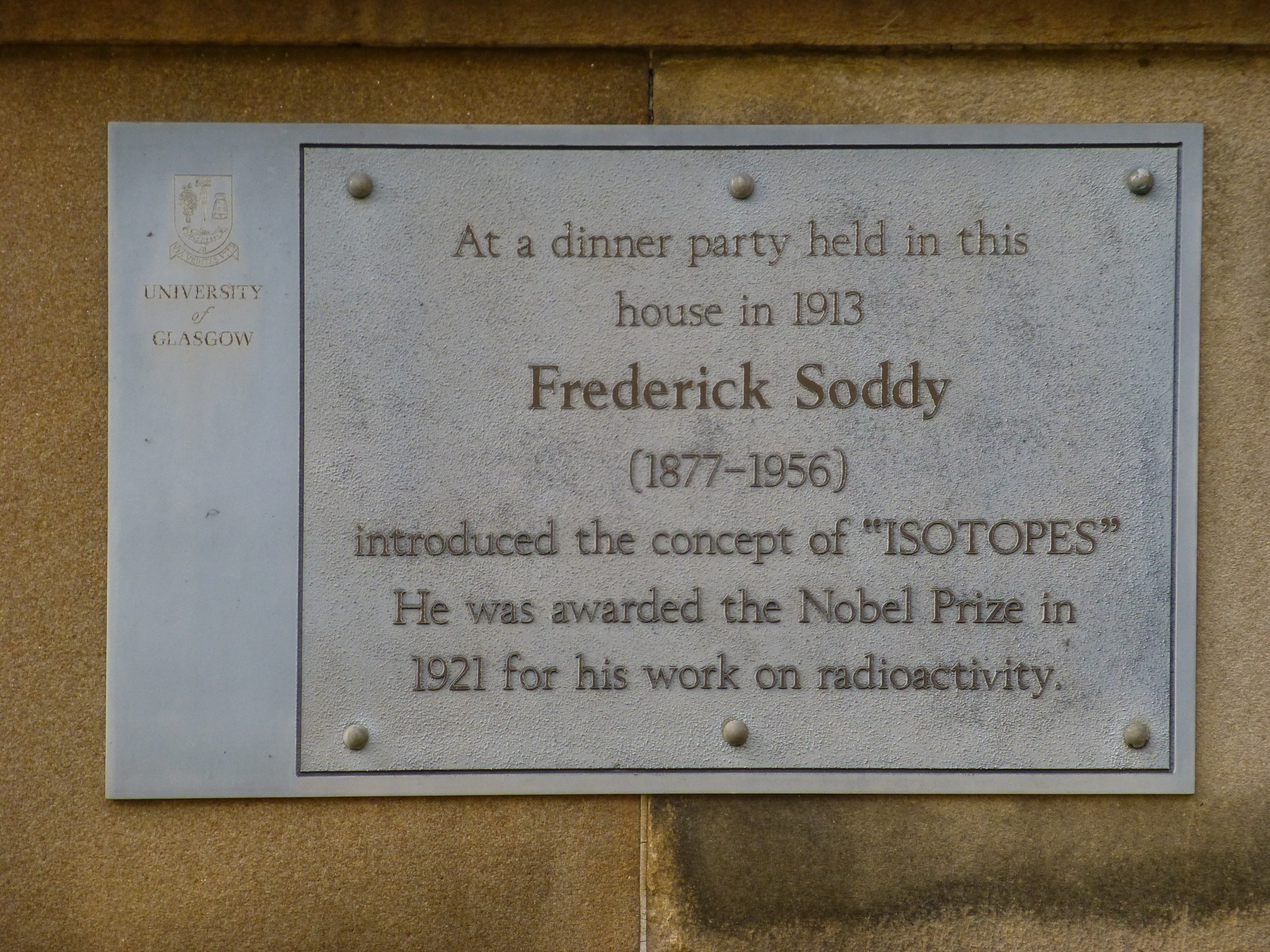
This wasn’t just a dinner party, this was a defining-moment-in-science dinner party. (Apologies to M&S){credit}Courtesy of Ross Forgan{/credit}


Today we published a Thesis article in our December issue (subscription required) that commemorates a century of isotopes — following the first use of the term by Frederick Soddy in the pages of Nature in December 1913. Written by Brett F. Thornton and Shawn C. Burdette, the article describes early work by Daniel Strömholm and Theodor Svedberg on radium, that was largely ignored at the time it was published. The story then turns to Soddy:

The evidence of chemically inseparable elements became more undeniable in May 1913 when J. J. Thomson reported that neon seemed to be made of two gases with masses 20 and 22. Nature then published Frederick Soddy’s proposal on 4 December 1913, which hypothesized that isotopes were “chemically identical elements of the same nuclear charge”. The name isotope, from Greek words meaning ‘same place’, had been suggested to Soddy at a dinner party. Soddy’s Nobel Prize speech nine years later summarized the events surrounding the realization of isotopy, and included an apologetic acknowledgement of Strömholm’s and Svedberg’s research. Much of the early work leading to the rationalization of isotopes was based on classical chemistry techniques rather than physics-based methods, and isotopes were put on a solid footing just before Moseley’s X-ray studies firmly established that each element has a unique atomic number.

Later today, I noticed Chemistry World joining the isotope party, publishing a story by Mark Peplow on ‘A century of isotopes‘. Go and read it to learn about isotope day, what we can learn from isotopes in ancient samples of rock and ice, and the development of deuterated drugs (amongst other things) — I highly recommend it.

Finally a plug for two isotope-related pieces of content we’ve published in the past that were written by Dan O’Leary. He penned the In Your Element essay on deuterium and also wrote a companion piece on the blog that went into more detail about Urey and his involvement with deuterium, as well as the infamous Rosenberg spy case (both of these pieces are free to read).

Blogroll: Turf wars

Editor’s note: As we continue to invite bloggers out there in the wild to compose our monthly Blogroll column, Alasdair Taylor penned the December 2013 column.

———-

Molecular modellers scoop Nobel and a publishing ‘trash heap’ uncovered.

Nobel season has come and gone, with this year’s chemistry prize awarded to Martin Karplus, Michael Levitt and Arieh Warshel. Once more, Paul Bracher at ChemBark must be thanked for collating the runners and riders on his blog. That the prize was awarded for computational chemistry delighted Ash Jogalekar at The Curious Wavefunction, who noted that it recognized both a whole field and the lifetime achievements of the three winners. Realizing that not everyone was happy with the decision, Jogalekar’s delight soon turned to frustration at those chemists who snipe at researchers in other fields of chemistry. As Ash put it, these ‘turf wars’ hardly help improve the public image of chemists.

Speaking of turf wars, a recent sting investigation reported in Science on open-access (OA) publishers caused a stir both in the blogosphere and the mainstream press. John Bohannon, under the superb alias Ocorrafoo Cobange, sent a spoof paper describing the new (non-existent) anticancer properties of a new (equally non-existent) wonder drug to 304 OA journals. It was accepted in 157, occasionally without peer review, despite clear scientific and ethical shortcomings.

“An Open Access Trash Heap” cried Derek Lowe at In The Pipeline, with his two barrels aimed directly at those journals who rip off authors for “whatever fees they can scam”. Open Access advocates, including PLOS founder Michael Eisen, were quick to defend OA publishing, suggesting similar failings would also occur in subscription-only journals. As Jon Tennant, guest-blogging on Matthew Shipman‘s SciLogs page, pointed out, Bohannon’s sting uncovered deeper issues with peer review and editorial processes in general, regardless of publishers’ business models.

Written by Alasdair Taylor, who blogs at https://attheinterface.wordpress.com.

———-

[As mentioned in this post, we’re posting the monthly blogroll column here on the Sceptical Chymist. This is the December 2013 article]

Speaking Frankly: Sanger’s legacy

Editor’s note: Frank Leibfarth is a postdoc who is trying to make his way through the academic maze. Find him contributing to the Sceptical Chymist or continue the conversation on Twitter @Frank_Leibfarth.

– – – – – – – – – – – – – – – – – – –

Frederick Sanger, the British biochemist and two-time Nobel laureate, died this week at the age of 95. He holds the distinction of being the only individual to win two Nobel Prizes in Chemistry and one of only four people to win two Nobel prizes in any field; an honour he shares with John Bardeen, Marie Curie, and Linus Pauling.

Sanger took a fundamentally chemical approach to solve complex problems in molecular biology and genetics. Early on he became interested in the structure and sequence of biopolymers, which led him to study and eventually fully sequence the protein insulin. This feat of ingenuity, chemistry, and spectroscopy led to his first Nobel Prize awarded in 1958. Soon after, he moved from the University of Cambridge to the British Medical Research Council Laboratory of Molecular Biology, where he studied with a slew of young, ambitious, and talented scientists including the likes of Max Perutz and Francis Crick.

Here, Sanger began his work on developing a method to sequence deoxyribonucleic acid, or DNA, the alphabet of heredity. His success in this field, culminating in the development of the ‘Sanger method’ for sequencing DNA, was one of the most important scientific feats of the last century. Originally employed for sequencing the complete genome of a virus and then human mitochondria, the Sanger method would eventually be the primary technology used to complete the sequencing of the entire human genome. Sanger shared his second Nobel Prize in 1980 for his work on sequencing DNA, only three years before his retirement from scientific research in 1983.

Sanger’s legacy will not be one of excess. Despite his groundbreaking contributions, he only published around 100 research articles. The quality of his work is undeniable; each of his publications has been cited an average of almost 1000 times. A commentary penned by Sanger in 2001 provides a rare glimpse into his research philosophies. He worked at the bench throughout his career, preferring to do experiments himself than plan them for others. Furthermore, he mentions the importance of interacting with scientists outside his discipline, “who were interested not only in what they were doing but also in other people’s work and keen to exchange ideas.”

Although Sanger won awards for his landmark discoveries, an underappreciated facet of his contributions was the technology he created to make these discoveries possible. He was primarily interested in developing simple, scalable, and reproducible chemical techniques to sequence these biopolymers. As a result, Sanger’s legacy extends far beyond the sequencing of the amino acids in insulin or the genetic code of mitochondria. His user-friendly methods have been adopted by scientists around the globe and are indirectly responsible for much of our advances in modern medicine.

Sanger’s scientific career ended more than three decades ago, but in many ways he is a model for the next generation of chemists. The day-to-day work in his lab consisted of fundamental chemical investigations of the structure of biopolymers; breaking them down, reconstructing them, and developing analytical methods to see how and where bonds broke and reformed. From a broader perspective, however, Sanger can be rightfully credited with being a founding member of the fields of molecular biology and genetics, a seemingly far cry from ‘traditional’ chemical disciplines. So while some would argue that chemistry is a mature discipline, I contend that well-trained chemists are only scratching the surface of their potential.

There are surely many grand challenges within the discipline, but chemists are broadly trained to be able to make molecules, understand their bonding properties, and connect their structure to function. If elucidating the primary structure of proteins and DNA revolutionized biochemistry in the 20th century, could understanding the structure, interactions, and dynamics of the cell membrane or extracellular matrix do the same in the 21st century? Problems of structure and bonding will always require the skills of a chemist to solve and Sanger recognized that in the 1940s. He has shown us the roadmap, now we only have to follow it.

Materials Girl: Looking back… and forward

[Posted on behalf of Materials Girl]

At the beginning of grad school I was bright-eyed and bushy-tailed, ready to tackle the challenges of being a Master’s student. I went to bed early, then eagerly got up in the morning to continue working. I even won a few awards, thanks in part to jumping into a good research topic. Unfortunately, my youthful fire was extinguished within two years, and wasn’t boosted after deciding to stay for a PhD. Additionally, I was unexpectedly bumped to entirely new projects almost annually — it’s been a challenge to settle on a thesis topic. When the new school year started a few months back, other students in my cohort had similar feelings of stagnation with their research. We’re all getting angsty about graduation (and funding!). Maybe the fifth year’s the charm for us?

Outside of school, fellow students from my undergrad internship [at chemistry R&D division of big company] have taken an amazing array of routes. Recently we had a giant chat on Facebook, catching up on what we’ve done in the past 6 (?!) years and where we’re headed. Our paths include:

– Materials Engineering PhD at U. of Illinois, turned ME Master’s, followed by a Master’s in Teaching of Chemistry. Goal: Teaching middle- or high-school chemistry.
– Law school at Stanford. Goal: Practicing intellectual property.
– Medical school, followed by cardiothoracic surgery in Detroit. Goal: Critical care.
– Psychology PhD at Cornell, turned Master’s. Goal: Working with animal shelters, or teaching math.
– Chemical Engineering PhD at Princeton. Goal: Undecided, with mention of the “3rd year -black hole”.
– Med school prereqs, followed by Teach For America, followed by programming jobs, followed by management at MIT, followed by entrepreneurship. Goal: ??

The rest of us PhD-pursuers are scattered around the likes of Caltech, Cornell, and Berkeley, pursuing research in chemistry, biochemistry, and/or materials. None of us feel strongly inclined towards staying in academia, and some are decidedly against it. (However I’ve seen people go the industry route, then within months are headed back to universities). Two of the bunch are set to graduate next year, and the rest are more in the “??” category. Regardless of our waffling, I’m proud to be part of such a talented group! Seeing the diversity (and number of grad school switcheroos) of my fellows gives me hope. We’re still young, and just at the beginning of our careers. There are still places to go, mistakes to make, and careers to choose — and maybe re-choose!

For readers who’ve gone all the way through the PhD path, where are you now? Was it what you imagined while in school? What words of wisdom would you give a bunch of mid-20-year-old kids?

Note: post updated on the day of posting to include a few minor edits.

Reactions: Philippe Zinck

Philippe Zinck is at the Catalysis and Solid State Chemistry Unit, University Lille 1 (France) and works on polymerization catalysis, with a focus on functional and bio-based polymers. He goes on Twitter by @PhilippeZinck.

1. What made you want to be a chemist?

I studied materials science, because at that time the materials science department of my college was more oriented toward research. I did the first year of my masters as an exchange student in Berlin, and the macromolecular chemistry teacher was really excellent, so I fell in love with that specialty. When I went back to France I chose the polymer chemistry department for the second year of my masters and my lab training period, and I stayed for my PhD.

2. If you weren’t a chemist and could do any other job, what would it be – and why?

Well I think I could have been a researcher in many other fields like physics or biology for example. What really makes me happy in my job is the research adventure. A bit like the ancient explorers, the researcher is discovering new territories, and that’s what makes me happy and excited when I go to work every morning (or almost).

3. What are you working on now, and where do you hope it will lead?

We are just starting a biorefinery project for making bio-based polymers, with several industrial and academic partners. It’s a 10 year project, and you rarely have projects that last so long in our profession. Honestly, I don’t know where it will lead, but it gives me the opportunity to work on issues in society. I hope it will be a success story.

4. Which historical figure would you most like to have dinner with – and why?

Pierre-Gilles de Gennes. I find the way he conducted research fascinating. A lot of his discoveries were achieved through analogies between different research fields. Besides, he was also an excellent teacher, and did a lot to raise high school student’s interest for research. He also took an interest in societal issues. I had the chance to give a seminar in his lab several years ago and to meet him briefly, but not to have dinner with him!

5. When was the last time you did an experiment in the lab – and what was it?

I had to open my lab-book to check. It was in July 2010, I was trying to polymerize some carbohydrate derivatives in a new way, but it did not succeed. These kinds of reactions almost never work, and that would have demoralized the students, so I used to do them myself.

6. If exiled on a desert island, what one book and one music album would you take with you?

I’m hesitating between a world encyclopedia of wines and a longboard user manual, but the latter will definitely be more useful on a desert island! For the music, I’ll take one of Pink Floyd’s albums, probably Atom Heart Mother, a fantastic brass instruments album.

7. Which chemist would you like to see interviewed on Reactions – and why?

Well, I think that green chemistry is more than ever an essential issue for our society, for many reasons that I will not explain here. Scientists from this area should be interviewed on Reactions, like Barry Trost for example, among many others.