Of polemics and progress

As Stuart posted last week, the March issue is now live and it features a ‘web focus’, which is a small collection of articles related by a topical theme and brought together on their own special page on the Nature Chemistry website. The theme of this web focus is protein dynamics and we have two Perspectives (Good vibrations in enzyme-catalysed reactions and Taking Ockham’s razor to enzyme dynamics and catalysis) and an editorial covering the topic.

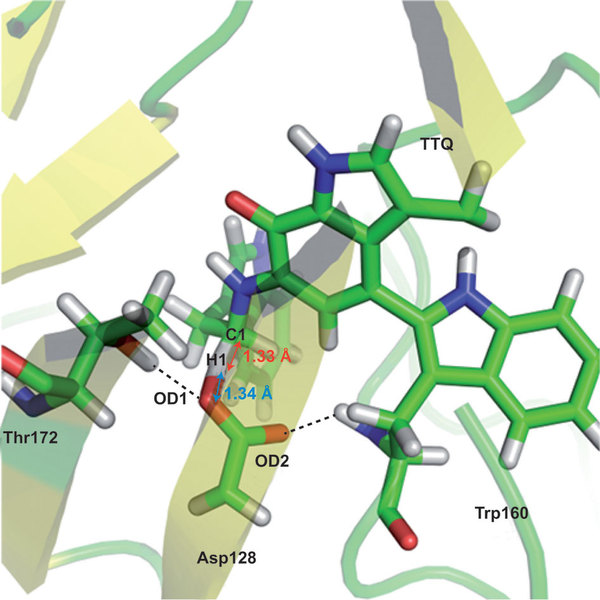
Taken from Glowacki et al.

It’s a somewhat contentious topic, in that many disagree on the effects that structural protein dynamics can have on the reactivity of enzymes. One of our Perspectives highlights evidence in support of such promoting effects and the other backs the stance that they are not required to explain enzyme reactivity.
 
Such disagreements between researchers are a common occurrence in science, and they can have both positive and negative effects on the topic under scrutiny. An abridged version of our editorial, which discusses this in more detail is below. The full text can be accessed here and is available FREE to all registered users. Please do join the discussion using the comments section below.

Gavin

Gavin Armstrong (Senior Editor, Nature Chemistry)

— — — — — — — — — — — — — — — — — — — —

Disagreements are common in science and can lead to better understanding, but must be handled carefully.

Science is, in essence, the pursuit of ‘truths’, but not all seemingly valid hypotheses are accepted as such. From the laws of planetary motion, to the wave–particle nature of light, and through to the recent suggestion of lifeforms that incorporate arsenic into their DNA1, disagreements born of critical thinking have played a central role in answering important scientific questions.

In this spirit we have two Perspective articles2, 3 in this issue that take differing views on the significance that structural dynamics have on the reactivity of enzymes. It is a debate that has been building over the past decade4, 5 and centres on the possibility that the motions of enzymes could amplify the contribution that quantum mechanical tunnelling makes to their activity.

The fact that the conformational movements of proteins can be integral to their function is broadly accepted. They can be important to ligand binding and release, and in allowing access to a given active site through large-scale loop–lid movements. The debate arises when discussing the reaction step that the enzyme catalyses, the all-important transition from reactant to product. At this point, how important are the fast structural fluctuations of the protein, motions such as vibrations? Can they significantly promote a reaction or can enzyme reactivity be accounted for with a model based on transition-state theory, which does not consider such individual atomic motions?

A Perspective article from Sam Hay and Nigel Scrutton highlights2 the evidence in favour of such promoting motions and an alternative view comes from David Glowacki, Jeremy Harvey and Adrian Mulholland, who take ‘Ockham’s razor‘ to the problem3.

These Perspectives2, 3 and recent contrary results6, 7 suggest that this debate is not likely to subside in the near future. The one thing that is agreed on, however, is that more direct experimental evidence is required if a significant role for enzyme dynamics is to be wholly accepted.

Protein dynamics is far from the only topic in science in which there are fundamentally different views taken by those actively studying it. And although such differences in opinion can be stimulating and drive advances in the field, they can also have the opposite effect, creating issues that impede progress.

The publication of articles in divided research fields can be very problematic for all involved: authors, referees and certainly editors. The benefits, and indeed the purpose, of peer review can be undermined by authors who create long lists of excluded reviewers and by referees who are either hypercritical or overly positive. Editors can find themselves in a situation where their initial choice of referees could dictate the fate of an article because of the chosen referees’ ‘allegiances’.

Although editors normally honour requests to exclude potential referees, in some cases, to ensure that a paper is competently refereed, this is not possible. To help editors in making such decisions, authors should provide details explaining why they have asked for a potential referee to be excluded; simply stating that there is a ‘conflict of interest’ is not enough in controversial fields.

Even when fundamentally disagreeing, referees should try to judge the technical aspects of research articles on controversial topics, and should thoroughly explain their subjective opinions on a paper’s possible significance. Such topics inevitably generate alternative interpretations of the same data, and without enough evidence to conclusively prove one over another, referees should not recommend the rejection of technically sound, well-analysed data simply because the author’s interpretation is incongruous with their own.

All practitioners of the scientific method know that disagreements can occur, but human foibles must not be allowed to hamper the communication of competently acquired results. Although progress in the study of enzyme dynamics has not been smooth, it is a relatively new field and further research is certainly needed if a consensus of opinion is to be reached. For now, we shall leave it to the reader to make their own mind up.

Blogroll: For safety’s sake

Learning from a tragedy, and forthright feedback.

Although the death of Sheri Sangji after an accident at UCLA was more than three years ago, it continues to generate interest, especially when news broke that UCLA and her PI Professor Patrick Harran were being charged for felony violations of labour laws. For continuing excellent coverage of this, read C&ENtral Science‘s The Safety Zone by Jyllian Kemsley for example). Kemsley regularly rounds up news and blog discussion about the case, so The Safety Zone is a great place to start finding out what people think about it.

Matt Hartings at ScienceGeist took a different tack to many of the bloggers discussing the specifics of the case, and the possibility that Harran may face jail. Hartings, an assistant professor at American University and thus responsible for training students in the lab, put forward some ideas for how safety training could be improved. Following on from ChemBark’s suggestion of incorporating safety into weekly group meetings, Hartings proposes that these could be held at the start of the week. That way, new reactions could be discussed before they were performed, forcing individual group members to “assess the safety of any new procedure”. Furthermore, everyone else present in the lab “will be made aware of when any hazardous protocols will be in use”. Regardless of personal views on the specific advice, it is good to see lessons being learnt and safety being discussed seriously.

And finally…ratemyprofessor.com is probably already famous — or infamous — among some of our readers, but we recently learnt of BerateMyProfessor. This contains some student evaluations from the anonymous blogger’s “ten years of teaching general and organic chemistry”. There are some forthright views from all those students, especially when it comes to their professor’s ‘attempts’ at humour — and dress sense!

[As mentioned in this post, we’re posting the monthly blogroll column here on the Sceptical Chymist. This is February’s article]

Reactions: Dante Gatteschi

Dante Gatteschi is in the Department of Chemistry at University of Florence and works on molecular magnetism — the design, synthesis, investigation, and exploitation of molecules for their magnetic properties.

1. What made you want to be a chemist?

I hesitated between Medicine, Physics and Chemistry. Eventually the idea of learning to create new substances made me choose Chemistry.

2. If you weren’t a chemist and could do any other job, what would it be – and why?

Not much fantasy, I could be a physicist.

3. What are you working on now, and where do you hope it will lead?

Molecular nanomagnetism and the extension from the nm to 10 nm range of size. It is a suitable border line where bottom up and top down approach merge and new properties may emerge. We are looking at the new opportunities in biomedicine.

4. Which historical figure would you most like to have dinner with – and why?

Lorenzo il Magnifico: it would be great to have an inside view of Florence when it was the cultural capital of the world.

5. When was the last time you did an experiment in the lab – and what was it?

Around 1990, it was a home made high frequency EPR spectrometer in Grenoble. The experiment was run by our hosts LC Brunel ad A-L Barra and Roberta Sessoli and myself were trying to explain the bizarre nature of the sample containing 12 Mn ions. It was the birth of single molecule magnetism as we later understood.

6. If exiled on a desert island, what one book and one music album would you take with you?

Dante’s Comedy and Sinatra’s My Way.

7. Which chemist would you like to see interviewed on Reactions – and why?

Achim Mueller, he is a volcano of ideas.

Urey, deuterium, and the Rosenbergs

Posted on behalf of Dan O’Leary. It’s a bit much longer than our usual blog entries, but it is more than worth it. Grab a coffee (or other favourite beverage), sit back, and enjoy — Stuart

— — — — — — — — — — — — — — — — — — — —

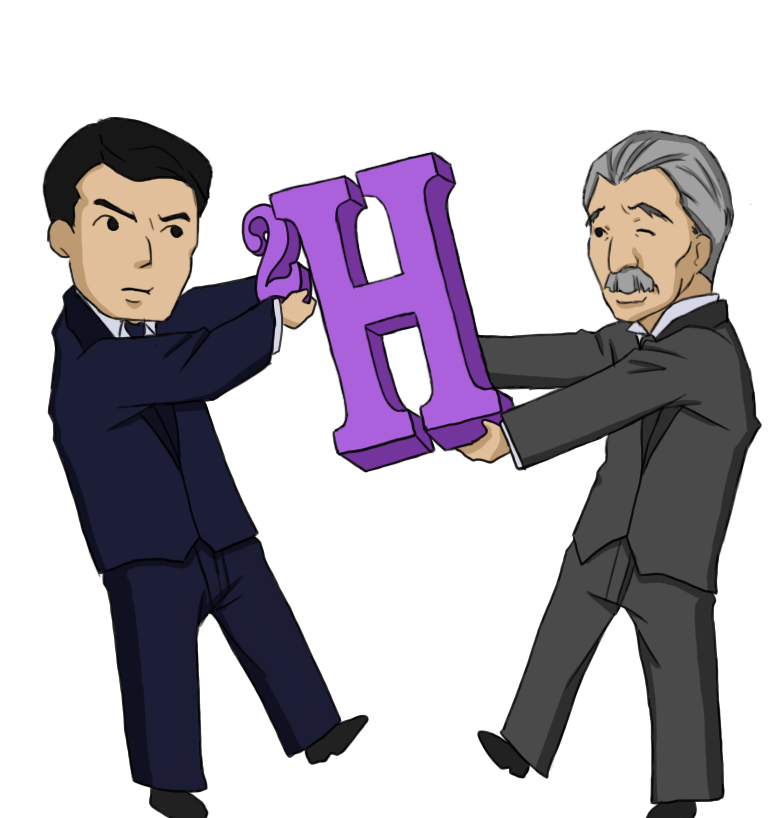
This month’s In Your Element essay is entitled ‘The deeds to deuterium’ (subscription req’d). I appreciate Stuart letting me take on the essay, for which he provided such a clever title, and for the opportunity to write this blog post. Many thanks also to Sarah Roh, a Pomona College student who previously fused anime and isotope effects, for the artwork featured in this project.

Now here’s a question: why did the hydrogen isotopes garner names when all others remained numerical? Harold Urey, George Murphy, and Ferdinand Brickwedde published spectroscopic evidence for the mass-2 form of hydrogen in 1932 (ref. 1) and suggested the name deuterium shortly thereafter (ref. 2). They thought a unique name was justified because it would alleviate any formulaic confusion caused by the use of ‘hydrogen two.’ In Cathedrals of Science, Patrick Coffey writes (ref. 3) that Frederick Soddy, who coined the term ‘isotope’ after a suggestion by Margaret Todd, wasn’t even sure that the heavy form of hydrogen met his definition of an isotope. In his view, isotopes had different atomic mass but identical chemical properties. The large mass difference between 1H and 2H gave deuterated substances unique properties relative to their lighter counterparts, thus making their discovery more elemental. Writing in the 1933 pages of Nature (ref. 4), Ernest Rutherford surmised “…the question of a suitable nomenclature is in this case of such general importance to scientific men that it deserves very careful consideration.”

When I started researching the IYE essay, however, I wasn’t much interested in isotopic appellations. I thought that part of the story was old news. At the outset of my research, I was much more intrigued by Harold Urey the person.

While I didn’t know much about him, I had read somewhere that Urey was involved in the Rosenberg espionage case in the 1950s. Chronicling his involvement in that hysteria-induced American tragedy would make for an intriguing essay, I thought, something along the lines of: deuterium & Nobel provide scientist with platform for Cold War political activism. But letters in his archive caused me to change my plan and I instead wrote a piece describing how Urey’s heavy-handed former doctoral advisor played a key role in his decision to name the mass-2 isotope ‘deuterium’. But before we get to that part of the story, indulge me with the activism angle for several more paragraphs.

Urey argued publicly that it made no sense to execute Julius and Ethel Rosenberg, but that was their fate after a brief trial in 1951. The evidence against them and the quality of the atomic secrets they supposedly passed, as known by the public at the time, were disputable. Declassified documents and other information, some made available as recently as 2008, suggests that only Julius was directly involved in delivering classified atomic information to the Soviets. Other conspirators were given prison sentences, but the government’s case against the Rosenbergs came down to a game of chicken in which Ethel could have avoided the electric chair if she testified against her husband. She remained silent, and they were executed within minutes of each other at Sing Sing prison on June 19, 1953.

Urey’s papers (ref. 5) are archived at the University of California at San Diego. An extensive set of documents provide a roadmap of his efforts to galvanize support within the scientific community and speak with the public about the case. The scientist in Urey left an imprint on the record, such as his use of charts to diagram the real and inferred flow of information between the Rosenbergs and Soviet General Consul Anatoli Yakovlev, Klaus Fuchs, Harry Gold, Morton Sobell, and David Greenglass (Ethel Rosenberg’s brother who testified against them at trial and served a 10 year prison term).

Urey even wrote personal appeals to Presidents Truman and Eisenhower to reverse the execution order. When these efforts failed, Urey largely withdrew from the cause and from communists eager to ally themselves with him. Particularly telling is a handwritten draft of a 12 February 1953 telegram (ref. 6) sent to an organizer hoping to use a pre-recorded Urey speech at a Los Angeles rally protesting newly-elected President Eisenhower’s decision not to commute the death sentences: “I believe meeting should be held and do not wish my recording to be used. Case will now be used by communists to embarrass the U.S. (emphasis his) and I do not wish to help them. We can not help the Rosenbergs. (text strikeouts his) Harold C. Urey”

In an unpublished 1970 autobiography (ref. 7), Urey wrote: “I doubted seriously if justice had been done. My own concern was not a matter of communism or capitalism of my country or some other country at all, it was only a question as to whether justice had been done by the courts of the United States. That was my interest entirely. I was not a friend of the Rosenbergs or Sobell.”

Although there is evidence in the archive suggesting Urey regretted his involvement in the Rosenberg case, his spirits were lifted by a letter dated 17 June 1953, which read: “Dear Urey, your intervention in the Rosenberg case has been one my most heartening experiences in the human sphere. With kind greetings and my highest respect, yours, A. Einstein.” Urey responded (ref. 8) on 25 June, saying in part “But your support of my position and your letter have been most heartening to me, for very few scientific people have troubled to consider the case at all.”

So the IYE essay was almost about the deuterium-enabled Urey and his frustrating quest for justice in the Rosenberg case. But the essay could have been about other heavy topics, such as H-bombs and their deuterated fusion cores, prepared by a post-war team led by Ferdinand Brickwedde. Of these devices, Urey — himself a key player in the Manhattan Project — wrote (ref. 7): “I once thought deuterium would be as useful as to be produced in small amounts to be used for trace techniques in chemistry, and turns out to be an important part in the hydrogen bomb. I am sorry that that it is part of such a destructive instrument as that, and I would be awfully glad if it were not.”

I was taking a break from Rosenberg-related material at the UCSD library when I reached for a folder containing letters between Urey and Brickwedde, his collaborator and supplier of hydrogen enriched in the heavy isotope. This correspondence, dated May and June of 1933, surprised me. It revealed that Urey and Brickwedde were all over the place in terms of what to name the ‘the hydrogen.’ Early candidates, beyond ‘iso-hydrogen’, were property-based: Pycnydrogen or pycnogen [pycnos = thick or dense (Greek)], barydrogen, barogen, or barhydrogen [baro/bary/bar = weight, heavy (Greek)]. Urey was favoring pycnogen in the first of these letters (ref. 9).

Brickwedde then suggested a numbers-based system inspired by a colleague: diplogen or diplohydrogen for the heavy form while hydrogen would become haplogen or haplohydrogen [diplous = double (Greek), haplous = single (Greek)]. He anticipated that Urey wouldn’t like those names and wrote “I know you won’t like them when you first hear them but after a few days they don’t sound so bad.”
Urey vs. Lewis. Credit: Seo (Sarah) Roh

Where was the name deuterium in these exchanges? Well, if Urey has been considered the naming protagonist then it is only fitting this drama has a deuteragonist. The character of secondary importance was none other than Urey’s doctoral advisor, G.N. Lewis. He was also working on the isotope and had lobbied Urey to name the isotope dygen. Then he changed his mind and suggested the name deuton for the mass-2 nucleus. This suggestion, coupled with Brickwedde’s numerical proposition, seems to have inspired Urey to consider the name deutium and then, after consulting Greek experts at Columbia University, deuterium. These names worked nicely, because they could be bookended by names like protium or proterium and tritium or triterium. Urey and his crew ultimately decided to go with protium, deuterium, and tritium and published these in the Journal of Chemical Physics on 1 July 1933 (ref. 2).

One of my favorite quotes from the exchange is Urey’s prediction (ref. 9) to Brickwedde on 6 June 1933: “As to tritium, it will probably never be needed, for we have proven here that it does not exist to more than one part in five billion of protium, and therefore, I believe it does not exist at all.”

A year or so later, tritium’s existence was discovered in Ernest Rutherford’s deuterated collision experiments. As noted earlier, the Right Honourable Lord Rutherford — who named the proton — also had strong nomenclature opinions and published his preferences in Nature on 23 December 1933: diplon for the nucleus and diplogen for heavy hydrogen (ref. 4). Urey’s names persisted, although it took some time for the matter to settle down. News of the disagreement went as viral as one could imagine in the 1930s, with Time magazine even reporting on the controversy (ref. 10).

A very detailed account of the interactions between Lewis, Urey, and Rutherford was written by physicist Roger Stuewer in 1986 (ref. 11). In addition to the diplon/diplogen possibility, Rutherford had also considered deuteron/deuterogen and dion/diogen as names for the nucleus and the heavy isotope and was discussing names with Lewis before he did with Urey. Stuewer also chronicles a part of the story that was new to me, that Urey apparently lost his temper at a meeting of the American Physical Society on 19 June 1933, where he introduced his soon-to-be published names and received a negative response.

Missing from accounts such as Steuwer’s is what was happening within the Urey camp. It is now clear that it was Lewis who suggested a name based upon the Greek deuteros, and Urey grudgingly says as much in a letter to Brickwedde. Of course, you’ll need to read the IYE essay to see his exact language. The letters in the UCSD archive left me with the impression that some historical accounts need correcting. Coffey’s Cathedrals, for example, accurately portrays Lewis as trying to influence Urey but is incorrect in asserting that Urey “had already decided the isotope’s name.” Then again, Coffey studied correspondence from the Lewis archive at UC Berkeley, and these letters reflect only what Urey wanted Lewis to hear. The Urey–Brickwedde exchange puts the matter in a new light. One can imagine Urey maintaining a poker face in communications with his overstepping former advisor. Stuewer’s article affirms this view by reproducing tracts from the Urey–Lewis correspondence, and in these Urey comes across both polite and blunt.

On 18 May 1933: “As to the name deuton for the hydrogen two nucleus, it is a very suggestive one. My own personal reaction to it, however, is that it is unnecessary [to provide a name for something not a fundamental particle].” And later in the same letter, Urey wrote (ref. 11): “If the California group will not give us a little time and be a little patient, they will force us into publishing a name for this isotope which may not be satisfactory for some reason or another. I would suggest, therefore that the California group use the name hydrogen two provisionally and allow the discoverers of this element to name it when they see fit.”

It’s interesting that the Urey archive at UCSD, as extensive as it is, does not catalogue any Urey–Lewis or Urey–Rutherford correspondence. In their absence, the record is defined by the drafts sent or received by Lewis and Rutherford (ref. 11). Steuwer’s excerpts project Urey as diplomatic once he’s made up his mind to publish his names. After writing a measured letter outlining protium/deuterium/tritium to Lewis on 29 May 1933 he closes with a request to hear Lewis’ opinion of them before publication. Lewis, who by Steuwer’s account had started the naming rush in the first place, answered by saying he felt Urey’s names were “very good” although he would “slightly prefer ‘protium’ and ‘deutium,’ or even ‘protum’ and ‘deutum’… .” But he also realized that he had caused a ruckus and closed with “kindest regards, and apologies for the deuton’… .”To a 20 June Rutherford letter outlining the diplon/diplogen, deuteron/deuterogen , and dion/diogen possibilities, Urey responded on 6 July outlining the names he was publishing and apologized for not reaching out to scientists in Europe regarding the names, citing the rush caused by the Berkeley people. He added that it was “interesting that so many people have thought of very much the same names.”

But there is another snippet (ref. 11) from that 6 July letter that is perhaps most revealing about how Urey felt about the entire nomenclature quagmire. “Protium” and “deuterium,” Urey wrote to Rutherford, were “as good a compromise as we could get.”

In his autobiography written some forty years later, Urey wrote (ref. 7) of Lewis’ presence in the hunt for deuterium: “I have always felt badly about Professor Lewis’ attitude in this matter. I have tried in the years since then, whenever my former students make an important discovery, to help them as much as possible rather than to try to take the subject matter away from them.” In a 1972 children’s book about Urey (ref. 12), written from the autobiography, these sentiments were rephrased as “Urey felt a little hurt at this. In future years, whenever one of his students made an important discovery, he tried to help the student as much as possible, rather than take the subject away from them.”

Urey’s philosophy of support for his students — forged in the early deuterium years — is probably best exemplified by one of his other significant works, the single-authored Science paper by then-graduate student Stanley Miller, whose Miller–Urey experiment opened the field of prebiotic chemistry. Urey has been quoted (ref. 13) as saying “There are a lot of people around who are smarter than me. But I pick only the most important problems.” Indeed, these contributions included a method to determine geological temperatures, the development of the field of cosmochemistry, and providing a leading role in lunar science and exploration. Any one of these accomplishments would have made a scientist’s career. Readers who want to learn more about Harold C. Urey, a remarkable chemist, are encouraged to read his biographical memoir at the US National Academy of Sciences.

DAN O’LEARY is in the Chemistry Department at Pomona College in Claremont, California 91711, USA.
e-mail: doleary@pomona.edu

References

1. Urey, H. C., Brickwedde, F. G. & Murphy, G. M. Phys. Rev. 39, 164–165 (1932). [LINK]
2. Urey, H. C., Murphy, G. M. & Brickwedde, F. G. J. Chem. Phys. 1, 512–513 (1933). [LINK]
3. Coffey, P. Cathedrals of Science: the Personalities and Rivalries That Made Modern Chemistry. Oxford University Press, 2008.
4. Rutherford, Rt Hon. Lord Nature 132, 955–956 (1933). [LINK]
5. Harold Clayton Urey Papers, Mandeville Special Collections Library, University of California, San Diego. An online catalog of the collection can be found here.
6. Rosenberg file, Harold Clayton Urey Papers, Mandeville Special Collections Library, University of California, San Diego.
7. Unpublished autobiography dated 1970, Harold Clayton Urey Papers, Mandeville Special Collections Library, University of California, San Diego.
8. Urey–Einstein correspondence, by date, Harold Clayton Urey Papers, Mandeville Special Collections Library, University of California, San Diego.
9. Urey–Brickwedde correspondence, by date, Harold Clayton Urey Papers, Mandeville Special Collections Library, University of California, San Diego.
10. Science: Deuterium v. Diplogen
11. Stuewer, R. H. Am. J. Phys. 54, 206–218 (1986). [LINK]
12. Silverstein, A., & Silverstein, V. Great Men of Science: Harold Urey, the Man Who Explored From Earth to Moon. John Day Company, 1971.
13. Harold Urey, Scientist, Dies at 87; War foe’s work led to H-bomb

March 2012 issue

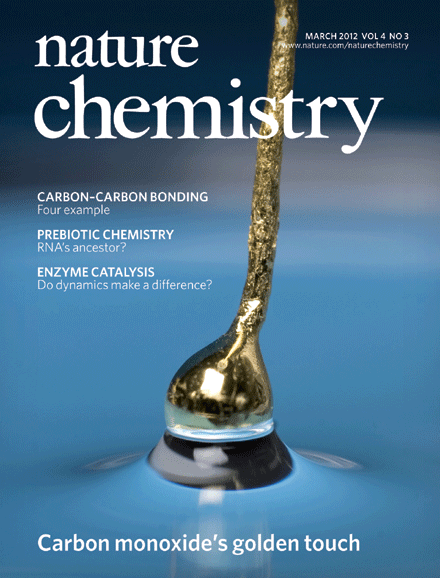
If you haven’t already noticed, our March 2012 issue went live today. It’s full of the usual good stuff, including research articles, News & Views pieces, and research highlights. This issue is somewhat special, however, in that it also contains what we call a web focus. What’s that you might ask? Well, it’s a small collection of related articles (grouped together on the web), and in this case it’s about protein dynamics. We have two Perspectives (Good vibrations in enzyme-catalysed reactions and Taking Ockham’s razor to enzyme dynamics and catalysis) that offer differing views on the significance that structural dynamics have on the reactivity of enzymes. To round up the web focus, there is also an editorial: ‘Of polemics and progress‘, that looks at how disagreements in science can have both good and bad sides. There will be a longer blog post on the editorial next week. The content of the focus (the Editorial and both Perspectives) is free to access until March 22. (Actually, all of our editorials are now free, so you’ll be able to read that whenever you like).

The In Your Element article is about deuterium (we haven’t even done plain old protium yet!) and was written by Dan O’Leary (and has a great illustration drawn by Seo (Sarah) Roh). You need to be a subscriber to read the article itself, but we’ll have a longer blog post later this week that adds some backstory to Dan’s essay. It will be a long read, but well worth it.

In the Thesis article: ‘Zen and the art of molecules’, regular columnist Michelle Francl ponders what it is that makes a molecule beautiful. Her top ten comprises: azulene, carvone, ferrocene, ethanol, vanillin, caffeine, penicillin, insulin, snoutane and cubane. You’ll have to read the article (subscribers only, sorry) to find out why she picked each of these, but she concludes by saying that:

In my eyes, elegant molecules are symmetric; unexpected; revelatory of unseen mysteries; have a touch of sabi, a patina of history; a rich set of associations that stimulate our imaginations; useful; logically simple; sometimes whimsical — and sometimes profoundly graceful.

Obviously beauty lies in the eye of the beholder, so while we don’t necessarily expect you to list your top ten, why not leave a comment and tell us what, in your eyes, are the most beautiful molecules… and why you picked them.

And while you’re thinking about pretty molecules, why not go and check out the rest of the March issue.

Stuart

Stuart Cantrill (Chief Editor, Nature Chemistry)


IMAGE: MARC DE HAAN, PARAMACONI RODRIGUEZ, MARC KOPER

COVER DESIGN: ALEX WING

Reactions: Paula Diaconescu

Paula Diaconescu is in the Department of Chemistry & Biochemistry at University of California, Los Angeles, and works on synthetic organometallic chemistry.

1. What made you want to be a chemist?

My failure to be truly competitive in the physics Olympiad in high school. Of all science subjects, I first liked math until it became very abstract, and then physics. Chemistry seemed too easy in the beginning but I realize now I was naive and I am really glad I ended up choosing it because it allows me to create new molecules.

2. If you weren’t a chemist and could do any other job, what would it be – and why?

A foreign correspondent. I always thought that good journalists use the same analytical skills as scientists and I have always been interested in understanding and observing different cultures and societies.

3. What are you working on now, and where do you hope it will lead?

My group is working on several aspects of ferrocene chemistry ranging from the fundamental understanding of weak metal-metal interactions to applications to polymer chemistry. I always hope that we can create new molecules/materials with our approach and that they will find uses that we can’t even fathom now.

4. Which historical figure would you most like to have dinner with – and why?

I initially thought of Socrates because I admire his pursuit of interrogating everything around him, the same thing we do in science all the time. And then Oscar Wilde popped into my mind because I find his witticism truly entertaining and very appealing as a prospect for a dinner conversation.

5. When was the last time you did an experiment in the lab – and what was it?

I still go to the lab on a regular basis and mount crystals for my group. The last time I mixed chemicals though was around the end of my second year as an independent scientist. The reaction was the hydrogenation of 1,1’-ferrocene diazide, one of the steps to generate our ligand precursors, and failed. I knew then that I don’t have the focus to carry out true lab experiments anymore (I did that reaction many times before and although it is somewhat capricious, I thought I had a fool-proof method of doing it).

6. If exiled on a desert island, what one book and one music album would you take with you?

I would take “The Glass Bead Game” by Herman Hesse because I always wanted to see if I can come up with the rules of the game proposed in it. For music, it is “Tristan und Isolde” by Richard Wagner; since it has so many layers, I think I wouldn’t get bored listening to it over and over again.

7. Which chemist would you like to see interviewed on Reactions – and why?

Marie Curie for various reasons. First to know her opinion of the society at the time and the fact that she had to work as her husband’s assistant. Secondly, her discoveries prompted the effort to work with elements beyond uranium and push the limits of what we know about what makes the world around us.

Element of the month: Cool as helium

This month’s ‘in your element’ article (subscription required) is also a winning entry from last year’s competition. Christine Herman, known on Twitter at @CTHerman, a PhD student at the Department of Chemistry, University of Illinois at Urbana-Champaign, who also likes to write about science — for example she contributes to C&En’s Just Another Electron Pusher — shares why she loves helium.

In 1868, astronomers Jules Janssen and Norman Lockyer — who was about to found a certain Nature journal — both noticed (independently) a bright yellow line in the spectrum of the Sun that could not be accounted for by known elements. The suggestion that this line might come from an element present in the Universe but so far undiscovered on Earth seemed bizarre at first, but was to be later unambiguously backed up. Luigi Palmieri detected this element in 1882 in Mt Vesuvius’ lava, and William Ramsey managed to isolate it in 1895 by treating a sample of the uranium mineral (cleveite) with sulfuric acid, liberating helium that had been produced by the radioactive decay of uranium.

It’s perhaps no wonder that this noble gas wasn’t noticed earlier — it is, after all, colourless, odourless, tasteless, non-toxic, and escapes easily from the Earth’s atmosphere so that its concentration is only about 0.0005% by volume. It does however get trapped under the surface, usually with natural gas, and this is where we get the helium we need.

And need it we do, not just for balloons and squeaky voices at parties. You already know this if you’re, among other things, a paleontologist, a deep-sea diver or an arc welder; read Herman’s article to find out more.

She does make a fair point — helium is cool. So much so that many scientists in many fields (for example physics and medicine but also nuclear energy applications) use it as a cryogen. And if you go down to temperatures below 2 K, helium becomes downright bizarre and very intriguing: it adopts a superfluidic state that has no viscosity but a very high thermal conductivity. It is also enticing to chemists who, undeterred by its inertness, keep trying to combine it with various elements. Some of these — excited dimers rather than actual compounds — went on to find a use in lasers.

And, as if helium wasn’t exciting enough in its own right, antihelium observed last year made for the heaviest anti-particles produced so far. All in all, colourless, odourless, tasteless, non-toxic element 2 is very far from dull.

Anne


Anne Pichon (Associate Editor, Nature Chemistry)


Reactions – David Chandler

David Chandler is in the Department of Chemistry at the University of California, Berkeley.  He is a member of the US National Academy of Sciences and a Foreign Member of the Royal Society. He works on theories of complex systems.

1. What made you want to be a chemist?

During my childhood, I had a chemistry set and a microscope, and I read about the life of Louis Pasteur. I loved all of that, found it romantic, but I was not a good high school student. I initially went off to college thinking about other things, until a few terrific chemistry and physics teachers made these subjects vivid and exciting, and I could not resist doing both as a career. I’ve written about it in my Festschrift Autobiography.

2. If you weren’t a chemist and could do any other job, what would it be – and why?

A competitive professional tennis player. I always loved sports and was a reasonably good tennis player in my youth, but I lacked the athletic talent — sufficient strength and agility — to be a star, even though I wished to be a star. If I could always be tops in sport, I would avoid the afflictions of old age.

3. What are you working on now, and where do you hope it will lead?

The theory of self assembly — how is it that reversible molecular dynamics leads to hierarchical nano-scale structures. Understanding such things requires a deep understanding of dynamics far from equilibrium, and it is of practical importance for understanding the formation, stability and function of biological structures, not to mention the design of advanced materials.

4. Which historical figure would you most like to have dinner with – and why?

Richard Feynman. I once met him and we talked for an hour. It was enjoyable and I would like to do it again.

5. When was the last time you did an experiment in the lab – and what was it?

I never do experiments. I’m a theorist!

6. If exiled on a desert island, what one book and one music album would you take with you?

The book: The Feynman Lectures on Physics. The music album: too difficult to decide because I play the piano and enjoy both classical and jazz. I guess I’d simply want the piano.

7. Which chemist would you like to see interviewed on Reactions – and why?

Linus Pauling. That would be a good trick, and maybe you could piece it together from all that has been written by him and about him.

Reactions – Zheng Yin

Zheng Yin is in the College of Pharmacy at Nankai University, and works on chemical biology and medicinal chemistry.

1. What made you want to be a chemist?

I was truly attracted by chemistry when I had the module of organic synthesis as undergraduate student. I was fascinated by the logic of connecting bonds and eventually being able to creatively produce new molecule that can change the world.

2. If you weren’t a chemist and could do any other job, what would it be – and why?

Never thought about it. Probably as an entrepreneur to start a business. The reason is the risk and initiatives associated in the process.

3. What are you working on now, and where do you hope it will lead?

I am working on the interface between chemistry and biology, specifically several essential viral proteins such as 3C, 3D etc. My dream is to create a novel molecule that can be clinical useful for the treatment of those infected children during EV71 outbreak.

4. Which historical figure would you most like to have dinner with – and why?

Mother Teresa, 1979 Nobel Peace Prize Laureate. I was very much inspired by her legacy and being enlightened with the meaning of life.

5. When was the last time you did an experiment in the lab – and what was it?

I did the synthesis of nucleoside derivatives together with my first student in the lab of Nankai University about 2 years ago. It’s truly fun to work on the bench.

6. If exiled on a desert island, what one book and one music album would you take with you?

The book is “The old man and the sea” (written by Ernest Hemingway). The album is likely Moonlight Sonata by Benthovan.

7. Which chemist would you like to see interviewed on Reactions – and why?

Paul Anderson, one of the top pharmaceutical industry chemists. He is truly one of the role models in drug discovery.