Happy birthday Robert Boyle!

Apparently today is Robert Boyle‘s 386th birthday. He also happens to be the reason that this blog is called ‘The Sceptical Chymist’. So today, of all days, why not go and have a look at the first ever post on this blog (almost 7 years ago — wow…) explaining a little more about Boyle and his ‘The Sceptical Chymist‘.

PS: the e-mail address listed in that first post no longer works; if you want to contact us, use nchem@nature.com or leave a comment.

Reactions: Matthew Todd

Matthew Todd is in the School of Chemistry at The University of Sydney, and works on organic synthesis, asymmetric catalysis and chemical sensing. He has a particular interest in the use of open source methods in research, particularly for open source drug discovery. He can also be found on Twitter at @mattoddchem.

1. What made you want to be a chemist?

Childhood disbelief. I remember learning about molecules and being fascinated that we could work out so much about things that we could never see. I couldn’t believe the speed of molecular events or the complexity of the cell. One day I saw a crude black and white wireframe animation of DNA – from a whole chromosome, zooming in, unfurling, until one could see the base pairs. It was like some living sculpture – a masterpiece. All I could think was “You have got to be kidding me. That’s real?”

2. If you weren’t a chemist and could do any other job, what would it be – and why?

Movie location scout. This would couple two of my greatest pleasures – movies and travel. And I’d get paid doing it.

3. What are you working on now, and where do you hope it will lead?

Open source drug discovery. We’re trying to show that you can discover a drug via an open source process where all data and ideas are freely shared, anyone can participate and there are no patents. You don’t actually need patents to discover and develop drugs, we just all assume it’s necessary. By working openly you stimulate contributions from a wide range of experts. Open source creates this unique mixture – an open, meritocratic arena which is truly, and rather brutally, competitive, but because everything is shared the competition ultimately results in cooperation – I find that fascinating. The open drug discovery project maintains public, online lab books, meaning anyone can use the data and criticise/contribute at any level. We published a paper last year (https://www.nature.com/nchem/journal/v3/n10/full/nchem.1149.html) that described the acceleration we saw in our first open source chemistry project – motivated strangers contributed and sped things up significantly, leading to a drug synthesis that was benchmarked against one developed by a commercial organisation. Where are we hoping it will lead? To a change in the way we do research – that keeping secrets in science is, most of the time, slowing us down and that we should value negative results along with the positive. We’re spending a lot of time showing how open research can be done, because if it can be done then we can tackle really hard problems that aren’t remotely tractable at the moment – new drugs for most diseases would fall into that category, but some of the really interesting basic scientific questions are just too complex to manage without an open approach.

4. Which historical figure would you most like to have dinner with – and why?

Socrates. Anyone who drinks and can talk about anything at all is OK by me.

5. When was the last time you did an experiment in the lab – and what was it?

I did a trituration about 4 years ago that made chewing gum.

6. If exiled on a desert island, what one book and one music album would you take with you?

Book would be Plato’s Republic because it’s the most beautifully written argument I can’t agree with. Music album would be the Ring cycle – you’d need a lot of variety for a long stay. Music to help you reflect, conquer and, ultimately, escape.

7. Which chemist would you like to see interviewed on Reactions – and why?

Barry Trost or Rainer Herges – wise, funny, honest.

Blogroll: Numerous nitrogens

Editor’s note: As we continue to invite bloggers out there in the wild to compose our monthly Blogroll column, DrFreddy penned the February 2013 column.

———-

Kevlar-suit-wearing synthetic chemists and the art of nomenclature.

Some interesting nitrogen-based chemistry featured in the chemical blogosphere in 2012. Several bloggers commented on a peculiar (and perhaps somewhat terrifying) compound containing 10 nitrogens in a row, reported in Inorganic Chemistry. David Perrey at Chemical Space wrote, “The graphical abstract tells the story eloquently: the structure with a back-drop of broken lab equipment,” and muses “inadvertent explosions is a lovely expression”.

A picture of a Klapötke group member working with these materials was posted on the blog Reactions from Last Night — “notice the full Kevlar suit he’s wearing” notes the caption! There are strict rules about who can do what in the group; undergraduates don’t handle explosives, masters students only work with known compounds, and PhD students are the ones who “make and characterize anything novel”.

At the other extreme, in a post on ‘Handheld chemistry’ over at The Culture of Chemistry, Michelle Francl-Donnay advises the reader to “wash those hands” if you are going to repeat an experiment described in a 1937 chemistry-kit manual for “making ammonia in your hand,” by mixing calcium oxide and ammonium chloride with your fingers. Francl-Donnay further admits to “using Hess’ law for fun,” but follows with a serious calculation on the heat of formation for the reaction: “–635 kJ […] for about a tablespoon of material,” to be precise.

And finally, at The Heterocyclist blog, dipolar-cycloaddition veteran Will Pearson ponders over an apparent mix-up between nitrogen imines and ylides in the title of a paper in Angewandte Chemie International Edition and throws out a “What am I missing here?” Judging by the lack of objectors so far — nothing.

Written by Fredrik von Kieseritzky, who blogs as DrFreddy at https://syntheticremarks.com/

———-

[As mentioned in this post, we’re posting the monthly blogroll column here on the Sceptical Chymist. This is February’s article]

The art of presenting

Editor’s note: This is a guest post by Fabian Carson, who is a PhD student in the Department of Materials and Environmental Chemistry at Stockholm University, Sweden. If you agree or disagree with anything — or want to share your own presentation tips — let us know in the comments.

– – – – – – – – – – – – – – – – – –

Let’s face it, most presentations are bad: too much information; unreadable fonts; monotonous speaking and poor slide design. It can sometimes be a struggle to follow the speaker through a seminar and some audience members will succumb to sleep. And yet it shouldn’t be this way. A talk should be engaging, informative and motivating. Talks can be good — even spectacular. The TED series demonstrate this (ref. 1). Yet many speakers can’t present well and don’t even realise there is a problem.

Scientific presentations seem to be particularly poor; perhaps because chemistry degrees stress little importance on rhetoric. Instead, the focus — with good reason — is on exams, experiments and coursework. In an age where communication is everything, poor presentation skills are unacceptable (ref. 2).

It’s not only students who struggle to present, but professors too. There has been much focus recently on chemists communicating with non-scientists and the general public (refs 3,4). Yet most chemists can’t even communicate among themselves. How many talks have you attended recently that tick the boxes in Bad Presentation Bingo (pdf link here)? This game was developed by Monica Metzler at the Illinois Science Council to highlight the importance of communication skills in science (ref. 5).

So what is the secret to presenting? Storytelling. At a recent RSC event in London about science communication, the broadcaster Adam Hart-Davis was eager to extol the virtues of storytelling. If you want your audience to listen, you have to connect. Make it personal and tell a story. They are there to be educated and entertained. Of course, it’s not just about jumping around the stage; the content has to be good. But it must be told in a captivating manner.

So how does one prepare, create and deliver an effective and engaging presentation? Start by brainstorming. List the topics, the key points and the main issues. Then filter. You shouldn’t talk about everything. If you want your audience to remember anything, then you need a story and a core message. It can’t just be a random collection of facts. It needs a plot with characters, heroes and villains.

The key to slide design is simplicity (ref. 6). Less is more. Many make the mistake of filling the entire slide with data, words and images. The audience will be overloaded. If something is complex, then build up the slide with animations (but not too many). Don’t be scared to fill the entire slide with one image; space is there for a reason. Chemists are blessed, since we have an incredibly visual language. Crystal structures, molecular orbitals and reaction schemes can be stunning when used appropriately. As for font size, take the age of the oldest audience member and divide by two (or don’t go below 30) (ref. 7). This will stop you including too many words and will enhance your talk because it will force you to select the most important points and explain them well. And avoid using too many bullet points. They may be useful for stating your aims, but slide after slide of bulleted lists will quickly bore your audience. A slide is a canvas, not a word document, so think visually.

You’re not limited to PowerPoint or Keynote. Prezi (ref. 8) is a relatively new cloud-based presentation software that is based on a zooming user interface. The speaker is provided with a map, or virtual canvas, on which to sketch his or her presentation. You can zoom in or out and pan around — similar to Google Earth. This offers a far more lateral perspective rather than the linear progression of classical presentation software. A basic account is free and those with educational email addresses can get an upgraded Prezi license here.

Presenting is closer to acting than writing. Treat it like a theatre. How often does the presenter speak to their slides? Face the audience and connect with them. Make eye contact and speak to everyone, like it’s a personal conversation. Your voice is important. If you want people to listen for longer than 10 minutes, you can’t be monotonous. Of course, we can’t all sound like Sir Michael Gambon, but having a natural, flowing voice helps. If you’re enthusiastic and interested about your subject, your voice will naturally develop.

Finally, we arrive at the biggest killer of all presentations: jargon. Chemistry is filled with jargon. Correct terminology is necessary and useful for explaining specific ideas. But if you want to alienate your audience, use jargon. If you want to reach them, avoid it. Use simple language. At the same time, explain important terminology to the audience — they’re here to be educated, right?

Presenting research results can be difficult and challenging — especially when you haven’t been trained. The science shouldn’t be dumbed down, but it has to be accessible. Content is important — you need to know your topic — but so are style and format. Engage with your audience — challenge them! If you’re creative, informative and motivated, people will enjoy your talks. Above all, tell a story. People want to hear stories.

1. https://www.ted.com/
2. İşsever, Ç. & Peach, K. Presenting Science: A practical guide to giving a good talk (Oxford University Press, New York, 2010). (Amazon link)
3. Hartings, M. R. & Fahy, D. Nature Chem. 3, 674–677 (2011). (Link)
4. Smith, D. K. Nature Chem. 3, 681–684 (2011). (Link)
5. https://illinoisscience.org/docs/badpresentationbingo.pdf
6. Reynolds, G. Presentation Zen 2nd Ed. (New Riders, Berkeley, 2012). (Link)
7. https://blog.guykawasaki.com/2005/12/the_102030_rule.html#axzz25IK1Kx6I
8. https://prezi.com/

Reactions: Ang Li

Ang Li is in the Shanghai Institute of Organic Chemistry, Chinese Academy of Sciences and works on the total synthesis of biologically active natural products.

1. What made you want to be a chemist?

Fascinating structures of organic molecules and unimaginable functions accompanying these structures.

2. If you weren’t a chemist and could do any other job, what would it be – and why?

A differential geometrist. I would like to use another language to describe and study structures.

3. What are you working on now, and where do you hope it will lead?

Total synthesis of biologically active natural products. It may lead to discovery of new reactivity and functions of organic compounds.

4. Which historical figure would you most like to have dinner with – and why?

The late Chinese philosopher Liang Shuming. To talk with him about the fate of Chinese culture.

5. When was the last time you did an experiment in the lab – and what was it?

A few weeks ago, I separated a synthetic sample of a natural product out of 3 very close bands on preparative TLC plate.

6. If exiled on a desert island, what one book and one music album would you take with you?

China: A Macro History by Ray Huang; Tao of Peace by Dean Evenson and Xiangting Li

7. Which chemist would you like to see interviewed on Reactions – and why?

Profs. Dawei Ma and Zhen Yang. Both fellows are my role models, who have made great contribution to China’s organic synthesis, especially natural product total synthesis.


Scrutinizing synthesis

Posted on behalf of See Arr Oh who blogs at Just Like Cooking.

Ever run a new reaction, and found it doesn’t quite live up to the hype? So have I. Frustrating, isn’t it?

Back in 1921, another frustrated group — the first Editorial Board of Organic Syntheses — published a ‘slender little pamphlet’ of vouched-for preps chemists could follow. More modern variants include Nature Methods, or Prof. Alison Frontier’s compilation of notoriously touchy reactions at Not Voodoo: ‘May Require Mojo’.

In 2009, amid growing skepticism over a hydride-catalysed ‘oxidation‘, chemist Paul Docherty of Totally Synthetic repeated the experiment and live-blogged his results. This effort quickly attracted the attention of the wider chemical community — other scientists wrote in to check his results.

Blog Syn takes a page from that playbook. My initial squad consisted of Organometallica, B.R.S.M., and Matt Katcher, three synthetic chemists active in the blogosphere. We launched this blog as a collaborative effort: starting with an iron/sulfur cyclization reaction recently reported in JACS, we agreed to re-test certain reactions and pool the resulting data.

Each chemist repeated a reaction in their own lab, using their own group’s reagents, while adhering closely to the original authors’ Supporting Information. We exchanged e-mails full of tips and advice before writing the final post. As well as writing up details of the procedures and the final yields, the post was augmented with pictures of the reactions, products, and spectral data.

We dubbed this first reaction ‘moderately reproducible’, indicating isolation of correct final products, but not at the originally published yields.

We’re pretty excited about this new crowdsourcing method for checking the literature, and hope it spreads. Do you have a reaction you’ve always wondered about? Want to help further the cause, perhaps as a reaction ‘checker’? Get in touch with us on Twitter (@Organometallica, @katmatcher, @BRSM_blog, @SeeArrOh) or leave a comment on our first post.

Here’s to reproducibility!

The simple life of an editor

Try explaining what you do for a living using only the 1000 most common words in the English language. This is the basis of the so called ‘Up-Goer Five‘ challenge (handy text editor available using that link) – sparked by an xkcd cartoon that tries to describe the Saturn V rocket in the same way. Several others in the chemistry blogosphere have made attempts so I thought I would try to explain being an editor – here is what I came up with:

Some people do some stuff that they think is new and exciting. They send it to us so we can help tell the world about it. We ask others who do stuff like it to help by telling us if there are any problems and whether they too are excited about the stuff.

If they are then we try to make it possible for lots of others to understand and explain to them why the stuff is important and why they should care.

And as a secondary challenge, if you don’t want to try writing your own, why not try to guess what other people do based only on their simple description.

Steve

Stephen Davey (Senior Editor, Nature Chemistry)

Reactions: Jan Hartmann

Jan Hartmann is in the Department of Chemistry at RWTH Aachen University, and works on organocatalytic asymmetric synthesis — he is also one of the winners of our In Your Element essay competition, for which he wrote about plutonium (here is a write-up of his article by yours truly) .

1. What made you want to be a chemist?

That is rather hard to say. I found the first year of chemistry in high school quite boring, but nevertheless wanted to do my own experiments with a chemistry set. My parents were reluctant back then, emphasizing that they wished the roof to remain where it is, but I was eventually able to persuade them and from then on, my interest has continually grown.

2. If you weren’t a chemist and could do any other job, what would it be – and why?

I have always been interested in the natural sciences in general, not just chemistry. I was diagnosed with type 1 diabetes at age two and that has had a remarkable influence on my life, far beyond my eating habits. It got me interested in biology, human anatomy and medicine while I was still in kindergarten and that interest may have shifted to other areas of science, but never faded. Still I consider those parts of chemistry on the borderline to biology as the most interesting and if I wasn’t a chemist, I would most likely be a biologist or a doctor.

3. What are you working on now, and where do you hope it will lead?

I have been working on several aspects of asymmetric organocatalysis for my bachelor thesis and a master research project. Work in this area is, of course, always connected to the hope of improvements in general synthetic methodology and especially in drug discovery. The extraordinary importance of correct stereochemistry in the latter has tragically been established here in Aachen in the 1950s and ’60s by the thalidomide scandal.

4. Which historical figure would you most like to have dinner with – and why?

Being a big fan of space travel, my choices here would be Neil Armstrong or “Buzz” Aldrin. The Apollo Program and especially Apollo 11 as arguably one of the greatest technological feats of mankind have remained and sure always will remain a powerful symbol and an inspiration to keep exploring.

5. When was the last time you did an experiment in the lab – and what was it?

(Since I am in the lab almost every day, whatever I put here will be more than outdated by the time it’s posted.)

6. If exiled on a desert island, what one book and one music album would you take with you?

As for the music album, probably a Scorpions Best Of. The book would be a much harder choice, but Hemingway’s “For Whom The Bell Tolls” and Lee’s “To Kill A Mockingbird” would certainly be among the top contenders.

7. Which chemist would you like to see interviewed on Reactions – and why?

My research group leader, Prof. Dieter Enders. Seriously, who wouldn’t want to know the last time their boss was productive in the lab?

All joking aside, with the discovery of the structure of DNA celebrating its 60th anniversary this year, I’d consider an interview with James D. Watson.


The allure of aluminium

In the first issue of the year, Daniel Rabinovich from the University of North Carolina at Charlotte shares with us anecdotes about an element we use on a daily basis (subscription required). But just because aluminium serves to package food and drinks, we shouldn’t overlook its grander history and rich chemistry.

Aluminium hasn’t always been such a common-or-garden element: it used to be pricier than gold, it is aluminium cutlery that Napoleon III reached for to impress guests, and I’ll leave you to check Rabinovich’s ‘in your element’ article to read Jules Verne’s praise of element 13.

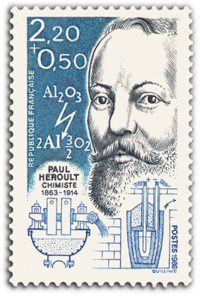
QUILLIVIC © LA POSTE, 1986

Alum, a hydrated sulfate salt of potassium and aluminium [KAl(SO4)2·12H2O], has long been known — ancient Greeks and Romans used it as astringent for dressing wounds. But although aluminium is present in various compounds, and abundant on Earth, it is so reactive in its elemental form that it wasn’t isolated until the 1820s.

Friedrich Wöhler isolated aluminium metal in 1827, Henri Sainte-Claire Deville produced larger quantities and published a detailed account of its properties and applications in the 1850s, and both Charles Hall and Paul Héroult devised electrolysis-based large-scale fabrication processes in the 1880s. Add to this the contribution of Karl Josef Bayer, who developed a route to extract and purify alumina from the mineral bauxite et voilà, aluminium became so widely used it was to be referred to as ‘the magic metal’ by National Geographic.

Its salts, compounds and coordination complexes have also proven useful for a variety of reactions, some of which have recognizable names such as the Friedel–Crafts acylation and alkylation reactions, or the Ziegler–Natta polymerization of olefins. Beyond its interesting chemistry and a myriad of practical applications, the unassuming metal also inspired artists — I particularly like the “Molecule Man”: 30m-tall structures by Jonathan Borofsky.

Anne

Anne Pichon (Associate Editor, Nature Chemistry)