Reactions – Michael O’Keeffe

Michael O’Keeffe is in the Department of Chemistry and Biochemistry at Arizona State University, and works on the application of geometry to the design and synthesis of inorganic materials.

1. What made you want to be a chemist?

Actually I wanted to be a mathematician, but was told that there would be no future in that. In school we were taught chemistry by a retired chemical engineer who regaled us with tales of his adventures as a mining engineer in South America. Chemistry seemed like a lot more fun than physics. Funnily enough, I have never been to South America, and recently at least one of their mines didn’t seem like much fun either.

2. If you weren’t a chemist and could do any other job, what would it be — and why?

If I had the talent I would love to be an architect. Such a wonderful marriage of art and engineering.

3. What are you working on now, and where do you hope it will lead?

I dream of arriving at some ideas for designed (“rational”) synthesis of new zeolites and related materials. It is remarkable that the synthesis of such important materials is at present almost entirely empirical — in contrast to what has recently been developed for metal–organic frameworks (MOFs) etc.

4. Which historical figure would you most like to have dinner with — and why?

Michael Faraday is my nominee for the greatest scientist ever. But I think J. D. Bernal, who is also high on my list, would be a delightful dinner companion.

5. When was the last time you did an experiment in the lab — and what was it?

A long time ago. In the early 70’s we were the first to realize that some simple salts would be good anion-conducting solid electrolytes (“superionic conductors”). At that time I had just one overworked student, Carl Derrington who was working on lead fluoride, so I decided to do yttrium fluoride and lutetium fluoride myself. The results were spectacular and I published them in Science. (How often do you see a single author experimental paper these days?). Carl wasn’t cheated. His lead fluoride work went into Nature, and he was first author on five other papers. Not bad for a Ph.D.

6. If exiled on a desert island, what one book and one music album would you take with you?

Book: I would take the best and deepest book on group theory that I could find to while away the hours. Music: Anything by Bach for a solo instrument, perhaps the Goldberg Variations. And might I have one program for my solar-powered computer? If so a FORTRAN compiler please.

7. Which chemist would you like to see interviewed on Reactions — and why?

Osamu Terasaki. I think experimental chemists could profitably learn some theory — such as in his case diffraction physics. Osamu and his group have done exquisite experiments that, when combined with deep theoretical insights, have had an enormous impact on materials chemistry. His story should be an inspiration to young chemists.
Blogroll: BOOM

[As mentioned in this post, we’re posting the monthly blogroll column here on the Sceptical Chymist. This is a slightly longer version of May’s article]

Exploding myths and exploding compounds

How do you make a compound with 10 nitrogen atoms in a row, formula C2H2N10? Carefully, that’s how. After a few blogs and tweets had picked up on a particularly violent TOC graphic in Inorganic Chemistry featuring shattered glass and fractured funnels, Infiniflux featured an interview with one of the authors, Davin Piercey. Piercey works with Thomas Klapötke at the Ludwigs-Maximilians University in Munich and told readers about his adventures with such violently explosive compounds. Fortunately, safety is taken incredibly seriously in the Klapötke lab with “personal protection equipment for potential shrapnel; Kevlar gloves and arm protectors […], and basic body armour or leather, face shield, and hearing protection.” This gear means Piercey is in the lucky position of considering the shrapnel-induced explosion of his remaining product merely “annoying”!

Have you ever wanted to irritate a whole industry? If so, you could take a leaf out of Donald Light and Rebecca Warburton’s publication in Biosocieties which suggested that the cost of developing a drug is around $50 million, rather than the oft-quoted $800 million. Derek Lowe took issue with this and took apart their article. Lowe feigned surprise that big pharma is in such bad shape: “$43 million for a drug, you should be able to raise that pretty easily, even in this climate — and then you just stand back as the money gushes into the sky.”

Chembites is a new addition to the chemistry blogosphere and aims to “help undergraduates navigate current chemical literature”. A group of MIT graduate students write the posts, which are short summaries of research articles. As Sidechain Bob says on Transition States “the hardest thing to do as an undergraduate is to read the literature”, so Chembites “distilling it down to be understandable for an undergraduate” may prove very useful.

Reactions – Philip Miller

Philip Miller is in the Department of Chemistry at Imperial College London, and works on developing fast chemistry for radiolabelling applications in the field of positron emission tomography (PET imaging).

1. What made you want to be a chemist?

I always had an interest in science even from a very young age but it wasn’t until high school that I began to take a closer interest in chemistry. What really ignited my interest in the subject was a fire! A supply teacher was covering our science class for a week and did lots of crazy demonstrations — alkali metal reactions, rat dissections etc. lots of the interesting practical stuff — the reaction he did with elemental phosphorus to demonstrate its reactivity was particularly memorable. On cutting a chunk of phosphorus from the main stick he managed to knock the phosphorous off the demonstration table — taking both him and the class by surprise when it burst into flames, causing a small fire! Fortunately no-one was injured but we didn’t see much of him after that which was a real pity.

2. If you weren?t a chemist and could do any other job, what would it be — and why?

I always fancied myself as a bit of an artist. Art is able to reach out to people and inspire them in a way that nothing else can.

3. What are you working on now, and where do you hope it will lead?

I’m currently working on some new and really exciting chemistry in the area of carbon-11 radiochemistry. Carbon-11 is a positron emitting isotope that is used to make radiotracer molecules for PET imaging. The challenges in this are mainly centred around the short C-11 half-life (it’s only 20 min!) so the chemistry has to be exceptionally slick and fast. What I’ve done over the past year is to develop a new method for C-11 radiolabelling that will hopefully make the labelling process much easier to do and lead to new series of C-11 tracers for PET imaging. Ultimately I hope this will have an impact on the discovery and development of new treatments for diseases such as Alzheimer’s and Parkinson’s.

4. Which historical figure would you most like to have dinner with — and why?

Winston Churchill. I cycle past his imposing statue on Parliament Square in central London almost every day and think, wow — there is someone who has changed the course of history for the better by standing-up for what was right at a time when the of odds of succeeding seemed very slim. I also hear that he was a bit of hell raiser and liked a drink or two!

5. When was the last time you did an experiment in the lab — and what was it?

I’ve recently been doing some palladium catalysed carbonylations (insertion of carbon monoxide) of organobismuth reagents to test if I couple together alkylbismuths with carbon monoxide and a nucleophile. This was a few days ago — I will let you know the outcome of these reactions soon!

6. If exiled on a desert island, what one book and one music album would you take with you?

Joseph Heller’s Catch-22. I’ve just finished reading it and am just about to read again!

U2’s ‘Achtung Baby’ album. It’s the first album I ever owned and I haven’t listened to it in ages.

7. Which chemist would you like to see interviewed on Reactions — and why?

Prof. A. P. de Silva, Department of Chemistry at the Queen’s University of Belfast. I was lucky enough to have him as a lecturer during my undergraduate years in Belfast and always found him an exceptionally enthusiastic, inspiring and friendly teacher.

They did a bad bad thing

[This post is based on the editorial in the May 2011 issue — the full text can be accessed here, available for free to all registered users. We welcome feedback on our editorials in the comments section below.]

When it comes to research misconduct, burying one’s head in the sand and pretending it doesn’t exist is the worst possible plan.

With human nature as it is, the only surprising thing about scientific misconduct should be that it continues to surprise us. Scientists are human, so why should we be more surprised when they behave unethically than, say, those in business or politics? Surprised or not, we should acknowledge that scientific misconduct is happening, will always happen, and probably always has happened. With an increased awareness, however, we can all be more vigilant and perhaps better equipped to prevent it happening.

To give some examples of wrongdoing, in case anyone is unaware of its existence, look at the rise and fall of Jan Hendrik Schön. Or the less headline-grabbing, but still worrying, 60 falsified structures published in Acta Crystallographica E. Or the 70 questionable articles published by Pattium Chiranjeevi, from Sri Venkateswara University.

These are just three relatively well-known examples. For more, the interested reader is directed to Retraction Watch, which, contrary to its moderators’ initial concerns that they would struggle to find enough examples to cover, has averaged around six posts per week since its inception in mid-2010. Of course, many of these retracted papers are not the result of unethical behaviour, but a worrying proportion are.

Very often the reaction to the discovery of these cases is ‘Why on earth did journal X publish THAT?’. However, when it comes to outright fabrication or falsification, editors and peer reviewers must consider the data with which they are presented at face value. Beyond a healthy scepticism, there are analytical tools available that can help identify suspicious data, for example for assessing tampered images and crystallography data. It is, however, hard to see that these would have been useful in the case of the determined fabrication that Schön engaged in.

Journals have a much greater stake in cases of plagiarism, against which Nature Chemistry and other Nature family journals can use CrossCheck. This tool can check the text of submitted articles against a large database of published papers. As the publication ethics section of our author guidelines clearly state, “[…] when large chunks of text have been cut-and-pasted, [s]uch manuscripts would not be considered for publication in a Nature journal.”

Of course, journals also have an important role in many other cases beyond plagiarism and cannot reject all responsibility. Publishers should ensure that data is made as widely available as possible. The outcome of any action a journal does take — such as correcting or retracting a paper — should be transparent, freely available and disseminated in the same way as the original paper. Investigations into data fabrication or manipulation are beyond the remit of publishers, and should be conducted by the relevant institutions and funding agencies.

One of the fundamental tenets of science is that experiments should be reproducible. ‘Peer review’ is broader than the pre-publication assessment that most people are referring to when they use the phrase. The true test comes once every aspect of a discovery can be scrutinized by one’s peers — and then built on. In spite of automated data-checkers and text-comparison tools, physically and independently recreating an experiment remains the best way to validate data.

So what should be done to deter misconduct? A shared awareness of correct research ethics needs to be fostered and passed on to the next generation. This should be emphasized by formal training from departments and institutions, which must have their own policies and guidelines for ethical behaviour and dealing with misconduct. Most of all, it needs to be put into everyday practice and an example of high standards should be shown by mentors.

Ultimately, science and the scientific record is self-correcting but only at the expense of much unnecessary work and potential anguish by those prepared to stand up and put things straight. No-one should have to put their careers on the line — or on hold — to investigate and report deliberately incorrect results. It is surely far better to act preventatively by insisting on higher standards at every step of research.

[Since we wrote, re-drafted, edited, laid-out, typeset etc this article we’ve found a few more interesting links for you all. Firstly, Science Betrayed on BBC Radio 4 by TV’s Adam Rutherford (iPlayer link probably only works in UK). Derek Lowe blogged about a recent PLoS1 paper on misconduct. Finally, The Scholarly Kitchen blogged about ‘paying for impact’ – the Chinese funding model for directly rewarding researchers based on which journals they publish in which we touched on in the full editorial.]

Essay competition update

Since we announced our essay competition last month, we’ve had a few questions regarding eligibility and one or two other queries. We’ve replied individually to each query, but just in case there is any confusion out there, this is what we had to say:

1. Are high-school students eligible?

Yes.

If you are currently a student (at high school, or at university studying for an undergraduate or graduate degree, or at an equivalent institution studying for an equivalent qualification) you are eligible.

2. I’ve finished my undergraduate degree but haven’t started a PhD yet — am I eligible?

Yes, as long as it is no more than five years since you completed your undergraduate degree as of 1st August 2011.

You are also eligible if you are no longer a PhD student or a postdoc — as long as it is no more than five years (on 1st August 2011) since you finished your PhD/postdoc.

3. I’m studying something other than science/chemistry, can I enter?

Yes. You don’t have to be a chemistry/science student to enter, and anyone who is no more than 5 years (on 1st August 2011) from their last formal stint of education — from high-school right up through to postdoc — is eligible to enter.

4. I’ve written something that has been published in a magazine/journal already — can I still enter?

Yes. As long as you fulfill the criteria, you can still enter. What we don’t want are essays from professional science writers who make their main living from science writing. If you’re just starting out on that path (and you still fall under the five-year-rule), then you are more than welcome to submit.

5. Are we allowed to include pictures with our submission?

You can if you wish, it would certainly do no harm to include images.

Try not to make your essay reliant on the picture, however, because should your essay be selected as one of the winning ones, we would then need to make sure the figure would be suitable for publication — and that might lead to complications if we can’t use your suggested image and your essay refers to it a lot.

Getting permissions to use images isn’t always quick and/or easy — and that is why for the In Your Element pieces we have published so far, we have typically used generic royalty-free stock images.

We also recommend that you avoid using technical figures or schematics — these are meant to be easy-read type articles.

With all that said, yes, you are free to include pictures, but you may wish to bear in mind the points made above and be aware that we might not be able to use your suggested image.


And don’t forget that, as well as current affairs in industrial or academic research, we are looking for some anecdotes or interesting stories – perhaps about the element’s history, or its reactivity, or an unusual application. There are some examples of In Your Element articles that we have already published that you can use for guidance (see this post), and we’ve announced who our external judges are.

Good luck!

Anne

Anne Pichon (Associate Editor, Nature Chemistry)

All in the name of science…

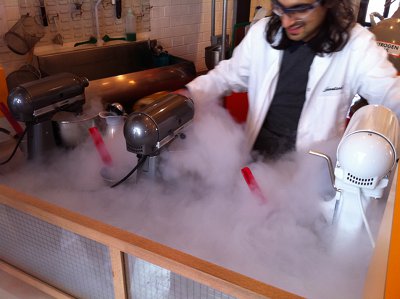
When word reached us here at Nature Towers that just a mile or two away there was a shop making ice-cream using liquid nitrogen, we looked one another in the eye and decided that, for the good of Science, we should go and test it out.

liqN2.JPG

We discovered that Chin Chin Laboratorists, “Europe’s first nitro ice-cream parlour”, contained so much lab equipment that we couldn’t help smiling. From the massive wheeled dewar of nitrogen in the corner to the beakers and conical flasks of sauce and toppings, we kept spotting things more familiar from the lab than the kitchen. My personal favourite was the huge frame all through the shop, like a (much) bigger version of the one I’d once built to put a vac-line on. In a very nice touch, the menu was on a clipboard clamped to the frame.

We enjoyed the visit – and the ice-cream – so much that we thought we should interview Ahrash & Nyisha, the guys behind Chin Chin. Here’s what they had to say:

What gave you the idea to have an ice cream shop using liquid cryogens?

We were initially going to open a really fancy dessert bar, but when we researched different methods of making ice cream we realised that there were no ice cream parlours that solely used liquid cryogens and the only place you could experience this was at the very best restaurants in the world. We decided to scrap the dessert bar idea and try and revolutionise what an ice cream parlour should be

Why do you make ice cream using liquid nitrogen?

The science behind it is that the quicker you freeze ice cream the smaller the ice crystals and the smoother the texture; there are also other major advantages such as an ultrasmooth texture that requires less milkfat (and thus fewer calories) and we have complete freedom to make any texture and flavour we want so vodka or space dust ice cream are possible. Ice cream is really all about texture and ours is the best.

What scientific backgrounds do you have?

Very little – our backgrounds are law and marketing, but we have a love of science and food and an obsessive compulsion to never miss BBC’s Horizon

How does a liquid-nitrogen ice cream recipe differ from a normal one?

Ahh that took us a few months to get right – more milk, less double cream, one-third less sugar and there are three secret ingredients that we use

How do people normally react when they see all the lab gear and nitrogen?

People always comment that they feel like they have stepped into a mad scientist’s lab or Willy Wonka’s factory

How much nitrogen do you get through?

Far too much: in summer we will go through up to 1000 litres of liquid nitrogen per week

Are people ever worried about the ice-cream/freezing themselves?

When I put my googles on people put their sunglasses on, some take a step back – we always assure any concerned customers that they won’t get frostbite and use a laser thermometer to illustrate the point. But someone once said that they enjoyed the ice cream very much but had to eat it carefully as they did not want to bite into a pocket of liquid nitrogen… we just smiled!

Have you had any other groups of PhD chemists coming in and getting hugely over-excited?

We have a group of science teachers who sometimes come in regularly for ‘Friday Night Licks’, lots of people that work in labs, young children that want to be scientists, liquid nitrogen handlers… We are completely ‘geek chic’

Do you any problems with health and safety inspectors?

Even the sternest of health inspectors cannot help but smile as the vapours flood across the counter! Nitrogen is used at McDonald’s around the country as part of their carbonation system for their soft drinks, and it is not classed as a hazardous substance. Having said that, it was a nightmare trying to get a supplier; it is always much harder being the first!

You say you are the first shop in Europe that offers this – does that mean there are other shops around the world that we can visit to try this?

The shop is a complete one of a kind and we know we are the first in Europe but are unsure about the rest of the world, the technique of using liquid nitrogen actually dates from the early 20th century but this is the first commercial venture that solely uses this technique to produce ice cream.

Neil

Neil Withers (Associate Editor, Nature Chemistry)

Reactions – Matthew Hartings

Matthew Hartings is in the Department of Chemistry at American University, and works on two projects that can be characterized as bioinorganic chemistry: synthesis of ruthenium-based molecules that may disrupt cell signalling pathways and protein engineering to develop photo-activated enzymes.

1. What made you want to be a chemist?

My love of chemistry comes from the inherent beauty of creating new molecules. I thought about studying physics or engineering, but I found that I couldn’t resist the lure of exacting control over molecular scale objects.

2. If you weren’t a chemist and could do any other job, what would it be — and why?

I would be the head grounds-keeper at Wrigley Field (home of the Chicago Cubs — Major League Baseball). I love sport. I specifically love baseball, and I have a very romantic notion of the canvas on which baseball is played. Being in charge of this canvas makes a person part-artist, part-scientist, part-priest. Pretty cool.

3. What are you working on now, and where do you hope it will lead?

Aside from my other research pursuits, I’m working on developing new set of advanced lab courses. I am hoping to take advantage of the ability of active research to effectively engage and instruct the researcher in order to educate the junior and senior-level undergrads at AU. I am hoping that this course, when developed properly, will replace all of our upper-level undergraduate instructional labs. I also hope that we can get some really cool, publishable results so that we can reward our students with publications and opportunities to present at conferences along with the A’s that they are bound to get for the course.

4. Which historical figure would you most like to have dinner with — and why?

Nikola Tesla. The man was just so absolutely interesting. I would have a million and one questions to ask him about his views on science and (especially) its application.

5. When was the last time you did an experiment in the lab — and what was it?

10 minutes ago I started activating some molecular sieves. I’m going to be synthesizing a ruthenium-ATP (adenosine triphosphate) complex, and I need to dry my solvents before I start. (I’m in the lab pretty much every day. One of the benefits/curses of being a first year Assistant Professor).

6. If exiled on a desert island, what one book and one music album would you take with you?

Book: The Survival Handbook: Essential Skills for Outdoor Adventure by Colin Towell.

Music album: (my favorite album of the moment) Rubber Factory by The Black Keys.

7. Which chemist would you like to see interviewed on Reactions — and why?

Emily Weiss. She is a good friend and one of my favorite people. Also, her research is just stellar (I am continuously envious of her research) and she is one of those young movers in the world of chemistry. More people should know Emily and her work.

Reactions – Jeremy Harvey

Jeremy Harvey is in the School of Chemistry at the University of Bristol, where his research is focused on investigating the mechanisms of chemical reactions using computational electronic structure methods.

1. What made you want to be a chemist?

Though I was never into explosions in a big way (I still have both eyes and all my fingers), I was fascinated by the tangible mystery of chemical transformation: I can still remember messing around pouring nitric acid onto iron in my early teens, and seeing the fumes of nitrogen dioxide. Much more fun than physics!

2. If you weren’t a chemist and could do any other job, what would it be — and why?

I would quite enjoy not really having a job — being able to lounge around, reading about things I’m interested in (and perhaps writing and talking about them).

3. What are you working on now, and where do you hope it will lead?

A lot of my work over the years has been about catalysis, and that’s still the overarching theme in my group. Within that, we do a lot of different things, which I think are all very exciting! I’m perhaps most excited for the moment by work which I’ve done with an extremely talented postdoc, Dave Glowacki, on developing potential energy surfaces to describe complex reactive systems, and techniques to explore the dynamics associated with reactivity in these systems. I think it can lead to a better understanding of what makes catalysis tick, and thereby help improve catalysts.

4. Which historical figure would you most like to have dinner with — and why?

Henry Eyring is one name that springs to mind. The 1930s were an exciting period for starting to work out what the new quantum theory might mean for understanding chemical reactions, and he was a key figure. His equation is still a daily part of my thinking about chemistry. He also comes from a different epoch and a different background to mine — in my dream, we would have had a wide-ranging discussion about all that.

5. When was the last time you did an experiment in the lab — and what was it?

Experiments — real ones, mixing up chemicals and watching them react — ages. About 15 years now, “looking” at ions react in a mass spectrometer when I was a postdoc with Helmut Schwarz in Berlin. As a computational chemist, I would say that calculations, especially simulations, are sort “experiments in the lab” and I’m happy to say I still do some of those myself. I was calculating the bond energy for a transition metal species, a model of a biological catalyst.

6. If exiled on a desert island, what one book and one music album would you take with you?

It would have to be a long one in both cases to keep me busy. I’d probably go for a nice recording of Bach’s St Matthew Passion, and for Proust’s Remembrance of Things Past.

7. Which chemist would you like to see interviewed on Reactions — and why?

It might be nice to see an interview with a younger scientist — a PhD student or postdoc.

Reactions – Banglin Chen

Banglin Chen is in the Department of Chemistry at The University of Texas at San Antonio, and works on porous metal-organic framework materials for gas storage, separation, sensing and heterogeneous catalysis.

1. What made you want to be a chemist?

I was greatly motivated by my high school chemistry teacher Yang Zhicai who was very enthusiastic and had a deep understanding of chemistry. I started wondering of how I could develop useful chemicals/materials some day because of my fascination with the magical power of chemistry and its ability to produce infinite numbers of new chemicals from simple raw materials.

2. If you weren’t a chemist and could do any other job, what would it be – and why?

When I was in College, I wanted to be a politician who might help poor people. If I were not a chemist, I would surely be a Christian Preacher.

3. What are you working on now, and where do you hope it will lead?

Now we are exploring new materials for gas storage and separation (H2, CH4, CO2, C2H2, C2H4 etc), and heterogeneous catalysis. I hope that we can discover one or two practically useful materials, not only just develop science.

4. Which historical figure would you most like to have dinner with – and why?

Alfred Werner. I want to know how imaginative he was. I wonder if he forsaw the significant impact of coordination chemistry on the modern chemistry.

5. When was the last time you did an experiment in the lab – and what was it?

About three years ago to synthesize a lovely chiral mixed-metal-organic framework, although I enjoy checking crystals with my postdocs/students almost everyday.

6. If exiled on a desert island, what one book and one music album would you take with you?

I would bring my Bible and Hymns of Life with me. Being a Christian is the most important and meaningful thing in my life.

7. Which chemist would you like to see interviewed on Reactions – and why?

Michael O’Keeffe. One of the very few scientists I have ever known who dedicates himself to science.