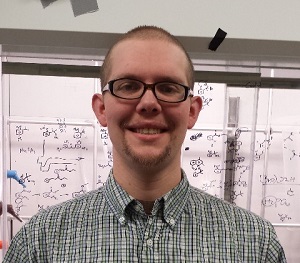
Reactions: Michael Young

MichaelCYoung-01Michael Young is in the Department of Chemistry & Biochemistry at the University of Toledo and works in the areas of supramolecular and organometallic chemistry.

1. What made you want to be a chemist?

I love the idea of creating new things, and when I discovered synthetic chemistry I couldn’t help but turn my love of doodling ideas into drawing (and later developing) new molecules.

2. If you weren’t a chemist and could do any other job, what would it be and why?

I’d probably be a composer or a chef. Basically something where I can create new things that improve the lives of others.

3. What are you working on now, and where do you hope it will lead?

My group is currently working on new strategies to use supramolecular principles for improving regioselectivity and activity in organometallic chemistry. The hope is that this will provide exciting opportunities for synthetic chemists to access new synthetic space, and maybe even develop some functional therapeutics.

4. Which historical figure would you most like to have dinner with — and why?

Alexander Borodin. His ability to be both a successful chemist and musician has always been inspirational to me.

5. When was the last time you did an experiment in the lab — and what was it?

Earlier today I set up an iron-catalyzed reduction of an aromatic amine. Prior to that I had run a Rosenmund von Braun reaction, as well as an amine C–H functionalization reaction that we’re currently developing.

6. If exiled on a desert island, what one book and one music album would you take with you?

I would take Brave New World by Aldous Huxley to read, and Get Acoustic by The Megas to listen to.

7. Which chemist would you like to see interviewed on Reactions — and why?

Stephen Buchwald everyone I know who has met him describes him as one of the most amicable chemists they’ve ever met, and his chemistry is intellectually stimulating. Also, I’d like to see what new comments he has about his cats, although that might require an eighth question.

Reactions: David Sarlah

David-1David Sarlah is in the Department of Chemistry at the University of Illinois and works in the area of synthetic organic chemistry. David recently published “Dearomative dihydroxylation with arenophiles” in Nature Chemistry.

1. What made you want to be a chemist?

My parents, indirectly. We had a small family-owned company that manufactured fruit syrups, and we had a small lab for quality-assurance. As a kid, I often spent time in this lab and eventually convinced my parents that they should get me an arsenal of chemicals and glassware to do organic synthesis. By the end of high school I had done most of the common reactions, including Grignard addition, LAH reduction, ozonolysis, and luminol synthesis. At that point, my mind was set to become an organic chemist.

2. If you weren’t a chemist and could do any other job, what would it be — and why?

I would be a food scientist or engineer, because that profession runs in my family.

3. What are you working on now, and where do you hope it will lead?

We are involved in both the chemistry and biology of natural products and methodology development. We work on how to streamline the synthesis of high-value chemicals by defining new chemical disconnections, as well as how to provide rapid and controlled access to natural products of broader significance.

4. Which historical figure would you most like to have dinner with — and why?

Robinson and Woodward at the same time, with me being there to moderate the conversation and observe their interactions. They both contributed significantly to the field of organic chemistry, yet they had very different views, principles, and personalities. Importantly, they are both from an era that was long before my time — it would be great to get a glimpse into it.

5. When was the last time you did an experiment in the lab — and what was it?

I synthesized MTAD1 a few months ago. I was helping to make more of this reagent so my graduate students could use it in their work. At some point, I had reactions running for days and weeks because I didn’t have time to work them up. Ahhh, I wish I could spend more time in lab, but my time is getting more and more limited these days.

6. If exiled on a desert island, what one book and one music album would you take with you?

Led Zeppelin’s Mothership. It helped me through grad school, so I guess it could help me keep my sanity on a desert island as well.

7. Which chemist would you like to see interviewed on Reactions — and why?

I can’t answer that — I know way too many candidates that should be featured and can’t really pick only one or two!

[1] 4-methyl-1,2,4-triazoline-3,5-dione

Reactions: Ariane Vartanian

thisisarianeAriane Vartanian studied materials chemistry at the University of Illinois before moving to New York, where she is now an Associate Editor for Nature Communications.

1. What made you want to be a chemist?

Strong undergraduate advising and a gallon of Red Bull. In college I wanted to be a cinematographer, but I took general chemistry to fulfill a requirement. I had found chemistry dry in high school; add that to an early morning class and some sort of teenage rebellious phase — I skipped class and found myself on the verge of failing as the semester ended. So I crammed the entire textbook in three sleepless days. By the 65th hour I was full-on hallucinating molecules. It was right around the chapter on molecular orbital theory when delocalized electrons started (in some sense literally) swimming around in front of me. My grade in the class was horrible, but it was worth it because I emerged totally fascinated.

2. If you weren’t a chemist and could do any other job, what would it be — and why?

I’d move to the Continental Divide, foster a bunch of dogs, and open an ice cream petting zoo bar. Essentially people would come to eat ice cream and play with my dogs. I’d try to encourage more people to adopt dogs and get them out of shelters. I’ve thought through this plan to the extent that it combines many of my favorite things, but there might be holes in the money-making part.

3. What are you working on now, and where do you hope it will lead?

I’m an editor for Nature Communications, and I love it. There’s this hungry, feverish feel of continuously taking in new knowledge and trying to shape the way my field is represented. It’s a great feeling to fight for a paper I find really interesting, and then see it published. One of my eventual aims is to be a molecular animator, making big screen films featuring giant, dynamic molecules to convince people that chemistry is more than just balancing equations.

4. Which historical figure would you most like to have dinner with — and why?

I’d be kind of interested in dining with Lucy the Australopithecus. She has a mythical reputation in grade school history books but I imagine there’s more to her story than the single paragraph we get.

5. When was the last time you did an experiment in the lab — and what was it?

About half a year ago. I was attempting to use DOSY NMR to figure out the conformational flexibility of ligands attached to different axes of anisotropic gold nanocrystals.

6. If exiled on a desert island, what one book and one music album would you take with you?

I would be a terrible hunter, so I doubt I’d survive any longer than a week. Therefore my choice would be about maximizing lifetime knowledge. I’d take The Western Intellectual Tradition, which I own for some reason but would never read otherwise. As far as music, I think listening to music created by humans would make me too lonely and sad1.

7. Which chemist would you like to see interviewed on Reactions — and why?

Any chemist who does research in a developing country. I’d like to learn about the differences in their experience and the unique challenges they face.

[1] Editor’s note: In this case, might I recommend music made by non-humans?

Reactions: Abraham Mendoza

mendozaAbraham Mendoza is an Assistant Professor in the Department of Organic Chemistry at Stockholm University, and works on scalable and automatic synthetic methods involving C–H functionalization and main-group organometallics towards natural and artificial molecules.

1. What made you want to be a chemist?

When I was pursuing my International Baccalaureate in high-school, I chose chemistry for my final project. I was given the keys to the lab during holidays to do some experiments and I guess that the feeling of freedom in a lab was too captivating for a teenager.

2. If you weren’t a chemist and could do any other job, what would it be — and why?

I think I would have loved being a program developer or a digital freelancer of some sort… creativity and computers!

3. What are you working on now, and where do you hope it will lead?

We are developing new synthetic reactions with common organometallic nucleophiles to enable abbreviated syntheses of useful molecules. Lately, we have been quite busy applying a natural product total synthesis mindset to artificial molecules, like ligands. We hope that our research will enable explorations in tailored ligand design that are unthinkable now.

4. Which historical figure would you most like to have dinner with — and why?

I’d be thrilled to share table with the double Nobel Prize winner, Linus Pauling (Peace and Chemistry!). I guess that an amazing scientist with such a social commitment would be just too good of company.

5. When was the last time you did an experiment in the lab — and what was it?

It was some weeks ago — I acquired and solved the structure of a single crystal. I happen to have recently turned into a crystallography aficionado…

6. If exiled on a desert island, what one book and one music album would you take with you?

Probably, I wouldn’t read or listen to music on a desert island… diving all day long sounds better to me!

7. Which chemist would you like to see interviewed on Reactions — and why?

Prof. K. Barry Sharpless. I’d love to read the answers of the true genius.