Materials Girl: ACS gives theobroma (food of the gods)

[Posted on behalf of Materials Girl]

On Sunday, I mentioned via Twitter that the longest lines exist for free food. (I could start a blog on how to feed yourself at conferences without spending a dime, give or take a lack of proper nutrition.) In second place are the booths dishing out non-academic freebies, as if oversized t-shirts and logo-covered canvas bags are the key to happiness. On a similar note, the most crowded talk seems to be here, at the Everything You Want to Know About Chocolate program. The organizers knew what they were doing – aside from the obvious appeal of the topic, they will be raffling off at least two massive, 10 lb chunks of bittersweet chocolate [4.5 kg – NW]. “To encourage you to stay until the bittersweet end [of the talk].” Ah, the sneaky wisdom.

Amusingly, the male—female ratio in here has shifted in favor of the ladies. Personally, I’ve never been afflicted by the female mania for chocolate – but nonetheless, lectures on chemistry+food/processing are more compelling than others. This reflects a choice I’ve made for the meeting: I’m going to have fun. Few of the talks relate to my current research and my PI isn’t paying for the trip, so I might as well kick back and learn about completely new topics.

Coming back to the original thought, the close quarters in this room are a bit disconcerting – partially because moving an elbow makes you bump the adjacent person. However, it’s definitely fun to see such relaxed enthusiasm at a technical talk. The studies’ details are interesting, although in the end the message is the same: yes, cocoa-based chocolate is good for you, but no, not in unlimited quantities.

All of us dieters should already know that moderation is the key to success. (Unless you’re one of those scrawny grad students who never eats real meals.) As the saying goes, Il faut souffrir pour etre belle. We must suffer for beauty! Rather like how we must suffer through long hours in the lab for academic survival – if only my research involved food…
Materials Girl: At the ACS

[Posted on behalf of Materials Girl]

According to the flight attendant on intercom, we arrived in “the beautiful tropical paradise” of San Francisco. Hah! Compared to the freezing weather elsewhere, 50-60 °F [10-15.55555 °C – NW] probably is a true paradise, but the joke also felt like a jab towards those of us not running wild on spring break (I never was one of those undergrads). Really, though, this is another sort of paradise – or at least a nice vacation. Winter finals are over, traveling is a rare luxury for me, and, most importantly, I have a valid excuse to be away from the lab. It’s my first ACS meeting!

Conventions are all about connections, and before they start it’s a good idea to check out the digital landscape. For example, if you kept up with The Sceptical Chymist (and Twitter) you would know that some Nature editors might be heading to SF. I hadn’t, actually, hence Gavin’s post was fresh news when I took an internet break at 8pm. Aside from helpful tips for a first-timer, it was revealed that Nature Publishing Group had a stand in Moscone Center…

And so, near the end of the first day exposition, a lone student limped over to booth #1000 on a mission to find Gavin. “Hi, I’m Materials Girl! How’s life in London?” That was me – cheerful, but bleary eyed and ruing the invention of the 3” stiletto heel [76.2 mm – NW] (wisdom dictates that I dress down tomorrow). Despite fatigue, it was the highlight of my day. Meeting people means so much more when you have a tangible connection and a host of topics to discuss. My only complaints are that Neil and Stu are far away – only existing as email addresses and Twitter feeds!

This week will be madness, but I look forward to it. In the meantime, I’ll try to choose which talks to attend, get some sleep, and start following @gav33. It’s already Monday.

Materials Girl: Applications + blogging = decreased rate of labwork

Posted on behalf of Materials Girl

Fellowship applications are almost done! To quote a confident labmate, in regards to his proposed research, “If [the NSF] doesn’t accept me, they’re jerks*!” (He probably meant to say “sorely misguided”, but was carried away with the emotion.) Ah, if only the government had enough money to fund all of our worthy causes… Academic bailout, anyone?

Despite attempts to avoid the computer, I’ve recently discovered the joy/timesink of other chemistry blogs – of which there are many great ones to choose from. Another grad student stated that he’s the most interested in “crazy, blow stuff* up and post it blogs”. (My engineering coworkers periodically ask when I’m going to start causing explosions. Probably never, unfortunately, unless I defect to inorganic chemistry. However, someone else in our lab did recently get a shower in vacuum pump oil…) Personally, I think any blog is potentially interesting. Regardless of whether or not they relate to science, the topics addressed in blog posts thrive through their delivery – give or take some snark and wit.

One of my favorite posts has been this one, as I’ve always regretted the lack of fitting eyewear for my bridge-less Asian nose. On a more relevant note, another by FemaleScienceProfessor stands out. Here, she ponders the merits and drawbacks of explicitly stating her gender in applications. I have considered that question as a grad student: in the interest of Broader Impacts, should I explicitly state my status as an underrepresented female scientist/engineer? (Side note: my name only implies ethnicity, not gender.) As a proponent of individual merit above all else, I’m not a fan of playing the gender card – I generally rely on expressing my motivation to assist qualified individuals in underrepresented groups. Still, many organizations seek out the extra factor of diversity. How should we convey our membership in underrepresented groups, without detracting from personal merits [that are not based on genetics]?

*Changed by the editor to remove original, more colourful, language

Materials Girl: Buried under a mountain of digital paperwork

Posted on behalf of Materials Girl

I have been in grad school for two weeks. Already, my original plans to jump into research – and sleep 9 hours a day – are currently thwarted by a flurry of newly discovered fellowship applications. Also, my nemesis has returned: physics class! I now have the pleasure of competing against graduate students who majored in applied physics, instead of the previous motley crew of undergraduate science and engineering majors. Serves me right for going into matsci instead of inorganic chemistry. This sounds like grounds for a discussion on the merits of GPAs in graduate school…

Application writing is tedious. I don’t know a soul who actually enjoys composing personal statements, previous research reports, or proposals. I have also spent many hours typing personal information into online forms via the cantankerous internet connection in my office (at least it saves paper). Personally, my problem is not so much the time it takes to type up everything. The issue is in composing something scientifically meaningful, which communicates my ideas in a clear, clever fashion that does not put people to sleep. (Being a slow writer also causes troubles. Or maybe it’s just my brain that might be slowing; my mother recently commented on yet another lapse in my short-term memory, stating that age 21 is a bit early for Alzheimer’s to be setting in. I’d like to think that we all have these sorts of problems, though.)

In terms of producing worthwhile content, I specifically have the personal statement in mind. It’s like a repetition of college applications, where all of my accomplishments, background, and any aspect that I write about has inevitably been done, experienced, and described by myriads of other applicants. How does one presume to be unique, and then convey it in one thousand words? To what extent can a short essay convey the subtleties of a personality and the drive to excel, avoiding horrid clichés and hackneyed concepts? For those who wade through the sea of incoming material: how do you distinguish between creativity and reiteration? The same can be said about research proposals, too. They need to know that I know what I’m talking about. But how?

All I can do is my best, and hope it is sufficient to propel my application into the “accept” list. Good luck to everyone else in the process of begging for funding. Unless you are one of my competitors. (Just kidding! Or am I…?)

Materials Girl: Upwards and onwards

Posted on behalf of Materials Girl

The day has arrived: fall quarter has begun and I am officially a grad student! I have long since left the comfort of teeming undergraduate dormitories and dining halls, in lieu of bare graduate apartments and my own kitchen. (Next step: avoiding frozen food and making time to cook up edible chemistry.) In the shiny new engineering building, there is a desk waiting for me alongside the other first years. Soon I shall take my research from the realm of theories & literature into that of wet-synthesis & laboratories! With my departmental transition from chemistry to Materials Science and Engineering (MSE), I am more of a “materials girl” than before.

My academic world will primarily consist of three categories: (1) graduate courses, (2) undergrad classes to TA, and — of course — (3) the everpresent job of scientific research.

1. My financial aid contract requires a full-time classload per 10-week quarter. So, I am enrolled in the obligatory [difficult] introductory MSE course, another on proposal writing, and slew of seminars. Nothing particularly new and exciting just yet.

2. To some, lecturing, presentations, grading, and all the works of teaching are trivial. To me, they are all important. With the undergraduate viewpoint still fresh (in which graduate students are expected to know everything and be available 24/7 to answer questions), I aspire to be one of those wonderfully enlightening, inspiring Teaching Assistants. Past experiences with terrible TAs make me wonder…

Deep down, there exists a nagging phobia that my chemistry-tuned background will be insufficient to support the inquiries of engineering students. The MSE class I will teach this term is a one of many core engineering requirements; statistics — and personal confessions — say that most of my students will be more concerned with lesser branches in the school of engineering. (Civil engineering? Who needs that?) How do quiet, calm, low-key individuals convey a passion for chemistry and materials science to students who don’t want to be there? (And contrary to what online ramblings may imply, in person I am quite verbally reserved.)

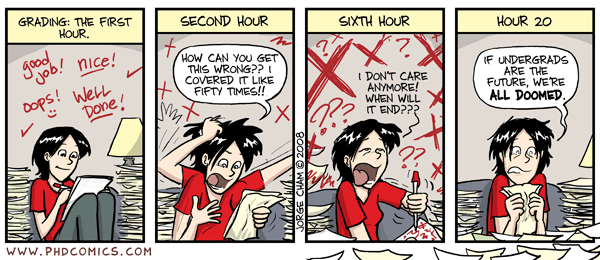
Any doubts aside, I am excited to wield power over undergrad— I mean, to teach. With my limited teaching/tutoring experience as aid, I can help cultivate minds and fend off requests for deadline extensions. We are the future!

3. Let’s just cross our fingers and hope for miracles. Or at least a stack of papers for Nature to publish. 😉

On a side note, it cannot be avoided that being a minority ensures that I stand out — even literally, as the department seems largely populated by short Asian males*. It’s not a bad thing, but I do wonder what judgments, expectations, and presuppositions await those with double X chromosomes.

*Let the record show that I am 1.68 m [= 5 ft 6 inches for those who like Imperial units and dislike mental arithmetic. NW], Vietnamese, and find it entirely appropriate to point out the common lack of great stature among my fellow Asians.

A flood of questions is before me: “what happened?”, “what now?”, “what am I doing?!”, “what if…”. Hopefully the journey will be more enjoyable than tedious (it’s already established that the road will be painful). For now, however, I must return to begging for fund— I mean, writing scholarship essays and proposals.

TBC

P.S.: My summer was spent doing little chemistry and a lot of art: throwing in a ceramics studio 8 hours a day, using an entire wall to paint a mural in my bedroom, and visiting museums. Should I feel guilty?

Materials Girl: Catching up

Posted on behalf of Materials Girl

Previously, summer class and the flurry of conference posts have been an excuse for my lack of posting. But, like Neil, I need to get back to it. So much has happened in my academic world since my last post! Does a personal Twitter feed with periodic chemistry references count as updates?

In May, we were drowning in midterms and the doom of upcoming finals. Merely weeks later, I discovered that my last chemistry exam was over and I was running off to multiple commencements, amidst moving out of a surprisingly stuffed little dorm room. Somewhere between the madness and sentence fragments, it suddenly hit me that I had GRADUATED.

Where did the last four years go? My memories are of sweat, blood, and tears – plus a few friends for eternity and a few classes that I truly enjoyed. (Admittedly, it could be argued that I liked any class that was relatively easy – whether matsci, English, or chem. This raises the issue of class content versus classmates and professors, but that topic is best left to a future post.) Of my most notable favorites were solid state and organic chemistry, both lecture and lab courses – despite the latter being slightly ruinous to my GPA. But hey, we have to start learning lab skill somewhere! Plus, it was fun to conjecture on how the professor really tested all the lidocaine we synthesized… And tetraphenylcyclopentadienone was such an impressive sounding name and such a pretty, shiny purple…

Not to marginalize all the toil, but do I look back and wonder what sort of lasting material those classes really taught. (It likely doesn’t count that I’ve been able to fit the allotropes of carbon into “regular” conversation.) My transition from high school to university was very profound; the difficulties of my first term eclipsed all previous academic experiences. Now having jumped those hurdles and refined my abilities, as with high school, my college education seems to lose value. Is undergrad just like [American] high school, where you’re learning to learn? How much of the foundation do we actually retain, forget, cram in for prelims, and then forget again?

It already seems far away, even though graduation is not even two months past.

Materials Girl: Expectations

Posted on behalf of Materials Girl

In discussions with various professors, I’ve noticed that researchers seek out an interesting range of qualities for their minions – aka: grad students. One absolutely required creativity and out-of-the-box thinking. The next expected independence and strategizing, while insisting that he himself was not the greatest of researchers (he’s amazing and brilliant).

Another said that inherent intelligence and academic background were irrelevant – he just wanted his students to work hard. (This was not too concerning. That is, until I was told that the HR lady received complaints from a different prof who was displeased that his students didn’t come in every weekend… Uhh…) My own advisor never asked for my experience or qualifications, being seemingly content with the fact that I was excited to be in the lab and willing to try anything.

So then, what other characteristics are required? Which are the most important, and to what branches of study?

Materials Girl: Readjusting

Posted on behalf of Materials Girl

It occurred to me that all this time I’ve had a mistaken notion/approach about my undergraduate education… First year was newly discovered distress in the form of higher standards, 10+ page papers, and relatively detailed lab experiments that didn’t go as well as planned. (98% yield on the first time doing a distillation? Why doesn’t my unknown ether smell like roses?! Hah!) I swore that after surviving such troubles from o-chem, nothing else would be difficult – even if I loved the subject.

The next fall, I realized that organic actually isn’t that difficult – physics was infinitely worse for me. Also, to my chagrin, bombing one final could mean getting one crappy grade that permanently tanked a good GPA. I looked forward to the day I returned to the realm of ~3.8.

During third year, after changing my major, I was introduced to the world of materials engineering, research, and more upper division classes. I wondered how half of my undergrad education was already over and why school was still so traumatic at times. If only I could just get another A and earn Latin Honors, all my troubles would dissipate… Now, with over two-thirds of my final year finished, I’ve almost convinced myself to believe that grades aren’t THAT important. It’s all about experience and adaptation!

The “moral” is, I’ve come to recognize, that there will be hardship at every stage of education – and life. Sometimes it’s unbelievably mind-blowing, depression-causing, head-banging-on-desk, extreme hardship. The difficulties just come in different forms, and once you get used to something, situations change. So it’s not about looking forward to when something unpleasant is over, but figuring out how to make it bearable. Enjoyable, even.

Perhaps I’m reiterating obvious truths, but it should be about the journey. I shouldn’t have the mindset of only looking forward to when my GPA goes back up or when graduation rolls around. You have to stop and smell the roses, right? Just make sure that the whiffing doesn’t make you pass out…

Materials Girl: Say, what?

Posted on behalf of Materials Girl

I am trying something new this quarter – skipping class! But, not skipping class because I want to sleep in; even if I did do something so atrocious, it hardly would be beneficial to advertise on this blog. 😉

Instead, I am leaving the classroom to attend a conference for the first time! A friend has secured a [tiny] bit of funding to aid any undergrads attending the MRS spring meeting. Speaking of which, is it really necessary to charge students $160 to merely get through the door? It probably explains why only four of us are going (from the undergraduate Materials Science & Engineering department). Grad students at least tend to get funded by their advisors…

Given our very limited budgets, I’m not sure what the available scope of activities will be. However, I am nonetheless excited – especially after hearing of all the wondrous things from ACS! Now if only Nature Chemistry were around so I could nab an awesome shirt.

What types of happenings do you expect and seek out from conferences?

[Editor’s note: the editorial in issue 2 of Nature Chemistry will be about scientific conferences…]

Materials Girl: How time flies

Posted on behalf of Materials Girl

So… it has sadly been ages since I wrote a post for TSC. Finals for winter quarter are rapidly approaching, and unlike Stu, I don’t have the legitimate reason of starting up Nature Chemistry. It’s just been long hours in class/lab and late nights spent writing lab reports or essays – nevermind battling senioritis. (The latter is especially difficult these days as my peers on the semester system are preparing for graduation, while the rest of us will be in school through June).

At the beginning of my undergraduate studies, the difference in academic standards between high school and university came as an unexpected shock. It felt as though that nothing could upstage the difficulties of earning all As instead of A-minuses. Now, those gruelling undergrad o-chem labs seem trivial and writing a 10-page paper in any subject is more of an extended frustration than a hair-ripping horror (although theses still scare me). With whatever wisdom my 3.5 undergraduate years have imparted, I have: 1) discovered that constantly working hard is a given, 2) come to terms with “bad” grades, and 3) learned the importance of higher education in the sciences.

This raises a subject that has lately piqued my curiosity: It comes without saying that a majority of chemists need graduate degrees, but how important is it to have them from a top university, renowned advisor, or an especially demanding program? It’s been said that the undergraduate institution attended is of relatively little consequence, but will the name of my graduate school make a real impact on my future prospects?