Reactions: Andrea Taroni

1. What made you want to be a chemist?

I suppose the reason I opted to apply for chemistry at university was the idea that it was the ‘central’ science, somehow sitting in between biology and physics. I soon realised that viewing the natural sciences like this is in some ways rather limiting, but once I started it was too late! I actually found the degree very challenging — there was so much to learn both in theory and in practice — but after some initial difficulties I enjoyed it. I chose to study at UCL because at the open day I went to, Andrea Sella (@sellathechemist) gave a talk in which he blew up loads of things and that made quite an impression.

2. If you weren’t a chemist and could do any other job, what would it be – and why?

Honestly, I don’t think I can call myself a chemist these days, at least not in front of other chemists. I got very interested in magnetism during my PhD, and I started to gravitate towards physics and statistical mechanics in particular. In that sense you can say that I chose to change jobs already! My two main spheres of interest as a teenager were football and music, and being either a footballer or a rockstar wouldn’t be bad, I guess. In moments of idle pensiveness I sometimes think I would like to be a writer, but deep down I think I would trade that all in to score a winning goal in the world cup final for Italy.

3. What are you working on now, and where do you hope it will lead?

Right now I am working with some colleagues on a long term editorial project focusing on the historical milestones that have defined the field of crystallography. It’s a field with a long and distinguished history and it really cuts across all the scientific disciplines. I’m hoping that once we publish it next year it will help raise awareness of its importance, especially to young aspiring scientists. I also deal with submissions in the fields of spintronics, magnetism and superconductivity at Nature Materials, but what that will lead to I couldn’t possibly say.

4. Which historical figure would you most like to have dinner with – and why?

There are tonnes of scientists I would like to meet, Ludwig Boltzmann in particular, but Julius Caesar would be hard to beat as a historical figure. He was so many things: a military commander, a politician (well, a dictator eventually, but let’s not split hairs), not to mention a writer and orator with a lasting legacy. I would just like to meet and get a feeling for the character of a figure of such towering importance. I would also ask him if the Gauls really drove him round the bend, like Asterix teaches us. And why not invite Cleopatra along too? That would be a great night out, Julius Caesar and Cleopatra!

5. When was the last time you did an experiment in the lab – and what was it?

That would be sometime in early 2010 in Uppsala, Sweden, where I was helping some colleagues measure the magnetic response of a laser beam shining off a thin magnetic film, a phenomenon known as the magneto-optic Kerr effect. We established that the magnetism of our films displayed all the hallmarks of being dimensionally confined, and we confirmed that I am a terrible experimentalist. I had very patient colleagues. If we’re talking about a chemistry experiment, then we would have to go back to 2003, in the last year of my degree: I tried very hard to synthesise crystals of a funny magnetic material called hydronium jarosite. Instead, I successfully made millions, if not billions, of really tiny particles of what goes by the generic name of ‘rust’. But I did make them in a really original and expensive way.

6. If exiled on a desert island, what one book and one music album would you take with you?

I would have to go for one of those timeless books with a certain amount of depth to it, I suppose, something like War and Peace or Don Quixote. If I had some advance warning I was about to be shipped off to the island for ever, I would also make sure I learned the Inferno from Dante Alighieri’s Divine Comedy by heart, like my grandfather does. As for the music album, I don’t think I would be too fussy. I always find that Blood Sugar Sex Magik by the Red Hot Chili Peppers periodically ends up back on my stereo, so I think I would go for that.

7. Which chemist would you like to see interviewed on Reactions – and why?

I often find that people don’t always appreciate how the tools that underpin analytical chemistry — spectroscopy and crystallography in particular – are used in all sorts of fields that aren’t immediately thought of as ‘chemistry’. So there are ‘chemists’ that work as restorers of fine art, others that work as solid-state physicists in disguise, and some that even brew beer for a living. I would like to see such people interviewed here. Also, three chemists I have fond memories of as great teachers and scientists at UCL are Andrea Sella, Willie Motherwell and Steve Bramwell.

Andrea Taroni is an Associate Editor for Nature Materials; he goes by @TaroniAndrea on Twitter.


Blogroll: Sharing your science

Editor’s note: As we continue to invite bloggers out there in the wild to compose our monthly Blogroll column, Chad Jones penned the October 2013 column.

———-

Informal chemistry review articles are a great way to spread the passion you have for your research.

Hours and hours spent in the lab with no results. Finally there’s a spike in the spectrum, a precipitate forms, or a colour changes; you’ve got a result to be proud of, and all of that hard work pays off when you share what you’ve found with your peers. Whether at a conference, in a peer-reviewed journal, or at a seminar, it’s important to communicate the science you’re passionate about.

These formal settings are usually what come to mind for sharing your research, but a new blog initiative by Andrew Bissette may also be worth your time. Bissette, who hosts #chemclub on Twitter and posts round-ups on his blog, has begun posting an informal review article each month. The first two posts were his own, on protcells and the Pummerer reaction, but since then he has invited others to fill the space with subjects they’re familiar with. JesstheChemist, who blogs at The Organic Solution wrote a great review about fluorinated drugs.

#Chemclub Reviews is a new project, but it’s a good idea and it will be interesting to watch it develop. Informal short reviews like these are a great way of telling the online chemistry community about the area you work in — a community that is very willing to listen and give relevant input. Reading the reviews is a quick way to learn more about a field that you might not be so familiar with and offers a complementary option to traditional journal review articles. If you would like to contribute an informal review, contact Bissette by e-mail (andrew.bissette@gmail.com) or on Twitter (@_byronmiller).

Written by Chad Jones, who blogs at https://www.thecollapsedwavefunction.com.

———-

[As mentioned in this post, we’re posting the monthly blogroll column here on the Sceptical Chymist. This is the October 2013 article]

Chlorine chronicles

I’ve had a rather busy summer, and apologize for not posting earlier about last month’s ‘in your element’ piece. Our before-latest article sees Barbara Finlayson-Pitts from the University of California, Irvine take a look at chlorine. I’m happy to say that this element, which chemists and non-chemists alike are well acquainted with, completes our first family of the periodic table!

© J. N. PITTS JR

© J. N. PITTS JR

The first report of chlorine has some fantastic and charming old chemical language in it (I think I may have already mentioned my penchant for archaic terms): Carl Wilhelm Scheele noticed that reacting “brunsten” with “muriatic acid” led to a yellowish green gas — check in the article just what those reactants were. At the time, the gas was referred to as “oxymuriatic acid”, a compound of oxygen and muriatic acid. It was Sir Humphry Davy that later identified it as a new element, and named it chlorine after its colour.

Element 17 is abundant, and has found many applications, for better (such as for bleaching and disinfecting water) or for worse (for example, chlorinated compounds have been used as chemical weapons). One aspect discussed in the article, which must not be neglected, is its atmospheric chemistry. The chlorofluorocarbons (CFCs) of aerosols and refrigerants have been linked to much damage in the atmosphere. Other sources of element 17 that contribute to its atmospheric chemistry are increasingly being identified. NaCl particles from seas and oceans, and dust from alkaline dry lakes, also contains chlorine that goes on to react with gases in the atmosphere; surprisingly, chlorine chemistry is also observed in continental regions.

In any case, don’t let the fact that “these atmospheric processes are incredibly intricate and difficult to study” stop you, Barbara Finlayson-Pitts emphasizes that “elucidating their chemistry is critical to quantitative predictions of processes, and in turn reducing or overcoming undesirable effects.”

One flerovium atom at a time

This month, our tour of the elements takes us to a corner of the periodic table that has only been explored recently, and from which only a handful of atoms have been observed. In the case of flerovium, literally one atom at a time. The superheavy element 114 has such a high nuclear charge that several months of nuclear fusion (in which calcium-48 ion beams are directed into targets of plutonium or curium isotopes) are required to produce just one atom — which then decays within seconds.

nchem.1688-i1

Georgii Nikolajevich Flerov
© RIA NOVOSTI / ALAMY

The discovery of element 114 is credited to a collaboration between the Flerov Laboratory of Nuclear Reactions in Dubna, Russia and the Lawrence Livermore National Laboratory in Livermore, California. In fact, things turned out pretty well for the two labs with two elements named at the same time: element 114, flerovium, and element 116, livermorium.

I’ll let you read Peter Schwerdtfeger’s account on what properties we might expect from flerovium, based on its structure, but also taking into account relativistic effects. Could those effects endow element 114 with an electronically closed-shell configuration, as suggested decades ago by Kenneth Pitzer? Is flerovium a gas at room temperature, or is it a metallic liquid? The properties and reactivity of flerovium are investigated both through calculations and experiments. For now, Peter Schwerdtfeger’s conclusion is that we should “expect the unexpected”.

Titanium tales

In this month’s ‘in your element’ article (subscription required), Mike Tarselli from Biomedisyn Corporation recounts just how pervasive titanium is in our lives. And by ‘our lives’ I refer to us human beings as well as us chemists.

[Note: Find out more about Mike here by reading his replies to our Reactions questions.]

Ti_nchem.1656-i1

{credit}© DIDIER ZYLBERYNG / ALAMY{/credit}

Element 22 is ubiquitous on Earth – although not as a pure metal, a form that has only become accessible in the 20th century. Titanium and its compounds serve a myriad of purposes. To name but a few, titanium is a component of jewellery, glasses frames, and the pins and screws used to staple together broken bones, while pigment TiO2 also endows paints, toothpaste and pharmaceutical coatings with a bright, glimmering white.  Not to mention partly making up the striking Guggenheim Museum in Bilbao (pictured)!

Chemists have long relied on titanium, in various compounds and oxidation states, to promote many, many reactions – the article elegantly relates diverse ways in which titanium, in different oxidation states and coordination environments, engages with a variety of molecules, but I will avoid spoiling it here. Let me point out though that titanium compounds may not be as environmentally-benign as we might have thought. Few efforts have been made so far to recover catalysts from finished products (for example polyethylene bottles), or by-product salts, but this is an issue that seems worthy of attention.

In any case, this year marks the 222nd anniversary of the discovery of element 22 — and what a rich 222 years that have been, too! As per Mike’s toast, “raise a titanium silicate-coated champagne glass, and enjoy some titania-frosted cake. Delicious!”


Reactions: Mike Tarselli

Mike Tarselli is a Principal Scientist at Biomedisyn, where he develops drugs to combat neural diseases.

1. What made you want to be a chemist?

Like many other scientists, two great teachers pointed me in that direction. The first, Mr. Vito, joyfully bounced around the room as he drew fantastically intricate chemical structures for my high school biology class. The second, Dr. Adams, inspired everyone with his enthusiasm for teaching sophomore organic chemistry.

2. If you weren’t a chemist and could do any other job, what would it be – and why?

No question – I’d be a professional musician. It’s been my passion since I was four years old. I still have a pipe dream to one day perform at Carnegie Hall.

3. What are you working on now, and where do you hope it will lead?

At Biomedisyn, we’re developing natural product-inspired molecules to help treat neurodegenerative disorders. As the population ages, we’ll need better treatments for Alzheimer’s, Parkinson’s and a variety of other challenging diseases.

4. Which historical figure would you most like to have dinner with – and why?

Tough choice. Probably Leonardo da Vinci, whose “non-traditional” career in science, art, and engineering fascinates me.

5. When was the last time you did an experiment in the lab – and what was it?

I work for a small company; I’m in lab every day! We mostly run reactions med chemists might find familiar: alkylations, cyclizations, deprotections, oxidations, and (of course) daily Pd cross-couplings.

6. If exiled on a desert island, what one book and one music album would you take with you?

For the book, let’s take Richard Feynman’s Surely You’re Joking, Mr. Feynman. I strive towards his style, which matches a light, playful tone with serious scientific undercurrent. I’ll cheat a little and bring two albums: Miles Davis’ Kind of Blue and They Might Be Giants Severe Tire Damage.

7. Which chemist would you like to see interviewed on Reactions – and why?

Let’s hear from Alois Furstner, an organometallic chemist from the Max Planck. I find his work with gold catalysis and metathesis refreshing and exciting.


Neon behind the signs

A few different versions of the periodic table do exist — as Michelle Francl wrote about here a while ago in a certain chemistry journal  — but we’re all attached to the one that adorned our science class rooms at school: Mendeleev’s version. We generally think that each position is firmly set, but in this issue’s ‘in your element’ article (subscription required) Felice Grandinetti ponders on whether neon should really be at the top of the noble gases group — this would involve helium moving next to hydrogen, at the top of group 2.

Print

{credit}© PHOTO JAPAN / ALAMY{/credit}

An argument in favour of this change is the fact that neon is less reactive than helium. ‘Less reactive’ is perhaps a bit of a stretch when it comes to the noble gases, let me rephrase this to “neon is more inert than helium”. We know that, moving down the periodic table (that is, when moving from helium to neon, then argon, krypton and finally xenon) an increase in polarizability accompanied with a decrease in ionization potential makes elements more prone to form bonds. This trend is in good agreement with what we know of noble gas reactivity, both from experimental and theoretical studies — I’ll let you go to the article to read about the compounds that have been prepared or predicted — except from the fact that neon is more inert than helium. Should helium move to group 2, the situation would be resolved.

Grandinetti also relates how the discovery of neon represents a good illustration of the synergy between fundamental and applied research, and how element 10 went on to participate in the development of mass spectrometry. What nicely connects today’s widespread uses of neon to its history is its bright red-orange emission. The spectroscopic line that led to the identification of this new element (quite literally, as its name comes from ‘neos’, the Greek word for ‘new’) is the basis for signs that brighten cities at night, barcode scanners, laser eye surgery and blood cell analysis.

Reactions: Felice Grandinetti

Felice Grandinetti is in the Department for Innovation in Biological, Agro-food and Forest systems (DIBAF) of the Università della Tuscia, Italy, and works on the computational investigation of the structure, stability, and reactivity of simple inorganic species. The studied systems are in general of fundamental interest, and play also an active role, for example, in environmental and plasma chemistry.

1. What made you want to be a chemist?

I was always fascinated by the atomic theory of matter, and by the possibility of interpreting macroscopic observations by the properties of invisible objects. However, when I had to choose my University courses, I initially ruled out chemistry. I believed that it was essentially a practical science, and I am not so able with my hands! However, I learned about theoretical and computational chemistry, and the possibilities offered by these disciplines. I therefore decided to attempt the road of computational chemistry. On the way, however, I realized that the most exciting opportunities come from the combination between theory and experiment.

2. If you weren’t a chemist and could do any other job, what would it be – and why?

I always had, and I still have, a great passion for classic languages, especially Latin and Greek. Thus, if not a chemist, I would like to be a classic philologist. Besides their intrinsic interest, these languages open the direct fruition of literary masterpieces. In addition, as a Roman citizen, it is nearly impossible to resist the temptation to learn Latin!

3. What are you working on now, and where do you hope it will lead?

I am now working on the chemistry of the noble gases, especially by theoretical methods but also in collaboration with experimental teams. I think that the chemistry of these elements is still posing fascinating questions, and I hope in particular to find novel compounds and bonding modes.

4. Which historical figure would you most like to have dinner with – and why?

Among chemists, I would certainly choose Linus Pauling. He was able to combine simple chemical intuition with rigorous theoretical and computational methods, and I believe that he had a greatest impact on the modern view of chemistry. He was also a really special person, and the winning of two Nobel Prizes (Chemistry and Peace) is a clear witness. Among non chemists, I would like to meet Socrates. He did not write anything, but his life and thought have permeated the western culture.

5. When was the last time you did an experiment in the lab – and what was it?

I did an experiment a couple of years ago in collaboration with colleagues working in the field of mass spectrometry and ion chemistry. Inspired by theoretical calculations, we were so fortunate to observe a first example of chemical species with a xenon-germanium bond: an exciting experience of predictions and observations working in concert.

6. If exiled on a desert island, what one book and one music album would you take with you?

I would take the “Auto da fé” by Elias Canetti and the 32 Sonate for Piano by L. van Beethoven.

7. Which chemist would you like to see interviewed on Reactions – and why?

I would like to see interviewed chemists who make reactions under less conventional environments such as the gas phase, the cold matrices, and superfluid helium. The results obtained under these conditions are somewhat different from those obtained in solution, and I feel that many “classical” chemists are still unaware of the exciting opportunities which come from these alternative methodologies.

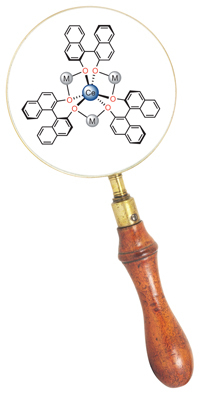
Cerium under the lens

In this month’s ‘in your element’ article (subscription required), Eric Schelter from the University of Pennsylvania draws our attention to cerium, an element that serves a variety of commercial and industrial applications, yet presents chemists with some rather peculiar challenges.

Cerium

©INGRAM PUBLISHING/ALAMY

Although it is one of the rare-earth elements, cerium is fairly abundant in the Earth’s crust, and widely used for various purposes. The oxide ceria (CeO2), for example, is a common abrasive for the polishing of surfaces ranging from optical lenses to electronic displays. The reason it is particularly efficient is that, in addition to a mechanical polishing action, it attacks the basic sites of surfaces.

Most of cerium’s applications rely on its interconversion between the +3 and +4 oxidation states. I’ll let you read in the article how “hydrocarbon fuels encounter element 58 at both the beginning and the end of their useful life”, and which cerium compound represents a “drastic ‘nuclear option’ for oxidation reactions” in synthetic chemistry.

There is much to explore regarding the reactivity of cerium, and even in terms of the electronic structure of some of its compounds — this is an aspect that I find particularly intriguing. Take cerocene, a seemingly straightforward complex that consists of a cerium centre sandwiched between two C8H8 ligands to form an eclipsed sandwich complex. Experimental characterization and computational calculations point to a multiconfigurational ground state, for which it’s proving rather difficult to determine unambiguously the Ce(III) and Ce(IV) contributions. As Schelter puts it, “this deceptively simple compound represents a stimulating case where the very human concept of a formal oxidation state fails to capture the essential essence of a molecule.”

Anne Pichon (Senior Editor, Nature Chemistry)


Reactions: Catherine Renouf

Catherine Renouf is a PhD student in the Department of Chemistry at The University of St Andrews, and studies the separation of olefin mixtures using metal–organic frameworks using adsorption-based and structural techniques — she is also one of the winners of our In Your Element writing competition, with her essay on indium.

1. What made you want to be a chemist?

At school I was always good at science, and I found all of science interesting and rewarding. However, I found chemistry both more challenging and more fascinating than the other sciences, probably due to one particular chemistry teacher. He was the only teacher in my school with a PhD, and he was fantastic at communicating his excitement for the subject. He made us do a lot of experiments during chemistry classes, and that really held my interest.

2. If you weren’t a chemist and could do any other job, what would it be – and why?

I love baking, which is really just chemistry in a different disguise, so maybe I would have been a professional baker. However, I am very passionate about communication, and particularly about the communication of science, so I would also have been very happy as a writer.

3. What are you working on now, and where do you hope it will lead?

I’m nearing the end of my PhD now, so I’m mainly working on my thesis! A large part of my research was developing an environmental gas cell to use in single crystal X-ray crystallography at the ALS in Berkeley. Over the past three years it has improved to a stage where we can see gases inside our MOFs which has been a significant and exciting development. Hopefully, with more time and development, the gas cell will become a standard piece of equipment available on end stations at synchrotrons throughout the world.

4. Which historical figure would you most like to have dinner with – and why?

I think it would have to be W. L. Bragg, the youngest Nobel laureate and one of the discoverers of Bragg’s law. He was the director of the laboratories where Watson and Crick discovered the structure of DNA using X-ray diffraction, so he certainly knew how important his discovery had been, and hearing about the early years of his field (and hearing his views about recent developments, such as quasicrystals) would be fascinating.

5. When was the last time you did an experiment in the lab – and what was it?

A couple of weeks ago I recorded an adsorption and desorption isotherm of propylene on a metal-organic framework using home-built gravimetric adsorption apparatus. It was nothing particularly exciting by that point – just a repeated measurement for inclusion in my thesis appendices.

6. If exiled on a desert island, what one book and one music album would you take with you?

I would take Ben Goldacre’s newest book, Bad Pharma. I love reading popular science books, but I haven’t had the time while finishing up my PhD. Music-wise, I would take something relaxing and inspiring, possibly some Elgar.

7. Which chemist would you like to see interviewed on Reactions – and why?

Someone who does something a little different with their chemistry – perhaps a beamline scientist at a national facility, a teaching fellow at a university or a writer for a science magazine.