How to get a job in science communication

By Chandrika Nair, contributor

At the Naturejobs Career Expo in London last week, I joined in on the session on science communication, which promised to give delegates insider advice on what the jobs involve and tips on how to break into the industry.

On the panel were Jenny Gimpel, senior press officer at Great Ormond Street Hospital, Alok Jha, science correspondent at The Guardian, Marek Kukula, public astronomer at the Royal Observatory Greenwich and Chris Tyler, director of the Parliamentary Office for Science and Technology (POST). Each panelist recounted their journey into science communication and provided expert advice to those wishing to follow in their footsteps.

As a final-year PhD student seriously considering leaving the bench for good, I took great interest in the discussion. Here are my thoughts on the matter.
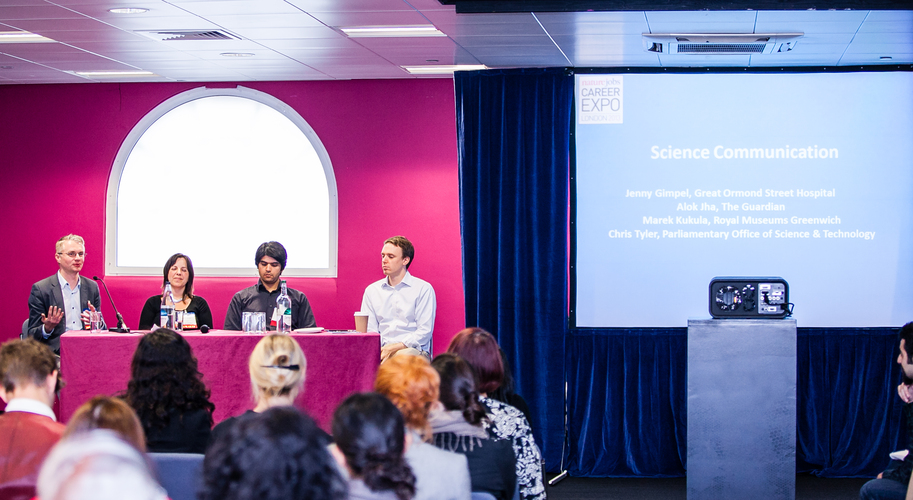
 

Marek Kukula, Jenny Gimpel, Alok Jha and Chris Tyler

Marek Kukula, Jenny Gimpel, Alok Jha and Chris Tyler{credit}Adby/Naturejobs{/credit}

Why bother?

Hard-working postdocs are let down by academia in its current state. There are too many PhDs and too few permanent academic jobs. The competitive “publish or perish” environment selects for boasters and encourages scientific misconduct. If like me you feel strongly about these issues, or have any other complaints relating to the way science is carried out or portrayed, why not do something about it?

What it takes

Scientific training equips us with many of the tools needed to influence change. Writing papers, drafting grants, presenting posters and giving talks are just a handful of the activities which hone our written and verbal communication skills. We’re also good at researching topics, reviewing evidence, and performing complex analyses to obtain sound conclusions. However, we stereotypically fall short in one important aspect: interpersonal skills.

In order to get a message across, such as our passion for science, we need to connect with others, and crucially, to enjoy this interaction. “Although I love science, what I love to do is speak to people,” says Kukula. We also have to be firm in our communication. Tyler warns that scientists wanting to get into science policy should not “hedge their bets” or be afraid to be hold strong opinions. After all, no matter how good or evidence-based your advice is, it will simply fall on deaf ears if you are unable to influence the people who matter, those who make the final decisions. Empathy is also crucial according to Jha. Science journalists absolutely must have an interest in people if they want to influence public opinion towards science. They should reflect on why, as scientists, they think the way they do – and then attempt to place themselves in the mind-set of their audience.

A career in science communication also involves a lot of hard work, and isn’t as glamorous as you might think, says Kukula: “You have to be prepared to muck in in.”  There are numerous tasks that take place behind the scenes, from organising events and inviting speakers, to stacking chairs and checking the microphones. Basically, “making things happen.” Gimpel also warns that those interested in becoming press officers should be prepared to be on call during unsociable hours. In her experience, this can mean giving up your Sunday night and rushing in at midnight to avert a press disaster.

Get involved

Jha made the point that often people who end up in science communication jobs have already self-selected themselves by seeking out opportunities in their spare time.

So if you feel passionate about science and would like to find opportunities to engage with an audience, why not volunteer at local or national outreach events, engage with schools, write for your university newspaper, or start a blog? Or demonstrate your skills by entering science writing competitions, the Naturejobs columnist competition, and other contests. Or get an internship in science journalism for first hand experience (plenty of tips here).

If your PhD is funded by a research council, you could also check if they run a policy-placement scheme.

For postdocs, the Royal Society organises an MP-pairing scheme and the British Science Association offers media fellowships.

Twitter users can also keep up with the latest news and opportunities by following #scicomm and #scipol.

Chandrika Nair is in the final year  of her PhD at Imperial College London, and is one of the winners of the Nature careers columnist competition. Keep an eye out for Chandrika’s work here on the blog and in the Careers pages of Nature magazine. 
 

Naturejobs Career Expo: the next chapter

web-2940

{credit}Adby/Naturejobs{/credit}

A big thank you to everybody who attended the Naturejobs Careeer Expo yesterday. We hope you managed to get a lot out of the day, make new contacts, get career inspiration, and of course fill your pockets with expo freebies!

For those of you who couldn’t attend, hopefully you will have followed some of the discussions on Twitter (#NJCE13) and we will also be posting write-ups from many of the sessions here on the blog, so stay tuned.

We would love to hear your feedback from the event, whether it’s what you thought of the conference sessions and speakers, the CV checking service, the interactive room, the exhibitors, or anything else. Please leave your feedback in the comments section below or send us a message via email: naturejobseditor@nature.com or on Twitter or Facebook.

We’d also love to hear whether the contacts you made led to any interviews, internships or jobs – so let us know. We will have more exciting careers expos happening next year, in more than one location, so keep an eye out for announcements. And in the meantime, don’t forget to follow up with all the new people you met yesterday, while it’s fresh in your mind – and theirs!

Keynote speaker Eva Amsen

Keynote speaker Eva Amsen{credit}Adby/Naturejobs{/credit}


Why bother with public engagement?

By Heather Doran, contributor

In the lead-up to our Naturejobs Career Expo and conference in London tomorrow, where we will have a panel discussion on science communication, Heather Doran, a Project Officer in Public Engagement with Research at the University of Aberdeen, shares her thoughts on the benefits that public engagement can bring to scientists in this guest blog post.

istockphoto/Thinkstock

{credit}istockphoto/Thinkstock{/credit}

In order to perform well in both academia and industry researchers need to develop their personal skill sets to not only complete research but also write papers, teach and demonstrate the impact and relevance of their work. Competition for jobs both in and out of academia is fierce and these skills and activities often viewed as being ‘extras’ are actually fundamental for success in any career. But there is no reason why activities designed to enhance skills in public engagement, writing and teaching should be seen as separate entities to the research process.

I’m going to share an example from my PhD. I wanted to share my research work at an overseas conference. After my abstract was accepted I needed to raise funding in order to attend. My travel budget did not cover the full cost of the conference. At that point in my PhD I had already been blogging about my PhD and had spent time developing my writing skills through my editing role at the science magazine I co-founded with other students. I was invited by one of the societies at the conference to act as an official conference blogger. Continue reading

Windback Wednesdays round-up: the Career Expo is back

windbackweds

{credit}Naturejobs{/credit}


Over the last four weeks, as we gear up to this year’s Naturejobs Career Expo and conference in London next Thursday 19th September, we’ve been revisiting some of the best tips and advice to come out of past expos.

We kicked off with a post on top tips for getting recruited abroad, before finding out how to identify those ever-elusive transferable skills.

This was followed by some great advice in our podcast all about the art of networking, and last week we revisited some vital tips from last year’s conference on social media for scientists.

The programme this year is as packed as ever, and there’s still time to register your place. All new this year will be the CV checking service, and an interactive room which lets you spend face-to-face time with our speakers and exhibitors. There will be two streams, covering academia and industry, but delegates are free to switch between the two.

Speakers include nutritionist Claire Hughes from Marks and Spencer talking about science jobs in the food and retail sector, Andrew Mackintosh from the Royal Society Enterprise Fund talking about entrepreneurship, and Nessa Carey from Pfizer speaking about careers in industry.

In the ‘Academia: the reality’ sessions delegates will have the chance to ask those in the know about the nitty-gritty of the job, from running a lab to successful grant submissions and juggling the demands of a career in science and a family. In our panel on science communication, Alok Jha from The Guardian, Jenny Gimpel from Great Ormond Street Hospital, Marek Kukula from the Royal Observatory Greenwich, and Chris Tyler from the Parliamentary Office of Science and Technology,will be speaking about how to get into science journalism, PR, public engagement/museums, and science policy. And of course there’s the keynote from Eva Amsen, Outreach Director for F1000Research.

That’s a mere taster – for the full programme, visit the Career Expo website here.

The expo itself is free to attend, and will feature over 60 companies from around the world, representing both industry and academia, public and private sectors.

We will be blogging and live-tweeting from the event, using the hashtag #NJCE so do join us, either in person or online – and send in any questions for our speakers. You can do so via twitter @naturejobs or on facebook, or by emailing the editor: naturejobseditor@nature.com

See you then!

Where Are Tomorrow’s Jobs in the Natural Sciences?

Ben Thomas PhotoBen Thomas writes articles about a variety of topics for the Riley Guide, an online repository for career and education resources. As a freelancer, Ben also covers scientific research and technological breakthroughs as well as social issues involving the sciences. A regular contributor to several leading science news websites, Ben helps scientists and academics connect with the general public by explaining their latest discoveries and controversies in clear, down-to-earth terms. You can follow Ben on Google+.

If you’re on the path toward a degree in the natural sciences, chances are you’ve already heard more than your share of grim career predictions. Competition for academic tenure is tougher than ever, government jobs often only arrive at the ends of long waiting lists, and even well-paying work in the nonprofit and private sectors may mean making distant detours from your central scientific passions. Still, natural-science jobs in certain sectors do appear to be poised for slow but steady long-term growth in the near future. Here, two experts in scientific career planning explain how your expertise and love of the natural sciences can point the way toward a stable, impactful career path. Continue reading