Top 5 most hated interview questions

By Anjie Cai, contributor

“What’s the most difficult question you were asked in an interview?”

We put this question to delegates at the Naturejobs Career Expo in London last month, and judging by the pained looks on their faces, it was clear that there had been some clangers. Here is a selection of the most hated questions, and what people thought of them.

161350828_interview_itstockthinkstock

{credit}iStockphoto/Thinkstock{/credit}

1. What’s a weakness of yours that has been mentioned by your colleagues?

Dreaded because: Having practiced the answer to ‘why are you the perfect candidate?’ you caught me by surprise with this negative twist. How am I supposed to navigate the fine line between being honest and planting a landmine?

 2. Tell me something unusual about yourself?

 Dreaded because: How unusual should I go? I have a pet spider? I could balance a chair on my chin? And compared to whom? How can I use this question to show the employer that I am capable, rather than weird?

 3. What other jobs have you applied for?

Dreaded because: This question is awkward and uncomfortable. It’s like being asked how many people you’ve dated. If I tell them all the jobs I have applied for, I might sound desperate and unappealing. If I say this job is my first choice, will you think I am committed? Or lacking in options?

4. Why does a PhD want an admin based job? Continue reading

Why does the new LEGO scientist work all night?

By Carolyn Beans, contributor

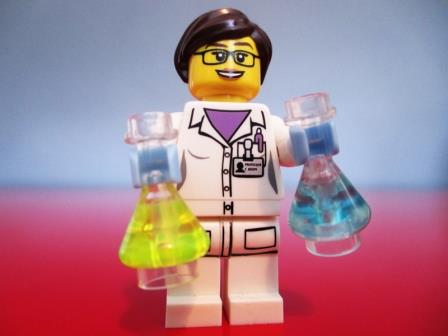
Professor C. Bodin, LEGO’s newest scientist minifigure, has a lot going for her. She built a fascinating career around finding “new and interesting ways to combine things together.” Her hard work was rewarded with a Nobrick Prize. She looks smart and professional in her crisp white lab coat and glasses. And last month, her very existence was met with a deluge of Tweets and blog posts as male and female science enthusiasts alike welcomed a long-over-due female scientist to the LEGO minifigure collection. Here is a LEGO character that will inspire girls to follow her away from pink-and-purple-sparkle-covered pass-times and into the lab.

The only trouble is that if girls actually read Professor C. Bodin’s bio, they’ll likely wonder whether they will ever get to leave that lab. According to Professor C. Bodin’s LEGO page, “She’ll spend all night in her lab analyzing how to connect bricks of different sizes and shapes…”

Prof Bodin

Prof Bodin{credit}Maia Weinstock {/credit}

I appreciate that LEGO wants to describe their new scientist as a hardworking professional. But I worry that we may lose budding scientists if we continue to depict STEM researchers as people who have no lives outside of their careers. Why can’t Professor C. Bodin do groundbreaking work during the day and still make it to her hip hop class or book club at night?  Continue reading

Windback Wednesdays: Achieving work-life balance

windbackweds

{credit}Naturejobs{/credit}

Stressed out? Exhausted? Can’t remember what your partner looks like? It’s time to address your work life balance.

That might be easier said than done. When experiments are going wrong, your PI or boss is breathing down your neck, and your colleagues are all useless, being told to ‘take a break’ is the last thing you need to hear. It’s not like you don’t want one, right?  That said, there are solutions to balancing work commitments and a family or social life. Sometimes just hearing other peoples’ experiences and perspectives can help. Over the next four weeks, we’ll be sharing tips and creative solutions on ensuring career success whist also enjoying a life outside of the lab.

Kiking off this week, he’s a post exploring a tricky question: Are long working hours inevitable for postdocs?

Tell us your tips on achieving a work-life balance on Facebook, Twitter using hashtag #WindbackWeds, or in the comments section below.

The involuntary PhD

by Monika Maleszewska, contributor

When I was a little girl, a classmate said to me: “Monika, perhaps you are smart at school… but you are not so smart in life!” Heavy words for an 8 year old. But words that still haunt me today.

The public debate  on the devaluation of the PhD degree and on the excess of PhD graduates in the job market  has, sadly, accompanied me all along my PhD track. I’ve heard accusations that a PhD is just a way to extend our studentship and postpone adult decisions. Could it be true that these presumably talented people, who continue with their development and education onto the PhD track, are after all the ones who are “not so smart in life”?

166620662_istock_thinkstock decision

{credit}iStockphoto/Thinkstock{/credit}

I used to protest: no, we all want to do science, that’s why we do a PhD! Now, with a few years’ hindsight struggling with my own PhD, I come to realise the reasons that lead people towards this decision are many and complex. While some are legitimate, others are no good at all. If you are just following the herd of your peer group or looking for an alternative to a regular job, you might add to the pool of ‘involuntary PhDs’ – people whose choice to enter a PhD track was either random or due to lack of a clear alternative career path when they graduated. Here are my thoughts on how to navigate this important career decision.

You SHOULD do a PhD because…

  • You want a career in science

A PhD is a prerequisite for an academic career. If you are already set on science, then go for it.

  • You want to see what being a scientist is like

Probing an academic career by doing a PhD is probably the best way to find out what it really is like. It is fine to be uncertain about whether this is the career for you, and to be flexible towards considering other options. Continue reading

Back to school: why choose a PhD?

Shimi Rii, contributor

When I walked up to the Graduate Division window to turn in my M.S. thesis back in 2006, I was 100% positive that I was walking away from school for good. In 2009, I returned to the same window to hand in my application for a PhD.

What changed?

Post M.S., I was working as a biochemical research specialist for a biotech company, growing 60,000 liters of microalgae as feedstock for biofuel.  I felt satisfied that what I got my degree in was actually applicable to real life energy solutions. Gone were the days trying to explain the significance of phytoplankton in oceanic cyclones at a Christmas party. Instead, I felt like a superstar trying to save the world. Not to mention that I could finally shop at Banana Republic, an activity that seemed as far-fetched to grad students as going to the moon.

However, life as a technician was challenging and interesting, but not entirely rewarding for me (disclaimer: the situation I’m about to describe is dependent on the person and their job). I felt dismayed to hand off my carefully calculated experiment results to Dr. Supervisor, who presented my findings at board meetings, decided on the next moves, and then handed me a list of to-dos.  Despite its relevance to society, I couldn’t talk about my work (especially the super-secret algae stuff). I felt insignificant. Looking five, even 10 years down the line, I didn’t see much change in my responsibilities.  In my company, the line between a M.S. and a PhD was like a one-way mirror in an interrogation room.

My feelings of inadequacy were also exacerbated by the fact that those with B.S. degrees were getting paid comparable if not higher salaries than me. They were certainly qualified for their jobs, and my responsibilities were not much more than theirs.  But I was proud of the work I put in to acquire my M.S., and I wanted a clear distinction of the value that was placed on my graduate degree, whether it was through monetary value or responsibilities. My 29-year-old brain whirled in anxiety: I have an aging mother and a special needs sister. How was I supposed to take care of them on a $40K salary? What about my future children? I never thought that I’d feel so trapped being a technician.
 

149038454_Uturn_istockthinkstock

{credit}iStockphoto?Thinkstock{/credit}

Perhaps in a different company with a different management team, I would have been given more ownership of my projects. For many, technician roles are perfectly fulfilling.

Regardless, I was faced with a choice – to switch jobs, or fields, or go back to school. And with that decision, I had to evaluate the Million Dollar Question: What qualifications do our degrees guarantee? What skills or abilities does a M.S. or PhD in basic sciences indicate that graduates have? This is what I came up with:

Basic Skills with a M.S. degree:

  • Can work independently as well as in groups
  • Ability to complete projects
  • Basic scientific report writing skills
  • Basic oral presentation skills
  • Problem-solving skills
  • Organizational skills


Making the list for a PhD graduate produces pretty much the same list https://www.nature.com/naturejobs/science/articles/10.1038/nj7343-381a. The main difference, I believe, is this: completing a Ph.D. takes persistence (an average of 5-7 years persistence).  PhD students can expect a different level of standards from their advisors, and not only do they have to complete 3 to 4 chapters for their thesis, they have to come up with the ideas for them too, which takes initiative.  Finally, being able to tie together different aspects of the chapters requires a broader knowledge of the field. Though dissertations are often highly specific, the ability to place their research in a wider context makes a PhD graduate a “professional” in their field to some degree.

This, I realized, was what employers were looking for in the differences between the two degrees. This was the final reason I went back to school: I wanted the covetable Ph.D. skillset.

People often ask me if I wish I went straight into a PhD.  The answer is, not at all. Without my strong conviction to get my M.S. and go into the workforce, I wouldn’t have had the experiences I’ve had, such as dealing with a management team and working in the field of profit-minded science.  I also might not have had a strong passion for my PhD project, which is an important requirement for anyone going into a doctorate program.  My favorite thing about being back in school, however, is the number of opportunities available to me again as a student, such as outreach, teaching, and of course, science communication.

Ultimately, I’m still not sure where I will end up after my PhD, and sometimes I fear that I will have fewer job options with a PhD as I may come across over-qualified.  But in the end, I think the journey – with opportunities and the people you meet along the way – may be more important than the letters after your name.

Shimi Rii is a fourth year PhD candidate at the University of Hawai’i, in the School of Ocean and Earth Science and Technology and is one of the winners of the Nature careers columnist competition. Keep an eye out for Shimi’s work here on the blog and in the Careers pages of Nature magazine. 

How to find a career away from the bench

By Laura Thomson, cross posted-from the Digital Science blog

Deciding to leave the bench after dedicating years to your career as a scientist can be a daunting prospect but with only about half of science graduates having a lifetime career in research it is an increasing reality for many scientists. Last week over 60 scientists joined us at the Nature Jobs Career Expo for the Digital Science workshop Life beyond the bench: I love science but I don’t want to stay in research!

After a brief intro to some of the careers available to scientists we opened a panel discussion with representatives from communications, marketing, product management, software engineers and start-ups to answer attendees questions about establishing a career away from the bench.

Exploring the options at the Naturejobs career expo

Exploring the options at the Naturejobs career expo{credit}Adby Creative/Naturejobs{/credit}


A common theme during the panel discussion was gaining relevant experience for a job away from the bench. Be proactive and write to companies you are interested in to find out if they have internships available. An internship will not only give you experience but it will also let you find out if that really is the career choice for you – the realities of a job can be very different to what you might think it will be like.

It isn’t always going to be possible to get an internship but there are other things you can do. Start a blog focusing on you area of interest to get your name and voice known, contact the companies you’re interested in working for even if they’re not actively recruiting, engage with science start-ups as they’re most likely to be in need of another pair of hands or apply for an entry level job in a larger organisation simply to get a foot in the door.

After the panel discussion attendees shared their take-homes and here are some of our favourites: Continue reading

Graduate school survival skills

by Jonathan Gross

During the course of graduate school we’ve all likely felt as if we were stuck on a deserted island or lost in a rain forest without a map. It’s tough. As graduate students, we strive to create knowledge, but we’re not explicitly taught how to practice science. I’d like to share three lessons about graduate school that I did not appreciate at the time, and that could help you find your path to the other side.

iStock/Thinkstock

{credit}iStock/Thinkstock{/credit}


Plan for progress

Just as any intrepid adventurer must plan ahead for food, water, or shelter, we need to plan how we progress in graduate school and not leave our paths to chance. For me this meant writing a plan for the week ahead with annotation of how it supported my goals and the lab’s focus. It helps when planning to think in figures, visualizing the answer we seek, to come up with the clearest path forward.

It seems simple, but the written plan lowered my stress level not just for arranging my time, but also when speaking to my PI. He often had quick chats to verify that we were on track and aware of the next steps. These talks shaped his impressions and assumptions of each of us as scientists.

Many of us, myself included, often fumbled these chats: “Oh…um…just working on this experiment and data analysis. Want to see it?” But once I started writing plans I could quickly say, “I am re-developing method X, which I noticed was not working because of Y. I will know tonight whether it worked and will send you the data. I expect that by Friday we will have moved on to Z to bring us closer to finishing paper A. Perhaps we can chat then about the next steps we expect?”

Quick, to-the-point progress updates helped him help me, seizing the most value from his limited attention to ensure my project would advance smoothly and that he understood my value to his lab.

As I see it, plans aren’t just the domain of corporate staff; planning is essential, deliberate preparation for a successful scientific career.

Share knowledge

I have noticed that successful scientists do not go it alone; they have support scientists and staff helping on the sidelines. Unfortunately, individual recognition is often over emphasized, leading academics to not share certain knowledge until problems arise. Continue reading

How to hire the best people to your team

When hiring new members of your team, whether it’s a PhD or PI, making sure you attract the right people is key. Following just a few hints and tips can make all the difference to the quantity and quality of applications. Here are some important things to consider when writing a science job advert.

iStock_Thinkstock

{credit}iStockphoto/Thinkstock{/credit}

General Advice

As with all writing, especially for the web, use succinct language to get your point across, and consider using bullet points where possible to keep the advert length to a minimum. Also it’s important to use the language and terminology of your audience to help your advert appear more often in online searches and also so it’s clear what you are looking for.

Job title

The job title is what will drive people to view your science job advert. It’s essential that you use terms that those searching for that job will use. If your organisation has job titles that are unique or quirky then you should include the standard equivalent job title in your advert. For example, a quick search on the web returned the job title “Conversation Architect” which is actually a different name for “Digital Marketing Manager”.

You should also make sure your job title isn’t too vague. There are plenty of jobs for “Research Technician”, for instance. To improve your chances of catching the eye of the right applicants, include details of the type of research you do. As scientists are a mobile workforce, it’s a good idea include the location of the role as well. If your research technician job title is listed as “Research Technician – Molecular Biology – Paris, France,” you’re likely to boost the number of relevant people viewing your advert.

Details

Where feasible, try to provide specific details of the job. This should help to lower the number of unsuitable applications. Things to consider including are:

– salary or salary range
– permanent or contract (if contract, what is the length?)
– job location
– job hours (full-time, part-time, unsocial)
– minimum qualifications for the job

Roles and responsibilities

Give an outline of the role and its responsibilities. For example, if budget management and leadership are key components of the position it’s worth adding these to the advert. If the job is project based, provide a quick outline of what these projects could be.

Person specification

Including a person specification in the advert will also help to filter out unsuitable applicants. Think about the kind of person who can fulfil the position, in terms of qualifications and experience, technical specification (e.g. do they need to have experience working with certain pieces of kit), aptitude (e.g. do they need strong organisational skills) and disposition (e.g. do they need to be able to stay calm under pressure).

Your organization

Remember to include some information about your organisation, for example, whether it is global or innovative in its approach. An extensive summary or history isn’t required as jobseekers should be able to get this information from your website. What is useful is to include a short overview of the culture of your organization; this will help jobseekers understand what it’s like to work there.

What else do you offer?

Not all organisations can offer amazing salaries but that doesn’t mean that yours should miss out on the best candidates. There may be other attractive benefits to working at your organisation, for example, the ability to travel within the role, state-of-the-art core facilities, access to experts in the field, and the option to purchase additional holiday are all the kinds of add-ons that will encourage job applicants to choose you.

What happens next?

It’s worthwhile providing information on the recruitment process, such as what applicants need to supply with their application, a timeline and (if feasible) position start date. This will reduce the number of follow-up enquiries from applicants.

For more information

Provide links for more information at the end of your advert, this should include your organisation’s website but also, where possible, links to the full job description, your organisation’s recruitment website or your organisation’s employer profile on an external jobsite, and your social media pages.