Q&A: Internships abroad: why it’s worth taking the plunge

Embarking on an internship abroad can feel daunting, but it could open up a world of opportunity.

Thinking of an internship this summer? Why not consider one abroad? There are several programmes that offer placements to science students or graduates looking to gain relevant work experience in an exciting location. Not only is it a great opportunity to travel, meet new people and learn a new language, the ability to push yourself out of your comfort zone will impress future employers and give you a lot to talk about in interviews.

Here, Jordan Kodner, currently a senior at the University of Pennsylvania, tells us about his summer placement with Contact Singapore, who offer summer placements lasting 3-6 months starting in July (application deadline is the 28th Feb).

Why did you decide to apply?

I had heard a number of positive and interesting things about Singapore in the past, and I needed something to do for the summer. I figured an internship in Singapore would be a win-win for me.


What did the application process involve?

The first part off the application just asked for which position I’d be interested in, my school and major, my resume, and other basic identifying information. A few weeks later, I received an email inquiring about my transcripts.


 Where was your placement and what did it involve?

I worked at the Spin and Energy Lab at the National University of Singapore Electrical and Computer Engineering Department. There, I researched microcontrollers that would be suitable for ultra-low power applications.


What do you feel that you achieved in the three months you were in Singapore?

I learned something about a field that I had very little prior experience in. I’m not an electrical engineer, so working in that area in a lab on the opposite side of the world was a bit of a challenge, but I feel like I succeeded.


What was the highlight of the experience? Continue reading

Getting an internship in science journalism


{credit}iStockphoto/Thinkstock{/credit}

 Last week, we received an email from one of our readers:

“I’ve just finished my PhD and I’m now focusing on a move into science journalism. I’d really like to apply for internships to gain some more concrete experience of the editorial atmosphere at a big publication to add to the freelancing and work experience I’ve done.

Although I’ve spotted a few journalism internships and graduate schemes, including some at Nature, it’s quite hard to identify these without sometimes having to apply speculatively to publications. Can you help?”

This is a question we get asked quite frequently, and whilst it’s true that getting any decent internship these days is competitive, those in science journalism are particularly hard to find.

Part of the problem is that they aren’t always advertised that widely, if at all. Whilst there are no hard and fast rules for starting out in the industry, there are some things you can do to keep your ear to the ground and boost your chances of Continue reading

Best UK internships: Shortlist announced

It’s good news for science graduates as the UK’s National Council for Work Experience (NCWE) announces the shortlist for its annual awards, which feature science employers in most of the categories.

According to Vicky Miles, the Event Manager for NCWE, nominated employers are judged on three main criteria – what skills the intern will take away from the placement and how much impact they can make on the organisation, the level of support and assessment the person on the placement will get, and what makes that particular placement exceptional compared to the competition. They also take note of the level of payment the employee will receive.

The awards are judged by four external judges, including an employer, a student and two careers experts. The entries are judged blind.

Science in the shortlist

In the category for large organisations, prominent science and technology employers – such as Glaxosmithkline, IMB, BP, and Centrica – featured in each of the sub-categories. The smaller companies category didn’t fare as well for science disciplines, but when it came to charities, both Cancer Research UK and Macmillan Cancer Support were shortlisted. Continue reading

Windback Wednesdays: Salary negotiations

{credit}Naturejobs{/credit}

Windback Wednesdays are back, and over the next four weeks we’ll be looking at the thorny issue of cash, and how to get more of it.

Kicking things off this week, we take a look at how to get a pay rise in academia.

For more top tips and salary advice, make sure you follow us on Twitter, Facebook, LinkedIn and Google+. Find our accounts by clicking through the links below.

Twitter

Facebook

Linkedin

Google +

Also, we want to hear from you – let us know which topics you want to see covered in future Windback Wednesdays series. Tweet us, or let us know in the comments section below.

Here’s a recap of what we’ve covered so far.

8 Ways to get the best internship

Competition for internships is as fierce as ever. Follow these top tips from Naturejobs and other industry experts to boost your chances.

1. Start early

Most people will be looking for an internship that take place over the summer, and the deadlines for these usually close in January or February – see our ever expanding list of placements. If you leave it to the last minute, you will seriously narrow your options, leaving speculative applications or placements which come up at short notice.  Naturejobs

2. Take a proactive approach to find a placement.

Whilst social media provides a great platform to communicate with a range of people, even potential employers, don’t just rely on sites such as LinkedIn or Facebook to find a placement. Many companies still welcome contact from potential interns via more traditional routes. Rather than making contact through online sites, a well-written letter or email to the right person is more likely to get you noticed. It is also worth noting that companies often outsource their search for interns to recruitment agencies, so you should get in touch with the leading recruitment consultants in the regions and industry sectors you are targeting.  Ken Jones, President & CEO of Astellas Pharma Europe Ltd, the European headquarters of Astellas Pharma Inc.

3. Question their motives

Ask yourself what you are going to get out of it, and what the company is offering the placement for. Good internships will have some structure to them, so the employer should be able to tell you beforehand what sorts of things you’ll be doing and the kind of support you will get. Although you can’t expect to be running the show as an intern, Continue reading

A to Z of social media for academics

iStockphoto/thinkstock

We know from readers responses to past blog posts that an increasing number of scientists (and academics in general) are using social media to communicate their work, network with peers, and come up with new research angles altogether. And as the number of people using these services grow, so do the number of tools and apps.

This has prompted Andy Miah, Professor in Ethics & Emerging Technologies and Director of the Creative Futures Institute at the University of the West of Scotland, to set up a new email list where academics (and others interested parties) can share social media platforms and apps that can serve as useful tools for their work. The list has been up and running for a few weeks now and has 250 members from over 90 universities in the UK.

In Miah’s own words:

The list was set up after I heard about Vyclone, a cool new iPhone app that allows you to create multi-angle films, by just pointing multiple iPhones at something and shooting. It automatically edits the different videos and spits out the results. When I saw this I thought, I really need something to keep abreast of all the new tools out there, so here it is. To kick things off, I’ve compiled a list of social media platforms that you may find helpful.

The list, an A to Z of social media tools for academics, can be found here. Check it out.

If you already use social media for your work, or are thinking about it, we highly recommend you join the list. Share the tools you use already and find out about more. If you don’t think social media and work mix, then we highly recommend you join the list. You might be surprised at what comes out of it.

Details of how to sign up here.

We hope you find it useful. Let us know how you get on, and do share with us your stories on how social media has helped to shape your work, in the comments section below.


The accidents nobody talks about

Cross-posted from the Digital Science blog

Last week, we wrote about the results of a new survey on lab safety. One of the findings was that scientists are unlikely to tell others of health and safety infringements in the lab. Here Nathan Watson, founder of BioRAFT, a Digital Science-supported company which co-published the survey, tells his story.

My left index finger should probably glow green under 488nm light for the rest of my life. As a junior researcher, I was producing recombinant viruses to overexpress genes including Green Florescent Protein (GFP) and a number of oncogenes. While isolating the virus carrying GFP, I was supporting the test tube with my left hand and slowly pressing a syringe needle through the tube’s soft plastic wall. I pressed too hard and the needle went completely through the tube and into my left index finger. I washed the finger with iodine and soap, put on a new pair of gloves, and finished the virus isolation.

I told no one.

I checked the cells and my finger daily over the next two weeks, and to my relief, the cells glowed and my finger did not. I corrected my methods when working with the oncogenes and consider myself lucky I had my incident with just the GFP.

This is the reality of research. If you had asked me if safety was important to me, I would have said, “sure it is.” If you had asked me if my lab was safe and if my PI cared about safety, I would have said yes. Yet, did I get training on the specific experiments I was doing or the hazards I was working with? Not really. Safety training, beyond the general lab safety lecture during new employee orientation, often entailed a post doc giving you a detailed protocol and encouraging you to ask questions. Yet, as an enthusiastic researcher who believed he already knew his way around a lab, I (and others like me) was more concerned with the scientific objectives, not the rigid tedium of safe experimentation.

Continue reading Nathan’s story here.

Does this sound like a familiar tale? Let us know your own experiences in the comments section or on Twitter: @naturejobs

Spot the sexist in you


Our number one careers New Year’s Resolution? Challenge our own implicit biases


{credit}iStockphoto/Thinkstock{/credit}

Guest post by Joanne Kamens, Executive Director, Addgene

What is wrong with women?  Why is it that women do 66% of the work in the US, but earn only 10% of the income?  Why is it that women working full time, year round in Maryland are paid only around 83 cents to every dollar earned by men in the same roles? Why is there still such a huge disparity in the numbers of women in leadership roles, especially in science and technical fields?

For a start, women in science still have to deal with blatant sexism. Take a recent Facebook posting by Professor Dario Maestripieri who shared this with his “friends” during the last Society for Neuroscience conference. Some of these ‘friends’ were women who work in his lab. Dr. Maestripieri posted:

“My impressions of the Conference of the Society for Neuroscience in New Orleans. There are thousands of people at the conference and an unusually high concentration of unattractive women. The super model types are completely absent. What is going on?  Are unattractive women particularly attracted to neuroscience? Are beautiful women particularly uninterested in the brain?  No offense to anyone.”

Is this type of sexism still the main problem for women? I don’t think so. I was heartened by the online community’s response to this Facebook posting – there was an outpouring of disdain and strong statements of how this can no longer be tolerated. This type of offense is easy to see and easy to combat by speaking out. I think the real threat to equity and diversity is more insidious and less tangible.

About 13 years ago while working as a Senior Scientist at BASF, I realized one Friday that I had spent a whole week in meetings and not seen one other woman in any of them. And, by the way, in three of these meetings I had been asked to take the minutes for no apparent reason. Behaving like the scientist I am, I started doing research to figure out where all my female classmates had gone (we were 50% women in grad school). I discovered a huge amount of sad data on the problems faced by women in science and women at work more widely -these problems seemed massive with so many possible facets. I didn’t completely despair. Continue reading

How safe is your lab?

{credit}SOURCE: Center for Laboratory Safety, UCLA/NPG/Bonamy Finch{/credit}


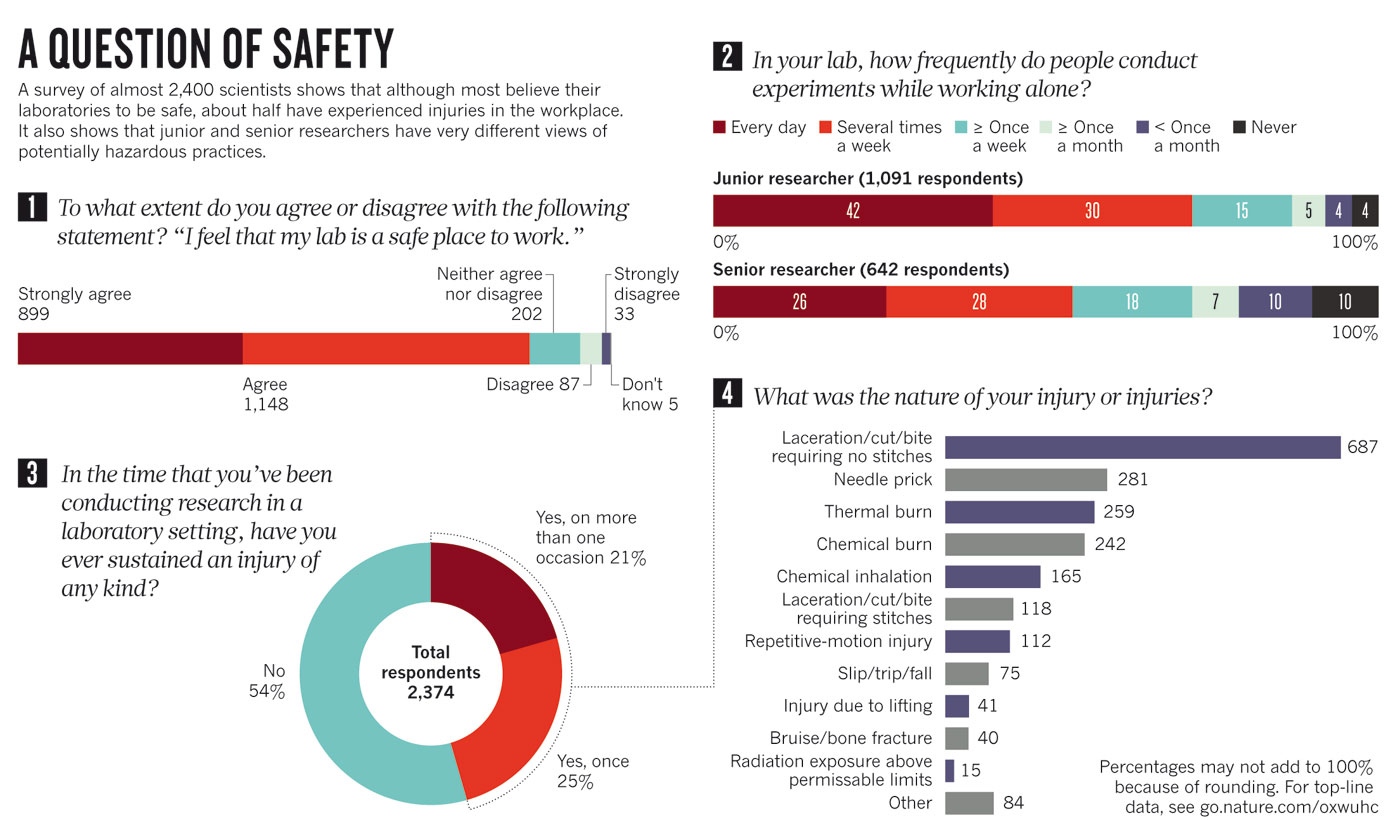
From snake bites to acid burns, accidents in the lab are a fairly common occurrence, according to the results of the first international survey of scientists’ attitudes and practices regarding safety in the workplace.

The survey of around 2,400 scientists was commissioned by the University of California in Los Angeles (UCLA) Center for Laboratory Safety, in collaboration with Nature Publishing Group and BioRAFT – a company providing software for safety compliance, which receives funding from Digital Science, a sister company to Nature Publishing Group. The survey was in part commissioned in response to the death of research assistant Sheharbano Sangji following a lab fire at UCLA in 2009, and a first analysis of the results was published in the news section of Nature this week. Continue reading

Unequal opportunities: Why aren’t there more Asian scientists in US leadership roles?


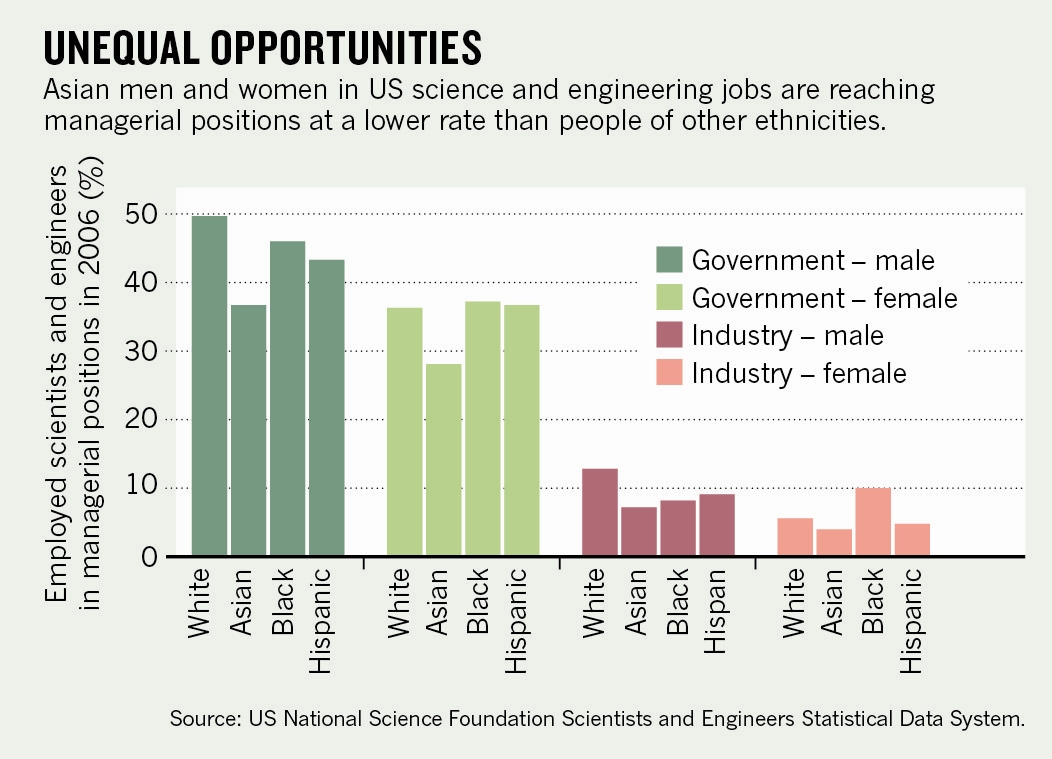
Asian scientists are underrepresented in leadership roles across US STEM careers, argue Lilian Gomory Wu and Wei Jing in this week’s Nature Careers column.

As can be seen in the graph above, Asians – people from the Far East, the Indian Subcontinent and Southeast Asia – are falling behind white people and members of other underrepresented groups, when it comes to filling leadership positions in US science. Whilst this is true for both Asian men and women, the problem seems to be compounded for female scientists, with just 4% of Asian women in industry and 28% in the federal workforce holding managerial positions. By comparison, Asians made up almost 80 per cent of doctoral recipients with temporary visas planning to work in the US. Why are they failing to reach the top?

Continue reading