March for Science 2018 gears up

Organisers of the second annual March for Science , scheduled for 14 April in Washington DC, are hoping to recapture the energy and enthusiasm that prompted more than 1 million researchers and others to march together last year across 600 cities around the world in support of evidence-based policy and upholding science for the greater good.

MarchforScience-Judith-2-smaller

Caroline Weinberg, an organizer for the upcoming march in Washington DC, expects smaller crowds than last year, although she admits her prediction may again be off the mark. “Last we expected 40,000 people, and we got around 100,000,” she says. She adds that most of the marchers in the nation’s capital city were concerned citizens, not practicing researchers.

In Washington DC and elsewhere, organisers envision events with fewer marchers, placards and chants but more advocacy-related activities. Weinberg and others aim to offer hands-on projects for those taking to the streets in Washington DC. In Berlin, Germany, organisers are planning a “local hero” programme where scientists will give public talks at bars, cafes and other venues. March-related activities in Portland, Oregon, will include speeches by local politicians and a science expo with at least 30 presenters, including a juggler who demonstrates the principles of physics.

The election and inauguration of Donald Trump for US president helped to spur marchers last year, and Weinberg says that she suspects that some scientists this year may be motivated to speak out against Trump’s recent budget proposal, which called for drastic cuts to the US Centers for Disease Control and Prevention spending plan . But she adds that the march and other forms of science activism shouldn’t depend on crises to draw interest and participation. “Our challenge is to build up a huge crowd and send a message that galvanizes everyone but to also make it sustainable,” she says. “We can’t allow our advocacy to be tethered to those moments.”

Roughly 15,000 people attended last year’s march in Portland, but that kind of enthusiasm will be hard to replicate, says Denesa Oberbeck, a behavioral neuroscientist at the Oregon Health & Science University in Portland and a member of the steering committee for this year’s march. “There’s some fatigue and some burnout, but we need to keep fighting,” she says. “We have to maintain an activist stance.”

Kristine Wadosky, a cancer researcher at Roswell Park Cancer Institute in Buffalo, New York, marched in Washington DC last year carrying a sign that read “Curing cancer is non-partisan.”  This year, she plans to join the march in Chicago, Illinois, where she will give a talk on advanced prostate cancer for the annual meeting of the American Association for Cancer Research. She says that she’s just as energized about science advocacy as ever before, and she thinks that many other young scientists feel the same way.

This time, Wadosky says, she won’t need a sign to send her message, which isn’t especially complicated. “I just want to go to show that I’m a scientists, and I exist,” she says.


Chris Woolston is a freelance writer in Billings, Montana.


Suggested reading:

Growing pains
In support of the March
Reflections on a movement

Growing the next generation of scientists

Scientists have a duty to inspire the next generation of students. To do this, we need greater interaction with young people and the local community.

Naturejobs journalism competition winner Jessica Gorrill

The future of STEM (science, technology, engineering and mathematics) in the UK is on shaky ground. The numbers of entries at A-level for Biology, Physics and Chemistry dropped by 1%, 2.6% and 1.6% respectively in 2016, according to statistics collected by the Joint Council for Qualifications. This ends the steady increase seen since 2009. Whilst this drop may be attributed to the first year of new government reforms, it could be the beginning of a worrying trend of students neglecting careers in science.

Ideas-naturejobs-blog

{credit}Topp_Yimgrimm/ThinkStock{/credit}

Continue reading

US research centres create opportunities

Training and mentoring opportunities for junior researchers in particle physics, cell biology, mechanobiology and materials science will be created in connection with four partnerships that are funded by the US National Science Foundation (NSF) in Arlington, Virginia.

New Image

NSF on 26 September announced US$94 million to support four new Science and Technology Centers (STCs). Each awardee will receive up to $24 million over a 5-year period, with the possibility of a continuation for 5 more years. In addition to these latest awards, NSF supports eight active STCs across the United States. Each STC involves partnerships across universities, federal labs, industry and other organizations.

Continue reading

8 Ways to get the best internship

Competition for internships is as fierce as ever. Follow these top tips from Naturejobs and other industry experts to boost your chances.

1. Start early

Most people will be looking for an internship that take place over the summer, and the deadlines for these usually close in January or February – see our ever expanding list of placements. If you leave it to the last minute, you will seriously narrow your options, leaving speculative applications or placements which come up at short notice.  Naturejobs

2. Take a proactive approach to find a placement.

Whilst social media provides a great platform to communicate with a range of people, even potential employers, don’t just rely on sites such as LinkedIn or Facebook to find a placement. Many companies still welcome contact from potential interns via more traditional routes. Rather than making contact through online sites, a well-written letter or email to the right person is more likely to get you noticed. It is also worth noting that companies often outsource their search for interns to recruitment agencies, so you should get in touch with the leading recruitment consultants in the regions and industry sectors you are targeting.  Ken Jones, President & CEO of Astellas Pharma Europe Ltd, the European headquarters of Astellas Pharma Inc.

3. Question their motives

Ask yourself what you are going to get out of it, and what the company is offering the placement for. Good internships will have some structure to them, so the employer should be able to tell you beforehand what sorts of things you’ll be doing and the kind of support you will get. Although you can’t expect to be running the show as an intern, Continue reading

Internships: Time to think small?

For those keen to get an internship, SMEs provide a different kind of experience, and placements may be easier to come by.

Personality is key at SMEs Credit: Stockbyte/Thinkstock

By Rob Blythe, contributor

Securing internships and graduate placements in 2012 is difficult. There has been a 25% increase in applications to graduate employers since 2009, with an average of 52 applications for each job, according to a comprehensive survey by High Flyers Research.

Certainly, as you’ll know if you’ve found your way to this blog, research roles are particularly competitive, but the landscape isn’t as bleak as the statistics suggest.

There are only vast numbers of applications for a small minority of well-publicised opportunities. Big corporations spend enormous amounts of money making sure their roles are really competitive both because it ensures they are introduced to the very best candidates but also because graduates subsequently really want their jobs.

But what about smaller companies? A recent survey produced by UKCES that interviewed over 15,000 UK employers from a cross-section of sectors reported that 27% of businesses have recruited someone aged between 19 and 24 in the past twelve months. There are jobs out there, but the vast majority will be with companies you won’t be familiar with and won’t have been on campus trying to reach you there.

‘SMEs’ (or small to medium enterprises) is an umbrella term for a real array of businesses. It might be a company run from the founder’s kitchen table or a business with hundreds of employees and very slick offices. The category represents the vast majority of UK employers – and a vast majority of prospective jobs.

If you haven’t considered applying for work placements at SMEs, you could be missing out. Not only are there fewer applicants per role but also some real advantages to the roles themselves. Working in close contact with senior management gives any new recruit the chance to learn from the best, and fast-growing businesses delegate real responsibility early on.

Finding the roles can be the hard part. To increase your chances of success:

Continue reading

Want an internship in 2013? Then now is your time

What deadline?{credit}iStockphoto/Thinkstock{/credit}

We know it’s nearly the Christmas holidays, and you deserve a break. But as well as getting some well-earned rest, this is also the perfect time to start thinking about what you want to do next Summer. If some kind of internship or work placement is on the list, don’t get too comfortable in front of the fireplace. With many of the application deadlines for top placements closing in the New Year, now’s the time to make sure your name is on the shortlist.

If  you’re not sure where to start, the good news is we’re here to do the hard work for you – just call it an early Christmas present. Over the next few weeks, Naturejobs will be will be serving up advice on how to find the right placement – whether at home or abroad, tips for an attention-grabbing application, and knowing your rights when it comes to what people can and can’t ask you to do. We’ll also show you how to make the most out of your internship when the time comes around, including how to make a good impression and all-important networking.

Follow the series here on the Naturejobs blog, and if you don’t already, you can also get updates by following us on social media:

Twitter

Facebook

Linkedin

Google +

As always, we would love to hear your thoughts and share your experiences, so keep in touch, and let us know if there’s any advice that is missing. And have a great holiday!

Was your degree worth it?

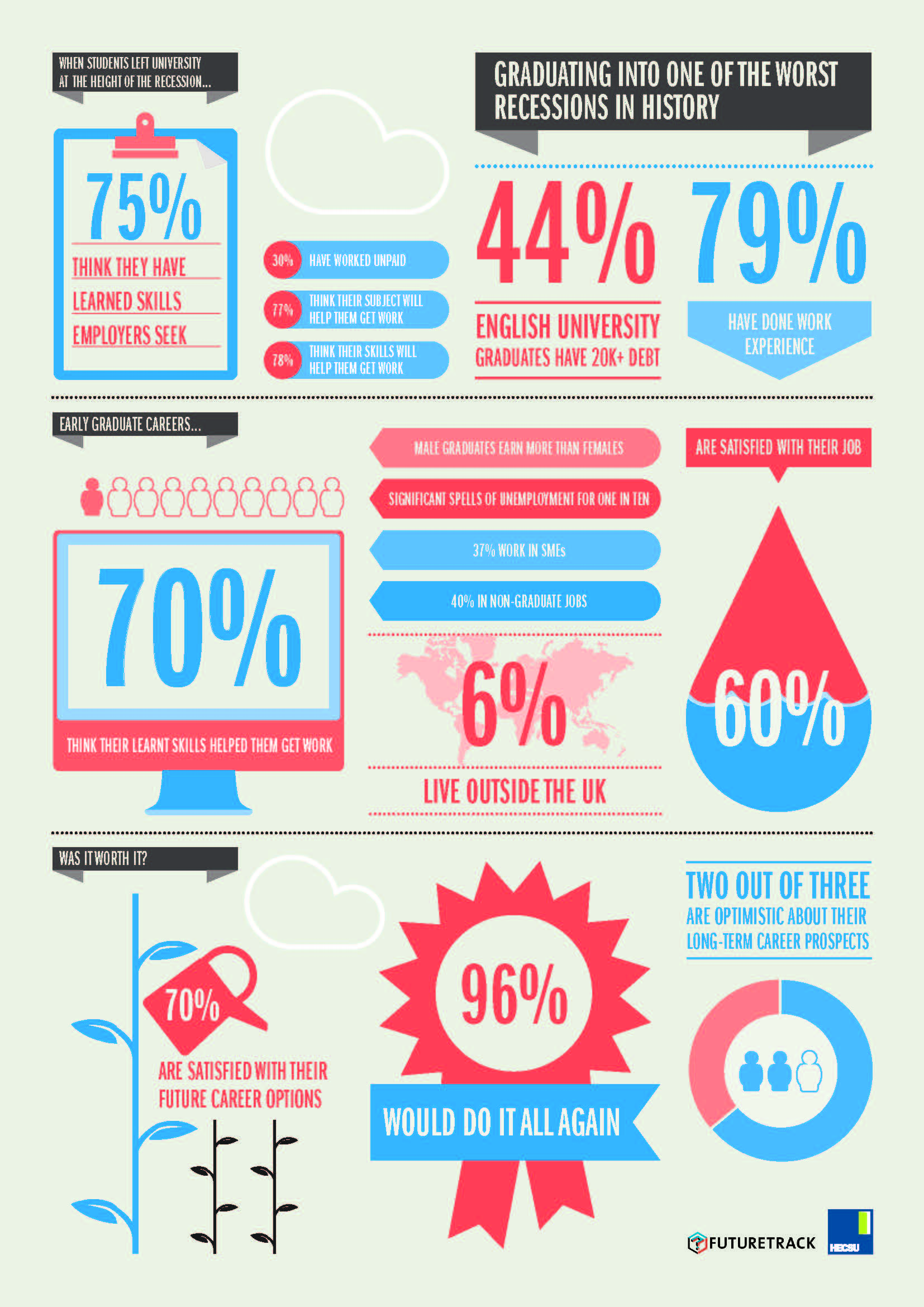
Would you do it all again?{credit}Futuretrack report{/credit}

A study tracking university students over 6 years from the moment they applied for university until well after they graduated has been published this week.

Perhaps unsurprisingly, the findings reveal just how hard it has been for UK students graduating during the recession, with a significant increases in debt and lower earnings compared with the class of ’99. On a positive note, the vast majority thought it was worth it – see the infographic above.

The study found that :

  • 1 in 10 graduates experienced significant spells of unemployment

Quarrelling parents fuel student credit card debt

Undergraduates whose parents argue about money are twice as likely to own several credit cards than those who say their parents do not argue about their finances. Perhaps unsurprisingly, those with more cards are also likely to be in more debt.

In their study of over 400 students, Adam Hancock and colleagues from the East Carolina University also found that female students were more than twice as likely to own two or more credit cards than their male counterparts. The study was recently published in the Journal of Family and Economic Issue.

The study follows another piece of research, conducted by the Money Advice Service, an independent service set up by the UK government, which found that first year students expect to graduate with debts of more than £39,000 ($63,000). What is more, of almost 1,500 students surveyed, more than one in ten of them have credit cards.

With the cost of fees increasing in the UK, it’s clear that the issue is going to get even bigger. Many students see credit cards as a low commitment way to get their hands on easy cash. But what can start off as a card ‘just for emergencies’ can end up hitting your wallet harder than expected. Plus, that available credit can fuel the temptation to spend beyond your budget. In actual fact, credit cards are often not the smartest option, especially as a student when you may be eligible for interest-free or low-interest bank loans (see the table below).

{credit}Hemera/Thinkstock{/credit}

Of course, used in the right way, credit cards might well be a neccessity, getting you through your student days and making sure you can pay for essentials that crop up, like unexpected field trips or conferences which could really be worth the money.

We asked Jane Symonds of the Money Advice Service for her tips on how to make the most of your options, whilst avoiding the biggest pitfalls of credit card debt. If your parents are the type to argue about their finances, following these tips might just help you break the cycle! Continue reading

Nobel laureates share career insights with young scientists

Each year, young researchers from all over the world meet with Nobel prize-winners on the German island of Lindau to discuss the big questions in science. The 2011 meeting focused on the world’s greatest health challenges and how to tackle them, and the Nature Video team was on hand to capture the conversations on camera.

The young researchers in these films are working on malaria, cancer, viruses and more. They are also learning how to be scientists: how to write grant applications, how to collaborate with other research groups and how to find the right career path. See what advice the laureates offer — and what questions they have in return.

There are five films in the series, and one will be published each week from 15 September to 13 October.

29 September: Bench or bedside? with Ferid Murad

Camelia-Lucia Cimpianu is trying to decide between a career as a researcher or a practising doctor. In this film, she seeks advice from Nobel Laureate Ferid Murad who faced the same dilemma as a medical student in the 1960s.

22 September: Combating cancer with Edmond Fischer

Nobel Laureate Eddie Fischer was born in Shanghai in 1920. Since then, China has emerged as an economic superpower. Now it’s becoming a scientific heavyweight too. Tong Qing belongs to the newest generation of Chinese scientists. She decided to study cancer after a family friend became ill with breast cancer. In this film, she tells Fischer about life and research in China today.

To see more videos, go to the Nature Video Lindau collection website.

If you have any problems loading the videos, please try updating your Flash player.

Survey finds science graduates neglect career planning

More than a quarter of final-year physics and maths undergraduates and a third of final-year geography undergraduates in the United Kingdom had no idea what kind of career they wanted when they entered university, according to new research from the Department for Business Innovation and Skills.

The survey of more than 7,000 science, technology, engineering and mathematics (STEM) students at undergraduate and postgraduate level also showed that less than a third of final-year PhD students have a definite career in mind.

Other key findings include:

• Fewer than half of final-year physics undergraduates definitely want to pursue a career related to their degree — the second lowest figure across all STEM subjects in the survey

• Almost half of final-year PhD students across all subjects are not sure they want to pursue a career related to their research

One of the report’s authors, Robin Mellors-Bourne from the Careers Research & Advisory Centre, says that the research highlighted weaknesses in the careers advice and information on offer to students before they go to university. “Very few students choose their subject with a career in mind,” he says.

Mellors-Bourne says schools and colleges focus on promoting university as a good thing in and of itself, and don’t give enough information about potential careers. This leaves students with a lack of broad labour-market knowledge. “I think that’s particularly true of physics,” he told Naturejobs.

He says that while students shouldn’t feel compelled to make highly rational career decisions before university, more forward planning is needed: “It’s quite useful for parents or students to have some inkling of the sorts of careers that naturally would be opened up [by doing a degree].”

Institute of Physics careers manager Vishanti Fox says that the skills learnt during a physics degree are highly valued by a wide range of employers, but she agrees that students considering the subject need more information about potential careers. “Careers advice to school students and undergraduates is an area that can always be improved,” she says. “We are working with schools, universities, businesses and Government to make sure students know the options open to them with qualifications in physics.”

Mellors-Bourne says forensic science is a prime example of the dangers of ignoring career prospects when choosing a course. He estimates that because of interest from students there are now around 100 forensic science degree courses available in the UK, but only around 50 jobs become available each year, leading to a “horrendous oversupply” of forensic science graduates. “I don’t think any of them entered [their degree] realising that they probably wouldn’t get a job at the end,” he says.

What’s your reaction to the report? If you’re a student, do you feel as though you have access to enough careers advice? If you’re working as a scientist, what’s your experience of career planning?