Most read on Naturejobs: November 2015

Career supervision, networking, women in science and more from Naturejobs in November 2015!

naturejobs-readsAnother busy month for the Naturejobs team, as we’ve held our very first Career Expo in Dusseldorf, Germany only last week. As well as that, we’ve started publishing the films from the 2015 London Naturejobs Career Expo.

And last Friday, we published out last podcast of the year, celebrating the failures in science.

So, there’s been plenty for you to feast your eyes and ears on. We’ve had a look at the numbers, and here are your favourite pieces from the last month.

Managing laboratory members as well as a research strategy can be difficult for early-career principal investigators, but help is at hand, says Boer Deng in Supervision: Clear direction.

Networking: Hello stranger, by Emily Sohn, explores how conferences are great for career development, but miscalculated moves can foil future prospects.

Non-profit organizations: Scientists on a mission, by Julie Gould, explores how scientists are ideally suited to a career in the non-profit sector. Continue reading

Careers in science: Celebrate the failures

The history and development of science is littered with failures, so early-career researchers should embrace, rather than be afraid of them.

Naturejobs-podcast“Success is advancing from failure to failure without loosing enthusiasm.” – Not said by either Winston Churchill or Abraham Lincoln.

“The things I remember best from college were the questions I got wrong on the exams.” – Kathryn Yatrakis, dean of academic affairs, Columbia College.

These are two of my favourite quotes from Stuart Firestein’s (professor of neuroscience at Columbia University, NY) new book, Failure: Why science is so successful.

Science’s history is littered with failures. Without them, science woudn’t have advanced to the point it’s at today. And yet a negative connotation goes hand-in-hand with it.

In this final Naturejobs podcast of 2015, I speak to Firestein about what failure in science means, what the negative connotations are, why they exist, why they impact young scientists and what they can do to overcome them.

#Scidata15: Make the most of your research: Publish better data

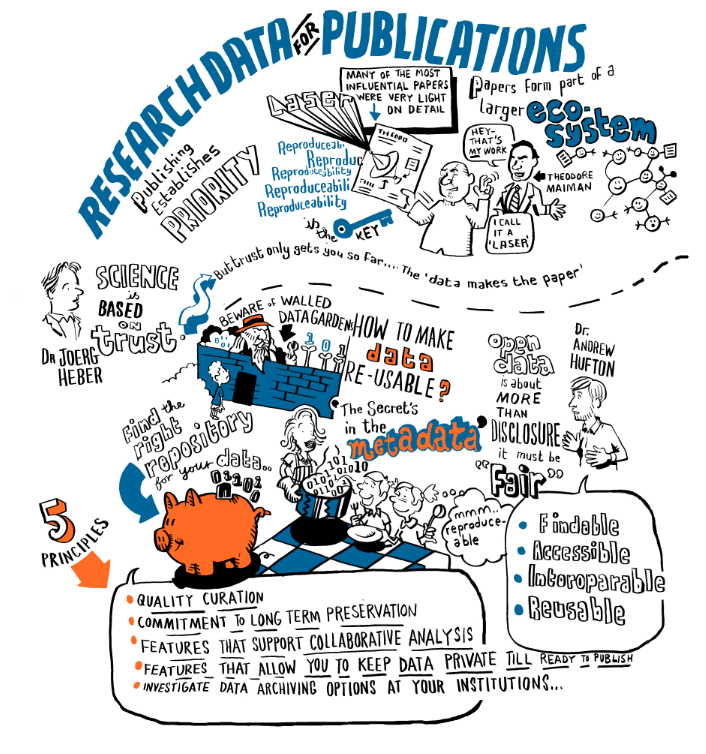
Primary research papers are the currency of academics, but they’re also part of a much wider body of knowledge that is restricted by a lack of transparency.

Guest contributor Lakshini Mendis

naturejobs-blog-Scidata15-ResearchData-for-Publications

{credit}Image credit: SCIENTIFIC DATA/LUDIC GROUP{/credit}

Historically, a great deal of trust has been placed in statements made in research papers for which the underlying data have not been shared. The invention of the laser was described in a paper containing just three data-points, for instance, and Watson and Crick first described the structure of DNA in a paper without any data at all. But with about 1,500 papers retracted since 2012, and 26.6% due to misconduct, scientific papers are now firmly under the microscope.

Improving the availability and readability of original research data would go a long way to improving matters. And as scientific publishers largely determine how research data is disseminated, their involvement will be central to any change. Speaking at Publishing Better Science Through Better Data in late October 2015, Dr Joerg Heber and Dr Andrew Hufton, editors at Nature Communications and Scientific Data respectively, emphasised that to make the most of research data it must be more open.

Overcoming the data-sharing challenge

According to Hufton, the status quo is for researchers to only share data with others directly. As well as being inefficient, data associated with published work disappears at a rate of about 17% a year as a result of researchers failing to properly catalogue findings. There is now, therefore, a move from scientific publishers to make data findable, accessible, interoperable and re-useable – or, to use an acronym as those of a scientific persuasion are so often inclined to do, FAIR. Continue reading

A science masterclass

Young researchers discuss science and careers with Nobel laureates at the 2015 Lindau Nobel meeting.

Image credit: Sam Falconer

Every year, Nobel laureates and young researchers come together in Lindau, Germany. It’s a unique opportunity to glean some advice for a successful career in science. The 2015 meeting cast a spotlight on super-resolution microscopy, as discussed in depth in the Nature Outlook: Science Masterclass, as well as fields as diverse as memory formation and the Higgs boson.

The first meeting was held in 1951, just two years before Francis Crick and James Watson revealed their structure of DNA. Since then, Nobel laureates from all walks of science have graced the small island with their presence, and 2015 was no different.

Elizabeth Blackburn, who shared the 2009 Nobel Prize in Physiology or Medicine with Carol Greider and Jack Szostak for their work on telomeres, was one of only three female laureates to attend the meeting. Other attendees included Richard Roberts (shared the 1993 Nobel Prize in Physiology or Medicine with Phillip Sharp for their discoveries of split genes), Francois Englert (shared the 2013 Nobel Prize in Physics with Peter Higgs for the theoretical discovery of a mechanism that gives mass to subatomic particles), Bruce Beutler (shared one half of the 2011 Nobel Prize in Physiology or Medicine with Jules Hoffmann for their work on the activation of innate immunity) and Susumu Tonegawa (winner of the Nobel Prize in Physiology or Medicine in 1987 for unlocking the genetic secrets behind antibodies’ diverse structures).

This particular Nature Outlook was supplemented with a series of videos highlighting some of the scientists’ work. On the blog, we’ve shown Saul Perlmutter’s work on the expanding universe, Stefan Hell’s work on breaking the diffraction barrier, Robert Wilson’s work on the cosmic microwave background and an insight into Elizabeth Blackburns interest in telomeres.

But of particular interest to the Naturejobs blog are three short videos that discuss certain elements of careers in science. Equal opportunities: Women in science, explores laureate Ada Yonath’s career, and why the gender gap in science persists. Young scientists also came together to discuss whose responsibility it is to disseminate science and finally, what does an early career scientist’s future look like, given the uncertainty in the job market?

Further reading/listening from the Naturejobs blog:

Podcast with Martin Chalfie, Venki Ramakrishnan and Arieh Warshel, on what it takes to be hired into their labs.

Podcast: Academia to industry, and back again, with Eric Betzig

Mentoring: A perspective from Nobel laureates

Mentoring: Before they were laureates

Mentoring: Where do laureates go for advice?

Lessons from a laureate

The faculty series: Setting up your own lab

Starting up a brand-new lab is a dream to many early-career researchers, but to make the most of it, they must be wise with their money.

Fancy/ Punchstock/ Getty Images

{credit}Image credit: Fancy/ Punchstock/ Getty Images{/credit}

We’ve covered setting up your own lab before, but there’s an awful lot more for you to consider when you begin your tenureship. Here’s some more of the story.

Equipment isn’t the only thing you need to think about when you finally get your (hopefully big) bag of cash. Staff and PhD recruitment is important, as is considering whether you need a closed or an open lab. How should you arrange everything? Does anyone else in the department need to share equipment? Should you stay traditional or move everything online? What else should you consider?

Recruiting staff

“There’s no point in paying for all of the new equipment if you don’t have enough hands available to use it,” says Rafael TM De Rosales, a lecturer in imaging chemistry at King’s College London. Too much focus on the equipment – be it computers, chemicals or carefully calibrated chronometers – and not enough on the people who’ll be using it, means you could find yourself in a brand new, decked out lab with little research output. Your most important hire will be the first one – your first postdoc needs to be skilled and enthusiastic enough to both carry out the research and teach your future hires what they need to know. Continue reading

In the classroom: Broadening students’ minds

A training programme is proposed to improve the interdisciplinary breadth and depth of a nanoscience research group.

Nature-nanotechnologyNanotechnology requires expertise from a range of fields, but students often have difficulties thinking about research in an interdisciplinary manner. In the November issue of In the classroom, Philip S. Lukeman (St. John’s University, New York) and Stefan Howorka (University College, London) outline a three phase training programme to help improve a student’s interdisciplinary skills. The approach is based around the widely used idea of a ‘journal club’, but is set in the context of a group’s interdisciplinary research and can be tailored to any specific topic. Experience with the training programme in Howorka’s own research group suggests that it can help students in a variety of ways, and can also benefit research teams as a whole.

Read Philip S. Lukeman and Stefan Howorka’s article, Broadening students’ minds, for free on the Nature Nanotechnology website.

#Scidata15: Big data: Challenges create opportunities

The era of big data brings with it a sea of opportunities for development and innovation.

Guest contributor Daniela Quaglia

naturejobs-blog-Scidata15-Opportunities-from-Research-Data

{credit}Image credit: SCIENTIFIC DATA/LUDIC GROUP{/credit}

Big data is here to stay. As scientists, we stand to benefit by being part of this exciting revolution. At the second Publishing Better Science through Better Data conference, held in London on October 23rd, Dr. Ewan Birney, joint associate director of the European Bioinformatics Institute (EBI), and Dr. Timo Hannay, founder of SchoolDash (a website that provides statistics about schools in England), walked us through some of the opportunities that arise from working with big data.

Opportunities in biology

Birney spoke about how the increase in big data is influencing the way we do biology. He promised to give the audience “an EBI centric view of the world”. I’m glad he did, because every scientist wanting to use big data should understand how EBI can help them.

EBI takes data provided by laboratories and stores, verifies, classifies and shares it. This approach means that a wealth of molecular-biology data, from DNA sequences to full systems (such us biomolecular pathways and metabolomics data), can be found in one place. As most scientists do not want to have to work from shared data in their raw form, the institute also works with the scientific community to convert original data into useful formats. Data from the Human Genome Project provides a compelling example of how such transformations can benefit the community — as Birney pointed out, not even the most experienced researchers want to analyse such complex raw data. Continue reading

Career paths: The future for young people

Becoming more informed about future careers, whether inside or outside academia, can help students make career decisions.

Laureate Eric Betzig ignored the traditional boundaries of academic disciplines. He attributes his success to a background in industry. Should young scientists look outside of the university system to progress their careers?