Seeking out stronger science: An incomplete, non-systematic list of resources

Our reporter Monya Baker runs through some of the statistical tools she found when writing her latest story.

As I reported in a Nature feature published this week, I found more online courses that were being developed than were actually in place. Resources to help scientists do more robust research are set to expand quickly. For example, the National Institute of General Medical Sciences has a competitive program that awards funds to institutions to enhance graduate student training; of 15 such supplements awarded in 2015, a dozen involved data analysis, statistics, or experimental rigor. You can find more here, and that is only a fraction of what is available. Some courses are still being developed and piloted to select students; others are being offered only to those in a particular department or training grant. If you find one that interests you, it can’t hurt to ask.

data-science-industry

{credit}PW Illustration/Getty{/credit}
Continue reading

#Scidata15: Make the most of your research: Publish better data

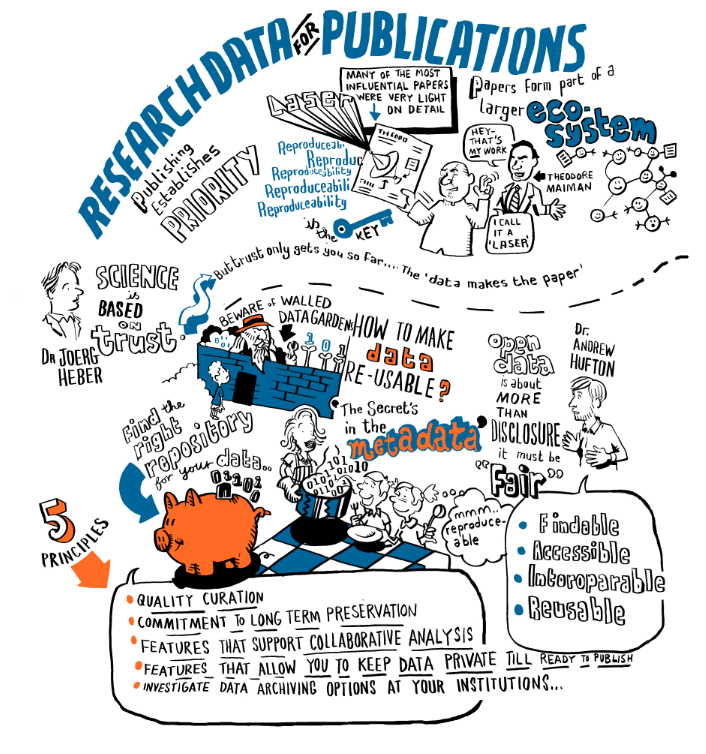
Primary research papers are the currency of academics, but they’re also part of a much wider body of knowledge that is restricted by a lack of transparency.

Guest contributor Lakshini Mendis

naturejobs-blog-Scidata15-ResearchData-for-Publications

{credit}Image credit: SCIENTIFIC DATA/LUDIC GROUP{/credit}

Historically, a great deal of trust has been placed in statements made in research papers for which the underlying data have not been shared. The invention of the laser was described in a paper containing just three data-points, for instance, and Watson and Crick first described the structure of DNA in a paper without any data at all. But with about 1,500 papers retracted since 2012, and 26.6% due to misconduct, scientific papers are now firmly under the microscope.

Improving the availability and readability of original research data would go a long way to improving matters. And as scientific publishers largely determine how research data is disseminated, their involvement will be central to any change. Speaking at Publishing Better Science Through Better Data in late October 2015, Dr Joerg Heber and Dr Andrew Hufton, editors at Nature Communications and Scientific Data respectively, emphasised that to make the most of research data it must be more open.

Overcoming the data-sharing challenge

According to Hufton, the status quo is for researchers to only share data with others directly. As well as being inefficient, data associated with published work disappears at a rate of about 17% a year as a result of researchers failing to properly catalogue findings. There is now, therefore, a move from scientific publishers to make data findable, accessible, interoperable and re-useable – or, to use an acronym as those of a scientific persuasion are so often inclined to do, FAIR. Continue reading

Data sharing: Contribute to the community

Data sharing can make a significant contribution to the scientific community, but it comes with challenges, says Caroline Weight.

Guest contributor Caroline Weight

We have all heard of it. We are all worried about it. We hear whispers of it in the corridors. We are advised to be careful what we say to ‘others’. We constantly check the literature. It matters to us. After all, it is our careers on the line.

‘Scooped’.

The process of publication is vigorous, competitive and tricky. It’s not uncommon for five years to pass between writing the grant application and publishing the work. Big labs with state-of-the-art facilities stand a better chance of getting their work out there first, given the extra manpower and often more-established protocols. This race for ownership of the data makes it difficult to share information and present new findings at meetings or conferences. Even at manuscript submission, there is often a chance to actively inhibit particular referees in case of conflicts of interest or personal competitors, to retain the novel concepts and data until they have been made public. Not until the publication has been accepted and is in print can you heave a sigh of relief and move on to the next project. Yet, sharing of data is essential to the progression of science in the modern world. Continue reading