Timothée Poisot recently travelled to London for MozFest 2017, “The world’s leading festival for the open Internet movement.” There, the quantitative and computational ecologist at the University of Montréal in Canada ran a session entitled “Scientific computing for the terabyte-less.” Here, he tells Naturejobs why life science research needn’t necessarily follow the Big Data model.
Open data can help us avoid inherent biases in our work, says Ayushi Sood
Better Science through Better Data writing competition winner Ayushi Sood
Recently, an economist friend told me that “scientific inquiry is inherently cursed.” At first I was offended. But I had to agree after he elaborated further – science today suffers from something economists enigmatically call the “winner’s curse”. Continue reading →
Follow the Panton Principles to ensure your data is licensed and accessible for immediate reuse, says Atma Ivancevic.
In a world where scientific discovery is driven by impact factor and funding, the idea of open data may seem idealistic. But the open data movement has been growing since the early 2000s, spurred by the rise of big data and computational capabilities. For the sake of reproducibility in science, we need to encourage data sharing after publication.
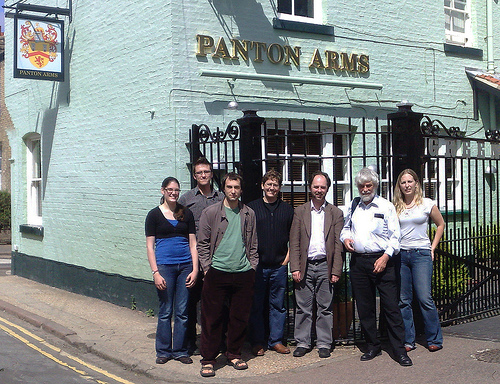
Founders of the Panton Principles at the Panton Arms, Cambridge UK. Copyright Panton Principles Authors (CC by 3.0).
Wandering the convention center among 30,000-plus researchers, students and vendors at the Society for Neuroscience annual meeting in San Diego last November, I struggled to wrap my head around a feature I was writing for this week’s Nature, on managing big brain data. Mice, molecular biology and cell sorting reigned supreme in my former life as a bench scientist. Neurons, brain imaging, terabytes — not so much. So when it came time to find an entry into the vast universe of the brain, I latched onto something that seemed small and manageable: the fruit fly.
Ann-Shyn Chiang of National Tsing Hua University, Taiwan, told the SFN crowd his team has spent a decade imaging 60,000 neurons in the Drosophila brain. The pictures produced 3D maps detailed enough to show which neurons control precise behaviors, such as shaking the head side to side (see video). But here’s the part that blew my mind: They aren’t even halfway done (flies have 135,000 brain neurons), and mapping the human brain with similar methods would take 17 million years!
Head shake behavior elicited by a 593.5-nm laser. Credit Po-Yen Hsiao and Ann-Shyn Chiang.
When preparing a grant or publication, where can you turn for new ideas? You can bounce ideas off colleagues, search PubMed and Web of Science for related literature, and maybe take a trip down Google lane. But it’s difficult to get outside one’s particular area of expertise — to mine the opportunities at cross-disciplinary boundaries unless you know what you’re looking for. The developers of a new document search engine hope to make such cognitive leaps easier, finds Jeff Perkel.
Researchers still need to adhere to the scientific method, regardless of how large the datasets are or how complicated the experiments become.
Publishing better science through better data journalism competition winner Erica Brockmeier
The life of today’s scientific researcher doesn’t look like it did in the 1940s. One of the papers I cited in my dissertation, published in 1941 by Dr. C.L. Turner, describes the efforts of a solo scientist manually counting bone segments in female fish fins after treatment with anabolic steroids. Turner was one of the first scientists to show that female mosquitofish exposed to androgens exhibited the type of fin growth which was normally only found in male mosquitofish.
Research involving vast quantities of data may be changing the image of scientific research, but is it changing the image of scientists too?
Scidata publishing better science through better data competition winner Jonathan Page.
An intrepid, khaki-clad explorer, machete in hand, cutting their way through some undiscovered wilderness. A bespectacled, grey-haired academic in a white coat, supervising some elaborate experiment in a lab, illuminated by glowing lights and flashing buttons. These are the classical images sometimes conjured when the word ‘scientist’ is mentioned.
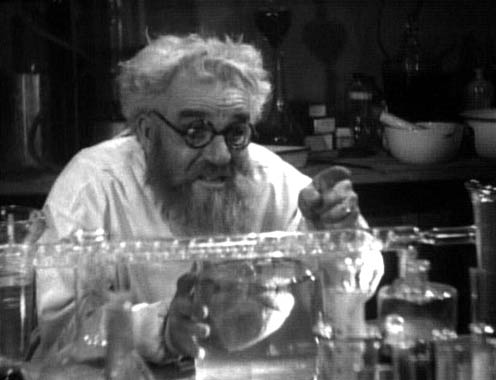
Horace B. Carpenter as Dr. Meirschultz, a scientist attempting to bring the dead back to life in the 1934 film Maniac
Data-intensive research requires a new breed of scientist: interdisciplinary analysts who enjoy swimming in data, says Atma Ivancevic.
There has always been an emphasis on the generation of novel data in science. Being a scientist involves progressing from observation to hypothesis to experiment to output. In the past, a combination of scarce data to look at and low throughput machinery to make more has led to limited experimental outcomes.
“Big data” is a catchall term for any data set of exceedingly large volume. It could be transaction information at a credit card company, invoice data at an online retailer, meteorological measurements from a weather station. All these data sets have unique characteristics that make it extremely difficult to use conventional computing technologies and techniques to store and process them for analysis. Their variety is daunting, and high velocity is required to handle them in a timely manner.
So who is going to store, manage and process all this information? Well, why not you? Companies are starved for people with this kind of expertise. Big data is a growth industry and people from a variety of academic backgrounds can find successful careers in this area.
The explosive economic impact of big data has blurred the line between the business world and the scientific world like never before. A new type of business leader, the data scientist, has evolved as an amphibian, capable of thriving in both worlds, swimming in data lakes to bring useful insights back to the solid ground of business concerns.
Of course, companies have been using business intelligence (BI) tools to analyse their operational and financial performance metrics for decades.
But datasets generated by the web are so large that they must be stored on clusters of servers with thousands of nodes. Traditional methods for analysing these datasets have faltered, necessitating a more scientific approach.