Resubmitting your study to a new journal could become easier

Rejected manuscripts are a fact of life in science, but a new initiative might take some of the sting out of the process.

newspaper-pile-naturejobs-blog-2

{credit}Image credit: Getty Images/Mateusz Zagorski{/credit}

By Chris Woolston

The National Information Standards Organization (NISO), a Baltimore, Maryland-based non-profit that promotes standardization in publishing, has embraced a plan to make it easier for journals to share rejected manuscripts and manuscript reviews without forcing authors to go through another arduous submission process. Continue reading

Last-author spot tough to nail for scientists who are not white or male

Many scientists mark the evolution of their careers by publications: Their first paper, their first stint as a lead author, the first time they earn a final or senior spot. But for women and members of some minority groups, those benchmarks can be especially hard to reach, according to a study published in the May 2018 issue of AEA Papers and Proceedings.

By Chris Woolston

scales

The analysis—which covered 486,644 biomedical articles with two to nine authors published between 1946 and 2009—found that female, black and Hispanic authors were less likely than were white men to hold prestigious last-author spots. And while all scientists tended to land more last-author spots as their careers went on, that trend was slower for women and minorities. “There’s a lack of progression for those groups,” says Bruce Weinberg, a co-author of the study and an economist at Ohio State University in Columbus. Continue reading

Where are the female first and last authors?

Women remain under-represented in many areas of science, but they are especially scarce in the pages of high-impact journals, according to an analysis published online 2 March in bioRxiv.
scales

Researchers at the University of Washington in Seattle gathered names of first and last authors from papers published from 2005-2017 in 15 major science and neuroscience journals, including Nature, Science, PNAS, Nature Neuroscience and Neuropsychology Review. Nearly 10% of the names were excluded because they were relatively gender neutral, but the rest told a clear story: In these journals, authorship is a male-dominated enterprise.

For example, women accounted for roughly 25% of all first authors in Nature and Science and just over 35% of first authors in PNAS. Female first authors outnumbered men in only one journal, Neuropsychology Review, but just barely (53% vs 47%). Women made up an even smaller proportion of senior (or last) author spots, ranging from about 15% in Nature and Science to just under 40% in Neuropsychology Review.

The study found an inverse relationship between the prevalence of female authors and the impact factor of the journal—the higher the impact, the lower the chances that a woman was involved. Because publication in high-impact journals is so crucial for a scientific career, any gender gap could have serious consequences, says Ione Fine, a neuroscientist and co-author of the study. “If you aren’t published in high-impact journals, you don’t get awards or jobs,” she says. “It becomes a cascade of events.”

The scarcity of women in journals doesn’t simply reflect a lack of women doing high-quality science, Fine says. The study notes that roughly 30% of prestigious R01 grants from the US National Institutes of Health go to women. But in almost all of the journals studied, the percentage of women in senior author spots falls below that mark, a sign that the gender disparity in authorship exceeds disparities in other measures of academic excellence and productivity. “That’s the smoking gun that we have a real problem here,” she says.

Subtle biases by reviewers may make it harder for women to get published, Fine says. But she notes that women themselves may be contributing to the gender gap through a reluctance to submit to top-tier journals. “My feeling is that women are self-censoring because it’s just a more brutal process for them,” she says. “I know my male colleagues submit papers that I wouldn’t submit, and they seem to do just fine.”

Fine and colleagues call for all journals to keep statistics on papers submitted by women and minorities. They also suggest that journals could greatly reduce the possibility of bias by adopting mandatory double-blind reviews, a system in which the reviewer doesn’t know the identity—or the gender—of the study’s authors. Nature and other journals provide double-blind reviews on request, but Fine says that practice won’t protect women from bias. If an author requests double-blind review, she says, the reviewer is likely to assume that the request came from a female researcher, thus defeating the purpose.

In response, Nature Research, the parent organisation of Nature, issued a statement that read, in part: “Nature Research is committed to gender equality and our journals strive to support women in science.” The company says that it does not ask submitters to indicate gender, so it doesn’t systematically track gender statistics. It also says that it will “continue to assess the merits” of mandatory and voluntary double-blind reviews.

A 2017 Nature editorial noted that the journal has made slow progress in other areas of gender equality. For example, women accounted for just over 20% of reviewers in 2015, a small improvement over previous years. In 2013, 13% of reviewers were women. But Fine says that hiring more female reviewers won’t necessarily close the publication gap. “Women can be biased too,” she says.


Chris Woolston is a freelance writer in Billings, Montana.


Suggested reading:

Women in physical sciences

Fight the brain drain

Science is failing women


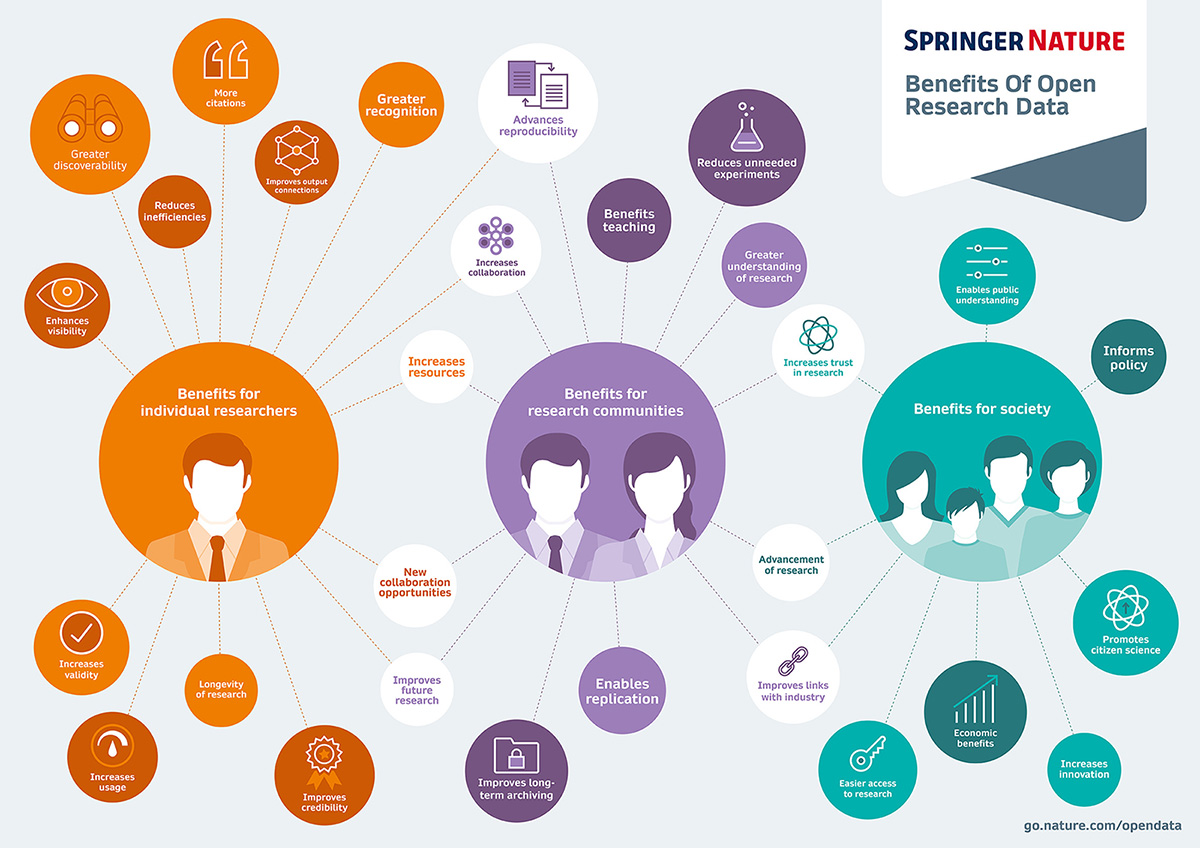
Ask not what you can do for open data; ask what open data can do for you

Mathias Astell, marketing manager for Scientific Data and Scientific Reports, outlines the benefits of open research data and provides some tips and tools researchers can use to make their data more open.

It has been shown that research articles receive more citations when they have their underlying data openly linked to them. With this in mind, it’s time to consider not just the ideological reasons for making research data open, but the selfish benefits of openly sharing data that all researchers can (and should) be taking advantage of.

mat1

This infographic can be downloaded under a CC-BY licence here

And as an increasing number of funders mandate data sharing, and publishers start implementing more consistent data policies at their journals, it is worth seriously considering how and why you should make the research data you generate more openly available. Continue reading

What I learnt from researching in Germany

Mit Bhavsar shares his thoughts on working in the German scientific environment

I’ve always been fascinated with medical research, which brought me from Ahmedabad, India, to Frankfurt (via Aachen, Düsseldorf and Göttingen) to pursue a Masters and a PhD in neuroscience. Germany boasts an excellent research ecosystem across the private and public sectors, with strong collaboration between each. Consequently, there are attractive career opportunities for local and international researchers, especially in a world where two of the west’s other major research hubs – the UK and the US – appear to be trending against science, evidence, and intellectualism. Having spent seven years here, this is what you need to know about research in Germany.

biomedical research-smaller

Credit: Getty/Andrew Brookes

Continue reading

How is the rise of data-intensive research changing what it means to be a scientist?

Data-intensive research requires a new breed of scientist: interdisciplinary analysts who enjoy swimming in data, says Atma Ivancevic.

There has always been an emphasis on the generation of novel data in science. Being a scientist involves progressing from observation to hypothesis to experiment to output. In the past, a combination of scarce data to look at and low throughput machinery to make more has led to limited experimental outcomes.

2016-09-12-Atma Ivancevic 04-smaller-cropped

Atma Ivancevic

Continue reading

Why you need to collaborate

Collaborating, formally or otherwise, is a huge component of your future (and current) success – even if you’re in the early stages of your career as a graduate student or postdoc.

7822101134_6cbcbb435b_o

{credit}CC-BY-SA Atos/Flickr{/credit}

Why? It’s how science works today – even in academia. You can’t do it all on your own — you need to work with others who have expertise in different areas to identify the right research questions, to ensure that your experiments answer the questions properly and that your data are robust, to fully interpret results and understand their broader implications and ramifications (as well as potential commercial application in some cases).

Continue reading

This week on Nature Careers: dealing with retractions

It’s never an easy thing, finding out that your work isn’t completely right AFTER it’s been published. The career of a scientist still hangs on the number of publications they have, so how do you manage a retraction?

retractions

{credit}Oivind Hovland/Ikon Images/Getty{/credit}

“The rise in retractions could be because scientists are making more errors, but it could also indicate a growing culture of coming clean on errors.” Continue reading