Building relationships for success in science – The Ben Franklin effect

Contributor Joanne Kamens

networking

{credit}iStock Photo/Thinkstock{/credit}

Networking has gotten a really bad name. I take your card, you take my card and then we don’t call each other. Scientists often don’t make time for it because it seems “fake” or as though it isn’t worthwhile. In reality, strong and abundant professional relationships are necessary for most people to have opportunities to develop their careers, including scientists. Continue reading

Communicating with Generation Y

This post was originally published at MassBioHQ on March 25th 2014

As a leader in your company or team, it is important to be able to communicate effectively with your staff.

In small start-ups and in the fast-paced biotech world, there are many opportunities for young graduates to help build a business and kick-start their careers. Many of these new recruits will be fresh-faced, eager-to-learn students straight from university: Generation Y, born in the 1980’s and 1990’s. This group has grown up in a digital world to which they’re constantly connected. For the same reason, they’re always curious about what others are doing, and this flows right into the way they work.

They have a different way of getting things done, so it’s worth finding out what makes them tick.

74773

{credit}PhotoDisc/ Getty Images{/credit}

Continue reading

How to break out of a scientific career rut part 1: Recognise your reasons

Contributor, Ben Thomas

The path to a fulfilling science career is steep and lined with obstacles, so landing a comfortable position can feel like a welcome relief. But what happens when you’re ready for a new challenge, a change of pace, or just to find out what you’re really capable of? In this three-part series of articles, workers in the sciences will explain how and why they got stuck in career ruts, and how they broke out into more fulfilling, thrilling careers.


149038454_Uturn_istockthinkstock

{credit}iStockphoto?Thinkstock{/credit}

Continue reading

Selling for scientists

Is selling science a dirty word? Or should scientists be embracing it? Peter Fiske, keynote speaker at the Naturejobs Career Expo in Boston on May 20th, tackles this issue of Selling for Scientists with the Science of Selling.

Many scientists cringe when they hear the word “selling.”  In our academic culture, we are taught that our technical work should speak for itself. “Selling” implies persuasion and potentially intentional distortion with (heaven forbid!) a monetary (and not an intellectual) goal. As “proper” scientists, we feel that “selling” is not only debasing but also a bit dirty.
selling for scientists Continue reading

This week on Nature Careers: Strapped students

“Postgraduate education is a minefield of financial pitfalls — from tuition fees and loans to long stretches without contributing to savings. And yet many graduate students neglect to plan their finances accordingly.”

strapped-students

{credit}Koya979/Shutterstock{/credit}

It’s not easy being a student, managing financial support from multiple sources “from teaching-assistant and research-assistant posts, external awards, internal scholarships, one-time entrance scholarships, tuition waivers and reimbursements…” Continue reading

This week on Nature Careers: dealing with retractions

It’s never an easy thing, finding out that your work isn’t completely right AFTER it’s been published. The career of a scientist still hangs on the number of publications they have, so how do you manage a retraction?

retractions

{credit}Oivind Hovland/Ikon Images/Getty{/credit}

“The rise in retractions could be because scientists are making more errors, but it could also indicate a growing culture of coming clean on errors.” Continue reading

Data management

digital tattoo

{credit}PhotoDisc/Getty Images{/credit}

As Euan Adie and Alex Hodgson discussed in this month’s Naturejobs podcast on scientific publishing and a digital future, the amount of data being created in science is phenomenal. It is being created faster than the technology to store it. But as the volumes are increasing, are scientists getting any better at managing it? As it turns out, there are still a few kinks in the system.

An article on Research Information called Better management reduces data loss risk, highlights some of the problems that scientists might have.

“After moving all of his data home to write up, biologist Billy Hinchen returned one afternoon to find that his laptop and all his backup hard drives had been stolen.” Continue reading

Scientific publishing and a digital future

e-readers and e-publication

{credit}iStock/Thinkstock{/credit}

What do you think will be the future of scientific publishing?

To match this month’s Windback Wednesday series on publishing, Julie Gould speaks to Euan Adie, director at Altmetric, and Alex Hodgson, head of marketing at ReadCube in this podcast about scientific publishing and a digital future.

Technology is changing fast, and it is having an effect on the way you can access, discover and share scientific publications. Euan, Alex and I discuss how we predict these three things will be changing.

Alex Hodgson makes a good point that we can look at the changes in how scientific papers are discovered and read. It used to be all about the printed word – it was easy, flexible and simple to manage. Now things are read online via databases. “If you stop to think about that, I mean, that’s a really big shift from more of a journal focus to more of a specific article focus.” And in order to read these papers, tools have become available that let scientists to “sift through the noise so that you’re not missing an important paper.”

Continue reading

Is science fashionable?

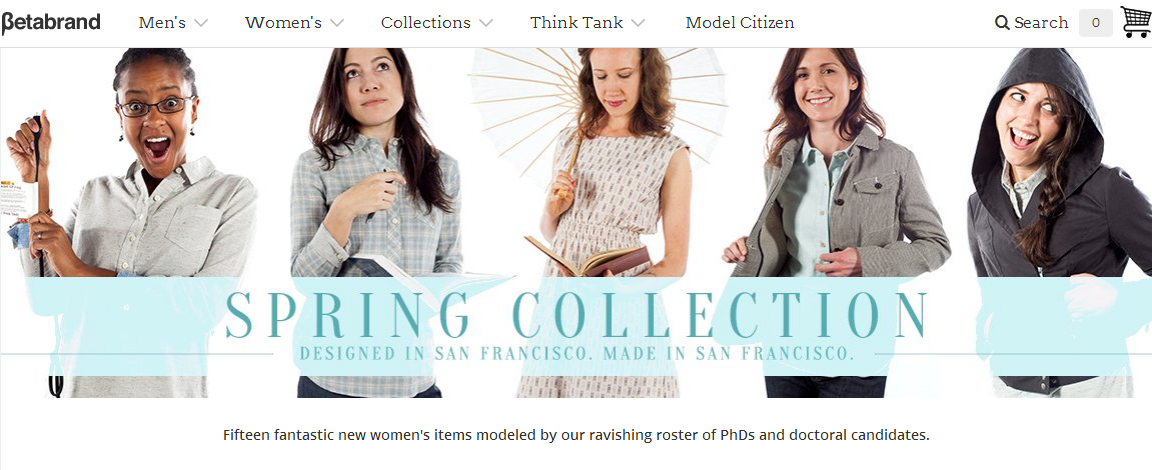
βetabrand has been using female PhD and post-docs to model their latest spring collection – but what does this mean for women in science?

betabrand

{credit}courtesy of Betabrand{/credit}

“Our designers cooked up a collection of smart fashions for spring, so why not display them on the bodies of women with really big brains?” Said the Betabrand CEO Chris Lindland in an interview to Adweek, “sixty women from around the world applied.” Just seven were chosen as the βetabrand to be the “New Women’s Spring Collection: modeled by a ravishing roster of PhDs & doctoral candidates.Continue reading