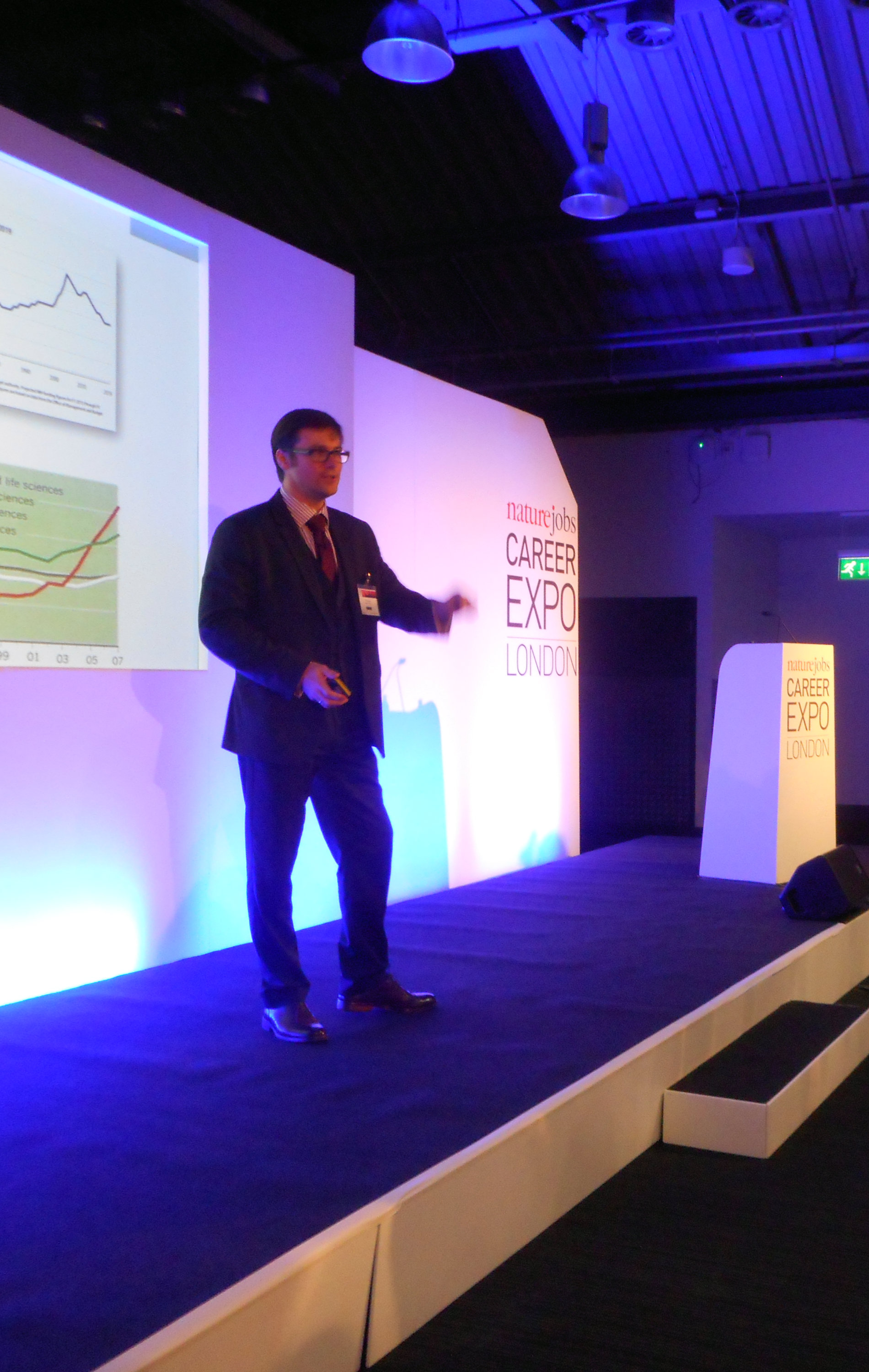
Phill Jones, keynote speaker at the 2015 London Naturejobs Career Expo, shares his career transition story.
Read the report on the keynote speech, Career paths: Out of the Ivory Tower, on the Naturejobs blog.

Read the report on the keynote speech, Career paths: Out of the Ivory Tower, on the Naturejobs blog.
Guest contributor Lauren Emily Wright
{credit}Image credit: Lauren Emily Wright{/credit}
Ever thought “I want to leave academia, but all I know is lab work”? Well despair no more — the path out isn’t as treacherous as it may seem. In a great keynote speech at the Naturejobs Career Expo 2015 on 18 September 2015, Phill Jones told the story of how he left academia to become the head of publisher outreach at Digital Science, a company that provides a multitude of services to scientists, institutions, publishers, and funding bodies.
Jones gave the audience the sense that calculated planning and sheer luck had both played their part in his career. With a PhD in physics, he was firmly grounded in the world of academia. But after following his wife to Boston, Jones realised that a postdoc in physics would be hard to come by in such a biology-centred city. “I had to be a little more flexible in my career,” he said.
As Jones notes, it is necessary to have an open mind when thinking of changing career paths. “You can’t think ‘all I know is how to pipette’.” Instead, think about what sort of transferrable skills you can offer an employer. For example, Jones finished his PhD with an in-depth knowledge of optics — perfect for a position in a biology lab that used optical imaging to investigate strokes.
But how can you identify which transferrable skills you already have, and which you need to gain for that ideal new career? How can you make contacts outside academia? Continue reading
Contributor Catherine Chimes

{credit}Image credit: Getty Images/Thinkstock/Catherine Yeulet{/credit}
Establishing yourself in your field is a challenge faced by many early-career researchers and academics. Accruing status as indicated by traditional methods (such as journal citation counts, public speaking opportunities and, at the pinnacle for some, being awarded tenure) can be fraught with difficulty in more ways than one.
As more and more scholarly work is reviewed, published and made publicly available each year in an increasing variety of formats, one question stands out: what other indicators are there that scholars can utilize to evidence the impact of their work?
Achieving recognition and credit for the work accomplished is crucial to advancing any scientific career. Recent articles have discussed the danger in publishing for publishing’s sake – instead, experts enthuse, the emphasis should be on publicly available, reproducible, robust data and outputs that extend far beyond the journal article. Continue reading
{credit}PhotoDisc/Getty Images{/credit}
As Euan Adie and Alex Hodgson discussed in this month’s Naturejobs podcast on scientific publishing and a digital future, the amount of data being created in science is phenomenal. It is being created faster than the technology to store it. But as the volumes are increasing, are scientists getting any better at managing it? As it turns out, there are still a few kinks in the system.
An article on Research Information called Better management reduces data loss risk, highlights some of the problems that scientists might have.
“After moving all of his data home to write up, biologist Billy Hinchen returned one afternoon to find that his laptop and all his backup hard drives had been stolen.” Continue reading