Resubmitting your study to a new journal could become easier

Rejected manuscripts are a fact of life in science, but a new initiative might take some of the sting out of the process.

newspaper-pile-naturejobs-blog-2

{credit}Image credit: Getty Images/Mateusz Zagorski{/credit}

By Chris Woolston

The National Information Standards Organization (NISO), a Baltimore, Maryland-based non-profit that promotes standardization in publishing, has embraced a plan to make it easier for journals to share rejected manuscripts and manuscript reviews without forcing authors to go through another arduous submission process. Continue reading

Why learning to mentor and teach is more important for US faculty members than publishing papers

An influential ally aims to reform the experience of US PhD students in science, technology, engineering and math (STEM) by advocating for a system that rewards faculty members for mentoring and advising students rather than for their own publications.


By Chris Woolston

In a 29 May report , Graduate STEM Education for the 20th Century, the National Academies of Science, Engineering and Medicine (NASEM) in Washington DC calls for providing faculty members with incentives for developing skills such as teaching and mentoring while de-emphasizing the importance of publications. The report recommends that institutions change their promotion and tenure policies and practices to recognise and reward faculty members’ contributions to graduate mentoring and education.

Continue reading

Last-author spot tough to nail for scientists who are not white or male

Many scientists mark the evolution of their careers by publications: Their first paper, their first stint as a lead author, the first time they earn a final or senior spot. But for women and members of some minority groups, those benchmarks can be especially hard to reach, according to a study published in the May 2018 issue of AEA Papers and Proceedings.

By Chris Woolston

scales

The analysis—which covered 486,644 biomedical articles with two to nine authors published between 1946 and 2009—found that female, black and Hispanic authors were less likely than were white men to hold prestigious last-author spots. And while all scientists tended to land more last-author spots as their careers went on, that trend was slower for women and minorities. “There’s a lack of progression for those groups,” says Bruce Weinberg, a co-author of the study and an economist at Ohio State University in Columbus. Continue reading

Science careers are careers that involve science

This piece was originally published on the BioMed Central blog network, part of Springer Nature.

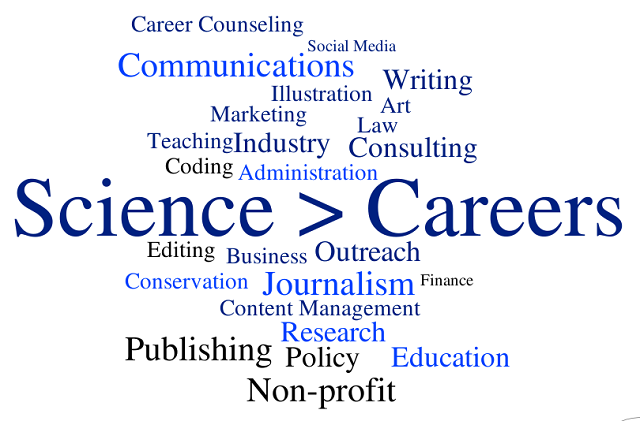
Dana Berry announces the launch of a new series ‘Science > Careers’ putting the spotlight on scientific careers outside of academia. Here she talks about her own experiences and how she hopes the series will inspire others that are searching for something different.
ScienceCareers640c

Dana Berry. Originally published 9 Feb 2016.

During my senior year of high school I decided that I wanted to be a research biologist. From there it was a straight path; I got my bachelor’s degree in biology, while also working in a lab, spent a year at the NIH after graduation, and then started at NYU for a PhD program in biomedicine.

Two years in I decided to leave. Not only was I not happy with what I was doing in the short term, I wasn’t happy with where it would take me. Leaving school with my masters was a difficult decision, and absolutely right for me, but figuring out what to do next was even more difficult.

I still wanted to be involved in science, I still loved biology, but being in a lab just didn’t fit. How do you do science without being a Scientist?

Searching for advice

I sought out as much advice as I could from other students, postdocs, professors, friends of friends, blogs, anyone and everyone. Because I only had research experience on my CV, and I was opting to not continue lab work in any form, I didn’t know what I was looking for, never mind how to find it.

Searching for a job is difficult at the best of times, but when you don’t know what you’re looking for? Seemingly impossible.

On the whole, the job advice I got was either vague or was only helpful in retrospect. Much of it left me more confused about my future than I was before. What exactly are those jobs that are supposedly so plentiful for graduate students? Typing ‘science communication’ into a job search engine gave me search results that were broad, baffling and relatively useless.

Where I work now

By what still seems like sheer luck, I actually found a job that would utilize my experience and involved my interests. For more than a year now I have been working as a Journal Development Editor at BioMed Central, working mainly with microbiology journals.

Seeing as I got my masters in microbiology, it’s been a pretty good fit. Working at a desk, instead of at the bench, has been great. I get to keep up with the latest research, in a much broader context than as a student, attend conferences to meet with our editorial boards and other leading researchers, and work towards improving the lives of researchers and citizens alike.

More than that, and outside of the obvious publishing experience, I’ve gained experience in marketing, science communication, content management and social media. I’ve also come to discover just how vast the world of science is beyond the lab.

So much out there

The web of scientific careers is bigger than most people realize, and definitely bigger than most graduate students see on a regular basis or are even made aware of. Although career training in graduate school is getting better, there’s still an entrenched feeling of two opposing monolithic choices for students: ‘lab research’ or ‘other’.

These two options are not separate, and they’re significantly more than just two categories. Since I started at BioMed Central, I’ve learned about new science jobs nearly every day. Both jobs that I’ve never heard of and jobs that I knew about, but didn’t know that they could revolve around science. I love finding out about these like-minded people, people who love science but aren’t ‘Scientists’.

Using our experience to educate others

I still think back to the difficulties I had looking for a job two years ago, and I wish I could tell the person I was then everything I know now. But since we haven’t invented that technology yet, I am going to share this knowledge with others who are currently going through it.

I am very happy to announce a new series all about careers in science. Previous posts on our network have touched on career exploration, but with this series I want to delve deeper into what these careers truly involve.

Science is not a solitary pursuit, but a team effort, made up of teachers, journalists, policy makers, publishers, as well as researchers. But how does this team work? What do they do and where do they do it?

Starting right here at BioMed Central, our next post will identify and explain four job types in our publishing team, and how the employee’s previous experience lends itself to their current day-to-day tasks.

Beyond that we’ll have in depth interviews with people in science policy, outreach, teaching, communications, art, administration, technology and probably more publishing. We want to explore every nook and cranny of every sector you’ve heard of, those you haven’t, and then some.

danaberry


Dana graduated with a MS in Microbiology from New York University before joining BMC in 2014, where she manages the infectious diseases portfolio.


Suggested posts

Surviving academia as an early career researcher: an unreliable guide

Careers for scientists away from the bench

Adios to academia

Where are the female first and last authors?

Women remain under-represented in many areas of science, but they are especially scarce in the pages of high-impact journals, according to an analysis published online 2 March in bioRxiv.

scales

Researchers at the University of Washington in Seattle gathered names of first and last authors from papers published from 2005-2017 in 15 major science and neuroscience journals, including Nature, Science, PNAS, Nature Neuroscience and Neuropsychology Review. Nearly 10% of the names were excluded because they were relatively gender neutral, but the rest told a clear story: In these journals, authorship is a male-dominated enterprise.

For example, women accounted for roughly 25% of all first authors in Nature and Science and just over 35% of first authors in PNAS. Female first authors outnumbered men in only one journal, Neuropsychology Review, but just barely (53% vs 47%). Women made up an even smaller proportion of senior (or last) author spots, ranging from about 15% in Nature and Science to just under 40% in Neuropsychology Review.

The study found an inverse relationship between the prevalence of female authors and the impact factor of the journal—the higher the impact, the lower the chances that a woman was involved. Because publication in high-impact journals is so crucial for a scientific career, any gender gap could have serious consequences, says Ione Fine, a neuroscientist and co-author of the study. “If you aren’t published in high-impact journals, you don’t get awards or jobs,” she says. “It becomes a cascade of events.”

The scarcity of women in journals doesn’t simply reflect a lack of women doing high-quality science, Fine says. The study notes that roughly 30% of prestigious R01 grants from the US National Institutes of Health go to women. But in almost all of the journals studied, the percentage of women in senior author spots falls below that mark, a sign that the gender disparity in authorship exceeds disparities in other measures of academic excellence and productivity. “That’s the smoking gun that we have a real problem here,” she says.

Subtle biases by reviewers may make it harder for women to get published, Fine says. But she notes that women themselves may be contributing to the gender gap through a reluctance to submit to top-tier journals. “My feeling is that women are self-censoring because it’s just a more brutal process for them,” she says. “I know my male colleagues submit papers that I wouldn’t submit, and they seem to do just fine.”

Fine and colleagues call for all journals to keep statistics on papers submitted by women and minorities. They also suggest that journals could greatly reduce the possibility of bias by adopting mandatory double-blind reviews, a system in which the reviewer doesn’t know the identity—or the gender—of the study’s authors. Nature and other journals provide double-blind reviews on request, but Fine says that practice won’t protect women from bias. If an author requests double-blind review, she says, the reviewer is likely to assume that the request came from a female researcher, thus defeating the purpose.

In response, Nature Research, the parent organisation of Nature, issued a statement that read, in part: “Nature Research is committed to gender equality and our journals strive to support women in science.” The company says that it does not ask submitters to indicate gender, so it doesn’t systematically track gender statistics. It also says that it will “continue to assess the merits” of mandatory and voluntary double-blind reviews.

A 2017 Nature editorial noted that the journal has made slow progress in other areas of gender equality. For example, women accounted for just over 20% of reviewers in 2015, a small improvement over previous years. In 2013, 13% of reviewers were women. But Fine says that hiring more female reviewers won’t necessarily close the publication gap. “Women can be biased too,” she says.


Chris Woolston is a freelance writer in Billings, Montana.


Suggested reading:

Women in physical sciences

Fight the brain drain

Science is failing women


Walking the walk: how the scientific community is embracing open data

Open data is the new normal, says Anastasia Greenberg.

Lots of people connected in hexagon pattern sharing data

The 2017 Better Science through Better Data event in London, UK, hosted by Springer Nature and Wellcome, was a full day exposé of emerging open data practices, tools, strategies, and policies. Among the potential benefits of open data are replicability, reproducibility, and reusability. While open data is a relatively new hype, some evidence suggests that open data does indeed increase reproducibility.

Continue reading

The struggles of female and underrepresented scientists

Initiatives to increase diversity among faculty members—particularly in science, technology, engineering and maths (STEM)—have prompted efforts to track university recruitment and retention of women and underrepresented minorities (URM). Three new US studies shed light on the issues, including salary and publication rates.

nj7668-489a-i1

Continue reading

The power of data shared

In a world of interdisciplinary research, we need to make data freely available, says Katie Ember

Better Science through Better Data writing competition winner Katie Ember

Every Monday in the University of Edinburgh’s School of Chemistry, the Campbell group gather in Room 233 for a lab meeting. If you’re hosting the meeting, you bring cake. Or you forget and everyone pretends they’re not feeling a bit hungry and disappointed. Then, two scientists in the group present that month’s work.

Every Friday in the Centre for Regenerative Medicine, a fifteen minute cycle from the School of Chemistry, the Forbes group file into the first floor meeting room. After battling with the “motion-activated” lights, we all talk through what we’ve achieved that week.

Teamwork

The reason I go to two lab meetings in one week is because I’m attempting to detect liver damage using laser light. It’s multidisciplinary and it’s hard: requiring input from biologists, physicists and transplant surgeons from different institutes. The end result is that I spend about four hours each week not doing science but discussing it. Whilst this may seem like a strange way to do research, I cannot overstate how important it is. Continue reading

Remapping the scientific landscape: moving from a closed to open science world

Science is changing – and we will change with it, says Anastasia Greenberg

Better Science through Better Data writing competition winner Anastasia Greenberg

“Information is power. But like all power, there are those who want to keep it for themselves.” Those were the words of Aaron Swartz, a young programming prodigy and the creator of Reddit, in his Guerilla Open Access Manifesto. In 2011, Swartz wrote some code that systematically downloaded millions of academic papers from the JSTOR database onto his computer, which was hidden in a basement closet at the Massachusetts Institute of Technology (MIT). This act of hacktivism resulted in felony charges, with potential for decades of jail time. Swartz hanged himself in 2013.

To some, Swartz’s story embodies the open-science movement, but it is far from clear what his motives for downloading JSOR’s database were, and which, if any, segments of the open science movement Swartz identified with. Continue reading

Turning scientific scrutiny on science itself

A proactive approach could help researchers contribute to solving many of the problems they encounter in academia

Naturejobs journalism competition winner Jiska van der Reest

microscope-385364_1920

Continue reading