Where are the female first and last authors?

Women remain under-represented in many areas of science, but they are especially scarce in the pages of high-impact journals, according to an analysis published online 2 March in bioRxiv.
scales

Researchers at the University of Washington in Seattle gathered names of first and last authors from papers published from 2005-2017 in 15 major science and neuroscience journals, including Nature, Science, PNAS, Nature Neuroscience and Neuropsychology Review. Nearly 10% of the names were excluded because they were relatively gender neutral, but the rest told a clear story: In these journals, authorship is a male-dominated enterprise.

For example, women accounted for roughly 25% of all first authors in Nature and Science and just over 35% of first authors in PNAS. Female first authors outnumbered men in only one journal, Neuropsychology Review, but just barely (53% vs 47%). Women made up an even smaller proportion of senior (or last) author spots, ranging from about 15% in Nature and Science to just under 40% in Neuropsychology Review.

The study found an inverse relationship between the prevalence of female authors and the impact factor of the journal—the higher the impact, the lower the chances that a woman was involved. Because publication in high-impact journals is so crucial for a scientific career, any gender gap could have serious consequences, says Ione Fine, a neuroscientist and co-author of the study. “If you aren’t published in high-impact journals, you don’t get awards or jobs,” she says. “It becomes a cascade of events.”

The scarcity of women in journals doesn’t simply reflect a lack of women doing high-quality science, Fine says. The study notes that roughly 30% of prestigious R01 grants from the US National Institutes of Health go to women. But in almost all of the journals studied, the percentage of women in senior author spots falls below that mark, a sign that the gender disparity in authorship exceeds disparities in other measures of academic excellence and productivity. “That’s the smoking gun that we have a real problem here,” she says.

Subtle biases by reviewers may make it harder for women to get published, Fine says. But she notes that women themselves may be contributing to the gender gap through a reluctance to submit to top-tier journals. “My feeling is that women are self-censoring because it’s just a more brutal process for them,” she says. “I know my male colleagues submit papers that I wouldn’t submit, and they seem to do just fine.”

Fine and colleagues call for all journals to keep statistics on papers submitted by women and minorities. They also suggest that journals could greatly reduce the possibility of bias by adopting mandatory double-blind reviews, a system in which the reviewer doesn’t know the identity—or the gender—of the study’s authors. Nature and other journals provide double-blind reviews on request, but Fine says that practice won’t protect women from bias. If an author requests double-blind review, she says, the reviewer is likely to assume that the request came from a female researcher, thus defeating the purpose.

In response, Nature Research, the parent organisation of Nature, issued a statement that read, in part: “Nature Research is committed to gender equality and our journals strive to support women in science.” The company says that it does not ask submitters to indicate gender, so it doesn’t systematically track gender statistics. It also says that it will “continue to assess the merits” of mandatory and voluntary double-blind reviews.

A 2017 Nature editorial noted that the journal has made slow progress in other areas of gender equality. For example, women accounted for just over 20% of reviewers in 2015, a small improvement over previous years. In 2013, 13% of reviewers were women. But Fine says that hiring more female reviewers won’t necessarily close the publication gap. “Women can be biased too,” she says.


Chris Woolston is a freelance writer in Billings, Montana.


Suggested reading:
Women in physical sciences

Fight the brain drain

Science is failing women


The three-year PhD program: good for students? Or too good to be true?

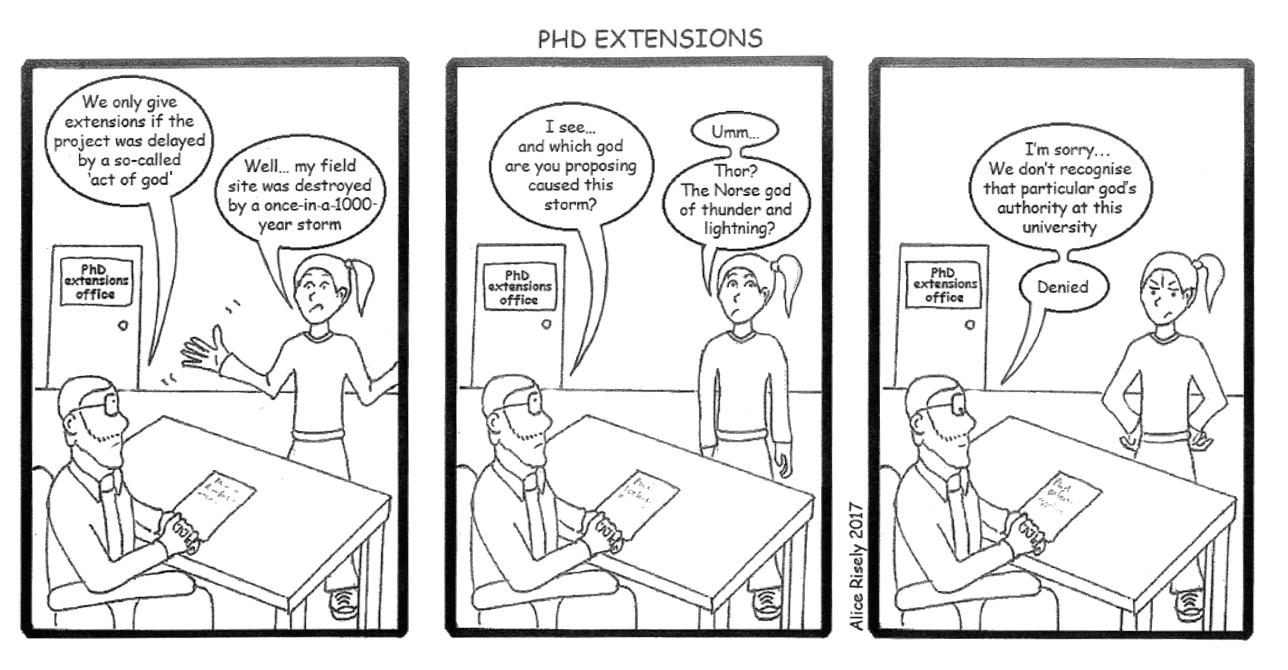
Calls to modernize the PhD to meet the demands of the job market are being answered by the introduction of a more streamlined three-year PhD program. But such changes are not necessarily in the best interests of students, say Alice Risely and Adam Cardilini

PhD students are the backbone of the research industry, often responsible for compiling precious datasets for their lab and learning the cutting-edge techniques required for analysis. But completing a PhD is hard, and getting harder as scientific standards creep steadily upwards. It takes over a year longer for current students to publish their first scientific paper than those 30 years ago because of the increasing data requirements of top journals. Across Europe and Australia, this is one reason why students are taking an average of four to six years (or longer) to complete their PhDs, despite candidature contracts usually being a maximum of four years, and government scholarships lasting at most three and a half years.

Delays in completion reflect badly on universities, and can threaten future funding. They can also threaten the job prospects of graduates, who are increasingly expected to have excellent time and project management skills for careers outside academia. In an attempt to combat lagging completion times and increase employability of graduates, universities are redesigning the PhD by rolling out three-year PhD programs. These shorter programs are intended to provide increased structural support to students, whilst also promoting broader and more applied skills required by non-academic employers. The catch is that these PhDs must be completed within three years, unless the student faces project delays that were unequivocally beyond their control. But is the three-year PhD program really in the best interests of all, or even most, students?

It will be harder to get PhD extensions under the new model.

It will be harder to get PhD extensions under the new model.

Continue reading

Ten top science career tips for 2017

Top tens are very much a theme of the last issue of Nature for 2016. They include images of the year, 10 people who made a mark in science this year, and a review of the year in science. Naturejobs also gets into the “listicle” spirit by trawling through a year of articles to bring you our ten top career tips (and a few more thrown in for good measure) for the coming year.

1. Want to learn how to design an experiment or analyse data? Training is there if you look.

nj7622-703a-i1Scientific irreproducibility — the inability to repeat others’ experiments and reach the same conclusion — is a growing concern.

Much blame is placed on weak experimental and analytical practices that cause researchers to inadvertently favour exciting hypotheses.

Monya Baker reports.

In a separate post for Naturejobs, Monya runs through some of the statistical tools she discovered as part of her research. Continue reading

How not to respond to reviewers: Eight simple tips

Responding to reviewer reports is a key part of publishing academic work in peer reviewed journals. But if you’ve received mixed reviews of a paper or are publishing for the first time, where do you start?

This piece was republished from Sophie Lewis’ blog.

My first attempt at publishing a paper was a breeze. A collaborator was asked to contribute to a special issue and offered me the opportunity to lead the paper. I was a PhD student at the time, and spent two months visiting her lab overseas and writing. By the end of my visit, I’d carved out a draft that I left behind for comments. After a bunch of emails and several rounds of revisions over the next month, we were ready to submit.

Flickr/AJ Cann, CC BY-SA

Flickr/AJ Cann, CC BY-SA

Continue reading

Q&A with Gerjon Ikink: Using policy to change science

Gerjon Ikink

{credit}Courtesy of Gerjon Ikink{/credit}

Gerjon Ikink is currently in his fifth and final year of a PhD at the Netherlands Cancer Institute in Amsterdam, but is thinking about leaving research. He always wanted to be a scientist so that he could contribute to society by exploring the unknown in search of the truth, in this case research into the genetic pathways involved in breast cancer.

But a few years into his PhD, he found it difficult to imagine continuing down this career path. Although his interest in science hadn’t wavered, his feelings towards the infrastructure of the academic life had. Now he is planning on moving into the world of science and education policy, hoping to right the wrongs that are pulling him out of academia.

When did you become disillusioned by science?

When I was an undergraduate, science was all about looking for the answers to the big questions, looking for the truth and understanding how our world works. But during my PhD, and maybe a little before, I became disillusioned with this idea. Continue reading

Peer-review tips for young researchers

Cross-posted from Nature Middle East’s House of Wisdom blog

During the Euroscience Open Forum 2012 (ESOF 2012) which opened in Dublin yesterday, Alaa Ibrahim, an astrophysicist from the American University in Cairo, Egypt, gave his advice to young researchers starting their research career on how to handle the peer reviewing process. Here is a summary of his tips:

  1. Understand that the peer reviewing process is an essential part of proper science. It gives credibility to your work and acts as an initial endorsement of your work by the science community.
  2. Start early. You now have an option to be involved in undergraduate research during graduate school. This is useful to give you a feel for the peer review process and to understand and appreciate how it works.
  3. Be part of the research community in your particular discipline. Go to meetings and conferences and get engaged with the latest research taking place. Read papers and see how they are written to get a feel for the quality of published, peer-reviewed work.
  4. Get to know the leading researchers in your field. These are likely to be your editors and reviewers. They are usually experts so don’t be shy to ask them for their advice and even mentorship when you are still starting your research career.
  5. Present your research results at meetings and solicit feedback from senior researchers and peers before you go for publishing. Their advice could help improve your work to make it publishable before you submit (and possibly get refused)
  6. Once you have a good network of contacts among senior researchers in your field, circulate your paper among them for feedback and input before submitting your manuscript for review.

For three more top tips and other peer-review advice for early-career scientists, continue reading on the House of Wisdom blog.