In January 2014 I started running the Naturejobs blog; it’s been an interesting journey and I’ve enjoyed working with some great writers (see full list below!) to make the blog what it is today. My vision was to turn the Naturejobs blog into a place where scientists could come for career advice and personal stories: to read (or hear) about the experiences that other scientists have had in their careers and learn from their experiences. Using a combination of blog posts, podcasts and videos, I hope that I have achieved this and that you, our readers, have benefited from these stories.
I’ve been through the numbers and have picked out the top ten most popular blog posts from 2014. Here they are in order:
1) When a PhD isn’t enough, highlights Bianca Marcolino’s experience of finding a job after finishing her PhD. “The best advice I can give a graduate student is to start asking yourself the hard questions regarding your career aspirations as early as possible.”
{credit}Image credit: Daisy Hessenberger{/credit}
2) Thesis writing tips for the I-left-it-to-the-last-minute PhD student, is what it says on the tin: tips for writing up your PhD if you’re running out of time. Daisy Hessenberger shares her story of joining a writing group and dividing her time into tomatoes. Yes, you read that correctly. Tomatoes.
3) Make your cover letter and CV stand out gives advice on how to make sure that your CV or cover letters aren’t overlooked when you apply for a job. By using techniques similar to those in web design, you can make the important parts of your CV and cover letter jump off the page and keep the attention of future employers. By Julie Gould. Continue reading →
Contributor Monya Baker, assistant editor of Nature Careers
To kick off 2015, Nature’s Careers section asked a dozen highly recognized young scientists—all 40 or under— about their plans for the year ahead and their wishes for the future of science. Several respond below; see Nature’s 1 January issue for the rest and for New Year’s thoughts from global scientific leaders.
Please leave a comment below, or tweet your own plans and hopes for 2015 for science at #scihopes15.
Seek a scientific optimum
Fyodor Kondrashov
Fyodor Kondrashov, 35, at the Centre for Genomic Regulation in Barcelona, nabbed an inaugural International Early Career Scientist award from the Howard Hughes Medical Institute in the United States. He wants to know why a genetic polymorphism that causes harm in one individual is neutral or even beneficial in another.
Science is becoming more of a corporate endeavour rather than an academic and intellectual one. We have to be good managers, sell ourselves, and be in constant competition for resources. The pressure to achieve in the short term limits the types of questions my lab can ask.
European graduate students have a very specific time frame in which they must finish their PhD that doesn’t allow them time to explore or to make mistakes; they have to pursue projects that will get them the papers that they need. It’s a feedback loop of us willingly participating in this competition and the system encouraging us to compete.
There must be an optimum, and I am not so certain that we are there – not in Europe, not in the United States. There has to be some sort of systematic solution. My hope is that we at least start looking. Continue reading →
So far, in December 2014, you’ve done a lot of reading and writing! We want to thank our wonderful contributors this month: Shimi Rii and Frances Saunders. Thank you both very much.
Here are the 5 most popular posts from this month.
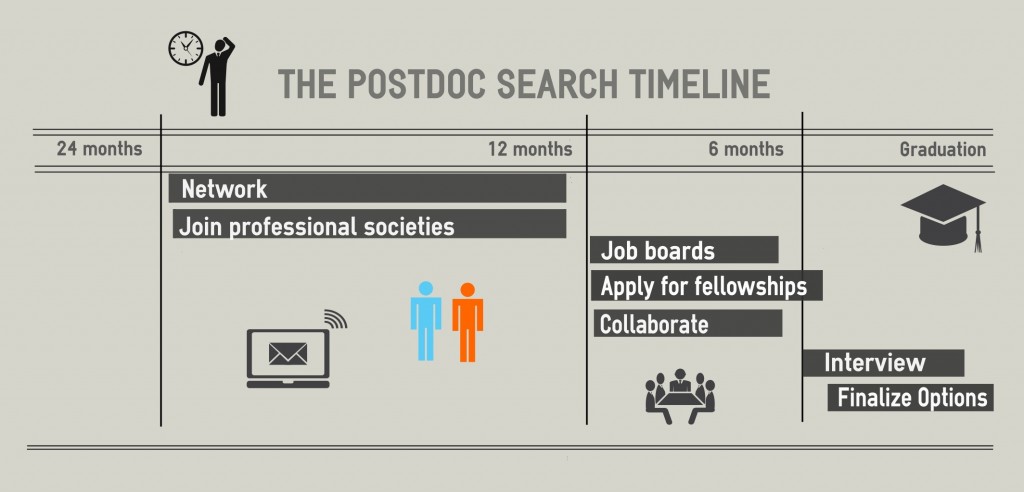
The postdoc search timeline. Image credit: Shimi Rii
1) The postdoc search timeline. Shimi Rii interviews fellow postdoc researchers about their job hunt, in particular, she focuses on how long they spent looking.
2) Ask the expert: Can research ever be a ‘9-5’ job? Dr Frances Saunders, president of the Institute of Physics in London, tries to answer this question for you. The conclusion: it is possible, but it requires a joint effort from many people.
3) How to cope when things go wrong in academia. This short Q&A film from the 2014 London Naturejobs Career Expo highlights some of the coping strategies that academics have when things go wrong.
4) How to publish your data in a data journal is a piece in which we highlight the main tips from Andrew Hufton at a recent Scientific Data event on publishing your data in data journals.
PhD students should take responsibility for their own careers, but careers advisers and Higher Education Institutions can do a lot to help them.
The Royal Society, the UK equivalent to most countries’ academies of science, recommends that PhD students should “consider and take responsibility for managing their own career expectations” in Doctoral students’ career expectations: principles and responsibilities, published on December 18th 2014. Although this is a very UK-centric piece of work, it can be extremely useful for PhD students and research universities the world over. So even if you’re not from the UK or doing a PhD in the UK, it’s worth having a look at.
The document, along with the complimentary pieces from the round-table discussions, aims to do three things:
1) raise awareness among students and higher education institutions (HEIs) of existing issues in managing PhD students’ career expectations;
2) offer possible solutions to these challenges; and
3) encourage HEIs to implement these solutions.
I spoke to Professor Athene Donald, the chair of the working group that put together this document to find out more.
Use two sentences to communicate the essence of your research and aim everything you say to 12-year-olds, say science communicators at the 2014 Naturejobs Career Expo in London.
The career paths in science communication panel at the 2014 London Naturejobs Career Expo was chaired by the Naturejobs editor, Julie Gould, who was joined by Greg Foot (Freelance), Jonathan Sanderson (StoryCog), Steven Palmer (Cancer Research UK) and Celeste Biever (Chief editor for online Nature news & comment).
Steve Palmer, head of press and science communication at CRUK, runs a “media training booth” where scientists go through various training workshops. “If you’re talking to a print journalist, explain what you are doing to a 12-year-old child… If you’re talking to a TV journalist, you’ve got to explain what you do to a 5-year-old child.” This might sound harsh, but it does help scientists condense their research into a 5 minute talk, which is often all the time they get when speaking to print journalists. If you’re on TV, you’ve got to get your spiel down to 45 seconds, hence being able to explain it to a 5-year-old. The main thing scientists need to think about when communicating their research is impact: “What is the impact on society, on all those people?…Or why did you decide to start doing this in the first place? What did you want to change?” If you can communicate this in two sentences, you’re set.
Palmer suggests that all scientists should try to explain their research to their friends. “Do they understand roughly what you do? And I don’t mean in a rambling long conversation across a whole Friday night. I mean in 5 minutes. Do they get it? And let them replay it to you. If they’ve got it, you’re fine.”
Research papers and newspaper articles are written in the opposite way, says Palmer. News stories start with one message, the main message (the conclusion of the research or the impact it may/is having), and from there the journalist unpacks the details. The scientific papers always start with the question you’re trying to answer and then you slowly move to your conclusion after working through the introduction, methods and discussion sections. It’s useful to know this, says Palmer, because if you don’t invert the pyramid and give journalists your conclusions first, they might misconstrue what you are telling them.
Palmer has lots of experience when it comes to sitting in on interviews with scientists and journalists. He will sit down with the scientist and work our a plan of action: what is the main message, how are you going to communicate it etc. However, scientists tend to meander off course, which leads the journalists to find a different story, one that they weren’t there to be interviewed about.
Jonathan Sanderson thinks that not all of your science communication activities will be linked to the media. Science policy is a part of science communication, which includes dialogue events. Medical communications is a big industry in its own right, mostly self-contained, that also fits into this field. Science visitor centres, university open days, family events science festivals, “the total number of engagements across that sector is tremendous. Tens of millions each year… You don’t have to be mediated by the media.”
Greg Foot stresses that it’s all about your audience. “Some times we call it science translation.” Greg aims for 12 year-olds for everything he does, including work on Youtube. Also, not everyone is a natural communicator, “every single person has to work on it. It’s a craft, it’s a skill that you have to learn.”
Sanderson finishes off the Q&A by suggesting that everyone should find their niche form of communication. Some are better at presenting than others; some are better at writing. Try them all, see which one fits you and your research best.
One of the popular career choices for scientists that look for jobs outside of academia is science communication. In this film, three science communicators look back at what inspired them to try this job.
As this is the case, we also want to know what attracted you to science communication. Please share why you decided to start doing science communication in the comments section below. We’ll be creating another blog post to highlight all the reasons in 2015.
The career paths in science communication panel at the 2014 London Naturejobs Career Expo was chaired by the Naturejobs editor, Julie Gould, and consisted of Greg Foot (Freelance), Jonathan Sanderson (StoryCog), Steven Palmer (Cancer Research UK) and Celeste Biever (Chief editor for online Nature news & comment).
Celeste Biever started working in science communication because she enjoys the thrill of not knowing what’s going to happen from one day to the next. She enjoys trying to “understand and pull out essence of complex ideas very quickly.” Rapid turn-around times are also an attraction: “Everything is done within a day or two or in a week. Anything long term is one month.”
Greg Foot always enjoyed the wonder and curiosity of science as well as the way of looking at world and answering questions. “If you’re working in a lab you focus on one thing. If you’re a science communicator, especially if you’re freelance, there is an opportunity to work on many projects at once; some fast and some slow.” However, when Greg was starting out in science communication, it was still an extremely small and under-developed field. Had science communication been as big then as it is now, he “would potentially think about doing the science and science communication at the same time… there is a lot more opportunity to do that now. I don’t think it’s a case of “Leave the lab; Do science communication.”
Jonathan Sanderson believes that the expectation that you have a plan of what you’re going to do with your life is utter rubbish when it comes to science communication: “It’s a nice story that people tell themselves.” Like Celeste, Jonathan knew that timelines were important to him. “The sense of having one career for my working life was something that 17/18 year old me recognised that it wasn’t going to make me as happy.”
Dr Frances Saunders, President of the Institute of Physics in London, gives a concise and useful answer to the question: Can research ever be a “9-5” job?
Contributor: Dr Frances Saunders
Yes, but it requires good planning, effective teamwork and a supportive environment. There will be some people that claim that their research requires 24 hr running of an experiment or can only be done at night, when various noise sources are reduced. But these are the exceptions. By far the largest driver for working long hours is a culture of “presenteeism” that equates commitment and contribution to time spent in the lab rather than the ideas and innovation that deliver results. If you plan and manage your time at work to make it as productive as possible and if you work effectively with colleagues to share out tasks and support each other, then everyone can benefit.
Does this sound too good to be true, in what is often seen as a highly intellectually competitive environment? Research Leaders need to set the tone and ensure the environment they create enables everyone to deliver their best and exploit their talents to full effect. This is what supporting diversity is really about. Little great research, these days, is down to the efforts of one individual. It requires a team effort. People that are only at work 9 to 5 can deliver just as much to the team as those who are worn out by working long hours for the sake of being seen to be there.
If you’ve got any questions for Dr Saunders, please leave a comment below and she’ll do her very best to answer them.
Many roles in academia require you to teach future researchers. But how important is it to have experience for this? And where should you go to get some?
Lauren Celano is our expert for this coming month, say hello!
{credit}Yuric Photography {/credit}
What is your scientific background?
I have a BS degree in biochemistry and molecular biology from Gettysburg College and about 10 years of experience working in the life sciences area focused on drug metabolism, pharmacokinetics, safety pharmacology, toxicology, and other studies needed to move a drug candidate from preclinical into the clinic.
Why did you decide to leave academia?
I decided to enter industry so that I could play a role in supporting the discovery and development of novel therapeutics and learn about the business considerations involved in the process. I also enjoy a fast-paced and multifaceted environment and felt that industry would align well with my personal interests. When I entered industry, I chose to work for a contract research organization, Absorption Systems so that I could gain exposure to many aspects of the industry. Continue reading →
Doing underwater research is not always what the Hollywood films make out, but the office can be incredible!
Marine biology is the study of underwater animal and plant life from the microscopic plankton to the blue whale. To understand the behaviours that these underwater creatures exhibit, scientists need to spend some time in their environment. Setting up experiments and running them underwater isn’t as simple as setting one up in a lab or out in the woods. Being underwater for any considerable period of time is not what humans are built for. So how do these scientists get their experiments done?
Bring in the scientific divers. Scientific divers, or aquanauts (as some like to refer to them), are divers that do science underwater. It sounds simple enough, but there are a lot of rules and regulations that define this role. The American Academy of Underwater Sciences defines scientific diving specifically as:
“…diving performed solely as a necessary part of a scientific activity by employees whose sole purpose for diving is to perform scientific research tasks.”
Nick Tolimieri {credit}Image credit: NOAA{/credit}
So, if you’re taking equipment down, inspecting any equipment or doing any diving that doesn’t have any science in it, this isn’t considered scientific diving. Scientific diving, according to Nick Tolimieri, a research fishery biologist at the National Oceanic and Atmospheric Administration (NOAA)Northwest Fisheries Science Center in Seattle, WA, is “data collection under water.”
There are a group of standard skills, according to Tolimieri, that every scientific diver will need to have. Continue reading →