Career paths: Beyond the ivory towers

Take control of your own career by doing some self-reflection and going to informational interviews.

Naturejobs-podcastAt the end of 2014, we set our Naturejobs podcast listeners, especially the PhD students, a challenge: Take control of your own careers.

Earlier this month I attended a one day careers conference in Edinburgh called Beyond the Ivory Towers, where 7 speakers took to the stage to share their transitions from academia into “other”. The “other” included law, entrepreneurship, research in industry, tech transfer, public engagement, clinical science, publishing, and more. What struck me about each of these speakers is that from the outside, it looked as though their careers had been perfectly planned from the day they started at a university. This was definitely not the case. Each speaker had their own challenges to face, from the expected (no more funding) to the unexpected (becoming allergic to rubber gloves).

Transitions are never easy, but there are things you can do to make them smoother. In this podcast I’m joined by two of the speakers, each one taking a different approach to tackling their transitions from academia into “other”

Elizabeth Fairley from EFB Services took an outward approach: find out what she needed to do to become successful in her chosen career in industry. This included going out and speaking to industry professionals who could give her insight into what her future career might look like and what she would need to do to make it.

Phill Jones from Digital Science took the inward approach: determine what skills I learned by self-reflection so that I can market them and sell them to industry. This included analysing what he had done whilst in academia, not just the technical stuff, and learning to convey it in an appropriate way.

Listen to the podcast to find out more!
4 ways to identify smaller companies to work for

Lauren Celano offers advice on how to identify and research smaller companies that can offer growth opportunities and a variety of skills.

Contributor Lauren Celano

It’s easy to identify large companies in an area of interest, as they work hard to build strong brand recognition and awareness. But how do you identify the small and stealth-mode companies working in your field? Since these companies can provide tremendous growth opportunities and a chance for you to develop a variety of skills, it is important to include them in your target list during your career search. Below are a few suggestions on how to identify these companies and jump-start your search.

Scientific Conferences & meetings

Scientific conferences and meetings provide a wealth of information regarding research in a particular field and the organizations working in and/or supporting the area. Often, conferences and meetings have a website to profile the meeting and highlight the speakers, poster presenters, exhibitors and sponsors. Continue reading

Most read on Naturejobs: December 2014

So far, in December 2014, you’ve done a lot of reading and writing! We want to thank our wonderful contributors this month: Shimi Rii and Frances Saunders. Thank you both very much.

Here are the 5 most popular posts from this month.

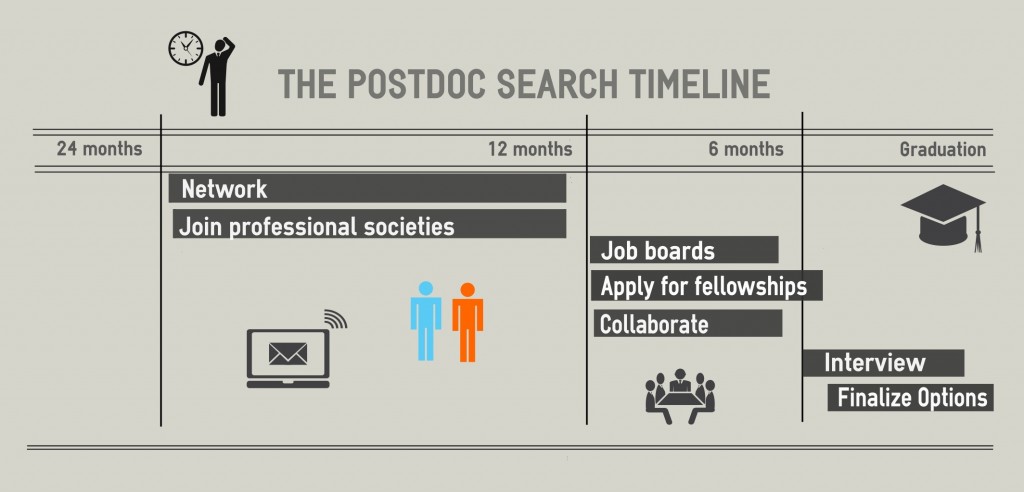
postdoc-search-timeline

The postdoc search timeline. Image credit: Shimi Rii

1) The postdoc search timeline. Shimi Rii interviews fellow postdoc researchers about their job hunt, in particular, she focuses on how long they spent looking.

2) Ask the expert: Can research ever be a ‘9-5’ job? Dr Frances Saunders, president of the Institute of Physics in London, tries to answer this question for you. The conclusion: it is possible, but it requires a joint effort from many people.

3) How to cope when things go wrong in academia. This short Q&A film from the 2014 London Naturejobs Career Expo highlights some of the coping strategies that academics have when things go wrong.

4) How to publish your data in a data journal is a piece in which we highlight the main tips from Andrew Hufton at a recent Scientific Data event on publishing your data in data journals.

5) From academia to policy with David Carr is a Q&A interview about his transition into policy work at the Royal Society in London.

Merry Christmas everyone!