Female scientists in UK report improved prospects – but there’s still a long way to go

The gap between men’s and women’s careers in academia in the UK is closing as women become more ambitious, according to the 2010 Athena Survey of Science, Engineering and Technology (ASSET) summary report published earlier this month.

The 2010 survey, which included responses from over 7,000 male and female academics and postdocs from 84 UK universities, found that women are increasingly likely to aspire to senior leadership positions and are as likely as men to hold posts such as head of research and director of postgraduate studies.

Female postdocs are more positive about their career success to date than female academics, suggesting a more positive outlook for younger generations of scientists, and the availability of flexible working is having a beneficial effect on career development.

However, there are still significant differences between men’s and women’s experiences at every career stage. For example, on average:

  • Women are more likely to be employed on temporary contracts
  • Men are more likely to receive routine appraisals
  • Women have less understanding of the promotion process and criteria
  • Men feel more valued and visible in their departments and have more control over their employment choice

In the foreword to the report, Royal Society president Paul Nurse said there is still a long way to go before the UK can be confident it is making the most of the talents of female scientists. “It is more important than ever that we ensure the best scientists can flourish,” he wrote. “All groups should be able to participate to the full extent of their abilities.”

What is your opinion on prospects in the UK? Share your thoughts below.
Do women need to act like men to be successful managers?

Women who take on leadership roles in academia and business should resist the urge to adopt ‘masculine’ traits such as aggression to get results and use emotional intelligence instead, says psychologist Paula Nicolson from Royal Holloway, University of London in the United Kingdom.

In a recent study of leadership and management in the UK’s National Health Service (NHS), Nicolson found that women in senior positions tend to behave as they think men behave. “This notion drives women away from a healthy assertiveness into emulating more aggressive male models,” she says.

Nicolson says the issue is exacerbated by a lack of support at the top. “Organisations feel that provided they have appointed enough women at a certain level, their job ends there,” she tells Naturejobs. “There don’t seem to be enough role models who [use] emotional intelligence.”

Both women and men should use emotional intelligence more to understand the needs and motivations of employees, says Nicolson: “There are different approaches for different situations, but you still need to make it worth their while to do something with and for you and the organisation.”

Although the study was conducted in the healthcare sector, Nicolson says the findings also apply to labs and research departments. “As the primary investigator, you still need to think about how your staff are managing their own roles,” she says. “You can’t make assumptions.”

Rachel Webster, an astrophysicist at the University of Melbourne in Australia and winner of one of Nature‘s 2006 mentoring awards, is a good example of how using emotional intelligence can help you succeed as a leader in science. In her nomination for the mentoring award, she was commended for recognising the skills of individuals in her team and for appreciating that not everyone will have the same career trajectory as her. “She assumes you are a complex person who also happens to be a scientist, instead of a scientist who it so happens turns out to be a complex individual,” says Maurizio Toscano of the University of Melbourne (see ’Model mentors’ for more).

Webster says she works hard at using emotional intelligence in her professional interactions. “As a supervisor, I try to work as a collaborator, to allow my students to develop their own agendas rather than imposing my own,” she says. Her management style eschews the stereotypical ‘male’ model of leadership, which she says is characterised by traits such as low levels of empathy, a rigid hierarchy and a reluctance to express divergent opinions. “I try to understand things from my students’ point of view,” she says.

What do you think? What is your experience of different management styles, and what style would you say is most effective in a research environment? Share your thoughts below.

UPDATE: 14 July, 2011 – A new meta-analysis published in Psychological Bulletin supports the notion that men fit the cultural stereotype of leadership better than women, but shows that the perception of women in leadership roles is improving.

FameLab: Secrets of successful science communicators

This Saturday evening The Times Cheltenham Science Festival in the United Kingdom will host the 2011 international final of the FameLab competition, featuring leading science communicators from Europe, Asia and the Middle East. Naturejobs caught up with three of the 14 finalists to get their tips on how you can improve the way you present and discuss your research to those outside your field.

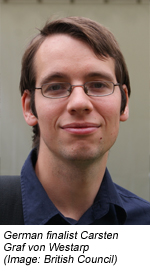
carsten.jpgCarsten Graf von Westarp, a PhD student from Germany studying semiconductor physics at the University of Hamburg, says the key to successful communication is to show how your research relates to everyday life. “Be aware of the interests of the audience or reader,” he says. Use simple language: keep technical terms to a minimum, and make sure you explain any that you do use.

Another tip from Graf von Westarp is to show your fascination with your topic, advice that is echoed by the other two finalists. Karen Lavi, a PhD student studying memory and learning at the Bar-Ilan University and Haifa University in Israel, says enthusiasm is essential for good communication. “Keep in mind that [to you] your subject is the most interesting topic that ever existed — otherwise you wouldn’t have chosen to invest your whole life in it,” she says. “Try to pass on this feeling to your audience.”

karen.jpgFellow finalist Mahmoud Abu-khedr, a third-year student at the University of Alexandria in Egypt, agrees that talking from your heart is key, and adds that you also need to believe in the importance of science communication itself.

In addition, Lavi emphasises the power of using metaphors and story-telling, suggesting that you talk about your research as if it were a detective story rather than a presentation at a conference. She also recommends you try to personalise your audience — “Imagine you are talking with your mother,” she says — and make sure that you can sum up your entire talk in a few sentences: “What is the message your audience should take home with them? What will they tell their friends and family?”

mahmoud.jpgConsidering how you present yourself can also help you communicate better, says Abu-khedr. Remember to smile, and work on your charisma: “You have to act as well as present,” he says. Lavi adds that you should also inject some humour if you can. But don’t force it so that you become uncomfortable — it’s important to have confidence in yourself. “Be how you are,” concludes Abu-khedr.

Do you have any tips to add? Share your advice and experiences below. And best of luck to all the FameLab international finalists.

UPDATE: Congratulations to Karen Lavi and Mahmoud Abu-khedr, who took second and third places respectively in the competition. You can read more about the results on the FameLab website.