The three-year PhD program: good for students? Or too good to be true?

Calls to modernize the PhD to meet the demands of the job market are being answered by the introduction of a more streamlined three-year PhD program. But such changes are not necessarily in the best interests of students, say Alice Risely and Adam Cardilini

PhD students are the backbone of the research industry, often responsible for compiling precious datasets for their lab and learning the cutting-edge techniques required for analysis. But completing a PhD is hard, and getting harder as scientific standards creep steadily upwards. It takes over a year longer for current students to publish their first scientific paper than those 30 years ago because of the increasing data requirements of top journals. Across Europe and Australia, this is one reason why students are taking an average of four to six years (or longer) to complete their PhDs, despite candidature contracts usually being a maximum of four years, and government scholarships lasting at most three and a half years.

Delays in completion reflect badly on universities, and can threaten future funding. They can also threaten the job prospects of graduates, who are increasingly expected to have excellent time and project management skills for careers outside academia. In an attempt to combat lagging completion times and increase employability of graduates, universities are redesigning the PhD by rolling out three-year PhD programs. These shorter programs are intended to provide increased structural support to students, whilst also promoting broader and more applied skills required by non-academic employers. The catch is that these PhDs must be completed within three years, unless the student faces project delays that were unequivocally beyond their control. But is the three-year PhD program really in the best interests of all, or even most, students?

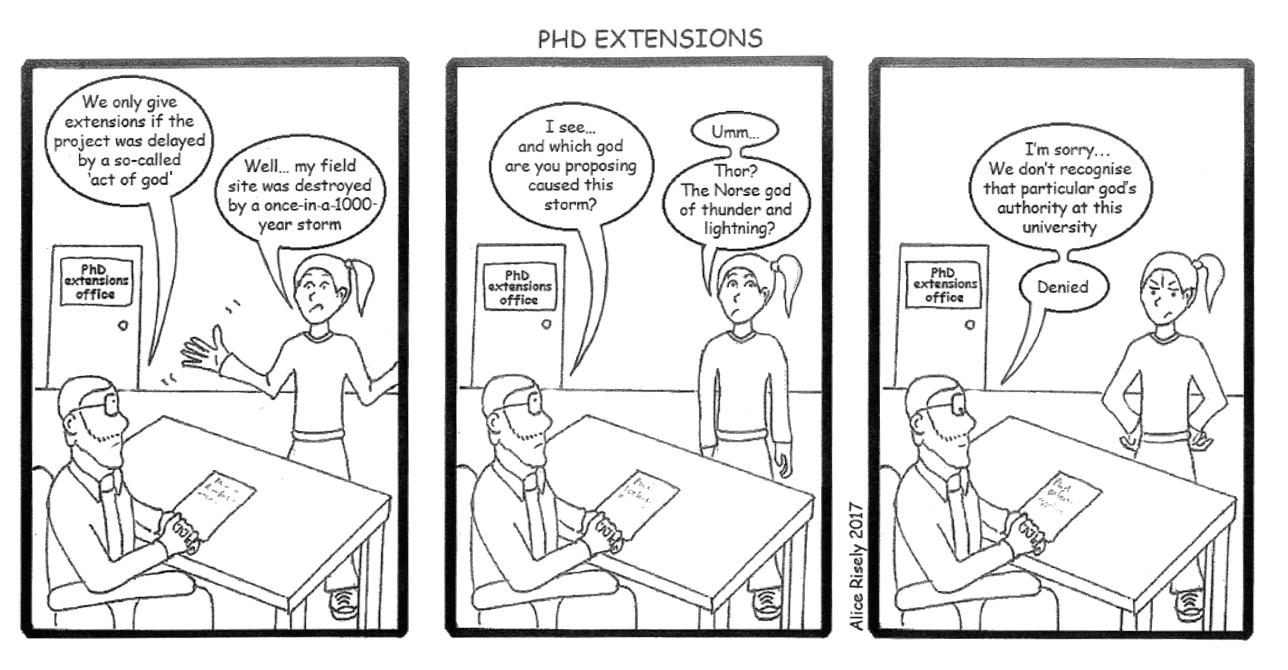
It will be harder to get PhD extensions under the new model.

It will be harder to get PhD extensions under the new model.

Continue reading

Why should we work so hard to make our work reproducible?

Most scientific work isn’t reproducible. Andy Tay explains why that’s a problem.

The call for reproducibility has never been stronger in the history of science. Since two major pharmaceutical companies, Amgen and Bayer, reported in 2011/12 that their scientists were unable to replicate 80-90% of the findings in landmark papers, scientific news outlets have caught up on the issue. Their reports have catalyzed conversations among stakeholders (policy makers, funding agencies and scientists) to improve reproducibility in science.

Copyright: LEGO

{credit}LEGO{/credit}

There are a lot of reasons why reproducibility is so important, and why Amgen and Bayer’s results caused such controversy. I’ll start at the individual level. Continue reading

What’s your most burning science-careers question?

We want to know what you want to know so that we can give you what you want to know!

Questions-naturejobs-blogAt Nature Careers and Naturejobs, we want to make sure that we’re answering your questions and providing you with the information that you need to make informed decisions about your science careers.

To that end, we’re asking you what you would like us to ask the experts.

We’re looking for everything and anything from the mundane, ‘What do I do when my labmate keeps dropping test tubes on the floor?’ to the more philosophical, ‘Why am I pursuing a scientific career?’

We want to know what you’re thinking, wondering and hoping can be answered.

To this end, we’ve created an online survey where we can collect your questions! Please take just a couple of minutes to take part in our survey, and then share it far and wide, so we can help as many of you as possible!

Alternatively, you can leave your most burning question in the comments section below.

Thank you!

Career paths: Tracking PhDs

PhD graduates can take part in a survey to help create a visual map of career clusters.

Melanie-sinche-naturjeobs

PhD Melanie Sinche{credit}Image credit: Stephan Lieske{/credit}

Melanie Sinche is a nationally certified career counselor focused on STEM careers, currently serving as a Senior Research Associate at the Labor and Worklife Program in Harvard Law School, studying employment patterns of science PhDs. She formerly served as Director of the FAS Office of Postdoctoral Affairs at Harvard University. She is an accomplished career counselor, trainer, and speaker. In addition to building three career centres for graduate students and postdoctoral scholars, she has delivered career development presentations and training sessions for universities, government agencies, professional associations and non-profit organizations across the country on career-related topics for graduate students and postdocs. Her current focus is to improve data collection on PhDs and postdoctoral scholars across the U.S. She is also working on a book-length project on careers for PhDs in science with Harvard University Press, scheduled to be on the market in the fall of 2016. In this interview, Julie Gould asks Sinche about how she got involved and interested in this field, her new book and how PhD graduates can help with her research.

How did you get involved in the STEM careers space?

I don’t actually have a STEM background – other than my dad having a PhD in physics and being involved in scientific organizations over the years, such as the Society for Native Americans, Chicanos in Science and the Biomedical Sciences Careers Program in Boston. I was actually in graduate school decades ago for Russian and Eastern European Studies at the University of Michigan (UoM). But while I was there, I volunteered at the career centre to be a peer counsellor and work with other grad students, reviewing CVs and advising. I absolutely loved it.

When I was close to finishing my studies and was thinking about my career – whether or not to do a PhD – a job opened up in the career centre at Michigan and I took it. I’ve been in this field ever since. Continue reading

We want to know: What do researchers do next?

what do researchers do next?In May this year, Vitae (a career development service for researchers)  and Naturejobs co-launched a survey: What do research staff do next? The goal of this survey, according to Dr Janet Metcalfe, Chair and Head of Vitae, is to: “create a range of career stories of former research staff that reveals their career journeys and explores what were the tipping points in their careers.”

There have been 1500 responses to this survey so far, but we’re hoping to have more input from those who have transitioned from academia into industry. This is an on-going survey, and the initial results will be announced at the Vitae Researcher Development International Conference in September this year.

Advice to transitioning scientists 

Imagine you are your younger self: an academic, unsure of your future prospects as funding bodies chop and change their budgets and the number of postdoc positions dwindle. You’ve decided you would like to leave academia. But what now? It can be a daunting position to be in, and one that would welcome some advice from someone who has been through this before.

Fast forward to your present self: Would you agree with the advice that others presented in the survey? What would you add?

“Try and identify which kind of skills you acquire while doing research, there are many such as management skills, analytical skills, organizational skills, etc. that will be useful in many jobs.”

“To nurture a strong ethic of self-care when making the transition, as sloughing off one’s academic identity is no small feat. Also, be patient; your first job is unlikely to be your dream job. Try to use your first job as a means of figuring out what you’d really like to do.”

“If your passion isn’t in bench research, do something else.  There is tons of stuff out there for life scientists that leverages your existing skills.”

“If you’re not ready to let HE go completely, look for support roles. Often the work is similar to research, and there is less focus on profit margins and overzealous management than in industry. Your employer is also more likely to support future professional training because they understand your need to learn and develop intellectually.”

“Go for it!  It may seem daunting but if you never try, you’ll never know. And if you decide that a career outside of research is not for you, there’s nothing to stop you from going back.”

Insight into transitions

By taking part in this survey, you’re providing an insight into the transition between the two. “Through the survey results we will also start to understand the motivations for researchers leaving higher education,” says Metcalfe, “and how their competencies and experiences are transferable into other employment options.” This insight could help careers advisers and others understand how to provide better advice to those wishing to move from academia to industry. Several of the researchers highlighted areas of difficulty during their transition when they were asked about their reasons for leaving academia.

“When I failed to secure further research funding or teaching posts, I fell back on my transferable skills and found myself immediately short-listed for two jobs I applied for.”

Some transitions are harder than others. A few of those who have shared their stories have mentioned that they chose to leave because they wanted to and a great opportunity came up.

“I had a good opportunity at the right time:  permanent and interesting employment that fitted with my desire to continue to do research for the benefit of society.”

Others weren’t so fortunate.

“Organisational restructuring led to a loss of my department and insufficient alternative posts to accommodate everyone.”

Whatever your story, whether you left academia to pursue your dream career, or because you had to leave, please share it and take part in the survey by following this link.

You can share this survey with colleagues, friends and family – anyone who has transitioned from academia into another career. You can also follow the action on Twitter by using the hashtag #PostAcStory, where you will find those who have blogged about their experience, including Dr Beeton (@Shackleford_LB) and you can watch the #PostAcStory Vitae Google Hangout.

You can also share this flyer to help spread the word.

What do research staff do next?

On this Naturejobs blog we’ve looked at quite a few things on moving from academia to industry: we spoke to Nessa Carey from Pfizer on her transition from academia to industry, we’ve written about transferable skills that are needed, we’ve been through our archives to find you some great reads on our Windback Wednesday round-up: From academia to industry. We’ve even looked at how to find your path when leaving the academic track.

But however much information we give you, or stories we bring you from those who have left academia to go on to do other things, we would like to know what YOU are doing now. How have you taken your transferable skills and used them in your new position? Why did you decide to leave academia? We want to understand why you leave, what tipping point led you to take the plunge? Was leaving academia a good or bad decision? All these insights could help future scientists who are currently trying to make this decision right now.

To figure this out, Naturejobs have joined forces with Vitae to try and find out what academic staff (postdocs, assistant professors etc) do when they leave the higher education sector.

By sharing your stories, adventures and experiences with us, you could help thousands of others in academia who are looking for advice on what to do next, and what options are available to them.

Some really exciting and diverse stories are already being shared:

Although this is a rather unique career path, you might find some inspiration from it. You can get involved with the discussions around this survey by following the #postacstory hash tag on Twitter.

To take part in the survey, just follow this link. If you know anyone who has left an academic career behind for one in industry, please consider passing this survey on to them.

US scientists have their say on plans for biomedical workforce

Posted on behalf of Gene Russo, Nature Careers editor

US biomedical scientists recently had a chance to set their field’s priorities. And what was the most pressing problem they reported? The very real possibility that there are too damn many biomedical scientists.

The balance between the supply of biomedical researchers and the demand in terms of available career opportunities should be the biggest priority for reforming the US biomedical workforce, according to a survey response issued by the National Institutes of Health (NIH). Other big priorities that scientists highlighted were PhD characteristics (i.e. PhD curriculum, length of the PhD training period, and lack of preparation for diverse career paths) and postdoctoral-fellow training characteristics (i.e. a bottleneck of jobseekers causing long stints as postdocs and poor mentoring).

Many of the respondents did not mince their words. On the supply and demand issue, some called the current structure of the research workforce a ‘pyramid scheme’ that takes advantage of cheap student and postdoc labour rather than hiring mid-career researchers. Solutions included tenure-model reform, decreasing the number of funded trainees per principal investigator (PI) and using more staff scientists. On the oversupply issue, respondents suggested class-size reductions, raising programme entry requirements and better training for ‘alternative’ careers. Regarding the contraction of research funding, respondents suggested increasing paylines and limiting the number of large grants a single PI is permitted to have.

The survey, part of an NIH working group effort, asked respondents to prioritize future issues for the biomedical workforce. It had 219 respondents — ranging from graduate students to senior scientists — who made a total of 498 ‘quotations’ about various priorities; multiple comments were ranked and the working group then calculated the overall priority of a given issue.

In addition to PhD characteristics and postdoctoral-fellow training characteristics, the working group asked for comment on six other categories: postdoc training, biomedical research career appeal, clinician characteristics, the staff-scientist career track, effects of NIH policies and the training-to-research grant ratio. Based on respondents’ comments, it then added four more categories to its analysis: diversity, mentoring, early educational interventions and industry partnerships.

It’s not a big sample size. But the message is clear: improving satisfaction among early-career biomedical scientists and boosting the efficiency of a system that churns out far more scientists than academia alone can accommodate will require big changes. And these changes will have side effects. Want labs with more full-time staff scientists, and fewer students willing to work 60-hour weeks? Lab productivity and publication rates could suffer (see ‘Mid-career crunch’ for more discussions around changes to NIH grants). Want to curtail tenure? Some argue this would threaten academic freedom and deflate the enthusiasm of academia’s rising biomedical research stars (see ‘The changing face of tenure’ for more).The NIH working group — whose ongoing charge includes developing a “model for a sustainable and diverse US biomedical research workforce” — certainly has its work cut out for it.