Career transitions: Increased support

Naturejobs-podcastResearch institutions, funding bodies and non-profits create resources to support researchers with their careers in academia and outside.

This month’s podcast I explore some of the February 2014 Nature Careers and Naturejobs articles with Monya Baker, and I speak to three people about three projects that are looking to increase support available for early career researchers and their career transitions.

MIND (Motivating INformed Decisions) at the University of California in San Franciso,is an experimental career programme supported by the BEST grant from the National Institute of Health. BEST stands for Broadening Experiences in Scientific Training, and is designed to increase trainee and mentor awareness of career pathways available in the biomedical workforce. MIND takes a two pronged approach by working with the students as well as working with the staff at the university to find out what support they need. Jennie Dorman, one of the lead researchers on the MIND project, shares what they are doing with students and faculty. Continue reading

How to recognise your transferable skills

transferable-skills

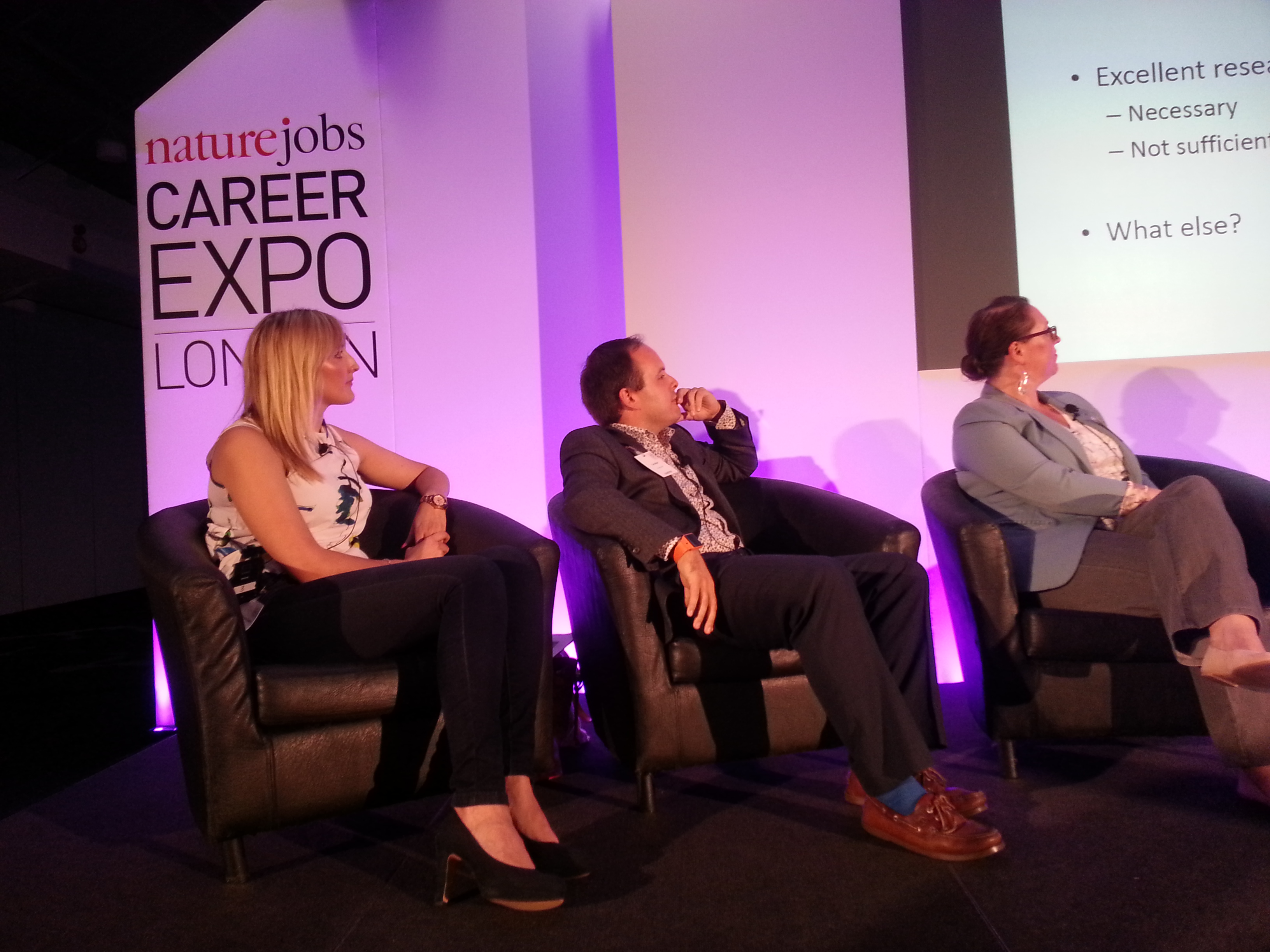
L-R: Jenna Stevens-Smith, Tom Weller, Elizabeth Bohm{credit}Creit: Lisa Restelli{/credit}

Anna Price and a panel of academics-turned-other-careers show that all scientists in academia have transferable skills, but the trick lies in recognising and applying them.

Contributor Lisa Restelli

Elizabeth Bohm is a policy advisor at the Royal Society. Before that, she was working in a lab and she also trained in law.

Tom Weller is a science teacher and runs children’s parties to transmit his love of science. Before that, he was studying physics and has a PhD from University College London.

Jenna Stevens-Smith is the outreach and public engagement manager for the Department of Bioengineering at Imperial College London. Before that, she studied bioengineering, for which she also holds a PhD.

They all started off on one career path, only to realize that their talents and interests lay elsewhere. Luckily, they found that they already possessed a number of abilities that made them especially suited for their prospective alternative careers. In short, they exploited their transferable skills.

At the Naturejobs Career Expo in London, I — along with other participants to the transferable skills session — was guided by panel chair Anna Price, Researcher Development Adviser at King’s College London, to discover these elusive abilities and their uses. Price defined a transferable skill as “any skill that you can learn in one context and employ in another”. This definition is certainly broad, but so are the skills it refers to. The challenge lies in identifying the ones we possess, as well as in establishing how to channel them into a rewarding career. They are not hard to find: a number of tools and lists exist, but the real question is, ‘how to apply them?’ To answer it, there are nothing like success stories. Continue reading

What do researchers do next? A sneak preview

what do researchers do next?


Naturejobs have been working in partnership with Vitae to understand what staff researchers do if they were to leave academia. It’s been interesting to see how the survey has been answered, and many people have shared their stories on Twitter with the hashtag #postacstory.

This week, Vitae are hosting their annual International Researcher Development Conference in Manchester and Naturejobs and Vitae will be releasing the first round of results. Here’s what we can tell you so far:

Those who answered the survey are most likely to have left their role as researchers in higher education (HE) for:

  • more job security
  • they don’t want to be employed on fixed term contracts
  • a better work/life balance
  • actively wanting a career outside higher education research Continue reading

We want to know: What do researchers do next?

what do researchers do next?In May this year, Vitae (a career development service for researchers)  and Naturejobs co-launched a survey: What do research staff do next? The goal of this survey, according to Dr Janet Metcalfe, Chair and Head of Vitae, is to: “create a range of career stories of former research staff that reveals their career journeys and explores what were the tipping points in their careers.”

There have been 1500 responses to this survey so far, but we’re hoping to have more input from those who have transitioned from academia into industry. This is an on-going survey, and the initial results will be announced at the Vitae Researcher Development International Conference in September this year.

Advice to transitioning scientists 

Imagine you are your younger self: an academic, unsure of your future prospects as funding bodies chop and change their budgets and the number of postdoc positions dwindle. You’ve decided you would like to leave academia. But what now? It can be a daunting position to be in, and one that would welcome some advice from someone who has been through this before.

Fast forward to your present self: Would you agree with the advice that others presented in the survey? What would you add?

“Try and identify which kind of skills you acquire while doing research, there are many such as management skills, analytical skills, organizational skills, etc. that will be useful in many jobs.”

“To nurture a strong ethic of self-care when making the transition, as sloughing off one’s academic identity is no small feat. Also, be patient; your first job is unlikely to be your dream job. Try to use your first job as a means of figuring out what you’d really like to do.”

“If your passion isn’t in bench research, do something else.  There is tons of stuff out there for life scientists that leverages your existing skills.”

“If you’re not ready to let HE go completely, look for support roles. Often the work is similar to research, and there is less focus on profit margins and overzealous management than in industry. Your employer is also more likely to support future professional training because they understand your need to learn and develop intellectually.”

“Go for it!  It may seem daunting but if you never try, you’ll never know. And if you decide that a career outside of research is not for you, there’s nothing to stop you from going back.”

Insight into transitions

By taking part in this survey, you’re providing an insight into the transition between the two. “Through the survey results we will also start to understand the motivations for researchers leaving higher education,” says Metcalfe, “and how their competencies and experiences are transferable into other employment options.” This insight could help careers advisers and others understand how to provide better advice to those wishing to move from academia to industry. Several of the researchers highlighted areas of difficulty during their transition when they were asked about their reasons for leaving academia.

“When I failed to secure further research funding or teaching posts, I fell back on my transferable skills and found myself immediately short-listed for two jobs I applied for.”

Some transitions are harder than others. A few of those who have shared their stories have mentioned that they chose to leave because they wanted to and a great opportunity came up.

“I had a good opportunity at the right time:  permanent and interesting employment that fitted with my desire to continue to do research for the benefit of society.”

Others weren’t so fortunate.

“Organisational restructuring led to a loss of my department and insufficient alternative posts to accommodate everyone.”

Whatever your story, whether you left academia to pursue your dream career, or because you had to leave, please share it and take part in the survey by following this link.

You can share this survey with colleagues, friends and family – anyone who has transitioned from academia into another career. You can also follow the action on Twitter by using the hashtag #PostAcStory, where you will find those who have blogged about their experience, including Dr Beeton (@Shackleford_LB) and you can watch the #PostAcStory Vitae Google Hangout.

You can also share this flyer to help spread the word.

What do research staff do next?

On this Naturejobs blog we’ve looked at quite a few things on moving from academia to industry: we spoke to Nessa Carey from Pfizer on her transition from academia to industry, we’ve written about transferable skills that are needed, we’ve been through our archives to find you some great reads on our Windback Wednesday round-up: From academia to industry. We’ve even looked at how to find your path when leaving the academic track.

But however much information we give you, or stories we bring you from those who have left academia to go on to do other things, we would like to know what YOU are doing now. How have you taken your transferable skills and used them in your new position? Why did you decide to leave academia? We want to understand why you leave, what tipping point led you to take the plunge? Was leaving academia a good or bad decision? All these insights could help future scientists who are currently trying to make this decision right now.

To figure this out, Naturejobs have joined forces with Vitae to try and find out what academic staff (postdocs, assistant professors etc) do when they leave the higher education sector.

By sharing your stories, adventures and experiences with us, you could help thousands of others in academia who are looking for advice on what to do next, and what options are available to them.

Some really exciting and diverse stories are already being shared:

Although this is a rather unique career path, you might find some inspiration from it. You can get involved with the discussions around this survey by following the #postacstory hash tag on Twitter.

To take part in the survey, just follow this link. If you know anyone who has left an academic career behind for one in industry, please consider passing this survey on to them.

How researchers network

Researchers rely heavily on networking at conferences and seminars and make little use of personal introductions, online social networking or proactive self-promotion, according to a report published by UK researcher development organisation Vitae.

Vitae surveyed almost 500 researchers at eight UK universities and found that less than a fifth regularly use online social networking to develop existing work contacts or make new ones. Only 14 percent feel comfortable asking someone they know to introduce them to an important person in their field, and 85 percent rarely send copies of their work to these prominent individuals.  

Overall, researchers’ networks show several characteristics of a ‘good’ network as recognised by career theory, such as a large number of work-related contacts spread across a wide geographical area. However, the people researchers know through their work also tend to know each other, which can limit the effectiveness of the network.

“The picture was of networking within a fairly limited set of contacts, with few attempts to become more visible to many of the people with power in the respondent’s field,” said the report.

A recent post on the Guardian Careers blog also highlights the importance of having a diverse network that includes weaker ties as well as close contacts, explaining that acquaintances who hail from a different social circle or industry niche are more likely to have “unique network intelligence” about available job opportunities.

“Working out strategies to connect personally with key people would help researchers manage their profile within their research field, but may also prove useful in applications for roles outside higher education,” says Vitae director Ellen Pearce. “Good networking is about being purposeful as well as widening your contacts.”

Related articles

Useful resources

Becoming a global researcher

Posted on behalf of Hywel Curtis

What would it take for your research to go global? At Vitae’s international researcher development conference, held in Manchester in the United Kingdom last week, several speakers offered advice on how to boost your international profile. It’s an expanding area of interest: Emma Gillaspy, Vitae’s north-west hub manager, explains that institutions throughout academia are looking at how they can support the development of truly global researchers, and half of respondents to a recent Naturejobs poll said it was ‘very important’ for young researchers to work abroad early in their careers.

Furthermore, an increasing focus on international collaboration in funding calls and the development of new platforms and technologies mean it is easier than ever before for researchers to operate internationally. Adopting a global outlook is also highly beneficial for careers in a growing number of fields — not solely in disciplines that traditionally expect it, such as astrophysics. So how do you take those first steps towards gaining international credentials?

Work on ‘international’ research

Most fields of research offer scope for you to gain international experience. “Research is inherently a global endeavour,” says Claire McNulty, adviser on life sciences and science policy at the British Council. To start with, find out which areas of research your current institution recognises as being of international significance, as you are likely to receive more support in these areas. “International ties lend greater prestige to institutions,” explains Julie Reeves, the early career researcher (ECR) training coordinator at the UK’s University of Southampton. Quite simply, if you aren’t working in an area that offers international opportunities, you’ll need to consider moving into one that does.

Make connections, seize opportunities

Your network of contacts is potentially the best source of international opportunities. Lynn Clark of the graduate skills team at the UK’s University of Liverpool says that making connections with those who have a “global mindset” and value international collaboration could be the catalyst for your global experience. As with all aspects of your research career it is vital to identify and develop meaningful relationships with those in your field — whether they are someone you met at a conference, a previous collaborator or a personal connection. In addition, opportunities may arise in calls for funding, research partners or collaborations that have international elements, so be aware of these. Also watch out for industry research and development projects and exchanges.

Explore working abroad

If you’re considering working in another country, be sure this is really the right choice for you. Seek advice from those with experience and consider your family, financial situation and career prospects when evaluating options. “It is about your physical mobility to some degree,” says Clark.

You need to be willing and able to travel and live in a foreign culture for extended periods. Employers “are looking for someone who can cope with diversity”, explains Reeves. Consider whether you will really be able to thrive in a new environment despite professional or cultural differences. For example, “one particular problem for UK researchers is the language barrier,” says McNulty of the British Council, which is why many choose to gain international experience in the US.

Move successfully

To prepare for an international move, find out what support your home institution offers and query the internationalisation strategy it has in place. Additional help may be available at national and international levels; in Europe, for example, a scientific visa programme, coordinated by EURAXESS, helps researchers from non-European countries to work in the region. As part of the programme, research organizations sign hosting agreements with individual researchers. “The hosting agreement is fast-track immigration for researchers,” says Magdalena Wislocka, hosting agreement scheme manager at the Irish Universities Association. Support such as this can simplify your relocation significantly.

Succeed overseas

Once you have acquired a position, there are many ways to make your international experience a success. One area to focus on is preserving the same standards and professional integrity that you maintained previously. Cross-cultural supervision issues are a key concern for those managing researchers internationally, says Vitae’s Gillaspy, so it’s important to foster self-management skills. These can also benefit your career in general (see ‘Getting a pay rise in academia’).

In addition, operating effectively abroad will require you to develop global awareness and think beyond literature reviews to the people, institutions and cultures that those citations represent. This approach is used in Japan to improve graduate education, helping to foster researchers with a “comprehensive and panoramic” view of their field, particularly in the natural sciences, says Mutsuhiro Arinobu, comptroller of the University of Tokyo.

Finally, an important aspect of an effective global research experience is the new relationships you develop while abroad. Working alongside successful researchers in other countries will enhance your own international standing and benefit your career both during and after the placement.

If you have any other advice for researchers looking to gain international experience please feel free to share it below.


What do the new industry-led tuition deals mean for academia and postgraduate study?

The impending hike in university tuition fees in the UK is prompting companies to offer to shoulder the financial burden in order to attract top graduate talent. Pharma giant GlaxoSmithKline (GSK) followed the lead of accounting firm KPMG on Wednesday by announcing that it will reimburse tuition fees to all its UK recruits from September 2012. It’s an enticing deal – worth up to £27,000 for those taking a three-year degree – but what are the wider implications?

The scheme is only available to undergraduates and graduates in the United Kingdom who are not yet employed. They will be reimbursed once they start working for GSK, and they must remain with the company for a minimum of two years.

These new deals – which academic employers are unlikely to match – add to the uncertainty of how increased tuition fees will affect postgraduate study, an issue acknowledged by the UK minister for universities and science David Willetts in a speech to university leaders last week. In response to concerns that higher undergraduate fees could mean less postgraduate students, he announced that Adrian Smith, director-general for science and research at the Department for Business, Innovation and Skills, would reconvene an expert panel that examined the state of postgraduate study last year to review the potential impact.

Ellen Pearce, director of research staff support organisation Vitae, said she welcomed the review. “The potential implications of changes in the undergraduate tuition fees aren’t fully understood,” she told Naturejobs. She said the routes into doctoral research were likely to become more diverse and complex in light of the increased fees. And there may be more mobility between higher education and business if financial reward – such as the deal offered by GSK – becomes a higher priority for students. “There may also need to be new models of postgraduate education that provide more flexibility,” she added.

Universities that plan to charge the maximum allowable fees of £9,000 per year include University of Cambridge, Imperial College London and the University of Exeter.

What’s your reaction to GSK’s plans? Do you think less people will go on to postgraduate study once the higher undergraduate fees are charged? What can academic employers do to compete with the reimbursement deals that will be offered by industry?