Ask not what you can do for open data; ask what open data can do for you

Mathias Astell, marketing manager for Scientific Data and Scientific Reports, outlines the benefits of open research data and provides some tips and tools researchers can use to make their data more open.

It has been shown that research articles receive more citations when they have their underlying data openly linked to them. With this in mind, it’s time to consider not just the ideological reasons for making research data open, but the selfish benefits of openly sharing data that all researchers can (and should) be taking advantage of.
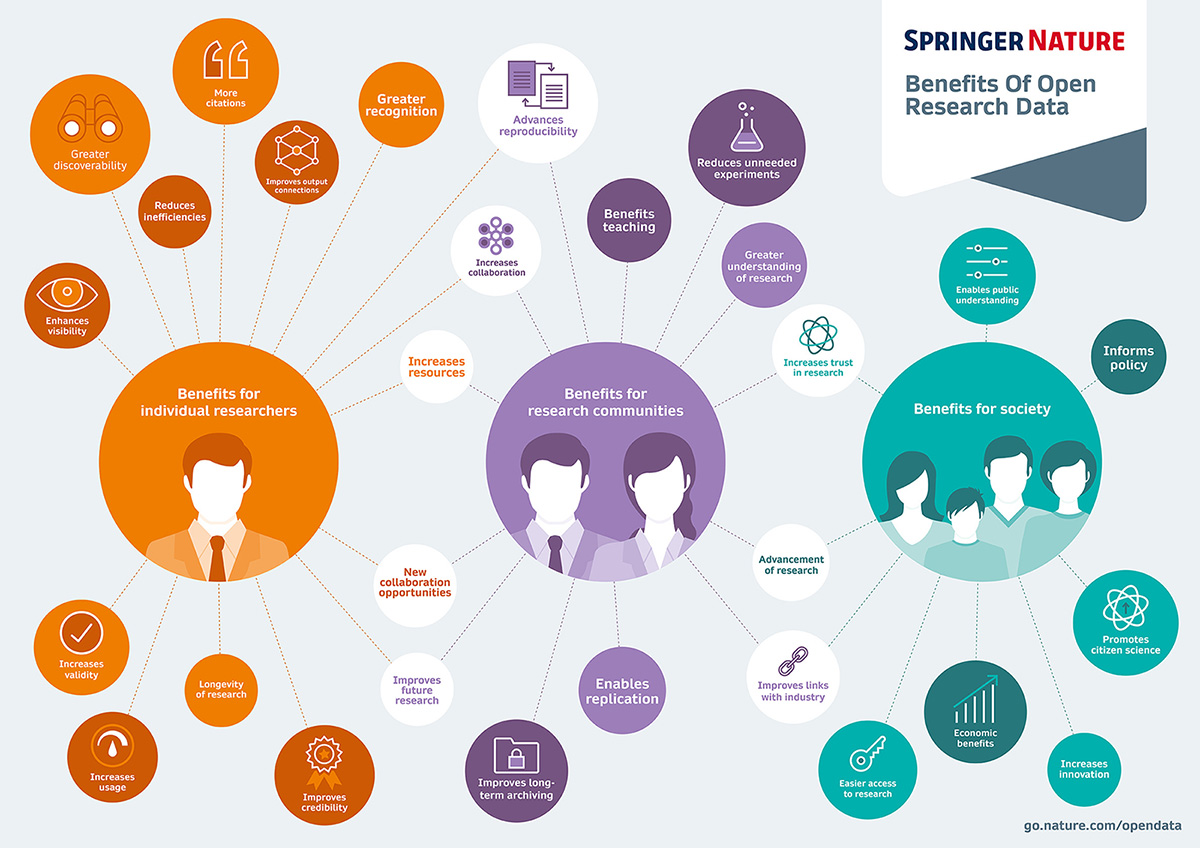
mat1

This infographic can be downloaded under a CC-BY licence here

And as an increasing number of funders mandate data sharing, and publishers start implementing more consistent data policies at their journals, it is worth seriously considering how and why you should make the research data you generate more openly available. Continue reading
The discomfort is worth it: share more

Making sure to communicate with the public is hard and takes time. Scientists should keep doing it, says Jessica Eise.

When David Eagleman, a neuroscientist at Stanford, wrote the New York Times bestseller Incognito, I read it voraciously. The world of the mind opened to me. My subconscious brain took on an entirely new meaning to me. Eagleman’s research felt salient, relevant, and crucial to our understanding and progress as a species.

Knowledge-sharing

{credit}Asonlobo/Wikipedia; CC-BY-SA-4.0{/credit}

Continue reading

Why don’t scientists always share their data?

Reproducibility is the cornerstone of science, and it can be compromised by insufficient data in peer-reviewed publications. Should scientists reveal everything?

Publishing Better Science through Better Data writing competition winner Emma Vander Ende.

One of the foundations of science is its reproducibility. Without it, results are not verifiable and are therefore not believable. But even if a published result is true, there is a chance it might not be reproducible, which introduces a plethora of problems for science.

Irreproducible experiments severely limit the ability of the scientific community to build on results and advance the field. This can happen when scientists don’t share enough data, or details of their experiments in papers, and it happens quite frequently.

So why might a scientist not share their data?

drugs

{credit}Comstock/Thinkstock{/credit}

Continue reading