#SciData15: Research Data for Discovery: Prepare to Share

Speakers at #SciData15 advocated for a wider degree of awareness of the field of data science and the implementation of data sharing technologies.

Guest contributor Caroline Weight
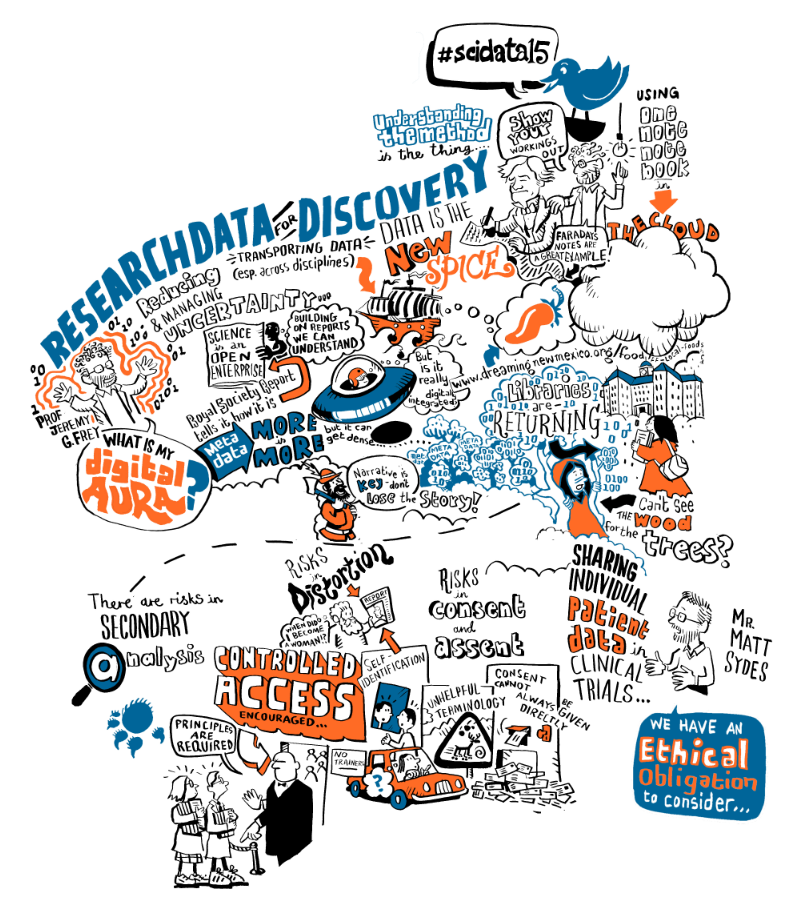
naturejobs-blog-Scidata15-Research-Data-for-Discovery

{credit}Image credit: SCIENTIFIC DATA/LUDIC GROUP{/credit}

“We must engage in the idea of sharing,” said conference chair Iain Hrynaszkiewicz as the 2015 Publishing Better Science through Better Data meeting kicked off at the headquarters of Nature Publishing Group (NPG) in London on 23rd October.

Hrynaszkiewicz, who develops new areas of open research publishing and data policy within NPG/Macmillan, noted that 30 funding bodies — including the Engineering and Physical Sciences Research Council and The Royal Society — have written policies that outline requirements for data-sharing. Examples include detailed methods and protocols, microscopy images and mathematical workings, as well as meta-datasets of, for example, genotypes and microarrays.

The meeting’s aims were to increase awareness of ways to effectively share data and to discuss how to improve the efficiency, implementation and overall impact of sharing among the scientific community. A recurring issue throughout the day was how to enforce sharing, and get the concept to become part of standard, everyday scientific practice –one that seeps into the lives and habits of working researchers. Continue reading

Data sharing: Contribute to the community

Data sharing can make a significant contribution to the scientific community, but it comes with challenges, says Caroline Weight.

Guest contributor Caroline Weight

We have all heard of it. We are all worried about it. We hear whispers of it in the corridors. We are advised to be careful what we say to ‘others’. We constantly check the literature. It matters to us. After all, it is our careers on the line.

‘Scooped’.

The process of publication is vigorous, competitive and tricky. It’s not uncommon for five years to pass between writing the grant application and publishing the work. Big labs with state-of-the-art facilities stand a better chance of getting their work out there first, given the extra manpower and often more-established protocols. This race for ownership of the data makes it difficult to share information and present new findings at meetings or conferences. Even at manuscript submission, there is often a chance to actively inhibit particular referees in case of conflicts of interest or personal competitors, to retain the novel concepts and data until they have been made public. Not until the publication has been accepted and is in print can you heave a sigh of relief and move on to the next project. Yet, sharing of data is essential to the progression of science in the modern world. Continue reading